SUBSCRIBE TO OUR FREE NEWSLETTER
Daily news & progressive opinion—funded by the people, not the corporations—delivered straight to your inbox.
5
#000000
#FFFFFF
To donate by check, phone, or other method, see our More Ways to Give page.
Daily news & progressive opinion—funded by the people, not the corporations—delivered straight to your inbox.
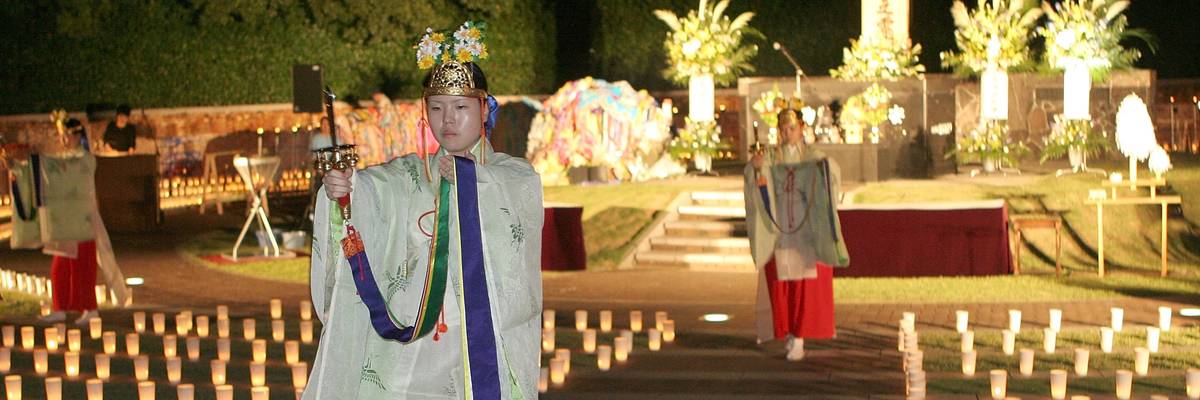
People take part in a ceremony for victims of the August 9, 1945 U.S. nuclear attack on Nagasaki, Japan in the city's Atomic Bomb Hypocenter on August 8, 2005.
"Given the critical humanitarian situation in Gaza and international opinion, there is a risk of unpredictable disruption occurring at the ceremony," Mayor Shiro Suzuki said.
The mayor of Nagasaki said Monday that he is withholding Israel's invitation to the annual peace ceremony commemorating the 1945 U.S. nuclear attack on the Japanese city and will call on the country's far-right government to accept an immediate cease-fire in Gaza.
"Given the critical humanitarian situation in Gaza and international opinion, there is a risk of unpredictable disruption occurring at the ceremony," said Mayor Shirō Suzuki, according to The Asahi Shimbun.
"The situation is changing day by day, so we have put sending an invitation letter on hold," Suzuki explained. "We need to carefully monitor the situation as it develops."
The ceremony is held each year on August 9, when at 11:02 am local time in 1945 a U.S. B-29 bomber dropped a single nuclear bomb over the city, killing tens of thousands of people instantly and dooming many thousands more to slow death by radiation-induced ailments.
Suzuki said he would extend an invitation to Israel once it's clear that doing so won't cause any problems. Palestine's envoy is invited to attend, although Japan is one of a global minority of nations that do not formally recognize a Palestinian state.
Once again, Russia—whose forces have been invading Ukraine since February 2022—and Belarus, which supports the invasion, are not invited.
City officials in Hiroshima are also calling on Israel to stop attacking Gaza. However, Israel is invited to take part in the city's annual commemoration of its August 6, 1945 atomic annihilation by the United States. A group of hibakusha, the Japanese word for atomic bombing survivors, have petitioned city officials to invite all the world's nations to attend.
Israel's 242-day assault on Gaza—which is the subject of an International Court of Justice genocide investigation—has left more than 130,000 Palestinians dead, wounded, or missing, according to Palestinian and international agencies. Most of those killed are women and children. Around 2 million of Gaza's 2.3 million people have been forcibly displaced. Widespread starvation caused by Israel's siege and blockage of aid has become what one top United Nations food official last month called "full-blown famine" in the northern Gaza Strip. Children are starving to death.
A cease-fire remains elusive. Responding to reports of a three-point Israeli proposal to end the war, Japan's Foreign Ministry said Sunday that it "strongly supports" efforts by the United States—which has been accused of complicity in genocide for providing Israel with billions of dollars in military aid as well as diplomatic support—to broker a cease-fire deal.
Dear Common Dreams reader, It’s been nearly 30 years since I co-founded Common Dreams with my late wife, Lina Newhouser. We had the radical notion that journalism should serve the public good, not corporate profits. It was clear to us from the outset what it would take to build such a project. No paid advertisements. No corporate sponsors. No millionaire publisher telling us what to think or do. Many people said we wouldn't last a year, but we proved those doubters wrong. Together with a tremendous team of journalists and dedicated staff, we built an independent media outlet free from the constraints of profits and corporate control. Our mission has always been simple: To inform. To inspire. To ignite change for the common good. Building Common Dreams was not easy. Our survival was never guaranteed. When you take on the most powerful forces—Wall Street greed, fossil fuel industry destruction, Big Tech lobbyists, and uber-rich oligarchs who have spent billions upon billions rigging the economy and democracy in their favor—the only bulwark you have is supporters who believe in your work. But here’s the urgent message from me today. It's never been this bad out there. And it's never been this hard to keep us going. At the very moment Common Dreams is most needed, the threats we face are intensifying. We need your support now more than ever. We don't accept corporate advertising and never will. We don't have a paywall because we don't think people should be blocked from critical news based on their ability to pay. Everything we do is funded by the donations of readers like you. When everyone does the little they can afford, we are strong. But if that support retreats or dries up, so do we. Will you donate now to make sure Common Dreams not only survives but thrives? —Craig Brown, Co-founder |
The mayor of Nagasaki said Monday that he is withholding Israel's invitation to the annual peace ceremony commemorating the 1945 U.S. nuclear attack on the Japanese city and will call on the country's far-right government to accept an immediate cease-fire in Gaza.
"Given the critical humanitarian situation in Gaza and international opinion, there is a risk of unpredictable disruption occurring at the ceremony," said Mayor Shirō Suzuki, according to The Asahi Shimbun.
"The situation is changing day by day, so we have put sending an invitation letter on hold," Suzuki explained. "We need to carefully monitor the situation as it develops."
The ceremony is held each year on August 9, when at 11:02 am local time in 1945 a U.S. B-29 bomber dropped a single nuclear bomb over the city, killing tens of thousands of people instantly and dooming many thousands more to slow death by radiation-induced ailments.
Suzuki said he would extend an invitation to Israel once it's clear that doing so won't cause any problems. Palestine's envoy is invited to attend, although Japan is one of a global minority of nations that do not formally recognize a Palestinian state.
Once again, Russia—whose forces have been invading Ukraine since February 2022—and Belarus, which supports the invasion, are not invited.
City officials in Hiroshima are also calling on Israel to stop attacking Gaza. However, Israel is invited to take part in the city's annual commemoration of its August 6, 1945 atomic annihilation by the United States. A group of hibakusha, the Japanese word for atomic bombing survivors, have petitioned city officials to invite all the world's nations to attend.
Israel's 242-day assault on Gaza—which is the subject of an International Court of Justice genocide investigation—has left more than 130,000 Palestinians dead, wounded, or missing, according to Palestinian and international agencies. Most of those killed are women and children. Around 2 million of Gaza's 2.3 million people have been forcibly displaced. Widespread starvation caused by Israel's siege and blockage of aid has become what one top United Nations food official last month called "full-blown famine" in the northern Gaza Strip. Children are starving to death.
A cease-fire remains elusive. Responding to reports of a three-point Israeli proposal to end the war, Japan's Foreign Ministry said Sunday that it "strongly supports" efforts by the United States—which has been accused of complicity in genocide for providing Israel with billions of dollars in military aid as well as diplomatic support—to broker a cease-fire deal.
The mayor of Nagasaki said Monday that he is withholding Israel's invitation to the annual peace ceremony commemorating the 1945 U.S. nuclear attack on the Japanese city and will call on the country's far-right government to accept an immediate cease-fire in Gaza.
"Given the critical humanitarian situation in Gaza and international opinion, there is a risk of unpredictable disruption occurring at the ceremony," said Mayor Shirō Suzuki, according to The Asahi Shimbun.
"The situation is changing day by day, so we have put sending an invitation letter on hold," Suzuki explained. "We need to carefully monitor the situation as it develops."
The ceremony is held each year on August 9, when at 11:02 am local time in 1945 a U.S. B-29 bomber dropped a single nuclear bomb over the city, killing tens of thousands of people instantly and dooming many thousands more to slow death by radiation-induced ailments.
Suzuki said he would extend an invitation to Israel once it's clear that doing so won't cause any problems. Palestine's envoy is invited to attend, although Japan is one of a global minority of nations that do not formally recognize a Palestinian state.
Once again, Russia—whose forces have been invading Ukraine since February 2022—and Belarus, which supports the invasion, are not invited.
City officials in Hiroshima are also calling on Israel to stop attacking Gaza. However, Israel is invited to take part in the city's annual commemoration of its August 6, 1945 atomic annihilation by the United States. A group of hibakusha, the Japanese word for atomic bombing survivors, have petitioned city officials to invite all the world's nations to attend.
Israel's 242-day assault on Gaza—which is the subject of an International Court of Justice genocide investigation—has left more than 130,000 Palestinians dead, wounded, or missing, according to Palestinian and international agencies. Most of those killed are women and children. Around 2 million of Gaza's 2.3 million people have been forcibly displaced. Widespread starvation caused by Israel's siege and blockage of aid has become what one top United Nations food official last month called "full-blown famine" in the northern Gaza Strip. Children are starving to death.
A cease-fire remains elusive. Responding to reports of a three-point Israeli proposal to end the war, Japan's Foreign Ministry said Sunday that it "strongly supports" efforts by the United States—which has been accused of complicity in genocide for providing Israel with billions of dollars in military aid as well as diplomatic support—to broker a cease-fire deal.