SUBSCRIBE TO OUR FREE NEWSLETTER
Daily news & progressive opinion—funded by the people, not the corporations—delivered straight to your inbox.
5
#000000
#FFFFFF
To donate by check, phone, or other method, see our More Ways to Give page.
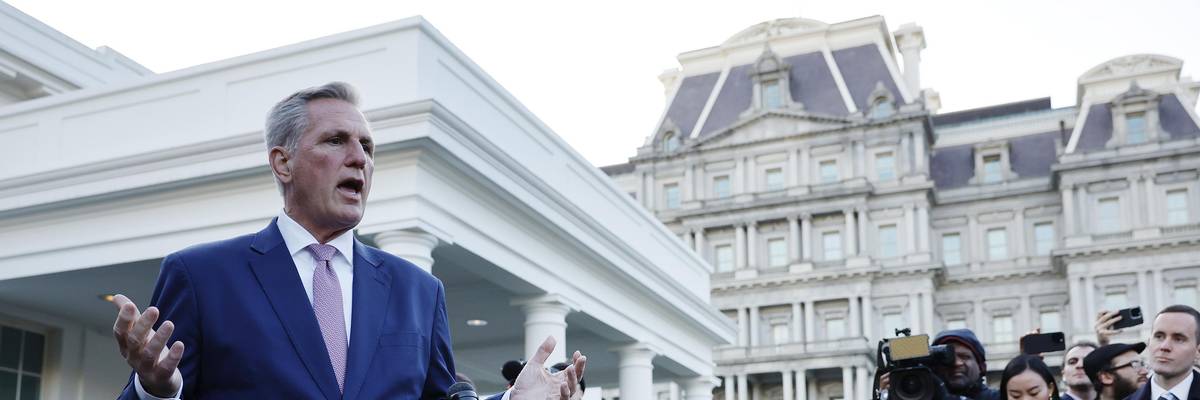
After a private meeting with President Joe Biden on Wednesday, House Speaker Kevin McCarthy reiterated his support for steep federal spending cuts as part of any deal to raise the debt ceiling, upholding his commitment to the far-right Republicans who threatened to deny him the top leadership post.
"I was very clear that we're not passing a clean debt ceiling," McCarthy (R-Calif.) told reporters following his conversation with the president. "We're not spending more next year than we spent this year. We've got to find a way to change this and I want to sit down and work."
While some members of his caucus have vocally singled out Social Security and Medicare, McCarthy has declined to explain precisely what and how much he wants to cut. But as part of a deal with the far-right flank of his caucus, McCarthy agreed to push for a cap on federal spending at fiscal year 2022 levels.
According to an analysis released Wednesday by the Center on Budget and Policy Priorities (CBPP), such a cap would entail significant cuts to "a wide array of public services that the federal government provides and that people and communities depend on, including public health; food safety inspections; air traffic control operations; the administration of Medicare and Social Security; housing and other assistance for families with low incomes; education and job training; and scientific and medical research, to name just a few."
"Moreover, many of these programs are still feeling the effects of austerity imposed largely by the 2011 Budget Control Act," CBPP's Joel Friedman and Richard Kogan wrote, pointing to a law that the GOP forced through following a damaging round of debt ceiling brinkmanship. "Even with a recent boost in 2023, funding for non-defense programs outside of veterans' medical care is about 2% below its 2010 level, adjusted for inflation, and 9% below when adjusted for both inflation and population growth. Funding for these programs needs to rise to meet national needs, address shortfalls that hamper the delivery of government services, and help create an economy in which everyone has the resources they need to thrive."
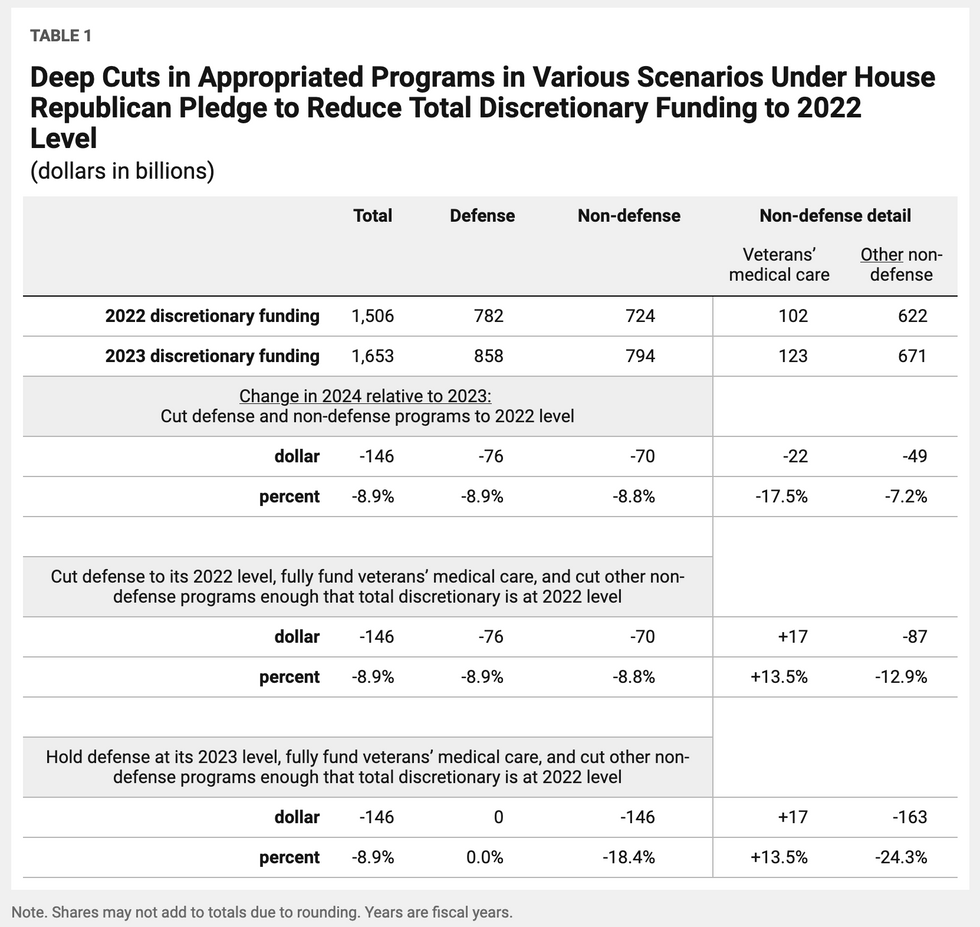
CBPP's estimates suggest that a federal spending cut of $146 billion across military and non-military programs would be required to meet House Republicans' demand to cap fiscal year 2024 spending at 2022 levels.
But Friedman and Kogan stressed that cuts to non-military discretionary spending—a broad category that includes healthcare and education programs—would have to be even larger if the Pentagon budget is shielded, as some House Republicans have proposed. Military spending represents more than half of all federal discretionary spending.
"Reducing defense funding to its 2022 level in 2024 would require a cut of $76.2 billion from its current level," Friedman and Kogan noted. "If instead one assumes that defense funding is frozen in 2024—that is, held at its 2023 level rather than being reduced to the 2022 level—but that House Republicans still press to return total discretionary funding to its 2022 level, then those additional cuts would need to be absorbed by non-defense programs. If that comes on top of protecting veterans’ medical care, then the remaining non-defense programs would need to be cut by 24.3% on average."
"The cuts the House Republicans are calling for, whether achieved by reducing non-defense programs categorized as discretionary or mandatory, are deep," Friedman and Kogan concluded. "Claims that they are designed merely to root out 'wasteful spending' are highly misleading and distract from the policy implications of these proposals and the harm they would cause."
The White House has insisted on legislation that raises the debt ceiling without any attached spending cuts or other conditions, a message it reiterated after Biden's meeting with McCarthy on Wednesday.
"President Biden made clear that, as every other leader in both parties in Congress has affirmed, it is their shared duty not to allow an unprecedented and economically catastrophic default," the White House said in a readout of the meeting. "The president welcomes a separate discussion with congressional leaders about how to reduce the deficit and control the national debt while continuing to grow the economy."
As McCarthy prepared for his discussion with Biden, the Republican Study Committee (RSC)—the largest House GOP caucus—convened on Capitol Hill to discuss their priorities for time-sensitive debt ceiling negotiations.
According to a presentation slide obtained by Politico's Olivia Beavers, RSC chair Rep. Kevin Hern (R-Okla.) offered a broad outline of the GOP's group's priorities, including a reversal of recent discretionary spending increases. Last year, the RSC called for gradually increasing the retirement age and partially privatizing Social Security.
Aaron Fritschner, communications director for Rep. Don Beyer (D-Va.), criticized House Republicans' continued refusal to put forth a budget detailing their specific demands.
"Wow what a disaster," Fritschner tweeted in response to the RSC presentation. "They truly have no idea what to do."
After a private meeting with President Joe Biden on Wednesday, House Speaker Kevin McCarthy reiterated his support for steep federal spending cuts as part of any deal to raise the debt ceiling, upholding his commitment to the far-right Republicans who threatened to deny him the top leadership post.
"I was very clear that we're not passing a clean debt ceiling," McCarthy (R-Calif.) told reporters following his conversation with the president. "We're not spending more next year than we spent this year. We've got to find a way to change this and I want to sit down and work."
While some members of his caucus have vocally singled out Social Security and Medicare, McCarthy has declined to explain precisely what and how much he wants to cut. But as part of a deal with the far-right flank of his caucus, McCarthy agreed to push for a cap on federal spending at fiscal year 2022 levels.
According to an analysis released Wednesday by the Center on Budget and Policy Priorities (CBPP), such a cap would entail significant cuts to "a wide array of public services that the federal government provides and that people and communities depend on, including public health; food safety inspections; air traffic control operations; the administration of Medicare and Social Security; housing and other assistance for families with low incomes; education and job training; and scientific and medical research, to name just a few."
"Moreover, many of these programs are still feeling the effects of austerity imposed largely by the 2011 Budget Control Act," CBPP's Joel Friedman and Richard Kogan wrote, pointing to a law that the GOP forced through following a damaging round of debt ceiling brinkmanship. "Even with a recent boost in 2023, funding for non-defense programs outside of veterans' medical care is about 2% below its 2010 level, adjusted for inflation, and 9% below when adjusted for both inflation and population growth. Funding for these programs needs to rise to meet national needs, address shortfalls that hamper the delivery of government services, and help create an economy in which everyone has the resources they need to thrive."
CBPP's estimates suggest that a federal spending cut of $146 billion across military and non-military programs would be required to meet House Republicans' demand to cap fiscal year 2024 spending at 2022 levels.
But Friedman and Kogan stressed that cuts to non-military discretionary spending—a broad category that includes healthcare and education programs—would have to be even larger if the Pentagon budget is shielded, as some House Republicans have proposed. Military spending represents more than half of all federal discretionary spending.
"Reducing defense funding to its 2022 level in 2024 would require a cut of $76.2 billion from its current level," Friedman and Kogan noted. "If instead one assumes that defense funding is frozen in 2024—that is, held at its 2023 level rather than being reduced to the 2022 level—but that House Republicans still press to return total discretionary funding to its 2022 level, then those additional cuts would need to be absorbed by non-defense programs. If that comes on top of protecting veterans’ medical care, then the remaining non-defense programs would need to be cut by 24.3% on average."
"The cuts the House Republicans are calling for, whether achieved by reducing non-defense programs categorized as discretionary or mandatory, are deep," Friedman and Kogan concluded. "Claims that they are designed merely to root out 'wasteful spending' are highly misleading and distract from the policy implications of these proposals and the harm they would cause."
The White House has insisted on legislation that raises the debt ceiling without any attached spending cuts or other conditions, a message it reiterated after Biden's meeting with McCarthy on Wednesday.
"President Biden made clear that, as every other leader in both parties in Congress has affirmed, it is their shared duty not to allow an unprecedented and economically catastrophic default," the White House said in a readout of the meeting. "The president welcomes a separate discussion with congressional leaders about how to reduce the deficit and control the national debt while continuing to grow the economy."
As McCarthy prepared for his discussion with Biden, the Republican Study Committee (RSC)—the largest House GOP caucus—convened on Capitol Hill to discuss their priorities for time-sensitive debt ceiling negotiations.
According to a presentation slide obtained by Politico's Olivia Beavers, RSC chair Rep. Kevin Hern (R-Okla.) offered a broad outline of the GOP's group's priorities, including a reversal of recent discretionary spending increases. Last year, the RSC called for gradually increasing the retirement age and partially privatizing Social Security.
Aaron Fritschner, communications director for Rep. Don Beyer (D-Va.), criticized House Republicans' continued refusal to put forth a budget detailing their specific demands.
"Wow what a disaster," Fritschner tweeted in response to the RSC presentation. "They truly have no idea what to do."
After a private meeting with President Joe Biden on Wednesday, House Speaker Kevin McCarthy reiterated his support for steep federal spending cuts as part of any deal to raise the debt ceiling, upholding his commitment to the far-right Republicans who threatened to deny him the top leadership post.
"I was very clear that we're not passing a clean debt ceiling," McCarthy (R-Calif.) told reporters following his conversation with the president. "We're not spending more next year than we spent this year. We've got to find a way to change this and I want to sit down and work."
While some members of his caucus have vocally singled out Social Security and Medicare, McCarthy has declined to explain precisely what and how much he wants to cut. But as part of a deal with the far-right flank of his caucus, McCarthy agreed to push for a cap on federal spending at fiscal year 2022 levels.
According to an analysis released Wednesday by the Center on Budget and Policy Priorities (CBPP), such a cap would entail significant cuts to "a wide array of public services that the federal government provides and that people and communities depend on, including public health; food safety inspections; air traffic control operations; the administration of Medicare and Social Security; housing and other assistance for families with low incomes; education and job training; and scientific and medical research, to name just a few."
"Moreover, many of these programs are still feeling the effects of austerity imposed largely by the 2011 Budget Control Act," CBPP's Joel Friedman and Richard Kogan wrote, pointing to a law that the GOP forced through following a damaging round of debt ceiling brinkmanship. "Even with a recent boost in 2023, funding for non-defense programs outside of veterans' medical care is about 2% below its 2010 level, adjusted for inflation, and 9% below when adjusted for both inflation and population growth. Funding for these programs needs to rise to meet national needs, address shortfalls that hamper the delivery of government services, and help create an economy in which everyone has the resources they need to thrive."
CBPP's estimates suggest that a federal spending cut of $146 billion across military and non-military programs would be required to meet House Republicans' demand to cap fiscal year 2024 spending at 2022 levels.
But Friedman and Kogan stressed that cuts to non-military discretionary spending—a broad category that includes healthcare and education programs—would have to be even larger if the Pentagon budget is shielded, as some House Republicans have proposed. Military spending represents more than half of all federal discretionary spending.
"Reducing defense funding to its 2022 level in 2024 would require a cut of $76.2 billion from its current level," Friedman and Kogan noted. "If instead one assumes that defense funding is frozen in 2024—that is, held at its 2023 level rather than being reduced to the 2022 level—but that House Republicans still press to return total discretionary funding to its 2022 level, then those additional cuts would need to be absorbed by non-defense programs. If that comes on top of protecting veterans’ medical care, then the remaining non-defense programs would need to be cut by 24.3% on average."
"The cuts the House Republicans are calling for, whether achieved by reducing non-defense programs categorized as discretionary or mandatory, are deep," Friedman and Kogan concluded. "Claims that they are designed merely to root out 'wasteful spending' are highly misleading and distract from the policy implications of these proposals and the harm they would cause."
The White House has insisted on legislation that raises the debt ceiling without any attached spending cuts or other conditions, a message it reiterated after Biden's meeting with McCarthy on Wednesday.
"President Biden made clear that, as every other leader in both parties in Congress has affirmed, it is their shared duty not to allow an unprecedented and economically catastrophic default," the White House said in a readout of the meeting. "The president welcomes a separate discussion with congressional leaders about how to reduce the deficit and control the national debt while continuing to grow the economy."
As McCarthy prepared for his discussion with Biden, the Republican Study Committee (RSC)—the largest House GOP caucus—convened on Capitol Hill to discuss their priorities for time-sensitive debt ceiling negotiations.
According to a presentation slide obtained by Politico's Olivia Beavers, RSC chair Rep. Kevin Hern (R-Okla.) offered a broad outline of the GOP's group's priorities, including a reversal of recent discretionary spending increases. Last year, the RSC called for gradually increasing the retirement age and partially privatizing Social Security.
Aaron Fritschner, communications director for Rep. Don Beyer (D-Va.), criticized House Republicans' continued refusal to put forth a budget detailing their specific demands.
"Wow what a disaster," Fritschner tweeted in response to the RSC presentation. "They truly have no idea what to do."