SUBSCRIBE TO OUR FREE NEWSLETTER
Daily news & progressive opinion—funded by the people, not the corporations—delivered straight to your inbox.
5
#000000
#FFFFFF
To donate by check, phone, or other method, see our More Ways to Give page.
Daily news & progressive opinion—funded by the people, not the corporations—delivered straight to your inbox.
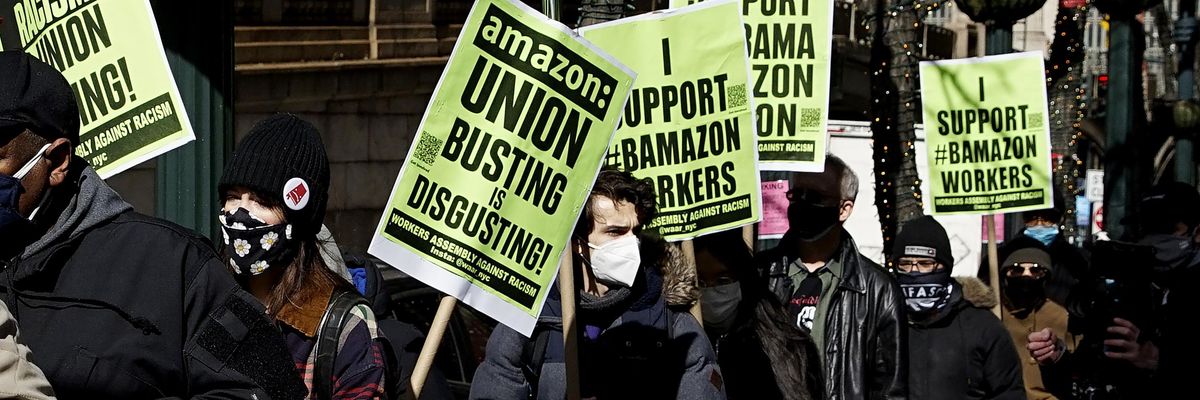
People in New York protest in support of Amazon workers in Alabama.
"So now capital, unable to hold back labor any longer, is arguing that the NLRB's very existence is unconstitutional," said one law professor.
Amid a recent surge in unionization and other workers' rights victories, wealthy U.S. corporations have fired union organizers, surveilled employees as they voted on forming a collective bargaining unit, and closed store locations to penalize labor leaders—but a court filing by Amazon on Thursday suggested a new tactic as the e-commerce giant seeks to dismantle the federal agency tasked with protecting employees.
Fighting accusations from prosecutors at the National Labor Relations Board (NLRB) that Amazon illegally retaliated against warehouse workers who unionized, the company submitted a legal filing arguing that the board itself is unconstitutional.
Amazon claimed it did not break the law by limiting workers' access to the warehouse, which the NLRB said last year was a transparent effort to quash union activity. In its filing, the company also claimed "the structure of the NLRB violates the separation of powers" by "impeding the executive power provided for in Article II of the United States Constitution."
The company is the third corporation to make such a claim in recent weeks.
In January, a lawyer for grocery chain Trader Joe's argued in an NLRB hearing over union-busting charges that the board, which was created nearly 90 years ago under the New Deal, is "unconstitutional"—"including but not limited to the structure and organization of the National Labor Relations Board and the agency's administrative law judges."
That claim came weeks after astronautics company SpaceX, owned by Tesla CEO Elon Musk—currently the second-richest person on Earth—claimed the NLRB's enforcement proceedings violate the company's right to a jury trial.
Amazon echoed that claim on Thursday.
Seth Goldstein, an attorney for Trader Joe's United, which sued the grocer over illegal retaliation, said last month that the company's argument suggested that workers "don't have the right to organize at all."
"This is really dangerous," Goldstein told HuffPost. "Are we really going back to 1920?"
On Thursday, he called Amazon's decision to launch its own anti-NLRB legal argument "a direct attack on the American labor movement and workers' rights."
Amazon's filing follows more than 250 NLRB complaints against its labor practices in recent years. In 2022, employees at the company's JFK8 warehouse in Staten Island, New York won what was called a "David versus Goliath" victory, defeating Amazon's multimillion-dollar anti-union effort by voting to form the Amazon Labor Union (ALU).
"So now capital, unable to hold back labor any longer, is arguing that the NLRB's very existence is unconstitutional," said Cornell Law School professor Robert Hockett.
Former New York Times labor reporter Steven Greenhouse pointed out that the new anti-union efforts by Amazon and SpaceX are being led by two of the richest men in the world—Musk and Amazon founder and executive chairman Jeff Bezos.
"Billionaires," said Christian Smalls, president of ALU and fired Amazon worker, "they gotta go!"
Corporate interests have previously worked to dismantle regulatory agencies tasked with protecting working Americans, with a trade association representing payday lenders taking its case against the Consumer Financial Protection Bureau to the U.S. Supreme Court last year. The group has argued the CFPB's funding structure through the Federal Reserve is unconstitutional.
Pawel Popiel, a researcher at the Annenberg School for Communication at the University of Pennsylvania, called Amazon's filing an "incredibly troubling lobbying effort."
Dear Common Dreams reader, It’s been nearly 30 years since I co-founded Common Dreams with my late wife, Lina Newhouser. We had the radical notion that journalism should serve the public good, not corporate profits. It was clear to us from the outset what it would take to build such a project. No paid advertisements. No corporate sponsors. No millionaire publisher telling us what to think or do. Many people said we wouldn't last a year, but we proved those doubters wrong. Together with a tremendous team of journalists and dedicated staff, we built an independent media outlet free from the constraints of profits and corporate control. Our mission has always been simple: To inform. To inspire. To ignite change for the common good. Building Common Dreams was not easy. Our survival was never guaranteed. When you take on the most powerful forces—Wall Street greed, fossil fuel industry destruction, Big Tech lobbyists, and uber-rich oligarchs who have spent billions upon billions rigging the economy and democracy in their favor—the only bulwark you have is supporters who believe in your work. But here’s the urgent message from me today. It's never been this bad out there. And it's never been this hard to keep us going. At the very moment Common Dreams is most needed, the threats we face are intensifying. We need your support now more than ever. We don't accept corporate advertising and never will. We don't have a paywall because we don't think people should be blocked from critical news based on their ability to pay. Everything we do is funded by the donations of readers like you. When everyone does the little they can afford, we are strong. But if that support retreats or dries up, so do we. Will you donate now to make sure Common Dreams not only survives but thrives? —Craig Brown, Co-founder |
Amid a recent surge in unionization and other workers' rights victories, wealthy U.S. corporations have fired union organizers, surveilled employees as they voted on forming a collective bargaining unit, and closed store locations to penalize labor leaders—but a court filing by Amazon on Thursday suggested a new tactic as the e-commerce giant seeks to dismantle the federal agency tasked with protecting employees.
Fighting accusations from prosecutors at the National Labor Relations Board (NLRB) that Amazon illegally retaliated against warehouse workers who unionized, the company submitted a legal filing arguing that the board itself is unconstitutional.
Amazon claimed it did not break the law by limiting workers' access to the warehouse, which the NLRB said last year was a transparent effort to quash union activity. In its filing, the company also claimed "the structure of the NLRB violates the separation of powers" by "impeding the executive power provided for in Article II of the United States Constitution."
The company is the third corporation to make such a claim in recent weeks.
In January, a lawyer for grocery chain Trader Joe's argued in an NLRB hearing over union-busting charges that the board, which was created nearly 90 years ago under the New Deal, is "unconstitutional"—"including but not limited to the structure and organization of the National Labor Relations Board and the agency's administrative law judges."
That claim came weeks after astronautics company SpaceX, owned by Tesla CEO Elon Musk—currently the second-richest person on Earth—claimed the NLRB's enforcement proceedings violate the company's right to a jury trial.
Amazon echoed that claim on Thursday.
Seth Goldstein, an attorney for Trader Joe's United, which sued the grocer over illegal retaliation, said last month that the company's argument suggested that workers "don't have the right to organize at all."
"This is really dangerous," Goldstein told HuffPost. "Are we really going back to 1920?"
On Thursday, he called Amazon's decision to launch its own anti-NLRB legal argument "a direct attack on the American labor movement and workers' rights."
Amazon's filing follows more than 250 NLRB complaints against its labor practices in recent years. In 2022, employees at the company's JFK8 warehouse in Staten Island, New York won what was called a "David versus Goliath" victory, defeating Amazon's multimillion-dollar anti-union effort by voting to form the Amazon Labor Union (ALU).
"So now capital, unable to hold back labor any longer, is arguing that the NLRB's very existence is unconstitutional," said Cornell Law School professor Robert Hockett.
Former New York Times labor reporter Steven Greenhouse pointed out that the new anti-union efforts by Amazon and SpaceX are being led by two of the richest men in the world—Musk and Amazon founder and executive chairman Jeff Bezos.
"Billionaires," said Christian Smalls, president of ALU and fired Amazon worker, "they gotta go!"
Corporate interests have previously worked to dismantle regulatory agencies tasked with protecting working Americans, with a trade association representing payday lenders taking its case against the Consumer Financial Protection Bureau to the U.S. Supreme Court last year. The group has argued the CFPB's funding structure through the Federal Reserve is unconstitutional.
Pawel Popiel, a researcher at the Annenberg School for Communication at the University of Pennsylvania, called Amazon's filing an "incredibly troubling lobbying effort."
Amid a recent surge in unionization and other workers' rights victories, wealthy U.S. corporations have fired union organizers, surveilled employees as they voted on forming a collective bargaining unit, and closed store locations to penalize labor leaders—but a court filing by Amazon on Thursday suggested a new tactic as the e-commerce giant seeks to dismantle the federal agency tasked with protecting employees.
Fighting accusations from prosecutors at the National Labor Relations Board (NLRB) that Amazon illegally retaliated against warehouse workers who unionized, the company submitted a legal filing arguing that the board itself is unconstitutional.
Amazon claimed it did not break the law by limiting workers' access to the warehouse, which the NLRB said last year was a transparent effort to quash union activity. In its filing, the company also claimed "the structure of the NLRB violates the separation of powers" by "impeding the executive power provided for in Article II of the United States Constitution."
The company is the third corporation to make such a claim in recent weeks.
In January, a lawyer for grocery chain Trader Joe's argued in an NLRB hearing over union-busting charges that the board, which was created nearly 90 years ago under the New Deal, is "unconstitutional"—"including but not limited to the structure and organization of the National Labor Relations Board and the agency's administrative law judges."
That claim came weeks after astronautics company SpaceX, owned by Tesla CEO Elon Musk—currently the second-richest person on Earth—claimed the NLRB's enforcement proceedings violate the company's right to a jury trial.
Amazon echoed that claim on Thursday.
Seth Goldstein, an attorney for Trader Joe's United, which sued the grocer over illegal retaliation, said last month that the company's argument suggested that workers "don't have the right to organize at all."
"This is really dangerous," Goldstein told HuffPost. "Are we really going back to 1920?"
On Thursday, he called Amazon's decision to launch its own anti-NLRB legal argument "a direct attack on the American labor movement and workers' rights."
Amazon's filing follows more than 250 NLRB complaints against its labor practices in recent years. In 2022, employees at the company's JFK8 warehouse in Staten Island, New York won what was called a "David versus Goliath" victory, defeating Amazon's multimillion-dollar anti-union effort by voting to form the Amazon Labor Union (ALU).
"So now capital, unable to hold back labor any longer, is arguing that the NLRB's very existence is unconstitutional," said Cornell Law School professor Robert Hockett.
Former New York Times labor reporter Steven Greenhouse pointed out that the new anti-union efforts by Amazon and SpaceX are being led by two of the richest men in the world—Musk and Amazon founder and executive chairman Jeff Bezos.
"Billionaires," said Christian Smalls, president of ALU and fired Amazon worker, "they gotta go!"
Corporate interests have previously worked to dismantle regulatory agencies tasked with protecting working Americans, with a trade association representing payday lenders taking its case against the Consumer Financial Protection Bureau to the U.S. Supreme Court last year. The group has argued the CFPB's funding structure through the Federal Reserve is unconstitutional.
Pawel Popiel, a researcher at the Annenberg School for Communication at the University of Pennsylvania, called Amazon's filing an "incredibly troubling lobbying effort."