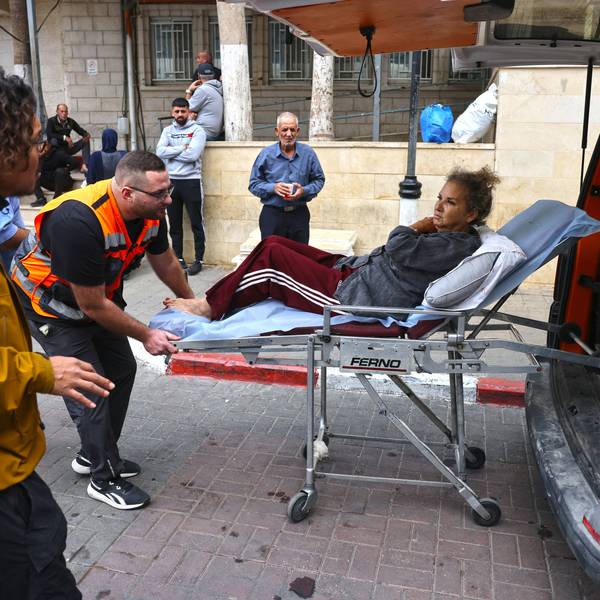
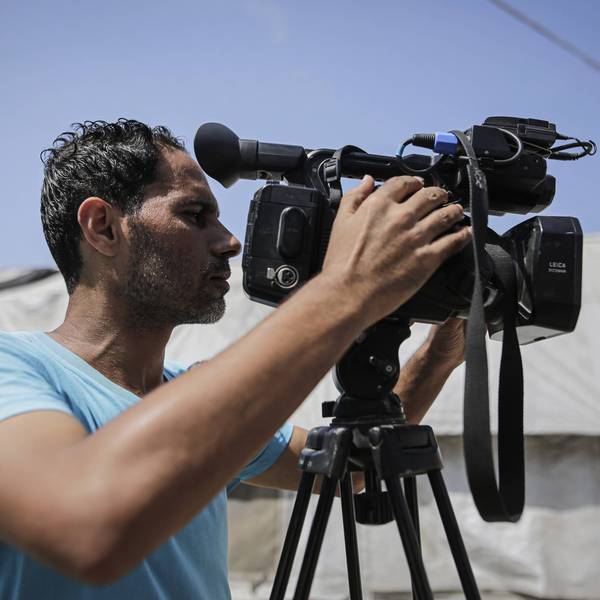
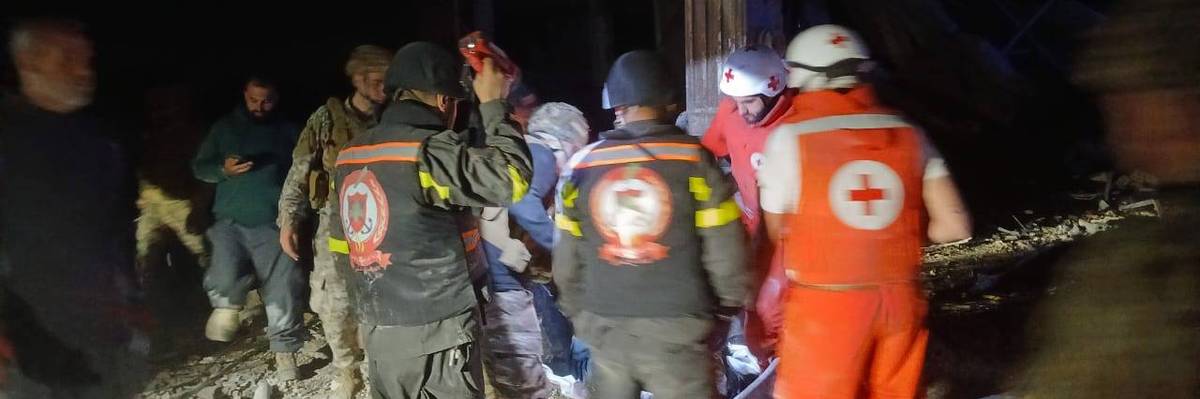
Rescue workers are pictured during an operation to recover the body of journalist Amal Khalil after Israeli strikes in al-Tiri, Lebanon on April 22, 2026.
Lebanese PM Condemns Israel's Killing of Journalist Amal Khalil as 'Clear-Cut War Crime'
"Israel’s targeting of media professionals in the south while they are performing their professional duties is no longer a matter of isolated incidents; rather, it has become a proven pattern."
Lebanese Prime Minister Nawaf Salam late Wednesday accused the Israeli military of war crimes after rescue workers recovered the body of journalist Amal Khalil from the ruins of a house in southern Lebanon that Israel bombed hours earlier.
"Targeting journalists, obstructing the access of relief teams to them—and indeed, re-targeting their locations after these teams have arrived—constitutes a clear-cut war crime," Salam wrote on social media. "Israel’s targeting of media professionals in the south while they are performing their professional duties is no longer a matter of isolated incidents; rather, it has become a proven pattern—one that we condemn and reject, just as it is condemned and rejected by all international laws and norms."
Khalil, who was reporting on Israel's assault on southern Lebanon for the daily newspaper Al-Akhbar, took cover in a local house after an Israeli strike nearly hit her car. Israeli forces then attacked the house, trapping Khalil and fellow journalist Zeinab Faraj under rubble.
A Red Cross team granted access to the scene was able to evacuate Faraj, who was badly wounded, before coming under attack by Israeli forces. The Associated Press reported that Khalil "remained under the rubble for hours before the Lebanese army, civil defense, and the Lebanese Red Cross were able to get to the scene hours later."
"Khalil’s body was retrieved shortly before midnight, at least six hours after the strike," AP noted. The Israeli attacks were seen as flagrant violations of the 10-day ceasefire that took effect on April 16.
Civil Defence crews were finally able to access the site where Leb journalist Amal Khalil was trapped under rubble but only hours later. They retrieved her body. Her newspaper Al Akbar has put out a video tribute. Lebanon’s Minister of Information condemned the incident… https://t.co/usLPJVjDF9 pic.twitter.com/J4Vvf0JmhW
— Alex Crawford (@AlexCrawfordSky) April 22, 2026
Paul Morcos, Lebanon's minister of information, confirmed Khalil's death and said she was "targeted by the Israeli occupation army while performing her professional duty" in southern Lebanon, which has been under intense Israeli assault since early March. Khalil is the fourth media worker killed by Israeli forces in Lebanon since March 2.
"Targeting journalists is a heinous crime and a flagrant violation of international humanitarian law, which we will not remain silent about," Morcos said in a statement. "We reiterate our call to the world and supporting international organizations to take action to stop it and prevent its recurrence."
The Committee to Protect Journalists (CPJ), an organization that works to protect press freedom worldwide, pointed to "reports that Khalil had received a direct death threat attributed to the [Israel Defense Forces] in September 2024" as potential evidence that Israel deliberately targeted her.
“The repeated strikes on the same location, the targeting of an area where journalists were sheltering, and the obstruction of medical and humanitarian access constitute a grave breach of international humanitarian law,” Sara Qudah, CPJ's regional director in the Middle East and North Africa, said Wednesday. "CPJ holds Israeli forces responsible."
We are at a crossroads
This country and this world are at a monumental crossroads. In a few short weeks, US voters will have an opportunity to beat back the forces of fascism and confront the billionaires who are rigging the economy, our media system, and our democracy, making it increasingly impossible for ordinary people to get by. We’re not just talking about the election. We’re talking about what must be done once these fascist elements are vanquished from power. We need a bolder set of solutions than what either major party has so far been willing to offer and a working-class movement ready to fight like hell for it. Trump didn't emerge from nowhere. The conditions that fueled MAGA authoritarianism were created by decades of radical neoliberal economic policies and a corrupt political system dominated by corporate interests. They slashed taxes on the super-rich, promising that the benefits would trickle down. They said giveaways to the corporate titans would make life more affordable for the rest of us. It was all bullshit. And when a bitter, betrayed populace searches for someone to blame, right-wing demagogues have little trouble finding scapegoats. People know when they're being lied to, but you won't hear any of this from the corporate media. Only independent journalism—powered and funded by people who believe in building a better world—can deliver truly trustworthy daily news. Our Fall Campaign is underway, and we need your help. To power our newsroom through the rest of the year, we need to raise $125,000 by midnight on October 31. So if you share our vision, please contribute whatever you can to sustain our work. |
Lebanese Prime Minister Nawaf Salam late Wednesday accused the Israeli military of war crimes after rescue workers recovered the body of journalist Amal Khalil from the ruins of a house in southern Lebanon that Israel bombed hours earlier.
"Targeting journalists, obstructing the access of relief teams to them—and indeed, re-targeting their locations after these teams have arrived—constitutes a clear-cut war crime," Salam wrote on social media. "Israel’s targeting of media professionals in the south while they are performing their professional duties is no longer a matter of isolated incidents; rather, it has become a proven pattern—one that we condemn and reject, just as it is condemned and rejected by all international laws and norms."
Khalil, who was reporting on Israel's assault on southern Lebanon for the daily newspaper Al-Akhbar, took cover in a local house after an Israeli strike nearly hit her car. Israeli forces then attacked the house, trapping Khalil and fellow journalist Zeinab Faraj under rubble.
A Red Cross team granted access to the scene was able to evacuate Faraj, who was badly wounded, before coming under attack by Israeli forces. The Associated Press reported that Khalil "remained under the rubble for hours before the Lebanese army, civil defense, and the Lebanese Red Cross were able to get to the scene hours later."
"Khalil’s body was retrieved shortly before midnight, at least six hours after the strike," AP noted. The Israeli attacks were seen as flagrant violations of the 10-day ceasefire that took effect on April 16.
Civil Defence crews were finally able to access the site where Leb journalist Amal Khalil was trapped under rubble but only hours later. They retrieved her body. Her newspaper Al Akbar has put out a video tribute. Lebanon’s Minister of Information condemned the incident… https://t.co/usLPJVjDF9 pic.twitter.com/J4Vvf0JmhW
— Alex Crawford (@AlexCrawfordSky) April 22, 2026
Paul Morcos, Lebanon's minister of information, confirmed Khalil's death and said she was "targeted by the Israeli occupation army while performing her professional duty" in southern Lebanon, which has been under intense Israeli assault since early March. Khalil is the fourth media worker killed by Israeli forces in Lebanon since March 2.
"Targeting journalists is a heinous crime and a flagrant violation of international humanitarian law, which we will not remain silent about," Morcos said in a statement. "We reiterate our call to the world and supporting international organizations to take action to stop it and prevent its recurrence."
The Committee to Protect Journalists (CPJ), an organization that works to protect press freedom worldwide, pointed to "reports that Khalil had received a direct death threat attributed to the [Israel Defense Forces] in September 2024" as potential evidence that Israel deliberately targeted her.
“The repeated strikes on the same location, the targeting of an area where journalists were sheltering, and the obstruction of medical and humanitarian access constitute a grave breach of international humanitarian law,” Sara Qudah, CPJ's regional director in the Middle East and North Africa, said Wednesday. "CPJ holds Israeli forces responsible."
Lebanese Prime Minister Nawaf Salam late Wednesday accused the Israeli military of war crimes after rescue workers recovered the body of journalist Amal Khalil from the ruins of a house in southern Lebanon that Israel bombed hours earlier.
"Targeting journalists, obstructing the access of relief teams to them—and indeed, re-targeting their locations after these teams have arrived—constitutes a clear-cut war crime," Salam wrote on social media. "Israel’s targeting of media professionals in the south while they are performing their professional duties is no longer a matter of isolated incidents; rather, it has become a proven pattern—one that we condemn and reject, just as it is condemned and rejected by all international laws and norms."
Khalil, who was reporting on Israel's assault on southern Lebanon for the daily newspaper Al-Akhbar, took cover in a local house after an Israeli strike nearly hit her car. Israeli forces then attacked the house, trapping Khalil and fellow journalist Zeinab Faraj under rubble.
A Red Cross team granted access to the scene was able to evacuate Faraj, who was badly wounded, before coming under attack by Israeli forces. The Associated Press reported that Khalil "remained under the rubble for hours before the Lebanese army, civil defense, and the Lebanese Red Cross were able to get to the scene hours later."
"Khalil’s body was retrieved shortly before midnight, at least six hours after the strike," AP noted. The Israeli attacks were seen as flagrant violations of the 10-day ceasefire that took effect on April 16.
Civil Defence crews were finally able to access the site where Leb journalist Amal Khalil was trapped under rubble but only hours later. They retrieved her body. Her newspaper Al Akbar has put out a video tribute. Lebanon’s Minister of Information condemned the incident… https://t.co/usLPJVjDF9 pic.twitter.com/J4Vvf0JmhW
— Alex Crawford (@AlexCrawfordSky) April 22, 2026
Paul Morcos, Lebanon's minister of information, confirmed Khalil's death and said she was "targeted by the Israeli occupation army while performing her professional duty" in southern Lebanon, which has been under intense Israeli assault since early March. Khalil is the fourth media worker killed by Israeli forces in Lebanon since March 2.
"Targeting journalists is a heinous crime and a flagrant violation of international humanitarian law, which we will not remain silent about," Morcos said in a statement. "We reiterate our call to the world and supporting international organizations to take action to stop it and prevent its recurrence."
The Committee to Protect Journalists (CPJ), an organization that works to protect press freedom worldwide, pointed to "reports that Khalil had received a direct death threat attributed to the [Israel Defense Forces] in September 2024" as potential evidence that Israel deliberately targeted her.
“The repeated strikes on the same location, the targeting of an area where journalists were sheltering, and the obstruction of medical and humanitarian access constitute a grave breach of international humanitarian law,” Sara Qudah, CPJ's regional director in the Middle East and North Africa, said Wednesday. "CPJ holds Israeli forces responsible."