SUBSCRIBE TO OUR FREE NEWSLETTER
Daily news & progressive opinion—funded by the people, not the corporations—delivered straight to your inbox.
5
#000000
#FFFFFF
To donate by check, phone, or other method, see our More Ways to Give page.
Daily news & progressive opinion—funded by the people, not the corporations—delivered straight to your inbox.
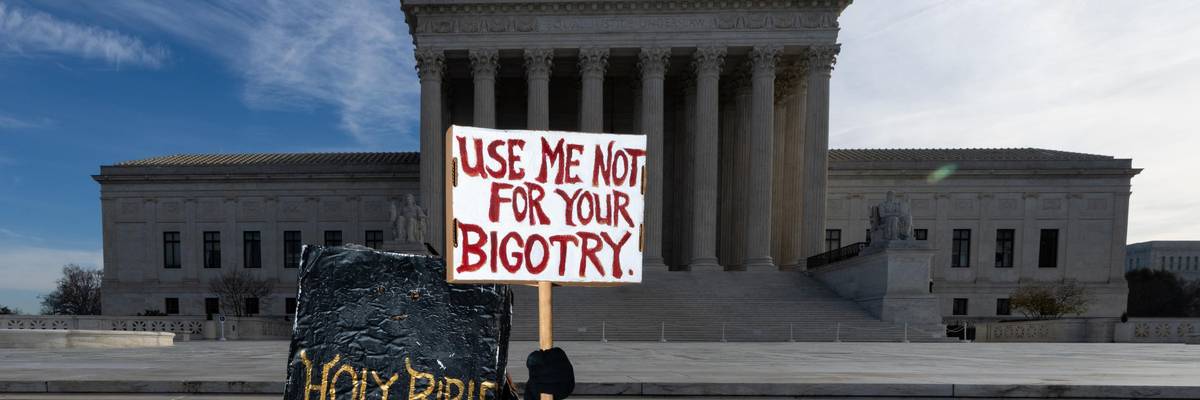
A protester dressed in a Bible costume stands in front of the U.S. Supreme Court during the 303 Creative v. Elenis case hearing in the court on November 5, 2022. (Photo: Bill Clark/CQ-Roll Call, Inc. via Getty Images)
With rights advocates rallying outside the U.S. Supreme Court on Monday, the right-wing majority of the court appeared poised to rule in favor of a web designer who aims to discriminate against LGBTQ+ couples when she creates wedding websites, as the justices heard arguments in the case 303 Creative LLC v. Elenis.
The court's six right-wing justices asked a number of pointed questions of Colorado Solicitor General Eric Olson and the state's principal deputy solicitor general, Brian Fletcher, as they defended Colorado's public accommodation law.
"This lawsuit was ginned up by a law firm--Alliance Defending Freedom--that has been labeled by the Southern Poverty Law Center as an anti-LGBTQ hate group."
The line of questioning suggested they believe the plaintiff, Lorie Smith, should legally be permitted to exclude LGBTQ+ couples from using her services--raising questions about what other groups they believe Smith's business should be allowed to discriminate against, said rights advocates.
Colorado's statute makes it one of nearly two dozen states which protect people from being refused services on the basis of their gender identity or sexual orientation, and has been targeted by the Alliance Defending Freedom (ADF)--the right-wing group that brought the case and others dealing with LGBTQ+ rights to the Supreme Court--as a law that violates the First Amendment.
A number of court observers noted before the arguments were presented Monday that Smith filed her lawsuit against the state in 2016 preemptively, not because she had received a request to create a wedding website for a same-sex couple.
"This lawsuit was ginned up by a law firm--Alliance Defending Freedom--that has been labeled by the Southern Poverty Law Center as an anti-LGBTQ hate group," said Rewire News Group. "They are on the frontlines when it comes to wielding the First Amendment as a weapon to discriminate against LGBTQ people."
The NAACP Legal Defense Fund added that the lawsuit "should be seen as part of the dangerous larger effort now underway to shut LGBTQ+ people out of public spaces more broadly."
The court's right-wing justices put forward a number of hypotheticals. Justices Samuel Alito and Brett Kavanaugh asked whether a victory for Colorado in the case could allow the state to then compel a speechwriter to write a speech going against their "most deeply held convictions."
When Fletcher answered that speechwriting would likely not be covered by the public accommodation law, Kavanaugh said, "I mean, that's what states could do."
Alito also compared LGBTQ+ couples' push for equal rights in public spaces to "a Ku Klux Klan outfit," asking whether a Black Santa Claus at a shopping mall should be legally required to pose for a picture with a child wearing a KKK robe.
"No, because Ku Klux Klan outfits are not protected characteristics under public accommodation laws," said Olson.
The comparison represented "a despicable new low for [Alito] and the Supreme Court," said activist Christine Pelosi.
Justice Neil Gorsuch also appeared ready to side with Smith, repeating views he stated in 2017 when the court heard Masterpiece Cakeshop v. Colorado Civil Rights Commission--another case in which Kristen Waggoner, Smith's attorney, argued in favor of a business being permitted to turn away a gay couple.
Compelling businesses to comply with anti-discrimination laws is synonymous with forcing business owners to undergo "reeducation training," Gorsuch told Olson, prompting the solicitor general's strong disagreement.
"It does not bode well for the future of civil rights law that Gorsuch believes a state imposes 'reeducation training' on employers when it reminds them how to comply with nondiscrimination rules," said Slate journalist Mark Joseph Stern.
Liberal Justice Sonia Sotomayor expressed deep concerns about how a ruling in favor of Smith could slash anti-discrimination protections for any number of groups.
"There is no line on race, there is no line on disability, ethnicity, none of the protected categories," said Sotomayor.
The arguments presented Monday "underscore the fundamental rights at stake" in the case, said Sunu Chandy, legal director for the National Women's Law Center, "including for LGBTQ people, people of color, women, people with disabilities, and people of all faiths."
"If the Supreme Court decides to toss away its own precedents, there would be little to stop businesses from discriminating against customers not only based on sexual orientation, but also because of other characteristics like race, sex, disability, religion, or national origin," said Chandy. "A print shop that disapproves of women working outside the home could refuse to make business cards for women. A jeweler opposed to interfaith marriages could refuse to design jewelry for a mixed-faith couple. A family photographer with white supremacist beliefs could refuse to offer their services to a Black family."
"The court must reject this approach, prevent second-class citizenship, and ensure all companies are open for business for all," Chandy added.
Dear Common Dreams reader, It’s been nearly 30 years since I co-founded Common Dreams with my late wife, Lina Newhouser. We had the radical notion that journalism should serve the public good, not corporate profits. It was clear to us from the outset what it would take to build such a project. No paid advertisements. No corporate sponsors. No millionaire publisher telling us what to think or do. Many people said we wouldn't last a year, but we proved those doubters wrong. Together with a tremendous team of journalists and dedicated staff, we built an independent media outlet free from the constraints of profits and corporate control. Our mission has always been simple: To inform. To inspire. To ignite change for the common good. Building Common Dreams was not easy. Our survival was never guaranteed. When you take on the most powerful forces—Wall Street greed, fossil fuel industry destruction, Big Tech lobbyists, and uber-rich oligarchs who have spent billions upon billions rigging the economy and democracy in their favor—the only bulwark you have is supporters who believe in your work. But here’s the urgent message from me today. It's never been this bad out there. And it's never been this hard to keep us going. At the very moment Common Dreams is most needed, the threats we face are intensifying. We need your support now more than ever. We don't accept corporate advertising and never will. We don't have a paywall because we don't think people should be blocked from critical news based on their ability to pay. Everything we do is funded by the donations of readers like you. When everyone does the little they can afford, we are strong. But if that support retreats or dries up, so do we. Will you donate now to make sure Common Dreams not only survives but thrives? —Craig Brown, Co-founder |
With rights advocates rallying outside the U.S. Supreme Court on Monday, the right-wing majority of the court appeared poised to rule in favor of a web designer who aims to discriminate against LGBTQ+ couples when she creates wedding websites, as the justices heard arguments in the case 303 Creative LLC v. Elenis.
The court's six right-wing justices asked a number of pointed questions of Colorado Solicitor General Eric Olson and the state's principal deputy solicitor general, Brian Fletcher, as they defended Colorado's public accommodation law.
"This lawsuit was ginned up by a law firm--Alliance Defending Freedom--that has been labeled by the Southern Poverty Law Center as an anti-LGBTQ hate group."
The line of questioning suggested they believe the plaintiff, Lorie Smith, should legally be permitted to exclude LGBTQ+ couples from using her services--raising questions about what other groups they believe Smith's business should be allowed to discriminate against, said rights advocates.
Colorado's statute makes it one of nearly two dozen states which protect people from being refused services on the basis of their gender identity or sexual orientation, and has been targeted by the Alliance Defending Freedom (ADF)--the right-wing group that brought the case and others dealing with LGBTQ+ rights to the Supreme Court--as a law that violates the First Amendment.
A number of court observers noted before the arguments were presented Monday that Smith filed her lawsuit against the state in 2016 preemptively, not because she had received a request to create a wedding website for a same-sex couple.
"This lawsuit was ginned up by a law firm--Alliance Defending Freedom--that has been labeled by the Southern Poverty Law Center as an anti-LGBTQ hate group," said Rewire News Group. "They are on the frontlines when it comes to wielding the First Amendment as a weapon to discriminate against LGBTQ people."
The NAACP Legal Defense Fund added that the lawsuit "should be seen as part of the dangerous larger effort now underway to shut LGBTQ+ people out of public spaces more broadly."
The court's right-wing justices put forward a number of hypotheticals. Justices Samuel Alito and Brett Kavanaugh asked whether a victory for Colorado in the case could allow the state to then compel a speechwriter to write a speech going against their "most deeply held convictions."
When Fletcher answered that speechwriting would likely not be covered by the public accommodation law, Kavanaugh said, "I mean, that's what states could do."
Alito also compared LGBTQ+ couples' push for equal rights in public spaces to "a Ku Klux Klan outfit," asking whether a Black Santa Claus at a shopping mall should be legally required to pose for a picture with a child wearing a KKK robe.
"No, because Ku Klux Klan outfits are not protected characteristics under public accommodation laws," said Olson.
The comparison represented "a despicable new low for [Alito] and the Supreme Court," said activist Christine Pelosi.
Justice Neil Gorsuch also appeared ready to side with Smith, repeating views he stated in 2017 when the court heard Masterpiece Cakeshop v. Colorado Civil Rights Commission--another case in which Kristen Waggoner, Smith's attorney, argued in favor of a business being permitted to turn away a gay couple.
Compelling businesses to comply with anti-discrimination laws is synonymous with forcing business owners to undergo "reeducation training," Gorsuch told Olson, prompting the solicitor general's strong disagreement.
"It does not bode well for the future of civil rights law that Gorsuch believes a state imposes 'reeducation training' on employers when it reminds them how to comply with nondiscrimination rules," said Slate journalist Mark Joseph Stern.
Liberal Justice Sonia Sotomayor expressed deep concerns about how a ruling in favor of Smith could slash anti-discrimination protections for any number of groups.
"There is no line on race, there is no line on disability, ethnicity, none of the protected categories," said Sotomayor.
The arguments presented Monday "underscore the fundamental rights at stake" in the case, said Sunu Chandy, legal director for the National Women's Law Center, "including for LGBTQ people, people of color, women, people with disabilities, and people of all faiths."
"If the Supreme Court decides to toss away its own precedents, there would be little to stop businesses from discriminating against customers not only based on sexual orientation, but also because of other characteristics like race, sex, disability, religion, or national origin," said Chandy. "A print shop that disapproves of women working outside the home could refuse to make business cards for women. A jeweler opposed to interfaith marriages could refuse to design jewelry for a mixed-faith couple. A family photographer with white supremacist beliefs could refuse to offer their services to a Black family."
"The court must reject this approach, prevent second-class citizenship, and ensure all companies are open for business for all," Chandy added.
With rights advocates rallying outside the U.S. Supreme Court on Monday, the right-wing majority of the court appeared poised to rule in favor of a web designer who aims to discriminate against LGBTQ+ couples when she creates wedding websites, as the justices heard arguments in the case 303 Creative LLC v. Elenis.
The court's six right-wing justices asked a number of pointed questions of Colorado Solicitor General Eric Olson and the state's principal deputy solicitor general, Brian Fletcher, as they defended Colorado's public accommodation law.
"This lawsuit was ginned up by a law firm--Alliance Defending Freedom--that has been labeled by the Southern Poverty Law Center as an anti-LGBTQ hate group."
The line of questioning suggested they believe the plaintiff, Lorie Smith, should legally be permitted to exclude LGBTQ+ couples from using her services--raising questions about what other groups they believe Smith's business should be allowed to discriminate against, said rights advocates.
Colorado's statute makes it one of nearly two dozen states which protect people from being refused services on the basis of their gender identity or sexual orientation, and has been targeted by the Alliance Defending Freedom (ADF)--the right-wing group that brought the case and others dealing with LGBTQ+ rights to the Supreme Court--as a law that violates the First Amendment.
A number of court observers noted before the arguments were presented Monday that Smith filed her lawsuit against the state in 2016 preemptively, not because she had received a request to create a wedding website for a same-sex couple.
"This lawsuit was ginned up by a law firm--Alliance Defending Freedom--that has been labeled by the Southern Poverty Law Center as an anti-LGBTQ hate group," said Rewire News Group. "They are on the frontlines when it comes to wielding the First Amendment as a weapon to discriminate against LGBTQ people."
The NAACP Legal Defense Fund added that the lawsuit "should be seen as part of the dangerous larger effort now underway to shut LGBTQ+ people out of public spaces more broadly."
The court's right-wing justices put forward a number of hypotheticals. Justices Samuel Alito and Brett Kavanaugh asked whether a victory for Colorado in the case could allow the state to then compel a speechwriter to write a speech going against their "most deeply held convictions."
When Fletcher answered that speechwriting would likely not be covered by the public accommodation law, Kavanaugh said, "I mean, that's what states could do."
Alito also compared LGBTQ+ couples' push for equal rights in public spaces to "a Ku Klux Klan outfit," asking whether a Black Santa Claus at a shopping mall should be legally required to pose for a picture with a child wearing a KKK robe.
"No, because Ku Klux Klan outfits are not protected characteristics under public accommodation laws," said Olson.
The comparison represented "a despicable new low for [Alito] and the Supreme Court," said activist Christine Pelosi.
Justice Neil Gorsuch also appeared ready to side with Smith, repeating views he stated in 2017 when the court heard Masterpiece Cakeshop v. Colorado Civil Rights Commission--another case in which Kristen Waggoner, Smith's attorney, argued in favor of a business being permitted to turn away a gay couple.
Compelling businesses to comply with anti-discrimination laws is synonymous with forcing business owners to undergo "reeducation training," Gorsuch told Olson, prompting the solicitor general's strong disagreement.
"It does not bode well for the future of civil rights law that Gorsuch believes a state imposes 'reeducation training' on employers when it reminds them how to comply with nondiscrimination rules," said Slate journalist Mark Joseph Stern.
Liberal Justice Sonia Sotomayor expressed deep concerns about how a ruling in favor of Smith could slash anti-discrimination protections for any number of groups.
"There is no line on race, there is no line on disability, ethnicity, none of the protected categories," said Sotomayor.
The arguments presented Monday "underscore the fundamental rights at stake" in the case, said Sunu Chandy, legal director for the National Women's Law Center, "including for LGBTQ people, people of color, women, people with disabilities, and people of all faiths."
"If the Supreme Court decides to toss away its own precedents, there would be little to stop businesses from discriminating against customers not only based on sexual orientation, but also because of other characteristics like race, sex, disability, religion, or national origin," said Chandy. "A print shop that disapproves of women working outside the home could refuse to make business cards for women. A jeweler opposed to interfaith marriages could refuse to design jewelry for a mixed-faith couple. A family photographer with white supremacist beliefs could refuse to offer their services to a Black family."
"The court must reject this approach, prevent second-class citizenship, and ensure all companies are open for business for all," Chandy added.