SUBSCRIBE TO OUR FREE NEWSLETTER
Daily news & progressive opinion—funded by the people, not the corporations—delivered straight to your inbox.
5
#000000
#FFFFFF
To donate by check, phone, or other method, see our More Ways to Give page.
Daily news & progressive opinion—funded by the people, not the corporations—delivered straight to your inbox.
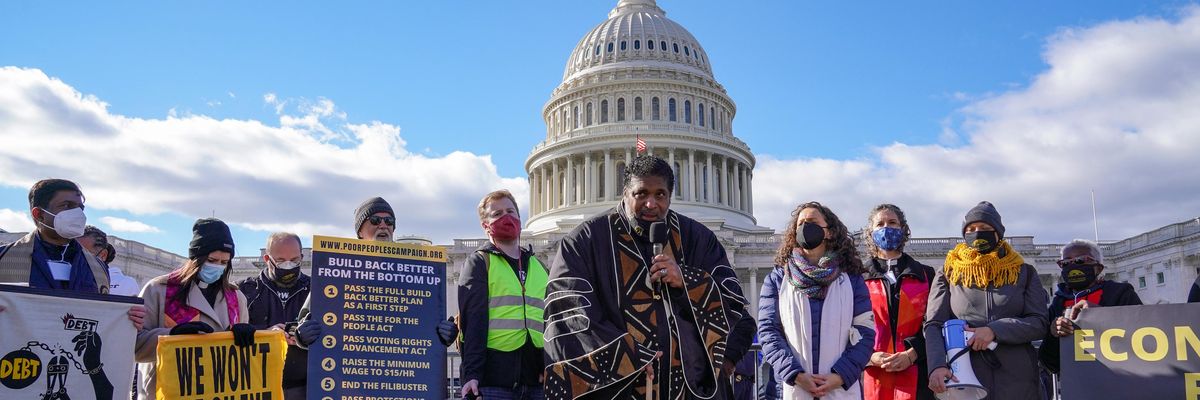
Rev. Dr. William J. Barber II leads faith leaders and activists in a march and demonstration at the U.S. Capitol on November 15, 2021 in Washington, D.C. (Photo: Jemal Countess/Getty Images for MoveOn)
The Rev. Dr. William J. Barber II, co-chair of the grassroots Poor People's Campaign, presented the latest evidence on Sunday that the Democratic Party stands little chance of winning congressional majorities and the White House in future elections if it continues ignoring low-income communities.
The push by progressives including Sen. Bernie Sanders (I-Vt.), Rep. Alexandria Ocasio-Cortez (D-N.Y.), and others to focus on the economic struggles facing working families across the country during the midterm elections was not just based on a theory, Barber suggested, but was a strategy that was ultimately backed up by data.
"Those persons making under $30,000 a year voted 12 points higher for Democrats, according to exit polls," he told Ali Velshi on MSNBC Sunday. "Those making under $50,000 a year voted about 5% higher."
"There's not a state in this country where poor and low-wage voters do not have at least 30% of the electorate," Barber added. "And in every state where the margin of victories is within 3%, poor and low-wealth voters have over 40% of the electorate. So you can't win by ignoring poor and low-wealth votes."
Barber's comments come weeks after Democrats maintained a narrow majority in the U.S. Senate and lost control of the House, with some unexpected losses in states including New York.
As Common Dreams reported earlier this month, Ocasio-Cortez is among the progressives who have called on Democratic leaders to look closely at which candidates were successful, pointing out that U.S. Sen.-elect John Fetterman (D-Pa.) ran a very different campaign than fellow Rust Belt candidate Rep. Tim Ryan (D-Ohio), who lost a Senate race to Republican J.D. Vance.
"In Arizona, in 2020, for instance, the number of poor and low-wealth voters who didn't vote was 756,000, and the margin of victory was only 10,000 votes."
While Ryan was one of the most vocal critics of President Joe Biden's student debt relief plan, Fetterman adamantly supports student loan debt cancellation and drew national attention to his campaign by taking aim at his GOP opponent's wealth, his support for tax cuts for the rich, and his opposition to raising the minimum wage.
Fetterman's victory "over celebrity surgeon Mehmet Oz, the perfect foil for a populist, has pushed national outlets that have often been dismissive of the appeal of progressive economics to reassess," wrote Austin Ahlman at The American Prospect on Monday.
While Democratic strategists and candidates have spent decades focused on winning over middle-class suburban voters, Barber implored the party to "stop chasing the elusive suburban vote" and focus on millions of low-wealth people who in recent years have declined to vote at all.
"In Arizona, in 2020, for instance, the number of poor and low-wealth voters who didn't vote was 756,000, and the margin of victory was only 10,000 votes," Barber told Velshi.
A number of Democratic victories and losses in the midterm elections demonstrated how when candidates focused on economic issues directly affecting working people and the poor--like corporate price-gouging, student debt, and inequality--they were successful.
Sen. Raphael Warnock (D-Ga.), who now faces a runoff scheduled for December 6, came close to outright beating his GOP opponent, Herschel Walker, and "ran a large distance ahead of [Democratic] gubernatorial candidate Stacey Abrams," wrote Ahlman, after pushing Biden to sign an executive order canceling student debt.
While generally a centrist Democrat, Sen.-elect Mark Kelly of Arizona beat Republican venture capitalist Blake Masters after running "ads dedicated entirely to his work fighting corporate greed and price-gouging," Ahlman added.
Meanwhile, Ahlman posited that Rep. Elaine Luria (D-Va.) "paid the price for jaw-dropping comments about a now-defunct effort to ban stock trades by members of Congress," which she called "bullshit" earlier this year. At least two in three voters support such a proposal, according to a Morning Consult/Politico poll released last month.
As Common Dreams reported, the progressive "Squad" in the U.S. House grew after the midterms, as left-wing candidates including Reps.-elect Maxwell Frost (D-Fla.), Summer Lee (D-Pa.), and Delia Ramirez (D-Ill.) won.
Ramirez--who earlier this year defeated her conservative primary opponent by 47 points in one part of her district--told Politico last week that she rejects claims by some Democratic strategists and political observers that Latino voters are turning away from the party because they're rejecting progressive policy proposals.
While a poll by The Washington Post/Ipsos in October showed that the Democratic lead among Latino voters had shrunk by 23 points since 2018, other polling from the Pew Research Center has shown that those same voters support raising the federal minimum wage and more government involvement in the delivery of healthcare.
"The first thing we need to do is acknowledge that people are hurting," Ramirez told Politico. "The reality is that gas is still too damn high; small businesses are struggling to stay open; people have a difficulty between choosing [between] healthcare and their mortgage. We have to walk in and say these are the realities that I'm gonna fight for. Here's what we've done, but it's still not enough."
Ahlman wrote that candidates were partially "enabled" to embrace progressive messaging on economics by "the Biden administration's clear rejection of the constrained economic orthodoxies that guided the last two Democratic administrations," as campaigners pushed the president to embrace student debt cancellation and climate investments in the Inflation Reduction Act.
"The encouraging number of candidates who managed to find success against daunting odds offers proof that the populist spark Democrats discovered this year may be their best shot in the future to build a broad enough coalition to pass significant pieces of the social and economic agenda Biden abandoned," such as his plan for tuition-free community college, free and universal preschool, and investments in childcare, wrote Ahlman.
To gain back control of the House, maintain power in the Senate and White House, and pass the Democratic agenda, said Barber, Democrats must "focus clearly and intensely on poor and low-wealth voters who tend to, when they vote, vote progressive if they're targeted."
Dear Common Dreams reader, It’s been nearly 30 years since I co-founded Common Dreams with my late wife, Lina Newhouser. We had the radical notion that journalism should serve the public good, not corporate profits. It was clear to us from the outset what it would take to build such a project. No paid advertisements. No corporate sponsors. No millionaire publisher telling us what to think or do. Many people said we wouldn't last a year, but we proved those doubters wrong. Together with a tremendous team of journalists and dedicated staff, we built an independent media outlet free from the constraints of profits and corporate control. Our mission has always been simple: To inform. To inspire. To ignite change for the common good. Building Common Dreams was not easy. Our survival was never guaranteed. When you take on the most powerful forces—Wall Street greed, fossil fuel industry destruction, Big Tech lobbyists, and uber-rich oligarchs who have spent billions upon billions rigging the economy and democracy in their favor—the only bulwark you have is supporters who believe in your work. But here’s the urgent message from me today. It's never been this bad out there. And it's never been this hard to keep us going. At the very moment Common Dreams is most needed, the threats we face are intensifying. We need your support now more than ever. We don't accept corporate advertising and never will. We don't have a paywall because we don't think people should be blocked from critical news based on their ability to pay. Everything we do is funded by the donations of readers like you. When everyone does the little they can afford, we are strong. But if that support retreats or dries up, so do we. Will you donate now to make sure Common Dreams not only survives but thrives? —Craig Brown, Co-founder |
The Rev. Dr. William J. Barber II, co-chair of the grassroots Poor People's Campaign, presented the latest evidence on Sunday that the Democratic Party stands little chance of winning congressional majorities and the White House in future elections if it continues ignoring low-income communities.
The push by progressives including Sen. Bernie Sanders (I-Vt.), Rep. Alexandria Ocasio-Cortez (D-N.Y.), and others to focus on the economic struggles facing working families across the country during the midterm elections was not just based on a theory, Barber suggested, but was a strategy that was ultimately backed up by data.
"Those persons making under $30,000 a year voted 12 points higher for Democrats, according to exit polls," he told Ali Velshi on MSNBC Sunday. "Those making under $50,000 a year voted about 5% higher."
"There's not a state in this country where poor and low-wage voters do not have at least 30% of the electorate," Barber added. "And in every state where the margin of victories is within 3%, poor and low-wealth voters have over 40% of the electorate. So you can't win by ignoring poor and low-wealth votes."
Barber's comments come weeks after Democrats maintained a narrow majority in the U.S. Senate and lost control of the House, with some unexpected losses in states including New York.
As Common Dreams reported earlier this month, Ocasio-Cortez is among the progressives who have called on Democratic leaders to look closely at which candidates were successful, pointing out that U.S. Sen.-elect John Fetterman (D-Pa.) ran a very different campaign than fellow Rust Belt candidate Rep. Tim Ryan (D-Ohio), who lost a Senate race to Republican J.D. Vance.
"In Arizona, in 2020, for instance, the number of poor and low-wealth voters who didn't vote was 756,000, and the margin of victory was only 10,000 votes."
While Ryan was one of the most vocal critics of President Joe Biden's student debt relief plan, Fetterman adamantly supports student loan debt cancellation and drew national attention to his campaign by taking aim at his GOP opponent's wealth, his support for tax cuts for the rich, and his opposition to raising the minimum wage.
Fetterman's victory "over celebrity surgeon Mehmet Oz, the perfect foil for a populist, has pushed national outlets that have often been dismissive of the appeal of progressive economics to reassess," wrote Austin Ahlman at The American Prospect on Monday.
While Democratic strategists and candidates have spent decades focused on winning over middle-class suburban voters, Barber implored the party to "stop chasing the elusive suburban vote" and focus on millions of low-wealth people who in recent years have declined to vote at all.
"In Arizona, in 2020, for instance, the number of poor and low-wealth voters who didn't vote was 756,000, and the margin of victory was only 10,000 votes," Barber told Velshi.
A number of Democratic victories and losses in the midterm elections demonstrated how when candidates focused on economic issues directly affecting working people and the poor--like corporate price-gouging, student debt, and inequality--they were successful.
Sen. Raphael Warnock (D-Ga.), who now faces a runoff scheduled for December 6, came close to outright beating his GOP opponent, Herschel Walker, and "ran a large distance ahead of [Democratic] gubernatorial candidate Stacey Abrams," wrote Ahlman, after pushing Biden to sign an executive order canceling student debt.
While generally a centrist Democrat, Sen.-elect Mark Kelly of Arizona beat Republican venture capitalist Blake Masters after running "ads dedicated entirely to his work fighting corporate greed and price-gouging," Ahlman added.
Meanwhile, Ahlman posited that Rep. Elaine Luria (D-Va.) "paid the price for jaw-dropping comments about a now-defunct effort to ban stock trades by members of Congress," which she called "bullshit" earlier this year. At least two in three voters support such a proposal, according to a Morning Consult/Politico poll released last month.
As Common Dreams reported, the progressive "Squad" in the U.S. House grew after the midterms, as left-wing candidates including Reps.-elect Maxwell Frost (D-Fla.), Summer Lee (D-Pa.), and Delia Ramirez (D-Ill.) won.
Ramirez--who earlier this year defeated her conservative primary opponent by 47 points in one part of her district--told Politico last week that she rejects claims by some Democratic strategists and political observers that Latino voters are turning away from the party because they're rejecting progressive policy proposals.
While a poll by The Washington Post/Ipsos in October showed that the Democratic lead among Latino voters had shrunk by 23 points since 2018, other polling from the Pew Research Center has shown that those same voters support raising the federal minimum wage and more government involvement in the delivery of healthcare.
"The first thing we need to do is acknowledge that people are hurting," Ramirez told Politico. "The reality is that gas is still too damn high; small businesses are struggling to stay open; people have a difficulty between choosing [between] healthcare and their mortgage. We have to walk in and say these are the realities that I'm gonna fight for. Here's what we've done, but it's still not enough."
Ahlman wrote that candidates were partially "enabled" to embrace progressive messaging on economics by "the Biden administration's clear rejection of the constrained economic orthodoxies that guided the last two Democratic administrations," as campaigners pushed the president to embrace student debt cancellation and climate investments in the Inflation Reduction Act.
"The encouraging number of candidates who managed to find success against daunting odds offers proof that the populist spark Democrats discovered this year may be their best shot in the future to build a broad enough coalition to pass significant pieces of the social and economic agenda Biden abandoned," such as his plan for tuition-free community college, free and universal preschool, and investments in childcare, wrote Ahlman.
To gain back control of the House, maintain power in the Senate and White House, and pass the Democratic agenda, said Barber, Democrats must "focus clearly and intensely on poor and low-wealth voters who tend to, when they vote, vote progressive if they're targeted."
The Rev. Dr. William J. Barber II, co-chair of the grassroots Poor People's Campaign, presented the latest evidence on Sunday that the Democratic Party stands little chance of winning congressional majorities and the White House in future elections if it continues ignoring low-income communities.
The push by progressives including Sen. Bernie Sanders (I-Vt.), Rep. Alexandria Ocasio-Cortez (D-N.Y.), and others to focus on the economic struggles facing working families across the country during the midterm elections was not just based on a theory, Barber suggested, but was a strategy that was ultimately backed up by data.
"Those persons making under $30,000 a year voted 12 points higher for Democrats, according to exit polls," he told Ali Velshi on MSNBC Sunday. "Those making under $50,000 a year voted about 5% higher."
"There's not a state in this country where poor and low-wage voters do not have at least 30% of the electorate," Barber added. "And in every state where the margin of victories is within 3%, poor and low-wealth voters have over 40% of the electorate. So you can't win by ignoring poor and low-wealth votes."
Barber's comments come weeks after Democrats maintained a narrow majority in the U.S. Senate and lost control of the House, with some unexpected losses in states including New York.
As Common Dreams reported earlier this month, Ocasio-Cortez is among the progressives who have called on Democratic leaders to look closely at which candidates were successful, pointing out that U.S. Sen.-elect John Fetterman (D-Pa.) ran a very different campaign than fellow Rust Belt candidate Rep. Tim Ryan (D-Ohio), who lost a Senate race to Republican J.D. Vance.
"In Arizona, in 2020, for instance, the number of poor and low-wealth voters who didn't vote was 756,000, and the margin of victory was only 10,000 votes."
While Ryan was one of the most vocal critics of President Joe Biden's student debt relief plan, Fetterman adamantly supports student loan debt cancellation and drew national attention to his campaign by taking aim at his GOP opponent's wealth, his support for tax cuts for the rich, and his opposition to raising the minimum wage.
Fetterman's victory "over celebrity surgeon Mehmet Oz, the perfect foil for a populist, has pushed national outlets that have often been dismissive of the appeal of progressive economics to reassess," wrote Austin Ahlman at The American Prospect on Monday.
While Democratic strategists and candidates have spent decades focused on winning over middle-class suburban voters, Barber implored the party to "stop chasing the elusive suburban vote" and focus on millions of low-wealth people who in recent years have declined to vote at all.
"In Arizona, in 2020, for instance, the number of poor and low-wealth voters who didn't vote was 756,000, and the margin of victory was only 10,000 votes," Barber told Velshi.
A number of Democratic victories and losses in the midterm elections demonstrated how when candidates focused on economic issues directly affecting working people and the poor--like corporate price-gouging, student debt, and inequality--they were successful.
Sen. Raphael Warnock (D-Ga.), who now faces a runoff scheduled for December 6, came close to outright beating his GOP opponent, Herschel Walker, and "ran a large distance ahead of [Democratic] gubernatorial candidate Stacey Abrams," wrote Ahlman, after pushing Biden to sign an executive order canceling student debt.
While generally a centrist Democrat, Sen.-elect Mark Kelly of Arizona beat Republican venture capitalist Blake Masters after running "ads dedicated entirely to his work fighting corporate greed and price-gouging," Ahlman added.
Meanwhile, Ahlman posited that Rep. Elaine Luria (D-Va.) "paid the price for jaw-dropping comments about a now-defunct effort to ban stock trades by members of Congress," which she called "bullshit" earlier this year. At least two in three voters support such a proposal, according to a Morning Consult/Politico poll released last month.
As Common Dreams reported, the progressive "Squad" in the U.S. House grew after the midterms, as left-wing candidates including Reps.-elect Maxwell Frost (D-Fla.), Summer Lee (D-Pa.), and Delia Ramirez (D-Ill.) won.
Ramirez--who earlier this year defeated her conservative primary opponent by 47 points in one part of her district--told Politico last week that she rejects claims by some Democratic strategists and political observers that Latino voters are turning away from the party because they're rejecting progressive policy proposals.
While a poll by The Washington Post/Ipsos in October showed that the Democratic lead among Latino voters had shrunk by 23 points since 2018, other polling from the Pew Research Center has shown that those same voters support raising the federal minimum wage and more government involvement in the delivery of healthcare.
"The first thing we need to do is acknowledge that people are hurting," Ramirez told Politico. "The reality is that gas is still too damn high; small businesses are struggling to stay open; people have a difficulty between choosing [between] healthcare and their mortgage. We have to walk in and say these are the realities that I'm gonna fight for. Here's what we've done, but it's still not enough."
Ahlman wrote that candidates were partially "enabled" to embrace progressive messaging on economics by "the Biden administration's clear rejection of the constrained economic orthodoxies that guided the last two Democratic administrations," as campaigners pushed the president to embrace student debt cancellation and climate investments in the Inflation Reduction Act.
"The encouraging number of candidates who managed to find success against daunting odds offers proof that the populist spark Democrats discovered this year may be their best shot in the future to build a broad enough coalition to pass significant pieces of the social and economic agenda Biden abandoned," such as his plan for tuition-free community college, free and universal preschool, and investments in childcare, wrote Ahlman.
To gain back control of the House, maintain power in the Senate and White House, and pass the Democratic agenda, said Barber, Democrats must "focus clearly and intensely on poor and low-wealth voters who tend to, when they vote, vote progressive if they're targeted."