SUBSCRIBE TO OUR FREE NEWSLETTER
Daily news & progressive opinion—funded by the people, not the corporations—delivered straight to your inbox.
5
#000000
#FFFFFF
To donate by check, phone, or other method, see our More Ways to Give page.
Daily news & progressive opinion—funded by the people, not the corporations—delivered straight to your inbox.
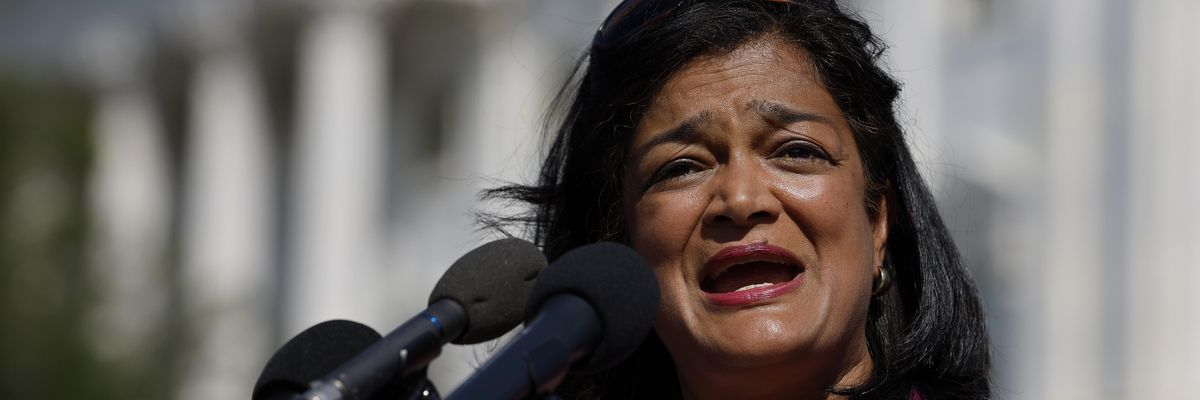
Rep. Pramila Jayapal (D-Wash.) speaks at a news conference ahead of the vote on the Inflation Reduction Act of 2022 outside the U.S. Capitol on August 12, 2022 in Washington, D.C.
As major election watchers on Wednesday officially announced that Republicans had secured a majority in the U.S. House of Representatives by winning at least 218 seats, top Democrats--whose party maintains control of the White House and Senate--tried to send a message of hope.
Appearing on MSNBC Wednesday night, Rep. Pramila Jayapal (D-Wash.) highlighted progressive candidates who won and the state-level ballot measures that passed, including initiatives legalizing marijuana, protecting abortion rights, expanding Medicaid, and raising the minimum wage.
"I think the lesson for us here is we might have to be an opposition party in the House, with Republican leadership... but we also have to be a proposition party," said Jayapal, chair of Congressional Progressive Caucus (CPC). "We have to show people what we stand for--give people hope that if we get into office, we will do what we did again in this last term."
"The line of defense is gonna be in the Senate and the White House," Jayapal explained. "What we might get in the House--I hate this--but what we might get is a really sharp contrast: Republicans trying to strip Social Security and Medicare" while Democrats attempt to protect key rights and recent progress.
During the campaign season for this past cycle, Republican candidates made clear they wanted to try to use the fight over raising the debt ceiling to force spending cuts, specifically targeting Social Security and Medicare. Along with passing appropriation legislation during the lame-duck session, the CPC leader stressed that "we also do need to make sure to take some tools that they're gonna use to hold us hostage off the table--so that's the debt ceiling."
However, as Common Dreams reported earlier Wednesday, the White House and congressional leadership aren't pushing for a Democrats-only budget reconciliation package to lift the debt limit before the end of the year, fearing they don't have the votes. Instead, they're hoping for a bipartisan deal, though there are no signs from Senate Minority Leader Mitch McConnell (R-Ky.) or House Minority Leader Kevin McCarthy (R-Calif.) that they'll get one.
McCarthy on Tuesday won the GOP nomination for House speaker, defeating Rep. Andy Biggs (R-Ariz.) of the Freedom Caucus 188-31.
The New York Times noted that his "nomination was only the opening act in what was shaping up to be a long and painful path to the speakership, and it exposed bitter divisions within the party, with the hard-right faction of Mr. McCarthy's conference--many of whom have sought for years to weaken him--newly emboldened after a disappointing showing for the party in the midterm elections, and eager to squeeze him for concessions."
Jayapal on Wednesday cast doubt on McCarthy's leadership, especially compared with that of outgoing House Speaker Nancy Pelosi (D-Calif.).
"They do not have an accomplished speaker the way that we've had Speaker Pelosi," she said of the GOP. "They have Kevin McCarthy, who is not gonna be able to bring that caucus--in my view--together. They're gonna fight with each other."
According to Jayapal, "It is going to be--instead of Dems in disarray, which always used to be a problem; we were described that way--this is Republicans in ruin."
President Joe Biden, meanwhile, congratulated McCarthy on the GOP winning the lower chamber and said that he is "ready to work with House Republicans to deliver results for working families."
"In this election, voters spoke clearly about their concerns: the need to lower costs, protect the right to choose, and preserve our democracy," Biden continued. "As I said last week, the future is too promising to be trapped in political warfare."
"The American people want us to get things done for them," he added. "They want us to focus on the issues that matter to them and on making their lives better. And I will work with anyone--Republican or Democrat--willing to work with me to deliver results for them."
Dear Common Dreams reader, It’s been nearly 30 years since I co-founded Common Dreams with my late wife, Lina Newhouser. We had the radical notion that journalism should serve the public good, not corporate profits. It was clear to us from the outset what it would take to build such a project. No paid advertisements. No corporate sponsors. No millionaire publisher telling us what to think or do. Many people said we wouldn't last a year, but we proved those doubters wrong. Together with a tremendous team of journalists and dedicated staff, we built an independent media outlet free from the constraints of profits and corporate control. Our mission has always been simple: To inform. To inspire. To ignite change for the common good. Building Common Dreams was not easy. Our survival was never guaranteed. When you take on the most powerful forces—Wall Street greed, fossil fuel industry destruction, Big Tech lobbyists, and uber-rich oligarchs who have spent billions upon billions rigging the economy and democracy in their favor—the only bulwark you have is supporters who believe in your work. But here’s the urgent message from me today. It's never been this bad out there. And it's never been this hard to keep us going. At the very moment Common Dreams is most needed, the threats we face are intensifying. We need your support now more than ever. We don't accept corporate advertising and never will. We don't have a paywall because we don't think people should be blocked from critical news based on their ability to pay. Everything we do is funded by the donations of readers like you. When everyone does the little they can afford, we are strong. But if that support retreats or dries up, so do we. Will you donate now to make sure Common Dreams not only survives but thrives? —Craig Brown, Co-founder |
As major election watchers on Wednesday officially announced that Republicans had secured a majority in the U.S. House of Representatives by winning at least 218 seats, top Democrats--whose party maintains control of the White House and Senate--tried to send a message of hope.
Appearing on MSNBC Wednesday night, Rep. Pramila Jayapal (D-Wash.) highlighted progressive candidates who won and the state-level ballot measures that passed, including initiatives legalizing marijuana, protecting abortion rights, expanding Medicaid, and raising the minimum wage.
"I think the lesson for us here is we might have to be an opposition party in the House, with Republican leadership... but we also have to be a proposition party," said Jayapal, chair of Congressional Progressive Caucus (CPC). "We have to show people what we stand for--give people hope that if we get into office, we will do what we did again in this last term."
"The line of defense is gonna be in the Senate and the White House," Jayapal explained. "What we might get in the House--I hate this--but what we might get is a really sharp contrast: Republicans trying to strip Social Security and Medicare" while Democrats attempt to protect key rights and recent progress.
During the campaign season for this past cycle, Republican candidates made clear they wanted to try to use the fight over raising the debt ceiling to force spending cuts, specifically targeting Social Security and Medicare. Along with passing appropriation legislation during the lame-duck session, the CPC leader stressed that "we also do need to make sure to take some tools that they're gonna use to hold us hostage off the table--so that's the debt ceiling."
However, as Common Dreams reported earlier Wednesday, the White House and congressional leadership aren't pushing for a Democrats-only budget reconciliation package to lift the debt limit before the end of the year, fearing they don't have the votes. Instead, they're hoping for a bipartisan deal, though there are no signs from Senate Minority Leader Mitch McConnell (R-Ky.) or House Minority Leader Kevin McCarthy (R-Calif.) that they'll get one.
McCarthy on Tuesday won the GOP nomination for House speaker, defeating Rep. Andy Biggs (R-Ariz.) of the Freedom Caucus 188-31.
The New York Times noted that his "nomination was only the opening act in what was shaping up to be a long and painful path to the speakership, and it exposed bitter divisions within the party, with the hard-right faction of Mr. McCarthy's conference--many of whom have sought for years to weaken him--newly emboldened after a disappointing showing for the party in the midterm elections, and eager to squeeze him for concessions."
Jayapal on Wednesday cast doubt on McCarthy's leadership, especially compared with that of outgoing House Speaker Nancy Pelosi (D-Calif.).
"They do not have an accomplished speaker the way that we've had Speaker Pelosi," she said of the GOP. "They have Kevin McCarthy, who is not gonna be able to bring that caucus--in my view--together. They're gonna fight with each other."
According to Jayapal, "It is going to be--instead of Dems in disarray, which always used to be a problem; we were described that way--this is Republicans in ruin."
President Joe Biden, meanwhile, congratulated McCarthy on the GOP winning the lower chamber and said that he is "ready to work with House Republicans to deliver results for working families."
"In this election, voters spoke clearly about their concerns: the need to lower costs, protect the right to choose, and preserve our democracy," Biden continued. "As I said last week, the future is too promising to be trapped in political warfare."
"The American people want us to get things done for them," he added. "They want us to focus on the issues that matter to them and on making their lives better. And I will work with anyone--Republican or Democrat--willing to work with me to deliver results for them."
As major election watchers on Wednesday officially announced that Republicans had secured a majority in the U.S. House of Representatives by winning at least 218 seats, top Democrats--whose party maintains control of the White House and Senate--tried to send a message of hope.
Appearing on MSNBC Wednesday night, Rep. Pramila Jayapal (D-Wash.) highlighted progressive candidates who won and the state-level ballot measures that passed, including initiatives legalizing marijuana, protecting abortion rights, expanding Medicaid, and raising the minimum wage.
"I think the lesson for us here is we might have to be an opposition party in the House, with Republican leadership... but we also have to be a proposition party," said Jayapal, chair of Congressional Progressive Caucus (CPC). "We have to show people what we stand for--give people hope that if we get into office, we will do what we did again in this last term."
"The line of defense is gonna be in the Senate and the White House," Jayapal explained. "What we might get in the House--I hate this--but what we might get is a really sharp contrast: Republicans trying to strip Social Security and Medicare" while Democrats attempt to protect key rights and recent progress.
During the campaign season for this past cycle, Republican candidates made clear they wanted to try to use the fight over raising the debt ceiling to force spending cuts, specifically targeting Social Security and Medicare. Along with passing appropriation legislation during the lame-duck session, the CPC leader stressed that "we also do need to make sure to take some tools that they're gonna use to hold us hostage off the table--so that's the debt ceiling."
However, as Common Dreams reported earlier Wednesday, the White House and congressional leadership aren't pushing for a Democrats-only budget reconciliation package to lift the debt limit before the end of the year, fearing they don't have the votes. Instead, they're hoping for a bipartisan deal, though there are no signs from Senate Minority Leader Mitch McConnell (R-Ky.) or House Minority Leader Kevin McCarthy (R-Calif.) that they'll get one.
McCarthy on Tuesday won the GOP nomination for House speaker, defeating Rep. Andy Biggs (R-Ariz.) of the Freedom Caucus 188-31.
The New York Times noted that his "nomination was only the opening act in what was shaping up to be a long and painful path to the speakership, and it exposed bitter divisions within the party, with the hard-right faction of Mr. McCarthy's conference--many of whom have sought for years to weaken him--newly emboldened after a disappointing showing for the party in the midterm elections, and eager to squeeze him for concessions."
Jayapal on Wednesday cast doubt on McCarthy's leadership, especially compared with that of outgoing House Speaker Nancy Pelosi (D-Calif.).
"They do not have an accomplished speaker the way that we've had Speaker Pelosi," she said of the GOP. "They have Kevin McCarthy, who is not gonna be able to bring that caucus--in my view--together. They're gonna fight with each other."
According to Jayapal, "It is going to be--instead of Dems in disarray, which always used to be a problem; we were described that way--this is Republicans in ruin."
President Joe Biden, meanwhile, congratulated McCarthy on the GOP winning the lower chamber and said that he is "ready to work with House Republicans to deliver results for working families."
"In this election, voters spoke clearly about their concerns: the need to lower costs, protect the right to choose, and preserve our democracy," Biden continued. "As I said last week, the future is too promising to be trapped in political warfare."
"The American people want us to get things done for them," he added. "They want us to focus on the issues that matter to them and on making their lives better. And I will work with anyone--Republican or Democrat--willing to work with me to deliver results for them."