SUBSCRIBE TO OUR FREE NEWSLETTER
Daily news & progressive opinion—funded by the people, not the corporations—delivered straight to your inbox.
5
#000000
#FFFFFF
To donate by check, phone, or other method, see our More Ways to Give page.
Daily news & progressive opinion—funded by the people, not the corporations—delivered straight to your inbox.
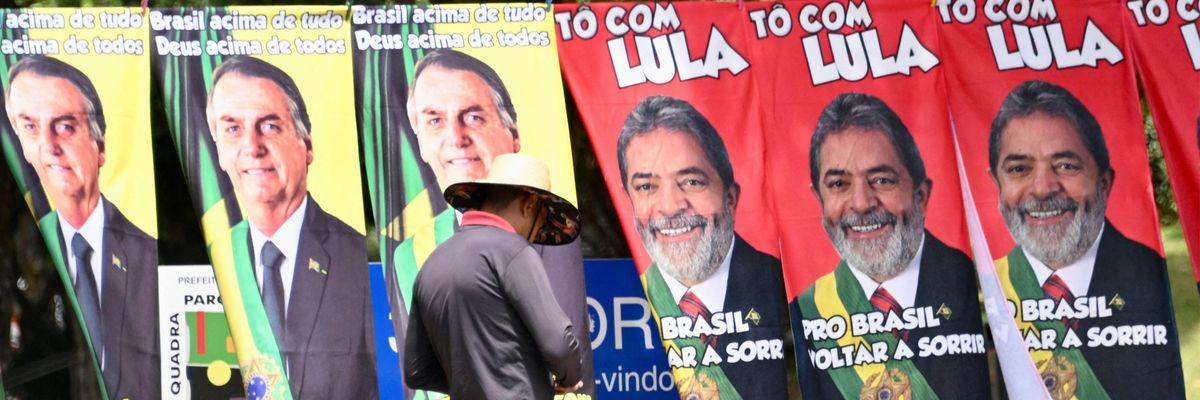
Towels with the images of Brazilian presidential candidates Jair Bolsonaro and Luiz Inacio Lula da Silva are seen for sale on a street in Brasilia, on September 27, 2022. (Photo: Everisto Sa/AFP via Getty Images)
As Brazilians vote in Sunday's presidential runoff, democracy defenders are sounding the alarm over what many observers claim is widespread voter suppression by federal police in an attempt by far-right President Jair Bolsonaro to steal the election.
"We are facing a clear attempt to curtail people's right to vote. This only happens in dictatorships."
The campaign of Workers' Party (PT) challenger Luiz Inacio Lula da Silva asked Brazil's Superior Electoral Court (TSE) to subpoena Silvinei Vasques, director-general of the Federal Highway Police (PRF), amid videos, photos, and reports--especially in the Northeast, a PT stronghold--of officers blocking highways and stopping buses transporting voters to polling places.
On Saturday, Alexandre de Moraes, who heads the TSE, banned PRF from conducting any operations relating to public transport until after Sunday's election. However, according to PRF figures reviewed by The Brazilian Report, routine vehicle searches soared by 80% Sunday compared with October 2, the date of the first-round vote.
De Moraes said Sunday that none of the voter bus surveillance operations--which, according to PRF involved traffic code violations--prevented people from voting, although he said there were delays in getting to the polls.
However, PT politicians and supporters pointed to reporting by journalist Lauro Jardim claiming the PRF operation was planned at Bolsonaro's residence earlier this month, and a since-deleted Instagram post in which Vasques urged his followers to vote for Bolsonaro, as evidence of something more nefarious.
"I don't want to believe that it's an orchestrated action for the people not to go to vote, but it's happening at this exact moment, in the middle of Election Day, in a blitz by the Highway Patrol at the entrance to Cuite," Charles Camaraense, mayor of Cuite, a town of 20,000 inhabitants in the interior of the northeastern state of Paraiba, said on social media.
Camaraense described the action as a "blitz inhibiting people from going to vote... this is absurd what is happening."
Sen. Humberto Costa (Pernambuco-PT) tweeted that "the illegal action orchestrated by the PRF in the Northeast was articulated in Jair Bolsonaro's own residence to prevent northeasterners from voting in the second round."
"We are facing a clear attempt to curtail people's right to vote," he continued. "This only happens in dictatorships."
Costa added: "So far, they have not been able to explain why the Northeast, which has 27% of the electorate, has received 50% of the PRF's operations today. While the Southeast, which has 42% of the electorate, only received 8% of PRF operations."
PT leader Gleisi Hoffman, who represents the state of Parana in the Chamber of Deputies, the lower house of Brazil's Congress, tweeted that "this PRF operation was criminal."
"We are asking for an extension of voting in the more than 500 places where the operations took place. Prioritizing the Northeast region," she added. "Elections are won by voting, not by coups and crime."
Dear Common Dreams reader, It’s been nearly 30 years since I co-founded Common Dreams with my late wife, Lina Newhouser. We had the radical notion that journalism should serve the public good, not corporate profits. It was clear to us from the outset what it would take to build such a project. No paid advertisements. No corporate sponsors. No millionaire publisher telling us what to think or do. Many people said we wouldn't last a year, but we proved those doubters wrong. Together with a tremendous team of journalists and dedicated staff, we built an independent media outlet free from the constraints of profits and corporate control. Our mission has always been simple: To inform. To inspire. To ignite change for the common good. Building Common Dreams was not easy. Our survival was never guaranteed. When you take on the most powerful forces—Wall Street greed, fossil fuel industry destruction, Big Tech lobbyists, and uber-rich oligarchs who have spent billions upon billions rigging the economy and democracy in their favor—the only bulwark you have is supporters who believe in your work. But here’s the urgent message from me today. It's never been this bad out there. And it's never been this hard to keep us going. At the very moment Common Dreams is most needed, the threats we face are intensifying. We need your support now more than ever. We don't accept corporate advertising and never will. We don't have a paywall because we don't think people should be blocked from critical news based on their ability to pay. Everything we do is funded by the donations of readers like you. When everyone does the little they can afford, we are strong. But if that support retreats or dries up, so do we. Will you donate now to make sure Common Dreams not only survives but thrives? —Craig Brown, Co-founder |
As Brazilians vote in Sunday's presidential runoff, democracy defenders are sounding the alarm over what many observers claim is widespread voter suppression by federal police in an attempt by far-right President Jair Bolsonaro to steal the election.
"We are facing a clear attempt to curtail people's right to vote. This only happens in dictatorships."
The campaign of Workers' Party (PT) challenger Luiz Inacio Lula da Silva asked Brazil's Superior Electoral Court (TSE) to subpoena Silvinei Vasques, director-general of the Federal Highway Police (PRF), amid videos, photos, and reports--especially in the Northeast, a PT stronghold--of officers blocking highways and stopping buses transporting voters to polling places.
On Saturday, Alexandre de Moraes, who heads the TSE, banned PRF from conducting any operations relating to public transport until after Sunday's election. However, according to PRF figures reviewed by The Brazilian Report, routine vehicle searches soared by 80% Sunday compared with October 2, the date of the first-round vote.
De Moraes said Sunday that none of the voter bus surveillance operations--which, according to PRF involved traffic code violations--prevented people from voting, although he said there were delays in getting to the polls.
However, PT politicians and supporters pointed to reporting by journalist Lauro Jardim claiming the PRF operation was planned at Bolsonaro's residence earlier this month, and a since-deleted Instagram post in which Vasques urged his followers to vote for Bolsonaro, as evidence of something more nefarious.
"I don't want to believe that it's an orchestrated action for the people not to go to vote, but it's happening at this exact moment, in the middle of Election Day, in a blitz by the Highway Patrol at the entrance to Cuite," Charles Camaraense, mayor of Cuite, a town of 20,000 inhabitants in the interior of the northeastern state of Paraiba, said on social media.
Camaraense described the action as a "blitz inhibiting people from going to vote... this is absurd what is happening."
Sen. Humberto Costa (Pernambuco-PT) tweeted that "the illegal action orchestrated by the PRF in the Northeast was articulated in Jair Bolsonaro's own residence to prevent northeasterners from voting in the second round."
"We are facing a clear attempt to curtail people's right to vote," he continued. "This only happens in dictatorships."
Costa added: "So far, they have not been able to explain why the Northeast, which has 27% of the electorate, has received 50% of the PRF's operations today. While the Southeast, which has 42% of the electorate, only received 8% of PRF operations."
PT leader Gleisi Hoffman, who represents the state of Parana in the Chamber of Deputies, the lower house of Brazil's Congress, tweeted that "this PRF operation was criminal."
"We are asking for an extension of voting in the more than 500 places where the operations took place. Prioritizing the Northeast region," she added. "Elections are won by voting, not by coups and crime."
As Brazilians vote in Sunday's presidential runoff, democracy defenders are sounding the alarm over what many observers claim is widespread voter suppression by federal police in an attempt by far-right President Jair Bolsonaro to steal the election.
"We are facing a clear attempt to curtail people's right to vote. This only happens in dictatorships."
The campaign of Workers' Party (PT) challenger Luiz Inacio Lula da Silva asked Brazil's Superior Electoral Court (TSE) to subpoena Silvinei Vasques, director-general of the Federal Highway Police (PRF), amid videos, photos, and reports--especially in the Northeast, a PT stronghold--of officers blocking highways and stopping buses transporting voters to polling places.
On Saturday, Alexandre de Moraes, who heads the TSE, banned PRF from conducting any operations relating to public transport until after Sunday's election. However, according to PRF figures reviewed by The Brazilian Report, routine vehicle searches soared by 80% Sunday compared with October 2, the date of the first-round vote.
De Moraes said Sunday that none of the voter bus surveillance operations--which, according to PRF involved traffic code violations--prevented people from voting, although he said there were delays in getting to the polls.
However, PT politicians and supporters pointed to reporting by journalist Lauro Jardim claiming the PRF operation was planned at Bolsonaro's residence earlier this month, and a since-deleted Instagram post in which Vasques urged his followers to vote for Bolsonaro, as evidence of something more nefarious.
"I don't want to believe that it's an orchestrated action for the people not to go to vote, but it's happening at this exact moment, in the middle of Election Day, in a blitz by the Highway Patrol at the entrance to Cuite," Charles Camaraense, mayor of Cuite, a town of 20,000 inhabitants in the interior of the northeastern state of Paraiba, said on social media.
Camaraense described the action as a "blitz inhibiting people from going to vote... this is absurd what is happening."
Sen. Humberto Costa (Pernambuco-PT) tweeted that "the illegal action orchestrated by the PRF in the Northeast was articulated in Jair Bolsonaro's own residence to prevent northeasterners from voting in the second round."
"We are facing a clear attempt to curtail people's right to vote," he continued. "This only happens in dictatorships."
Costa added: "So far, they have not been able to explain why the Northeast, which has 27% of the electorate, has received 50% of the PRF's operations today. While the Southeast, which has 42% of the electorate, only received 8% of PRF operations."
PT leader Gleisi Hoffman, who represents the state of Parana in the Chamber of Deputies, the lower house of Brazil's Congress, tweeted that "this PRF operation was criminal."
"We are asking for an extension of voting in the more than 500 places where the operations took place. Prioritizing the Northeast region," she added. "Elections are won by voting, not by coups and crime."