SUBSCRIBE TO OUR FREE NEWSLETTER
Daily news & progressive opinion—funded by the people, not the corporations—delivered straight to your inbox.
5
#000000
#FFFFFF
To donate by check, phone, or other method, see our More Ways to Give page.
Daily news & progressive opinion—funded by the people, not the corporations—delivered straight to your inbox.
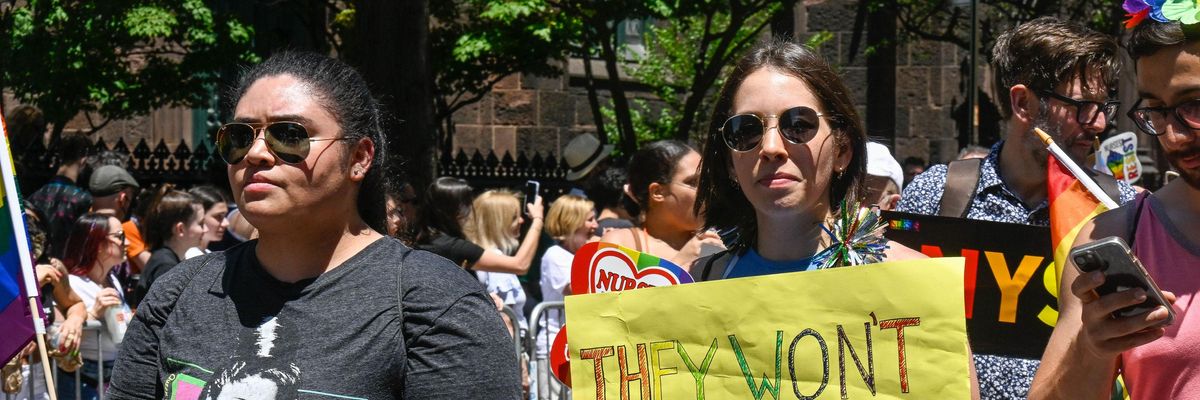
Marchers protest against the U.S. Supreme Court overturning Roe v. Wade during the Pride Parade on June 26, 2022 in New York City. (Photo: Astrida Valigorsky/Getty Images)
Progressive U.S. lawmakers joined LGBTQ+ advocates Thursday in condemning the Senate's postponement of a vote on proposed legislation that would codify protection for the constitutionally guaranteed right to same-sex marriage.
"You should be able to marry who you love. This shouldn't be controversial."
Sen. Tammy Baldwin (D-Wis.) said senators would delay action on the Respect for Marriage Act, of which she is the lead sponsor, until "after the election" in November.
Baldwin explained that the chances of getting the 10 Republican votes needed to pass the measure in an evenly split Senate would increase after the midterm elections. In July, House lawmakers passed a version of the bill by a vote of 267-157, with 47 Republicans joining their Democratic colleagues in voting yes.
"We're very confident that the bill will pass," Baldwin said, according to The New York Times. "But we will need a little more time."
However, Sen. Elizabeth Warren (D-Mass.) countered that "we need to vote on equal marriage today."
"Every single member of Congress should be willing to go on the record," she continued. "If there are Republicans who don't want to vote on that before the election, I assume it is because they are on the wrong side of history."
"Equal marriage has been a part of who we are as a nation. We've lived with it for years now," she added. "And protecting it by statute is something every single senator and every single member of Congress should be willing to vote for. And if they're not, they need to go on the record and say so."
"You should be able to marry who you love," tweeted Congressional Progressive Caucus Chair Pramila Jayapal (D-Wash.). "This shouldn't be controversial. Protect marriage equality now."
Rights groups also blasted the postponement.
"The Respect for Marriage Act is an incredibly necessary, popular, and bipartisan bill--and the lack of 10 Republican yes votes right now is extremely disappointing," Human Rights Campaign interim president Joni Madison said in a statement. "Marriage equality--for both LGBTQ+ and interracial couples--is not and should not be a partisan issue, and to treat it as such is an insult to the millions of families who are impacted."
Madison asserted that the proposed legislation "must be brought to a vote at the earliest possible moment."
In the aftermath of Dobbs v. Jackson Women's Health Organization, "it is clear there's a timely, urgent need to declare that the days of debate around marriage equality are over," she said, referring to the U.S. Supreme Court's June reversal of Roe v. Wade--a ruling that voided half a century of federal abortion rights.
The Respect for Marriage Act was born from fears that the high court's right-wing supermajority would not stop at rolling back abortion rights and could--as Justice Clarence Thomas suggested in a concurring opinion in Dobbs--revisit cases that enshrined constitutional rights to same-sex and even interracial marriage.
"Our fight is not over," Madison vowed. "When the Senate returns, they will have a lot of unfinished business to attend to--including both the Respect for Marriage Act and the Equality Act--to ensure that everyone's rights are protected."
"And with the midterm elections on the horizon," she added, "equality voters--LGBTQ+ voters and our allies--will make our voices heard."
Dear Common Dreams reader, It’s been nearly 30 years since I co-founded Common Dreams with my late wife, Lina Newhouser. We had the radical notion that journalism should serve the public good, not corporate profits. It was clear to us from the outset what it would take to build such a project. No paid advertisements. No corporate sponsors. No millionaire publisher telling us what to think or do. Many people said we wouldn't last a year, but we proved those doubters wrong. Together with a tremendous team of journalists and dedicated staff, we built an independent media outlet free from the constraints of profits and corporate control. Our mission has always been simple: To inform. To inspire. To ignite change for the common good. Building Common Dreams was not easy. Our survival was never guaranteed. When you take on the most powerful forces—Wall Street greed, fossil fuel industry destruction, Big Tech lobbyists, and uber-rich oligarchs who have spent billions upon billions rigging the economy and democracy in their favor—the only bulwark you have is supporters who believe in your work. But here’s the urgent message from me today. It's never been this bad out there. And it's never been this hard to keep us going. At the very moment Common Dreams is most needed, the threats we face are intensifying. We need your support now more than ever. We don't accept corporate advertising and never will. We don't have a paywall because we don't think people should be blocked from critical news based on their ability to pay. Everything we do is funded by the donations of readers like you. When everyone does the little they can afford, we are strong. But if that support retreats or dries up, so do we. Will you donate now to make sure Common Dreams not only survives but thrives? —Craig Brown, Co-founder |
Progressive U.S. lawmakers joined LGBTQ+ advocates Thursday in condemning the Senate's postponement of a vote on proposed legislation that would codify protection for the constitutionally guaranteed right to same-sex marriage.
"You should be able to marry who you love. This shouldn't be controversial."
Sen. Tammy Baldwin (D-Wis.) said senators would delay action on the Respect for Marriage Act, of which she is the lead sponsor, until "after the election" in November.
Baldwin explained that the chances of getting the 10 Republican votes needed to pass the measure in an evenly split Senate would increase after the midterm elections. In July, House lawmakers passed a version of the bill by a vote of 267-157, with 47 Republicans joining their Democratic colleagues in voting yes.
"We're very confident that the bill will pass," Baldwin said, according to The New York Times. "But we will need a little more time."
However, Sen. Elizabeth Warren (D-Mass.) countered that "we need to vote on equal marriage today."
"Every single member of Congress should be willing to go on the record," she continued. "If there are Republicans who don't want to vote on that before the election, I assume it is because they are on the wrong side of history."
"Equal marriage has been a part of who we are as a nation. We've lived with it for years now," she added. "And protecting it by statute is something every single senator and every single member of Congress should be willing to vote for. And if they're not, they need to go on the record and say so."
"You should be able to marry who you love," tweeted Congressional Progressive Caucus Chair Pramila Jayapal (D-Wash.). "This shouldn't be controversial. Protect marriage equality now."
Rights groups also blasted the postponement.
"The Respect for Marriage Act is an incredibly necessary, popular, and bipartisan bill--and the lack of 10 Republican yes votes right now is extremely disappointing," Human Rights Campaign interim president Joni Madison said in a statement. "Marriage equality--for both LGBTQ+ and interracial couples--is not and should not be a partisan issue, and to treat it as such is an insult to the millions of families who are impacted."
Madison asserted that the proposed legislation "must be brought to a vote at the earliest possible moment."
In the aftermath of Dobbs v. Jackson Women's Health Organization, "it is clear there's a timely, urgent need to declare that the days of debate around marriage equality are over," she said, referring to the U.S. Supreme Court's June reversal of Roe v. Wade--a ruling that voided half a century of federal abortion rights.
The Respect for Marriage Act was born from fears that the high court's right-wing supermajority would not stop at rolling back abortion rights and could--as Justice Clarence Thomas suggested in a concurring opinion in Dobbs--revisit cases that enshrined constitutional rights to same-sex and even interracial marriage.
"Our fight is not over," Madison vowed. "When the Senate returns, they will have a lot of unfinished business to attend to--including both the Respect for Marriage Act and the Equality Act--to ensure that everyone's rights are protected."
"And with the midterm elections on the horizon," she added, "equality voters--LGBTQ+ voters and our allies--will make our voices heard."
Progressive U.S. lawmakers joined LGBTQ+ advocates Thursday in condemning the Senate's postponement of a vote on proposed legislation that would codify protection for the constitutionally guaranteed right to same-sex marriage.
"You should be able to marry who you love. This shouldn't be controversial."
Sen. Tammy Baldwin (D-Wis.) said senators would delay action on the Respect for Marriage Act, of which she is the lead sponsor, until "after the election" in November.
Baldwin explained that the chances of getting the 10 Republican votes needed to pass the measure in an evenly split Senate would increase after the midterm elections. In July, House lawmakers passed a version of the bill by a vote of 267-157, with 47 Republicans joining their Democratic colleagues in voting yes.
"We're very confident that the bill will pass," Baldwin said, according to The New York Times. "But we will need a little more time."
However, Sen. Elizabeth Warren (D-Mass.) countered that "we need to vote on equal marriage today."
"Every single member of Congress should be willing to go on the record," she continued. "If there are Republicans who don't want to vote on that before the election, I assume it is because they are on the wrong side of history."
"Equal marriage has been a part of who we are as a nation. We've lived with it for years now," she added. "And protecting it by statute is something every single senator and every single member of Congress should be willing to vote for. And if they're not, they need to go on the record and say so."
"You should be able to marry who you love," tweeted Congressional Progressive Caucus Chair Pramila Jayapal (D-Wash.). "This shouldn't be controversial. Protect marriage equality now."
Rights groups also blasted the postponement.
"The Respect for Marriage Act is an incredibly necessary, popular, and bipartisan bill--and the lack of 10 Republican yes votes right now is extremely disappointing," Human Rights Campaign interim president Joni Madison said in a statement. "Marriage equality--for both LGBTQ+ and interracial couples--is not and should not be a partisan issue, and to treat it as such is an insult to the millions of families who are impacted."
Madison asserted that the proposed legislation "must be brought to a vote at the earliest possible moment."
In the aftermath of Dobbs v. Jackson Women's Health Organization, "it is clear there's a timely, urgent need to declare that the days of debate around marriage equality are over," she said, referring to the U.S. Supreme Court's June reversal of Roe v. Wade--a ruling that voided half a century of federal abortion rights.
The Respect for Marriage Act was born from fears that the high court's right-wing supermajority would not stop at rolling back abortion rights and could--as Justice Clarence Thomas suggested in a concurring opinion in Dobbs--revisit cases that enshrined constitutional rights to same-sex and even interracial marriage.
"Our fight is not over," Madison vowed. "When the Senate returns, they will have a lot of unfinished business to attend to--including both the Respect for Marriage Act and the Equality Act--to ensure that everyone's rights are protected."
"And with the midterm elections on the horizon," she added, "equality voters--LGBTQ+ voters and our allies--will make our voices heard."