

SUBSCRIBE TO OUR FREE NEWSLETTER
Daily news & progressive opinion—funded by the people, not the corporations—delivered straight to your inbox.
5
#000000
#FFFFFF
To donate by check, phone, or other method, see our More Ways to Give page.
Daily news & progressive opinion—funded by the people, not the corporations—delivered straight to your inbox.
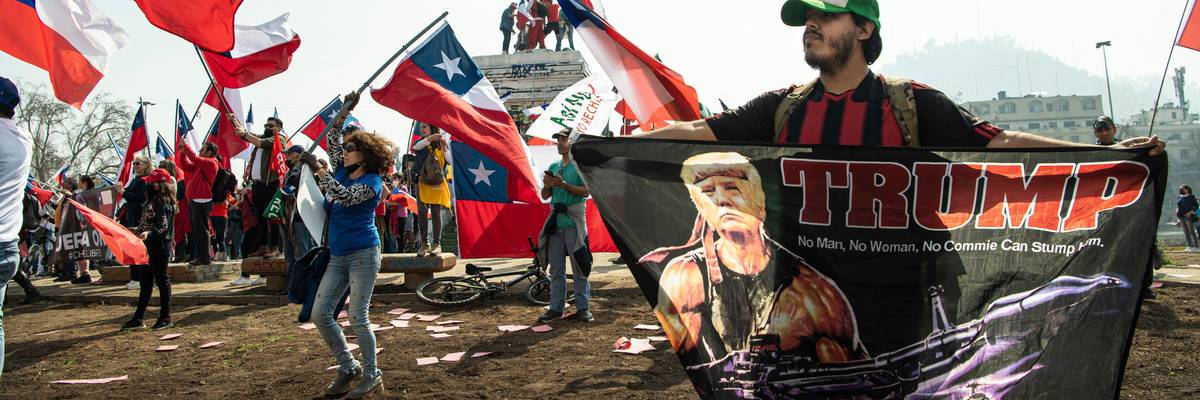
A man holds a flag with an image of former U.S. President Donald Trump during a demonstration against Chile's new draft constitution in Santiago on August 27, 2022. (Photo: Martin Bernetti/AFP via Getty Images)
Fears are growing that a new, progressive constitution drafted by a democratically elected body of citizens may not be approved by Chilean voters this weekend as right-wing forces flood the country with misinformation.
Even though Chileans voted by a 4-to-1 margin during a historic October 2020 plebiscite to create a new constitution to replace the neoliberal charter imposed by Gen. Augusto Pinochet's military dictatorship, the resulting document is at risk of being rejected in Sunday's referendum, polls have consistently shown.
"We're inundated with a tsunami of information," Eugenio Garcia--a former advertising executive who worked on the successful campaign urging Chileans to say "no" to eight more years of Pinochet's junta in a 1988 plebiscite--told The Guardian on Wednesday. "Nowadays, it's hard to tell what's true, false, biased, or malicious."
Following 10 months of debate at 103 plenary sessions, Chile's gender-equal 154-member constituent assembly in May finalized a new draft constitution that would empower workers with guaranteed labor rights and an expanded social welfare state, enshrine gender equality and Indigenous rights, and prioritize environmental protection.
The 178-page document, formally presented to the public in July, has been hailed by progressive scholars around the globe as a "visionary product" from which other countries have "much to learn."
Just as soon as the effort to establish an egalitarian and ecologically responsible society began, however, so too did the right-wing campaign to discredit it and prevent its passage.
"With the first plebiscite there was a boom of misinformation," Valentina Matus, the editor of Contexto Factual, told The Guardian, referring to the October 2020 referendum in which nearly 80% of Chileans voted in favor of writing a new constitution to replace the current right-wing one that was implemented in 1980 under anti-democratic conditions.
"Even though there wasn't anything written yet, they were already saying that you could have your house taken away," said Matus.
According to The Guardian:
During a televised campaign in 2021, a right-wing party falsely claimed that the new constitution would change Chile's national anthem, flag--and even the name of the country.
Online, the daily swirl of false announcements and misleading interpretations of the text have made fact-checking difficult.
"There are constant examples of statements that I don't consider outright lies, but rather exaggerations," said Eduardo Arriagada, an adjunct professor in the communications department at the Pontifical Catholic University in Santiago.
"Constitutions don't usually give details, they give broad definitions and allow for a range of scenarios for the law to sort out later," he added, "but that leaves them open to interpretation."
In May, for instance, Sen. Felipe Kast--nephew of Jose Antonio Kast, a far-right supporter of Pinochet who lost to leftist President Gabriel Boric in December's election--claimed that the new constitution would authorize abortion up to the ninth month of pregnancy. In reality, the text codifies reproductive freedom while leaving details up to legislators.
Among the most common falsehoods is that the new constitution could lead to the widespread confiscation of private property, The Guardian noted. One website designed to mimic that of the constitutional convention has gone so far as to claim that the draft constitution's provisions against water privatization would prohibit people from buying bottled water and bags of ice for backyard gatherings.
"From day one, the campaign against the new constitution manipulated what I said and sowed lies," said Elisa Loncon, an Indigenous academic who represented Mapuche people at Chile's constitutional convention and was elected its first president.
"What they want is to silence and minimize us," she said. "All of the Mapuche women in the convention were subject to these attacks."
Far-right activists have also reportedly emulated authoritarian figures like former U.S. President Donald Trump and Brazilian President Jair Bolsonaro by baselessly attacking the integrity of Chile's electoral system and suggesting that they may not accept the results if voters approve the new constitution.
The spread of misinformation by reactionary forces within Chile has been mirrored by a global right-wing smear campaign led by corporate media outlets.
For example, The Economist--which actively helped foment the 1973 coup that deposed democratically elected socialist President Salvador Allende and brought Pinochet to power--has criticized the draft constitution as a "left-wing wish list," while The Financial Times has asserted that it threatens Chile's "business climate."
Delegates to the convention crafted a founding document that guarantees universal access to health, housing, education, and a livable planet as human rights in an effort to combat the inequality that has been so deeply entrenched by the current neoliberal policy blueprint still in place more than three decades after Pinochet's ouster.
If a majority of adults don't vote yay on the draft on Sunday, September 4, the existing constitution--a key source of the reproduction of injustices that provoked a weekslong revolt in 2019--will remain in force by default.
Dear Common Dreams reader, It’s been nearly 30 years since I co-founded Common Dreams with my late wife, Lina Newhouser. We had the radical notion that journalism should serve the public good, not corporate profits. It was clear to us from the outset what it would take to build such a project. No paid advertisements. No corporate sponsors. No millionaire publisher telling us what to think or do. Many people said we wouldn't last a year, but we proved those doubters wrong. Together with a tremendous team of journalists and dedicated staff, we built an independent media outlet free from the constraints of profits and corporate control. Our mission has always been simple: To inform. To inspire. To ignite change for the common good. Building Common Dreams was not easy. Our survival was never guaranteed. When you take on the most powerful forces—Wall Street greed, fossil fuel industry destruction, Big Tech lobbyists, and uber-rich oligarchs who have spent billions upon billions rigging the economy and democracy in their favor—the only bulwark you have is supporters who believe in your work. But here’s the urgent message from me today. It's never been this bad out there. And it's never been this hard to keep us going. At the very moment Common Dreams is most needed, the threats we face are intensifying. We need your support now more than ever. We don't accept corporate advertising and never will. We don't have a paywall because we don't think people should be blocked from critical news based on their ability to pay. Everything we do is funded by the donations of readers like you. When everyone does the little they can afford, we are strong. But if that support retreats or dries up, so do we. Will you donate now to make sure Common Dreams not only survives but thrives? —Craig Brown, Co-founder |
Fears are growing that a new, progressive constitution drafted by a democratically elected body of citizens may not be approved by Chilean voters this weekend as right-wing forces flood the country with misinformation.
Even though Chileans voted by a 4-to-1 margin during a historic October 2020 plebiscite to create a new constitution to replace the neoliberal charter imposed by Gen. Augusto Pinochet's military dictatorship, the resulting document is at risk of being rejected in Sunday's referendum, polls have consistently shown.
"We're inundated with a tsunami of information," Eugenio Garcia--a former advertising executive who worked on the successful campaign urging Chileans to say "no" to eight more years of Pinochet's junta in a 1988 plebiscite--told The Guardian on Wednesday. "Nowadays, it's hard to tell what's true, false, biased, or malicious."
Following 10 months of debate at 103 plenary sessions, Chile's gender-equal 154-member constituent assembly in May finalized a new draft constitution that would empower workers with guaranteed labor rights and an expanded social welfare state, enshrine gender equality and Indigenous rights, and prioritize environmental protection.
The 178-page document, formally presented to the public in July, has been hailed by progressive scholars around the globe as a "visionary product" from which other countries have "much to learn."
Just as soon as the effort to establish an egalitarian and ecologically responsible society began, however, so too did the right-wing campaign to discredit it and prevent its passage.
"With the first plebiscite there was a boom of misinformation," Valentina Matus, the editor of Contexto Factual, told The Guardian, referring to the October 2020 referendum in which nearly 80% of Chileans voted in favor of writing a new constitution to replace the current right-wing one that was implemented in 1980 under anti-democratic conditions.
"Even though there wasn't anything written yet, they were already saying that you could have your house taken away," said Matus.
According to The Guardian:
During a televised campaign in 2021, a right-wing party falsely claimed that the new constitution would change Chile's national anthem, flag--and even the name of the country.
Online, the daily swirl of false announcements and misleading interpretations of the text have made fact-checking difficult.
"There are constant examples of statements that I don't consider outright lies, but rather exaggerations," said Eduardo Arriagada, an adjunct professor in the communications department at the Pontifical Catholic University in Santiago.
"Constitutions don't usually give details, they give broad definitions and allow for a range of scenarios for the law to sort out later," he added, "but that leaves them open to interpretation."
In May, for instance, Sen. Felipe Kast--nephew of Jose Antonio Kast, a far-right supporter of Pinochet who lost to leftist President Gabriel Boric in December's election--claimed that the new constitution would authorize abortion up to the ninth month of pregnancy. In reality, the text codifies reproductive freedom while leaving details up to legislators.
Among the most common falsehoods is that the new constitution could lead to the widespread confiscation of private property, The Guardian noted. One website designed to mimic that of the constitutional convention has gone so far as to claim that the draft constitution's provisions against water privatization would prohibit people from buying bottled water and bags of ice for backyard gatherings.
"From day one, the campaign against the new constitution manipulated what I said and sowed lies," said Elisa Loncon, an Indigenous academic who represented Mapuche people at Chile's constitutional convention and was elected its first president.
"What they want is to silence and minimize us," she said. "All of the Mapuche women in the convention were subject to these attacks."
Far-right activists have also reportedly emulated authoritarian figures like former U.S. President Donald Trump and Brazilian President Jair Bolsonaro by baselessly attacking the integrity of Chile's electoral system and suggesting that they may not accept the results if voters approve the new constitution.
The spread of misinformation by reactionary forces within Chile has been mirrored by a global right-wing smear campaign led by corporate media outlets.
For example, The Economist--which actively helped foment the 1973 coup that deposed democratically elected socialist President Salvador Allende and brought Pinochet to power--has criticized the draft constitution as a "left-wing wish list," while The Financial Times has asserted that it threatens Chile's "business climate."
Delegates to the convention crafted a founding document that guarantees universal access to health, housing, education, and a livable planet as human rights in an effort to combat the inequality that has been so deeply entrenched by the current neoliberal policy blueprint still in place more than three decades after Pinochet's ouster.
If a majority of adults don't vote yay on the draft on Sunday, September 4, the existing constitution--a key source of the reproduction of injustices that provoked a weekslong revolt in 2019--will remain in force by default.
Fears are growing that a new, progressive constitution drafted by a democratically elected body of citizens may not be approved by Chilean voters this weekend as right-wing forces flood the country with misinformation.
Even though Chileans voted by a 4-to-1 margin during a historic October 2020 plebiscite to create a new constitution to replace the neoliberal charter imposed by Gen. Augusto Pinochet's military dictatorship, the resulting document is at risk of being rejected in Sunday's referendum, polls have consistently shown.
"We're inundated with a tsunami of information," Eugenio Garcia--a former advertising executive who worked on the successful campaign urging Chileans to say "no" to eight more years of Pinochet's junta in a 1988 plebiscite--told The Guardian on Wednesday. "Nowadays, it's hard to tell what's true, false, biased, or malicious."
Following 10 months of debate at 103 plenary sessions, Chile's gender-equal 154-member constituent assembly in May finalized a new draft constitution that would empower workers with guaranteed labor rights and an expanded social welfare state, enshrine gender equality and Indigenous rights, and prioritize environmental protection.
The 178-page document, formally presented to the public in July, has been hailed by progressive scholars around the globe as a "visionary product" from which other countries have "much to learn."
Just as soon as the effort to establish an egalitarian and ecologically responsible society began, however, so too did the right-wing campaign to discredit it and prevent its passage.
"With the first plebiscite there was a boom of misinformation," Valentina Matus, the editor of Contexto Factual, told The Guardian, referring to the October 2020 referendum in which nearly 80% of Chileans voted in favor of writing a new constitution to replace the current right-wing one that was implemented in 1980 under anti-democratic conditions.
"Even though there wasn't anything written yet, they were already saying that you could have your house taken away," said Matus.
According to The Guardian:
During a televised campaign in 2021, a right-wing party falsely claimed that the new constitution would change Chile's national anthem, flag--and even the name of the country.
Online, the daily swirl of false announcements and misleading interpretations of the text have made fact-checking difficult.
"There are constant examples of statements that I don't consider outright lies, but rather exaggerations," said Eduardo Arriagada, an adjunct professor in the communications department at the Pontifical Catholic University in Santiago.
"Constitutions don't usually give details, they give broad definitions and allow for a range of scenarios for the law to sort out later," he added, "but that leaves them open to interpretation."
In May, for instance, Sen. Felipe Kast--nephew of Jose Antonio Kast, a far-right supporter of Pinochet who lost to leftist President Gabriel Boric in December's election--claimed that the new constitution would authorize abortion up to the ninth month of pregnancy. In reality, the text codifies reproductive freedom while leaving details up to legislators.
Among the most common falsehoods is that the new constitution could lead to the widespread confiscation of private property, The Guardian noted. One website designed to mimic that of the constitutional convention has gone so far as to claim that the draft constitution's provisions against water privatization would prohibit people from buying bottled water and bags of ice for backyard gatherings.
"From day one, the campaign against the new constitution manipulated what I said and sowed lies," said Elisa Loncon, an Indigenous academic who represented Mapuche people at Chile's constitutional convention and was elected its first president.
"What they want is to silence and minimize us," she said. "All of the Mapuche women in the convention were subject to these attacks."
Far-right activists have also reportedly emulated authoritarian figures like former U.S. President Donald Trump and Brazilian President Jair Bolsonaro by baselessly attacking the integrity of Chile's electoral system and suggesting that they may not accept the results if voters approve the new constitution.
The spread of misinformation by reactionary forces within Chile has been mirrored by a global right-wing smear campaign led by corporate media outlets.
For example, The Economist--which actively helped foment the 1973 coup that deposed democratically elected socialist President Salvador Allende and brought Pinochet to power--has criticized the draft constitution as a "left-wing wish list," while The Financial Times has asserted that it threatens Chile's "business climate."
Delegates to the convention crafted a founding document that guarantees universal access to health, housing, education, and a livable planet as human rights in an effort to combat the inequality that has been so deeply entrenched by the current neoliberal policy blueprint still in place more than three decades after Pinochet's ouster.
If a majority of adults don't vote yay on the draft on Sunday, September 4, the existing constitution--a key source of the reproduction of injustices that provoked a weekslong revolt in 2019--will remain in force by default.

