

SUBSCRIBE TO OUR FREE NEWSLETTER
Daily news & progressive opinion—funded by the people, not the corporations—delivered straight to your inbox.
5
#000000
#FFFFFF
To donate by check, phone, or other method, see our More Ways to Give page.
A trio of congressional lawmakers reintroduced the Espionage Reform Act on Wednesday to prevent reporters from being prosecuted for publishing classified information--a common journalistic practice used to expose government wrongdoing.
"Journalists should never be prosecuted by the government for what they publish. Especially when politicians abuse the law to keep the public in the dark."
Unveiled by Rep. Ro Khanna (D-Calif.), Sen. Ron Wyden (D-Ore.), and Rep. Thomas Massie (R-Ky.), the measure aims to narrow the scope of the 105-year-old Espionage Act and similar laws enacted during the First World War--ostensibly to protect the United States from spies but, according to critics, to criminalize anti-war dissent, resulting in the imprisonment of nearly a thousand people, including leading socialist Eugene Debs.
The Espionage Act and related secrecy statutes "go far beyond their stated purpose... to prevent government employees and other individuals entrusted with the government's secrets from selling or revealing that information to our enemies," the three lawmakers argue in a summary of the bill, "and have been repeatedly abused by the executive branch to chill investigative journalism and to prevent oversight of illegal government surveillance programs by Congress and the Federal Communications Commission."
The bicameral bill, which is identical to legislation introduced in 2020 but now has bipartisan support, would reaffirm First Amendment protections for journalists who share secret documents and expand avenues for whistleblowers to report government malpractice to members of Congress.
"When one journalist is prosecuted for doing his or her job, that's a threat to all journalists," Khanna said in a statement. "Our nation's strength rests on the freedom of the press and reporters must be allowed to work without fear of persecution."
Wyden echoed Khanna's message, saying: "Journalists should never be prosecuted by the government for what they publish. Especially when politicians abuse the law to keep the public in the dark."
"The Espionage Act currently provides the executive branch with sweeping powers that are ripe for abuse to target journalists and whistleblowers who reveal information some officials would rather keep secret," Wyden continued. "This bill ensures only personnel with security clearances can be prosecuted for improperly revealing classified information and that whistleblowers can reveal classified abuses directly to Congress, federal regulators, and oversight bodies."
According to Khanna, Wyden, and Massie, the bill would:
However, a summary of the bill adds, "every single person convicted, to date, under the Espionage Act could still have been convicted had this bill been the law at the time they were prosecuted."
Related Content

This means that Daniel Hale--the whistleblower who one year ago to the day was sentenced to nearly four years in prison for sharing classified materials about the U.S. military's drone assassination program with a journalist--could still have been charged with espionage.
The same is true of Edward Snowden--the former National Security Agency contractor who gave reporters access to a cache of files to sound the alarm on top-secret mass surveillance programs in 2013--along with Reality Winner, John Kiriakou, Chelsea Manning, Jeffrey Sterling, and others.
When it comes to Snowden, "this bill would have no impact," the lawmakers acknowledge. "The bill leaves in place criminal penalties for current and former government employees and contractors who reveal classified information they obtained through a trusted relationship with the government."
In addition, "the government would still be able to prosecute Julian Assange," the lawmakers note, neglecting to explain why the Wikileaks founder who published classified information that revealed U.S. war crimes should not be considered a journalist protected by the bill.
Presumably, Assange would fit under the provision that "keeps in place criminal penalties for foreign spies, individuals who are working for foreign governments, or those violating another federal law, who conspire, aid, or abet a violation" of the Espionage Act and related secrecy laws.
Last month, the United Kingdom approved the extradition of Assange to the U.S., where he has been charged with 17 counts of violating the Espionage Act as well as breaking the Computer Fraud and Abuse Act, a minimally defined anti-hacking statute. Charges were originally brought by the Trump administration, which also reportedly considered kidnapping or killing the journalist.
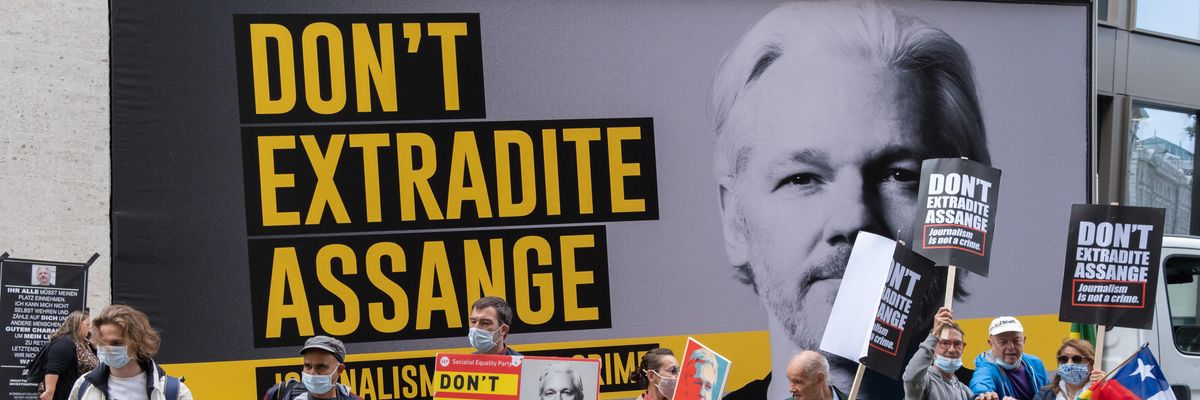
Earlier this month, lawyers for Assange made a final appeal to the U.K's High Court in a last-ditch effort to block his transfer to the U.S. At a demonstration in support of Assange, 79-year-old Gloria Wildman, told Agence France-Presse that the Wikileaks founder has "been in prison for telling the truth."
"If Julian Assange is not free, neither are we; none of us is free," she added.
Only Massie mentions the incarcerated Wikileaks publisher in his statement, saying that "ongoing attempts to prosecute journalists like Julian Assange under the Espionage Act threaten our First Amendment rights, and should be opposed by all who wish to safeguard our constitutional rights now and in the years to come."
Consecutive U.S. presidents have gone to great lengths to prevent leaks and punish government officials for divulging information to reporters. Before Donald Trump launched a "war on whistleblowers," the Department of Justice under Barack Obama prosecuted nine leak cases, more than all previous administrations combined.
Last year, the Washington Post's publisher accused Joe Biden of exacerbating the Trump-era assault on press freedom.
In response, the DOJ prohibited prosecutors from using secret orders and subpoenas to obtain journalists' phone and email records, but the Biden administration continued to prosecute Hale and is also still pursuing the case against Assange despite ongoing opposition from human rights and free press advocates.
A trio of congressional lawmakers reintroduced the Espionage Reform Act on Wednesday to prevent reporters from being prosecuted for publishing classified information--a common journalistic practice used to expose government wrongdoing.
"Journalists should never be prosecuted by the government for what they publish. Especially when politicians abuse the law to keep the public in the dark."
Unveiled by Rep. Ro Khanna (D-Calif.), Sen. Ron Wyden (D-Ore.), and Rep. Thomas Massie (R-Ky.), the measure aims to narrow the scope of the 105-year-old Espionage Act and similar laws enacted during the First World War--ostensibly to protect the United States from spies but, according to critics, to criminalize anti-war dissent, resulting in the imprisonment of nearly a thousand people, including leading socialist Eugene Debs.
The Espionage Act and related secrecy statutes "go far beyond their stated purpose... to prevent government employees and other individuals entrusted with the government's secrets from selling or revealing that information to our enemies," the three lawmakers argue in a summary of the bill, "and have been repeatedly abused by the executive branch to chill investigative journalism and to prevent oversight of illegal government surveillance programs by Congress and the Federal Communications Commission."
The bicameral bill, which is identical to legislation introduced in 2020 but now has bipartisan support, would reaffirm First Amendment protections for journalists who share secret documents and expand avenues for whistleblowers to report government malpractice to members of Congress.
"When one journalist is prosecuted for doing his or her job, that's a threat to all journalists," Khanna said in a statement. "Our nation's strength rests on the freedom of the press and reporters must be allowed to work without fear of persecution."
Wyden echoed Khanna's message, saying: "Journalists should never be prosecuted by the government for what they publish. Especially when politicians abuse the law to keep the public in the dark."
"The Espionage Act currently provides the executive branch with sweeping powers that are ripe for abuse to target journalists and whistleblowers who reveal information some officials would rather keep secret," Wyden continued. "This bill ensures only personnel with security clearances can be prosecuted for improperly revealing classified information and that whistleblowers can reveal classified abuses directly to Congress, federal regulators, and oversight bodies."
According to Khanna, Wyden, and Massie, the bill would:
However, a summary of the bill adds, "every single person convicted, to date, under the Espionage Act could still have been convicted had this bill been the law at the time they were prosecuted."
Related Content
This means that Daniel Hale--the whistleblower who one year ago to the day was sentenced to nearly four years in prison for sharing classified materials about the U.S. military's drone assassination program with a journalist--could still have been charged with espionage.
The same is true of Edward Snowden--the former National Security Agency contractor who gave reporters access to a cache of files to sound the alarm on top-secret mass surveillance programs in 2013--along with Reality Winner, John Kiriakou, Chelsea Manning, Jeffrey Sterling, and others.
When it comes to Snowden, "this bill would have no impact," the lawmakers acknowledge. "The bill leaves in place criminal penalties for current and former government employees and contractors who reveal classified information they obtained through a trusted relationship with the government."
In addition, "the government would still be able to prosecute Julian Assange," the lawmakers note, neglecting to explain why the Wikileaks founder who published classified information that revealed U.S. war crimes should not be considered a journalist protected by the bill.
Presumably, Assange would fit under the provision that "keeps in place criminal penalties for foreign spies, individuals who are working for foreign governments, or those violating another federal law, who conspire, aid, or abet a violation" of the Espionage Act and related secrecy laws.
Last month, the United Kingdom approved the extradition of Assange to the U.S., where he has been charged with 17 counts of violating the Espionage Act as well as breaking the Computer Fraud and Abuse Act, a minimally defined anti-hacking statute. Charges were originally brought by the Trump administration, which also reportedly considered kidnapping or killing the journalist.
Earlier this month, lawyers for Assange made a final appeal to the U.K's High Court in a last-ditch effort to block his transfer to the U.S. At a demonstration in support of Assange, 79-year-old Gloria Wildman, told Agence France-Presse that the Wikileaks founder has "been in prison for telling the truth."
"If Julian Assange is not free, neither are we; none of us is free," she added.
Only Massie mentions the incarcerated Wikileaks publisher in his statement, saying that "ongoing attempts to prosecute journalists like Julian Assange under the Espionage Act threaten our First Amendment rights, and should be opposed by all who wish to safeguard our constitutional rights now and in the years to come."
Consecutive U.S. presidents have gone to great lengths to prevent leaks and punish government officials for divulging information to reporters. Before Donald Trump launched a "war on whistleblowers," the Department of Justice under Barack Obama prosecuted nine leak cases, more than all previous administrations combined.
Last year, the Washington Post's publisher accused Joe Biden of exacerbating the Trump-era assault on press freedom.
In response, the DOJ prohibited prosecutors from using secret orders and subpoenas to obtain journalists' phone and email records, but the Biden administration continued to prosecute Hale and is also still pursuing the case against Assange despite ongoing opposition from human rights and free press advocates.
A trio of congressional lawmakers reintroduced the Espionage Reform Act on Wednesday to prevent reporters from being prosecuted for publishing classified information--a common journalistic practice used to expose government wrongdoing.
"Journalists should never be prosecuted by the government for what they publish. Especially when politicians abuse the law to keep the public in the dark."
Unveiled by Rep. Ro Khanna (D-Calif.), Sen. Ron Wyden (D-Ore.), and Rep. Thomas Massie (R-Ky.), the measure aims to narrow the scope of the 105-year-old Espionage Act and similar laws enacted during the First World War--ostensibly to protect the United States from spies but, according to critics, to criminalize anti-war dissent, resulting in the imprisonment of nearly a thousand people, including leading socialist Eugene Debs.
The Espionage Act and related secrecy statutes "go far beyond their stated purpose... to prevent government employees and other individuals entrusted with the government's secrets from selling or revealing that information to our enemies," the three lawmakers argue in a summary of the bill, "and have been repeatedly abused by the executive branch to chill investigative journalism and to prevent oversight of illegal government surveillance programs by Congress and the Federal Communications Commission."
The bicameral bill, which is identical to legislation introduced in 2020 but now has bipartisan support, would reaffirm First Amendment protections for journalists who share secret documents and expand avenues for whistleblowers to report government malpractice to members of Congress.
"When one journalist is prosecuted for doing his or her job, that's a threat to all journalists," Khanna said in a statement. "Our nation's strength rests on the freedom of the press and reporters must be allowed to work without fear of persecution."
Wyden echoed Khanna's message, saying: "Journalists should never be prosecuted by the government for what they publish. Especially when politicians abuse the law to keep the public in the dark."
"The Espionage Act currently provides the executive branch with sweeping powers that are ripe for abuse to target journalists and whistleblowers who reveal information some officials would rather keep secret," Wyden continued. "This bill ensures only personnel with security clearances can be prosecuted for improperly revealing classified information and that whistleblowers can reveal classified abuses directly to Congress, federal regulators, and oversight bodies."
According to Khanna, Wyden, and Massie, the bill would:
However, a summary of the bill adds, "every single person convicted, to date, under the Espionage Act could still have been convicted had this bill been the law at the time they were prosecuted."
Related Content
This means that Daniel Hale--the whistleblower who one year ago to the day was sentenced to nearly four years in prison for sharing classified materials about the U.S. military's drone assassination program with a journalist--could still have been charged with espionage.
The same is true of Edward Snowden--the former National Security Agency contractor who gave reporters access to a cache of files to sound the alarm on top-secret mass surveillance programs in 2013--along with Reality Winner, John Kiriakou, Chelsea Manning, Jeffrey Sterling, and others.
When it comes to Snowden, "this bill would have no impact," the lawmakers acknowledge. "The bill leaves in place criminal penalties for current and former government employees and contractors who reveal classified information they obtained through a trusted relationship with the government."
In addition, "the government would still be able to prosecute Julian Assange," the lawmakers note, neglecting to explain why the Wikileaks founder who published classified information that revealed U.S. war crimes should not be considered a journalist protected by the bill.
Presumably, Assange would fit under the provision that "keeps in place criminal penalties for foreign spies, individuals who are working for foreign governments, or those violating another federal law, who conspire, aid, or abet a violation" of the Espionage Act and related secrecy laws.
Last month, the United Kingdom approved the extradition of Assange to the U.S., where he has been charged with 17 counts of violating the Espionage Act as well as breaking the Computer Fraud and Abuse Act, a minimally defined anti-hacking statute. Charges were originally brought by the Trump administration, which also reportedly considered kidnapping or killing the journalist.
Earlier this month, lawyers for Assange made a final appeal to the U.K's High Court in a last-ditch effort to block his transfer to the U.S. At a demonstration in support of Assange, 79-year-old Gloria Wildman, told Agence France-Presse that the Wikileaks founder has "been in prison for telling the truth."
"If Julian Assange is not free, neither are we; none of us is free," she added.
Only Massie mentions the incarcerated Wikileaks publisher in his statement, saying that "ongoing attempts to prosecute journalists like Julian Assange under the Espionage Act threaten our First Amendment rights, and should be opposed by all who wish to safeguard our constitutional rights now and in the years to come."
Consecutive U.S. presidents have gone to great lengths to prevent leaks and punish government officials for divulging information to reporters. Before Donald Trump launched a "war on whistleblowers," the Department of Justice under Barack Obama prosecuted nine leak cases, more than all previous administrations combined.
Last year, the Washington Post's publisher accused Joe Biden of exacerbating the Trump-era assault on press freedom.
In response, the DOJ prohibited prosecutors from using secret orders and subpoenas to obtain journalists' phone and email records, but the Biden administration continued to prosecute Hale and is also still pursuing the case against Assange despite ongoing opposition from human rights and free press advocates.

