SUBSCRIBE TO OUR FREE NEWSLETTER
Daily news & progressive opinion—funded by the people, not the corporations—delivered straight to your inbox.
5
#000000
#FFFFFF
To donate by check, phone, or other method, see our More Ways to Give page.
Daily news & progressive opinion—funded by the people, not the corporations—delivered straight to your inbox.
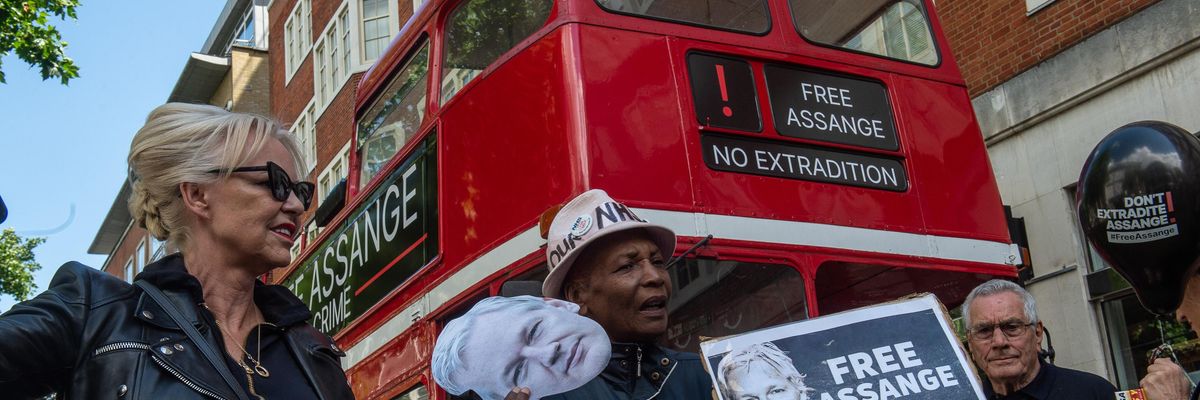
Supporters of jailed WikiLeaks founder Julian Assange staged a demonstration against his impending extradition to the United States, driving an open-top double-decker tour bus around central London on July 1, 2022. (Photo: Guy Smallman/Getty Images)
In a last-ditch effort to avoid extradition to the United States, lawyers for jailed WikiLeaks founder Julian Assange on Friday appealed to the United Kingdom's High Court to block the transfer.
"We also urge the Australian government to intervene immediately in the case to end this nightmare."
Assange's brother, Gabriel Shipton, told Reuters that the Australian publisher's legal team appealed his extradition, which was formally approved by U.K. Home Secretary Priti Patel last month.
"We also urge the Australian government to intervene immediately in the case to end this nightmare," Shipton said.
Supporters of Assange held protests ahead of his 51st birthday on Saturday, including one in an open-top double-decker London tour bus that passed by British government buildings in Westminster on Friday. One of the demonstrators, 79-year-old Gloria Wildman, told Agence France-Presse that Assange has "been in prison for telling the truth."
"If Julian Assange is not free, neither are we; none of us is free," she added.
Myriad human rights, journalistic, and other groups have condemned Assange's impending extradition and the U.S. government's targeting of a journalist who exposed American war crimes. In a Thursday statement, the Australian Journalists Union said that "the charges against Assange are an affront to journalists everywhere and a threat to press freedom."
Assange--who suffers from physical and mental health problems including heart and respiratory issues--faces U.S. charges including Espionage Act violations for which he faces up to 175 years behind bars if fully convicted.
Among the classified materials published by WikiLeaks--many provided by whistleblower Chelsea Manning--are the infamous "Collateral Murder" video showing a U.S. Army helicopter crew killing a group of Iraqi civilians, the Afghan War Diary, and the Iraq War Logs, which revealed American and allied war crimes.
According to the United Nations Working Group on Arbitrary Detention, Assange has been arbitrarily deprived of his freedom since he was arrested on December 7, 2010. Since then he has been held under house arrest, confined for seven years in the Ecuadorean Embassy in London while he was protected by the administration of former Ecuadorean President Rafael Correa, and jailed in London's notorious Belmarsh Prison.
Advocates contested Patel's assurance that the extradition would not be "incompatible with his human rights, including his right to a fair trial and to freedom of expression."
In a video published by WikiLeaks on Friday, Conservative British parliamentarian David Davis said that "the simple truth is, Assange won't get what we think of as a fair trial in the U.S."
"And in addition to that, there's a wider issue of imbalance in the U.K.-U.S. extradition treaty," he asserted. "When America requests an extradition from Britain, they have to have reasonable suspicion and the home secretary must process the request."
"When Britain requests an extradition to America, we have to demonstrate probable cause, and the American secretary of state may process our request, he's not forced to process that request," Davis noted. "The effect of this shows up in the statistics: Many, many more people are sent to America than are sent to Britain to face criminal trial."
The MP added that extradited Britons "face an alien justice system" in which "they're frog-marched in chains, they're jailed with hardened criminals, they're denied access to legal papers, they face really coercive plea-bargain systems which essentially say either plead guilty or face a huge length of time in prison."
"That sort of thing," Davis said, "does not give the sort of justice system that we're used to in the United Kingdom."
Dear Common Dreams reader, It’s been nearly 30 years since I co-founded Common Dreams with my late wife, Lina Newhouser. We had the radical notion that journalism should serve the public good, not corporate profits. It was clear to us from the outset what it would take to build such a project. No paid advertisements. No corporate sponsors. No millionaire publisher telling us what to think or do. Many people said we wouldn't last a year, but we proved those doubters wrong. Together with a tremendous team of journalists and dedicated staff, we built an independent media outlet free from the constraints of profits and corporate control. Our mission has always been simple: To inform. To inspire. To ignite change for the common good. Building Common Dreams was not easy. Our survival was never guaranteed. When you take on the most powerful forces—Wall Street greed, fossil fuel industry destruction, Big Tech lobbyists, and uber-rich oligarchs who have spent billions upon billions rigging the economy and democracy in their favor—the only bulwark you have is supporters who believe in your work. But here’s the urgent message from me today. It's never been this bad out there. And it's never been this hard to keep us going. At the very moment Common Dreams is most needed, the threats we face are intensifying. We need your support now more than ever. We don't accept corporate advertising and never will. We don't have a paywall because we don't think people should be blocked from critical news based on their ability to pay. Everything we do is funded by the donations of readers like you. When everyone does the little they can afford, we are strong. But if that support retreats or dries up, so do we. Will you donate now to make sure Common Dreams not only survives but thrives? —Craig Brown, Co-founder |
In a last-ditch effort to avoid extradition to the United States, lawyers for jailed WikiLeaks founder Julian Assange on Friday appealed to the United Kingdom's High Court to block the transfer.
"We also urge the Australian government to intervene immediately in the case to end this nightmare."
Assange's brother, Gabriel Shipton, told Reuters that the Australian publisher's legal team appealed his extradition, which was formally approved by U.K. Home Secretary Priti Patel last month.
"We also urge the Australian government to intervene immediately in the case to end this nightmare," Shipton said.
Supporters of Assange held protests ahead of his 51st birthday on Saturday, including one in an open-top double-decker London tour bus that passed by British government buildings in Westminster on Friday. One of the demonstrators, 79-year-old Gloria Wildman, told Agence France-Presse that Assange has "been in prison for telling the truth."
"If Julian Assange is not free, neither are we; none of us is free," she added.
Myriad human rights, journalistic, and other groups have condemned Assange's impending extradition and the U.S. government's targeting of a journalist who exposed American war crimes. In a Thursday statement, the Australian Journalists Union said that "the charges against Assange are an affront to journalists everywhere and a threat to press freedom."
Assange--who suffers from physical and mental health problems including heart and respiratory issues--faces U.S. charges including Espionage Act violations for which he faces up to 175 years behind bars if fully convicted.
Among the classified materials published by WikiLeaks--many provided by whistleblower Chelsea Manning--are the infamous "Collateral Murder" video showing a U.S. Army helicopter crew killing a group of Iraqi civilians, the Afghan War Diary, and the Iraq War Logs, which revealed American and allied war crimes.
According to the United Nations Working Group on Arbitrary Detention, Assange has been arbitrarily deprived of his freedom since he was arrested on December 7, 2010. Since then he has been held under house arrest, confined for seven years in the Ecuadorean Embassy in London while he was protected by the administration of former Ecuadorean President Rafael Correa, and jailed in London's notorious Belmarsh Prison.
Advocates contested Patel's assurance that the extradition would not be "incompatible with his human rights, including his right to a fair trial and to freedom of expression."
In a video published by WikiLeaks on Friday, Conservative British parliamentarian David Davis said that "the simple truth is, Assange won't get what we think of as a fair trial in the U.S."
"And in addition to that, there's a wider issue of imbalance in the U.K.-U.S. extradition treaty," he asserted. "When America requests an extradition from Britain, they have to have reasonable suspicion and the home secretary must process the request."
"When Britain requests an extradition to America, we have to demonstrate probable cause, and the American secretary of state may process our request, he's not forced to process that request," Davis noted. "The effect of this shows up in the statistics: Many, many more people are sent to America than are sent to Britain to face criminal trial."
The MP added that extradited Britons "face an alien justice system" in which "they're frog-marched in chains, they're jailed with hardened criminals, they're denied access to legal papers, they face really coercive plea-bargain systems which essentially say either plead guilty or face a huge length of time in prison."
"That sort of thing," Davis said, "does not give the sort of justice system that we're used to in the United Kingdom."
In a last-ditch effort to avoid extradition to the United States, lawyers for jailed WikiLeaks founder Julian Assange on Friday appealed to the United Kingdom's High Court to block the transfer.
"We also urge the Australian government to intervene immediately in the case to end this nightmare."
Assange's brother, Gabriel Shipton, told Reuters that the Australian publisher's legal team appealed his extradition, which was formally approved by U.K. Home Secretary Priti Patel last month.
"We also urge the Australian government to intervene immediately in the case to end this nightmare," Shipton said.
Supporters of Assange held protests ahead of his 51st birthday on Saturday, including one in an open-top double-decker London tour bus that passed by British government buildings in Westminster on Friday. One of the demonstrators, 79-year-old Gloria Wildman, told Agence France-Presse that Assange has "been in prison for telling the truth."
"If Julian Assange is not free, neither are we; none of us is free," she added.
Myriad human rights, journalistic, and other groups have condemned Assange's impending extradition and the U.S. government's targeting of a journalist who exposed American war crimes. In a Thursday statement, the Australian Journalists Union said that "the charges against Assange are an affront to journalists everywhere and a threat to press freedom."
Assange--who suffers from physical and mental health problems including heart and respiratory issues--faces U.S. charges including Espionage Act violations for which he faces up to 175 years behind bars if fully convicted.
Among the classified materials published by WikiLeaks--many provided by whistleblower Chelsea Manning--are the infamous "Collateral Murder" video showing a U.S. Army helicopter crew killing a group of Iraqi civilians, the Afghan War Diary, and the Iraq War Logs, which revealed American and allied war crimes.
According to the United Nations Working Group on Arbitrary Detention, Assange has been arbitrarily deprived of his freedom since he was arrested on December 7, 2010. Since then he has been held under house arrest, confined for seven years in the Ecuadorean Embassy in London while he was protected by the administration of former Ecuadorean President Rafael Correa, and jailed in London's notorious Belmarsh Prison.
Advocates contested Patel's assurance that the extradition would not be "incompatible with his human rights, including his right to a fair trial and to freedom of expression."
In a video published by WikiLeaks on Friday, Conservative British parliamentarian David Davis said that "the simple truth is, Assange won't get what we think of as a fair trial in the U.S."
"And in addition to that, there's a wider issue of imbalance in the U.K.-U.S. extradition treaty," he asserted. "When America requests an extradition from Britain, they have to have reasonable suspicion and the home secretary must process the request."
"When Britain requests an extradition to America, we have to demonstrate probable cause, and the American secretary of state may process our request, he's not forced to process that request," Davis noted. "The effect of this shows up in the statistics: Many, many more people are sent to America than are sent to Britain to face criminal trial."
The MP added that extradited Britons "face an alien justice system" in which "they're frog-marched in chains, they're jailed with hardened criminals, they're denied access to legal papers, they face really coercive plea-bargain systems which essentially say either plead guilty or face a huge length of time in prison."
"That sort of thing," Davis said, "does not give the sort of justice system that we're used to in the United Kingdom."