SUBSCRIBE TO OUR FREE NEWSLETTER
Daily news & progressive opinion—funded by the people, not the corporations—delivered straight to your inbox.
5
#000000
#FFFFFF
To donate by check, phone, or other method, see our More Ways to Give page.
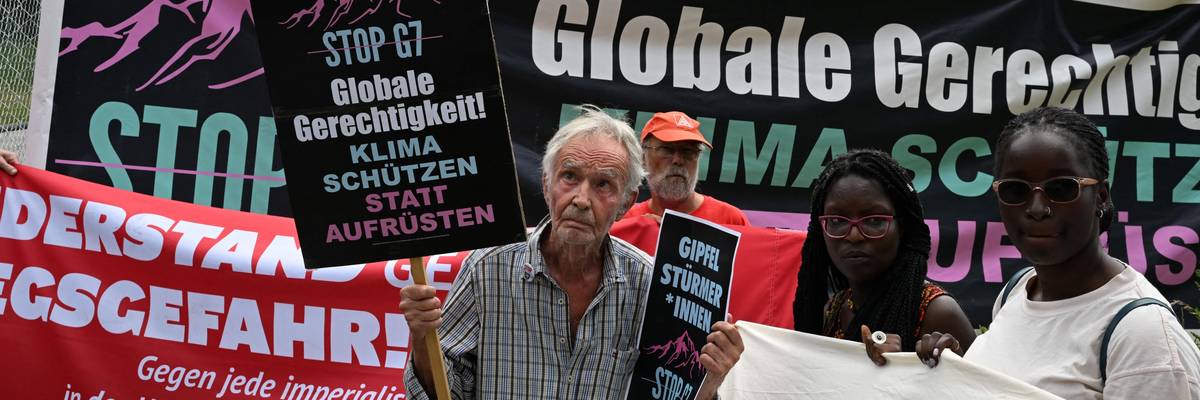
"The G7 countries have once again proved that they are morally bankrupt and have no real intention to solve the climate crisis and take responsibility for this crisis caused by their disproportionate use and relentless support for fossil fuels."
"The G7... has prioritized filling the pockets of the fossil gas industry over protecting peoples' lives."
That's how Tasneem Essop, executive director of Climate Action Network International, responded Tuesday to the Group of Seven (G7) watering down a May commitment that campaigners had celebrated at the time as a "massive win."
G7 nations last month pledged to end "new direct public support for the international unabated fossil fuel energy sector by the end of 2022, except in limited circumstances clearly defined by each country that are consistent with a 1.5degC warming limit and the goals of the Paris agreement."
The G7 is a forum of Germany, Canada, France, Italy, Japan, the United Kingdom, and the United States of America, plus the European Union. Germany currently holds the presidency, which will shift to Japan next year.
Following a three-day meeting in Germany that also included representatives from Argentina, India, Indonesia, Senegal, and South Africa, G7 leaders on Tuesday issued a communique that frames new investment in the liquefied natural gas (LNG) industry as a necessary response to Russia's war on Ukraine and the related impacts on global fossil fuel supplies.
The G7 statement says that "with a view to accelerating the phase-out of our dependency on Russian energy, we stress the important role increased deliveries of LNG can play, and acknowledge that investment in this sector is necessary in response to the current crisis."
"In these exceptional circumstances, publicly supported investment in the gas sector can be appropriate as a temporary response, subject to clearly defined national circumstances, and if implemented in a manner consistent with our climate objectives and without creating lock-in effects, for example by ensuring that projects are integrated into national strategies for the development of low-carbon and renewable hydrogen," the statement adds.
That position was swiftly rejected by climate campaigners around the world, who have pointed to the war as further evidence of the need for a global shift to renewable energy since Russia invaded Ukraine in late February.
Laurie van der Burg, co-manager of global public finance at Oil Change International (OCI), specifically targeted German Chancellor Olaf Scholz.
"Today the G7 under the leadership of Chancellor Scholz has prioritized filling the pockets of the fossil gas industry over protecting peoples' lives," she asserted, adding that the weakened pledge "cannot be allowed to turn into a huge missed opportunity to shift $33 billion a year to real solutions."
The campaigner continued:
Investing in new gas infrastructure is not a viable strategy to reduce Russian fossil fuel imports--these projects take years to build and do not support energy security in the long run. Renewable energy and efficiency solutions can be deployed faster, better serve development and energy access needs, and do not come with the stranded assets and financial stability risks of fossil gas. The G7 caving in to fossil fuel interests is a bad look for Germany and must not derail parallel efforts to implement a near-identical commitment to end international public finance for fossil fuels adopted by 39 countries and institutions at the U.N. climate conference last year. We cannot afford this kind of backsliding. There are lives on the line and we will hold countries accountable.
Her comments were echoed by other activists, such as Paul Cook, head of advocacy at Tearfund, who warned that "people in poverty around the world will pay the highest price for this backtrack by some of the wealthiest countries."
Nnimmo Bassey, director of health at Mother Earth Foundation, said that "we are not surprised at the move by the G7 to invest in dirty and to serve the interest of the dirty fossil fuel industry instead of investing in clean renewable energy sources."
"Leaders of the G7 countries have been the main agents for polluting corporations, and they have worked together to scuttle climate negotiations, enthrone futile voluntary emissions reduction systems, promote false climate solutions, encourage land grabs, and expose vulnerable nations to extreme harms," Bassey noted, demanding accountability.
Oxfam's head of inequality policy, Max Lawson, connected the forum's missteps on climate and global hunger, declaring that "instead of doing what is needed, the G7 are leaving millions to starve and cooking the planet."
Related Content

OCI U.S. program manager Collin Rees called the G7's climate declaration "an egregious betrayal of President Joe Biden's climate commitments," a critique echoed by Kate DeAngelis at Friends of the Earth (FOE) U.S.
"The G7 countries are failing as true climate leaders by abandoning their Glasgow commitments and holding up LNG as an energy response," DeAngelis said, referencing the pledge from the 2021 U.N. summit. "The United States is the largest historical contributor to the global climate crisis, yet the administration is encouraging the build-out of fossil fuel infrastructure both domestically and internationally."
OCI highlighted that the G7 commitment was notable in part because it included Japan, which did not sign on to the Glasgow pledge and "is the second largest provider of international public finance for fossil fuels, pouring $11 billion into dirty overseas fossil fuel projects each year."
FOE Japan campaigner Ayumi Fukakusa said that her nation's "stubborn addiction to fossil fuels is undermining the urgent action we need for climate and energy security."
"This is just the latest example of Japan blocking climate action at the G7 and other international fora," she added. "As next year's G7 host, Japan must strengthen its commitment to phase out oil and gas finance and implement it with integrity in order to protect our planet."
"The G7 countries have once again proved that they are morally bankrupt and have no real intention to solve the climate crisis and take responsibility for this crisis caused by their disproportionate use and relentless support for fossil fuels."
"The G7... has prioritized filling the pockets of the fossil gas industry over protecting peoples' lives."
That's how Tasneem Essop, executive director of Climate Action Network International, responded Tuesday to the Group of Seven (G7) watering down a May commitment that campaigners had celebrated at the time as a "massive win."
G7 nations last month pledged to end "new direct public support for the international unabated fossil fuel energy sector by the end of 2022, except in limited circumstances clearly defined by each country that are consistent with a 1.5degC warming limit and the goals of the Paris agreement."
The G7 is a forum of Germany, Canada, France, Italy, Japan, the United Kingdom, and the United States of America, plus the European Union. Germany currently holds the presidency, which will shift to Japan next year.
Following a three-day meeting in Germany that also included representatives from Argentina, India, Indonesia, Senegal, and South Africa, G7 leaders on Tuesday issued a communique that frames new investment in the liquefied natural gas (LNG) industry as a necessary response to Russia's war on Ukraine and the related impacts on global fossil fuel supplies.
The G7 statement says that "with a view to accelerating the phase-out of our dependency on Russian energy, we stress the important role increased deliveries of LNG can play, and acknowledge that investment in this sector is necessary in response to the current crisis."
"In these exceptional circumstances, publicly supported investment in the gas sector can be appropriate as a temporary response, subject to clearly defined national circumstances, and if implemented in a manner consistent with our climate objectives and without creating lock-in effects, for example by ensuring that projects are integrated into national strategies for the development of low-carbon and renewable hydrogen," the statement adds.
That position was swiftly rejected by climate campaigners around the world, who have pointed to the war as further evidence of the need for a global shift to renewable energy since Russia invaded Ukraine in late February.
Laurie van der Burg, co-manager of global public finance at Oil Change International (OCI), specifically targeted German Chancellor Olaf Scholz.
"Today the G7 under the leadership of Chancellor Scholz has prioritized filling the pockets of the fossil gas industry over protecting peoples' lives," she asserted, adding that the weakened pledge "cannot be allowed to turn into a huge missed opportunity to shift $33 billion a year to real solutions."
The campaigner continued:
Investing in new gas infrastructure is not a viable strategy to reduce Russian fossil fuel imports--these projects take years to build and do not support energy security in the long run. Renewable energy and efficiency solutions can be deployed faster, better serve development and energy access needs, and do not come with the stranded assets and financial stability risks of fossil gas. The G7 caving in to fossil fuel interests is a bad look for Germany and must not derail parallel efforts to implement a near-identical commitment to end international public finance for fossil fuels adopted by 39 countries and institutions at the U.N. climate conference last year. We cannot afford this kind of backsliding. There are lives on the line and we will hold countries accountable.
Her comments were echoed by other activists, such as Paul Cook, head of advocacy at Tearfund, who warned that "people in poverty around the world will pay the highest price for this backtrack by some of the wealthiest countries."
Nnimmo Bassey, director of health at Mother Earth Foundation, said that "we are not surprised at the move by the G7 to invest in dirty and to serve the interest of the dirty fossil fuel industry instead of investing in clean renewable energy sources."
"Leaders of the G7 countries have been the main agents for polluting corporations, and they have worked together to scuttle climate negotiations, enthrone futile voluntary emissions reduction systems, promote false climate solutions, encourage land grabs, and expose vulnerable nations to extreme harms," Bassey noted, demanding accountability.
Oxfam's head of inequality policy, Max Lawson, connected the forum's missteps on climate and global hunger, declaring that "instead of doing what is needed, the G7 are leaving millions to starve and cooking the planet."
Related Content
OCI U.S. program manager Collin Rees called the G7's climate declaration "an egregious betrayal of President Joe Biden's climate commitments," a critique echoed by Kate DeAngelis at Friends of the Earth (FOE) U.S.
"The G7 countries are failing as true climate leaders by abandoning their Glasgow commitments and holding up LNG as an energy response," DeAngelis said, referencing the pledge from the 2021 U.N. summit. "The United States is the largest historical contributor to the global climate crisis, yet the administration is encouraging the build-out of fossil fuel infrastructure both domestically and internationally."
OCI highlighted that the G7 commitment was notable in part because it included Japan, which did not sign on to the Glasgow pledge and "is the second largest provider of international public finance for fossil fuels, pouring $11 billion into dirty overseas fossil fuel projects each year."
FOE Japan campaigner Ayumi Fukakusa said that her nation's "stubborn addiction to fossil fuels is undermining the urgent action we need for climate and energy security."
"This is just the latest example of Japan blocking climate action at the G7 and other international fora," she added. "As next year's G7 host, Japan must strengthen its commitment to phase out oil and gas finance and implement it with integrity in order to protect our planet."
"The G7 countries have once again proved that they are morally bankrupt and have no real intention to solve the climate crisis and take responsibility for this crisis caused by their disproportionate use and relentless support for fossil fuels."
"The G7... has prioritized filling the pockets of the fossil gas industry over protecting peoples' lives."
That's how Tasneem Essop, executive director of Climate Action Network International, responded Tuesday to the Group of Seven (G7) watering down a May commitment that campaigners had celebrated at the time as a "massive win."
G7 nations last month pledged to end "new direct public support for the international unabated fossil fuel energy sector by the end of 2022, except in limited circumstances clearly defined by each country that are consistent with a 1.5degC warming limit and the goals of the Paris agreement."
The G7 is a forum of Germany, Canada, France, Italy, Japan, the United Kingdom, and the United States of America, plus the European Union. Germany currently holds the presidency, which will shift to Japan next year.
Following a three-day meeting in Germany that also included representatives from Argentina, India, Indonesia, Senegal, and South Africa, G7 leaders on Tuesday issued a communique that frames new investment in the liquefied natural gas (LNG) industry as a necessary response to Russia's war on Ukraine and the related impacts on global fossil fuel supplies.
The G7 statement says that "with a view to accelerating the phase-out of our dependency on Russian energy, we stress the important role increased deliveries of LNG can play, and acknowledge that investment in this sector is necessary in response to the current crisis."
"In these exceptional circumstances, publicly supported investment in the gas sector can be appropriate as a temporary response, subject to clearly defined national circumstances, and if implemented in a manner consistent with our climate objectives and without creating lock-in effects, for example by ensuring that projects are integrated into national strategies for the development of low-carbon and renewable hydrogen," the statement adds.
That position was swiftly rejected by climate campaigners around the world, who have pointed to the war as further evidence of the need for a global shift to renewable energy since Russia invaded Ukraine in late February.
Laurie van der Burg, co-manager of global public finance at Oil Change International (OCI), specifically targeted German Chancellor Olaf Scholz.
"Today the G7 under the leadership of Chancellor Scholz has prioritized filling the pockets of the fossil gas industry over protecting peoples' lives," she asserted, adding that the weakened pledge "cannot be allowed to turn into a huge missed opportunity to shift $33 billion a year to real solutions."
The campaigner continued:
Investing in new gas infrastructure is not a viable strategy to reduce Russian fossil fuel imports--these projects take years to build and do not support energy security in the long run. Renewable energy and efficiency solutions can be deployed faster, better serve development and energy access needs, and do not come with the stranded assets and financial stability risks of fossil gas. The G7 caving in to fossil fuel interests is a bad look for Germany and must not derail parallel efforts to implement a near-identical commitment to end international public finance for fossil fuels adopted by 39 countries and institutions at the U.N. climate conference last year. We cannot afford this kind of backsliding. There are lives on the line and we will hold countries accountable.
Her comments were echoed by other activists, such as Paul Cook, head of advocacy at Tearfund, who warned that "people in poverty around the world will pay the highest price for this backtrack by some of the wealthiest countries."
Nnimmo Bassey, director of health at Mother Earth Foundation, said that "we are not surprised at the move by the G7 to invest in dirty and to serve the interest of the dirty fossil fuel industry instead of investing in clean renewable energy sources."
"Leaders of the G7 countries have been the main agents for polluting corporations, and they have worked together to scuttle climate negotiations, enthrone futile voluntary emissions reduction systems, promote false climate solutions, encourage land grabs, and expose vulnerable nations to extreme harms," Bassey noted, demanding accountability.
Oxfam's head of inequality policy, Max Lawson, connected the forum's missteps on climate and global hunger, declaring that "instead of doing what is needed, the G7 are leaving millions to starve and cooking the planet."
Related Content
OCI U.S. program manager Collin Rees called the G7's climate declaration "an egregious betrayal of President Joe Biden's climate commitments," a critique echoed by Kate DeAngelis at Friends of the Earth (FOE) U.S.
"The G7 countries are failing as true climate leaders by abandoning their Glasgow commitments and holding up LNG as an energy response," DeAngelis said, referencing the pledge from the 2021 U.N. summit. "The United States is the largest historical contributor to the global climate crisis, yet the administration is encouraging the build-out of fossil fuel infrastructure both domestically and internationally."
OCI highlighted that the G7 commitment was notable in part because it included Japan, which did not sign on to the Glasgow pledge and "is the second largest provider of international public finance for fossil fuels, pouring $11 billion into dirty overseas fossil fuel projects each year."
FOE Japan campaigner Ayumi Fukakusa said that her nation's "stubborn addiction to fossil fuels is undermining the urgent action we need for climate and energy security."
"This is just the latest example of Japan blocking climate action at the G7 and other international fora," she added. "As next year's G7 host, Japan must strengthen its commitment to phase out oil and gas finance and implement it with integrity in order to protect our planet."