SUBSCRIBE TO OUR FREE NEWSLETTER
Daily news & progressive opinion—funded by the people, not the corporations—delivered straight to your inbox.
5
#000000
#FFFFFF
To donate by check, phone, or other method, see our More Ways to Give page.
A diverse coalition of civil society groups responded with disgust after the Senate Armed Services Committee voted Thursday to tack an additional $45 billion on top of President Joe Biden's already massive military spending request, bringing the total proposed budget for the coming fiscal year to a staggering $857.6 billion.
"It's about funneling money into the military-industrial complex."
The Biden administration's March request for $813 billion in military spending for Fiscal Year 2023 represented a $31 billion increase over the current level of $782 billion, which is already unprecedented.
During its closed-door markup of the National Defense Authorization Act this week, the Senate Armed Services Committee approved a bill with a topline budget of $847 billion--$817 billion of which is earmarked for the Pentagon. An additional $10.6 billion in national military spending falls outside the Senate panel's jurisdiction. The House is expected to make its own push to further boost military spending for the next fiscal year.
William Hartung, a senior research fellow at the Quincy Institute for Responsible Statecraft, called the Senate panel's decision "misguided."
"The administration's proposal is already higher than spending at the peaks of the Korean and Vietnam Wars and over $100 billion more than at the height of the Cold War," Hartung said in a statement. "Throwing more money at the Pentagon will not make us safer--it will just divert funds from addressing other urgent challenges like pandemics and climate change that put millions of Americans at risk."
Monica Montgomery, a research analyst at the Council for a Livable World, pointed out that the Senate committee's proposed $45 billion increase in military spending is equivalent to Biden's entire budget request for climate programs, demonstrating how "Congress will value militarism and defense contractors over a livable future."
"If Congress truly wants to keep people safe, they must start by rejecting this increase and investing taxpayer dollars in human wellbeing, instead," Tori Bateman, policy advocacy coordinator at the American Friends Service Committee, said in a statement.
Earlier this week, Reps. Barbara Lee (D-Calif.) and Mark Pocan (D-Wis.)--co-chairs of the Defense Spending Reduction Caucus--introduced the People Over Pentagon Act of 2022, which proposes cutting Pentagon spending for the next fiscal year by $100 billion and reallocating those funds toward threats facing the nation that "are not military in nature," such as the Covid-19 pandemic, the climate emergency, and worsening inequality.
Related Content

Although a majority of U.S. voters are opposed to military spending in excess of $800 billion, earlier efforts to slash the Pentagon's budget have failed to gain enough support to pass the House or Senate thanks in part to lawmakers who receive significant amounts of campaign cash from the weapons industry, which benefits from constantly ballooning expenditures.
Roughly 55% of all Pentagon spending went to private sector military contractors from FY 2002 to FY 2021, according to Stephen Semler of the Security Policy Reform Institute. "If this privatization of funds rate over the last 20 years holds," Semler wrote in December, arms dealers will gobble up an estimated $407 billion in public money in FY 2022.
In the words of Win Without War president Stephen Miles, "The Pentagon's ever-growing budget is quite simply a theft from American people enriching some of the wealthiest corporations in this country."
Julia Gledhill, an analyst at the Project on Government Oversight's Center for Defense Information, concurred.
"Increasing the Pentagon budget beyond President Biden's request isn't just irresponsible--it's a slap in the face to American taxpayers," said Gledhill. "Year after year the Department of Defense demonstrates its lack of fiscal discipline, failing financial audits and sinking money into weapon programs that do little more than enrich defense contractors."
"This $45 billion increase isn't about national security or the American people," she added. "It's about funneling money into the military-industrial complex."
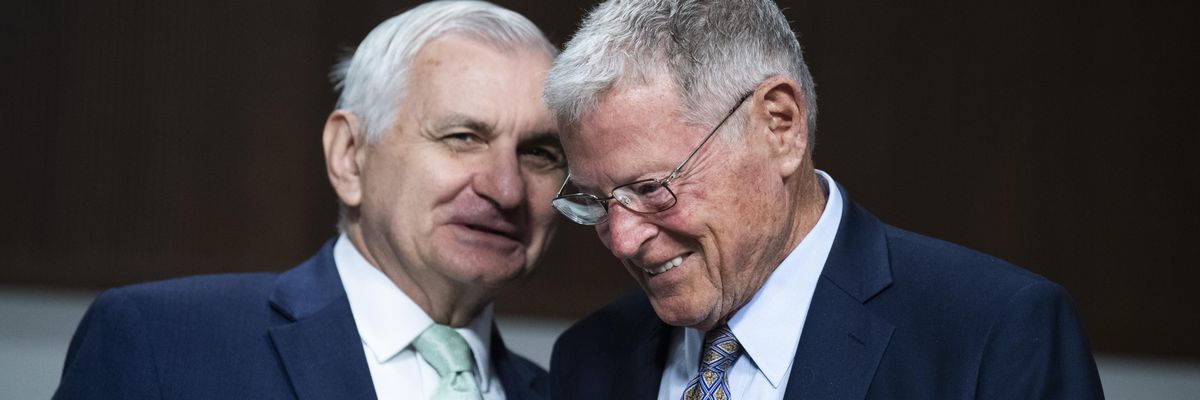
Sen. Jack Reed (D-R.I.) chair of the Senate Armed Services Committee, told reporters Thursday that inflation was "the first consideration" in increasing the topline. He also cited the need to support Ukraine, replenish weapons sent to aid the country's fight against Russia, and fund military priorities not included in Biden's Pentagon request, Politico reported.
The committee's ranking Republican Sen. Jim Inhofe of Oklahoma hailed the proposed spending hike as "everything I hoped for."
Experts, meanwhile, have documented how military spending has never moved in tandem with inflation. They have also warned that the nearly $60 billion worth of weaponry that Ukraine has already received from the U.S. is more likely to intensify the war than to advance peace, with arms manufacturers among the only beneficiaries of such prolonged suffering.
The Senate Armed Services Committee's move to increase U.S. military spending comes despite the Biden administration's withdrawal from Afghanistan following 20 years of war.
Robert Weissman, president of Public Citizen--a progressive advocacy group that is pushing the U.S. to ramp up vaccine manufacturing and inoculate the world against Covid-19 with an investment of just $25 billion, or roughly 3% of the nation's annual military budget--said that "the Senate Armed Services Committee's choice to defy both the president and public opinion and flood the Pentagon with more money is outrageous."
"Time and again, Congress funnels billions in additional funds to costly weapons programs, war, and defense contractors, while claiming that human needs would 'cost too much,'" said Weissman. "Most Americans oppose efforts to rocket-launch military spending towards a trillion dollars per year. Lawmakers should reject this and champion human-centered spending instead."
A diverse coalition of civil society groups responded with disgust after the Senate Armed Services Committee voted Thursday to tack an additional $45 billion on top of President Joe Biden's already massive military spending request, bringing the total proposed budget for the coming fiscal year to a staggering $857.6 billion.
"It's about funneling money into the military-industrial complex."
The Biden administration's March request for $813 billion in military spending for Fiscal Year 2023 represented a $31 billion increase over the current level of $782 billion, which is already unprecedented.
During its closed-door markup of the National Defense Authorization Act this week, the Senate Armed Services Committee approved a bill with a topline budget of $847 billion--$817 billion of which is earmarked for the Pentagon. An additional $10.6 billion in national military spending falls outside the Senate panel's jurisdiction. The House is expected to make its own push to further boost military spending for the next fiscal year.
William Hartung, a senior research fellow at the Quincy Institute for Responsible Statecraft, called the Senate panel's decision "misguided."
"The administration's proposal is already higher than spending at the peaks of the Korean and Vietnam Wars and over $100 billion more than at the height of the Cold War," Hartung said in a statement. "Throwing more money at the Pentagon will not make us safer--it will just divert funds from addressing other urgent challenges like pandemics and climate change that put millions of Americans at risk."
Monica Montgomery, a research analyst at the Council for a Livable World, pointed out that the Senate committee's proposed $45 billion increase in military spending is equivalent to Biden's entire budget request for climate programs, demonstrating how "Congress will value militarism and defense contractors over a livable future."
"If Congress truly wants to keep people safe, they must start by rejecting this increase and investing taxpayer dollars in human wellbeing, instead," Tori Bateman, policy advocacy coordinator at the American Friends Service Committee, said in a statement.
Earlier this week, Reps. Barbara Lee (D-Calif.) and Mark Pocan (D-Wis.)--co-chairs of the Defense Spending Reduction Caucus--introduced the People Over Pentagon Act of 2022, which proposes cutting Pentagon spending for the next fiscal year by $100 billion and reallocating those funds toward threats facing the nation that "are not military in nature," such as the Covid-19 pandemic, the climate emergency, and worsening inequality.
Related Content
Although a majority of U.S. voters are opposed to military spending in excess of $800 billion, earlier efforts to slash the Pentagon's budget have failed to gain enough support to pass the House or Senate thanks in part to lawmakers who receive significant amounts of campaign cash from the weapons industry, which benefits from constantly ballooning expenditures.
Roughly 55% of all Pentagon spending went to private sector military contractors from FY 2002 to FY 2021, according to Stephen Semler of the Security Policy Reform Institute. "If this privatization of funds rate over the last 20 years holds," Semler wrote in December, arms dealers will gobble up an estimated $407 billion in public money in FY 2022.
In the words of Win Without War president Stephen Miles, "The Pentagon's ever-growing budget is quite simply a theft from American people enriching some of the wealthiest corporations in this country."
Julia Gledhill, an analyst at the Project on Government Oversight's Center for Defense Information, concurred.
"Increasing the Pentagon budget beyond President Biden's request isn't just irresponsible--it's a slap in the face to American taxpayers," said Gledhill. "Year after year the Department of Defense demonstrates its lack of fiscal discipline, failing financial audits and sinking money into weapon programs that do little more than enrich defense contractors."
"This $45 billion increase isn't about national security or the American people," she added. "It's about funneling money into the military-industrial complex."
Sen. Jack Reed (D-R.I.) chair of the Senate Armed Services Committee, told reporters Thursday that inflation was "the first consideration" in increasing the topline. He also cited the need to support Ukraine, replenish weapons sent to aid the country's fight against Russia, and fund military priorities not included in Biden's Pentagon request, Politico reported.
The committee's ranking Republican Sen. Jim Inhofe of Oklahoma hailed the proposed spending hike as "everything I hoped for."
Experts, meanwhile, have documented how military spending has never moved in tandem with inflation. They have also warned that the nearly $60 billion worth of weaponry that Ukraine has already received from the U.S. is more likely to intensify the war than to advance peace, with arms manufacturers among the only beneficiaries of such prolonged suffering.
The Senate Armed Services Committee's move to increase U.S. military spending comes despite the Biden administration's withdrawal from Afghanistan following 20 years of war.
Robert Weissman, president of Public Citizen--a progressive advocacy group that is pushing the U.S. to ramp up vaccine manufacturing and inoculate the world against Covid-19 with an investment of just $25 billion, or roughly 3% of the nation's annual military budget--said that "the Senate Armed Services Committee's choice to defy both the president and public opinion and flood the Pentagon with more money is outrageous."
"Time and again, Congress funnels billions in additional funds to costly weapons programs, war, and defense contractors, while claiming that human needs would 'cost too much,'" said Weissman. "Most Americans oppose efforts to rocket-launch military spending towards a trillion dollars per year. Lawmakers should reject this and champion human-centered spending instead."
A diverse coalition of civil society groups responded with disgust after the Senate Armed Services Committee voted Thursday to tack an additional $45 billion on top of President Joe Biden's already massive military spending request, bringing the total proposed budget for the coming fiscal year to a staggering $857.6 billion.
"It's about funneling money into the military-industrial complex."
The Biden administration's March request for $813 billion in military spending for Fiscal Year 2023 represented a $31 billion increase over the current level of $782 billion, which is already unprecedented.
During its closed-door markup of the National Defense Authorization Act this week, the Senate Armed Services Committee approved a bill with a topline budget of $847 billion--$817 billion of which is earmarked for the Pentagon. An additional $10.6 billion in national military spending falls outside the Senate panel's jurisdiction. The House is expected to make its own push to further boost military spending for the next fiscal year.
William Hartung, a senior research fellow at the Quincy Institute for Responsible Statecraft, called the Senate panel's decision "misguided."
"The administration's proposal is already higher than spending at the peaks of the Korean and Vietnam Wars and over $100 billion more than at the height of the Cold War," Hartung said in a statement. "Throwing more money at the Pentagon will not make us safer--it will just divert funds from addressing other urgent challenges like pandemics and climate change that put millions of Americans at risk."
Monica Montgomery, a research analyst at the Council for a Livable World, pointed out that the Senate committee's proposed $45 billion increase in military spending is equivalent to Biden's entire budget request for climate programs, demonstrating how "Congress will value militarism and defense contractors over a livable future."
"If Congress truly wants to keep people safe, they must start by rejecting this increase and investing taxpayer dollars in human wellbeing, instead," Tori Bateman, policy advocacy coordinator at the American Friends Service Committee, said in a statement.
Earlier this week, Reps. Barbara Lee (D-Calif.) and Mark Pocan (D-Wis.)--co-chairs of the Defense Spending Reduction Caucus--introduced the People Over Pentagon Act of 2022, which proposes cutting Pentagon spending for the next fiscal year by $100 billion and reallocating those funds toward threats facing the nation that "are not military in nature," such as the Covid-19 pandemic, the climate emergency, and worsening inequality.
Related Content
Although a majority of U.S. voters are opposed to military spending in excess of $800 billion, earlier efforts to slash the Pentagon's budget have failed to gain enough support to pass the House or Senate thanks in part to lawmakers who receive significant amounts of campaign cash from the weapons industry, which benefits from constantly ballooning expenditures.
Roughly 55% of all Pentagon spending went to private sector military contractors from FY 2002 to FY 2021, according to Stephen Semler of the Security Policy Reform Institute. "If this privatization of funds rate over the last 20 years holds," Semler wrote in December, arms dealers will gobble up an estimated $407 billion in public money in FY 2022.
In the words of Win Without War president Stephen Miles, "The Pentagon's ever-growing budget is quite simply a theft from American people enriching some of the wealthiest corporations in this country."
Julia Gledhill, an analyst at the Project on Government Oversight's Center for Defense Information, concurred.
"Increasing the Pentagon budget beyond President Biden's request isn't just irresponsible--it's a slap in the face to American taxpayers," said Gledhill. "Year after year the Department of Defense demonstrates its lack of fiscal discipline, failing financial audits and sinking money into weapon programs that do little more than enrich defense contractors."
"This $45 billion increase isn't about national security or the American people," she added. "It's about funneling money into the military-industrial complex."
Sen. Jack Reed (D-R.I.) chair of the Senate Armed Services Committee, told reporters Thursday that inflation was "the first consideration" in increasing the topline. He also cited the need to support Ukraine, replenish weapons sent to aid the country's fight against Russia, and fund military priorities not included in Biden's Pentagon request, Politico reported.
The committee's ranking Republican Sen. Jim Inhofe of Oklahoma hailed the proposed spending hike as "everything I hoped for."
Experts, meanwhile, have documented how military spending has never moved in tandem with inflation. They have also warned that the nearly $60 billion worth of weaponry that Ukraine has already received from the U.S. is more likely to intensify the war than to advance peace, with arms manufacturers among the only beneficiaries of such prolonged suffering.
The Senate Armed Services Committee's move to increase U.S. military spending comes despite the Biden administration's withdrawal from Afghanistan following 20 years of war.
Robert Weissman, president of Public Citizen--a progressive advocacy group that is pushing the U.S. to ramp up vaccine manufacturing and inoculate the world against Covid-19 with an investment of just $25 billion, or roughly 3% of the nation's annual military budget--said that "the Senate Armed Services Committee's choice to defy both the president and public opinion and flood the Pentagon with more money is outrageous."
"Time and again, Congress funnels billions in additional funds to costly weapons programs, war, and defense contractors, while claiming that human needs would 'cost too much,'" said Weissman. "Most Americans oppose efforts to rocket-launch military spending towards a trillion dollars per year. Lawmakers should reject this and champion human-centered spending instead."