SUBSCRIBE TO OUR FREE NEWSLETTER
Daily news & progressive opinion—funded by the people, not the corporations—delivered straight to your inbox.
5
#000000
#FFFFFF
To donate by check, phone, or other method, see our More Ways to Give page.
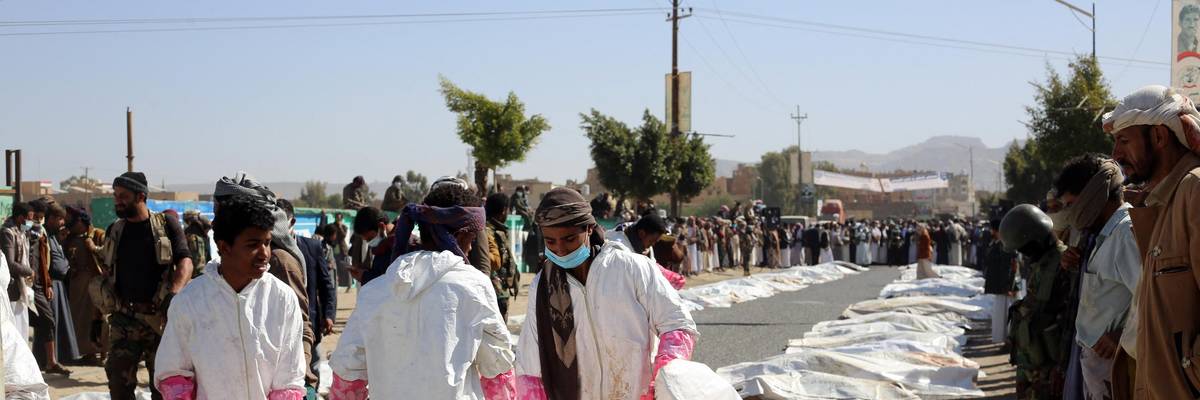
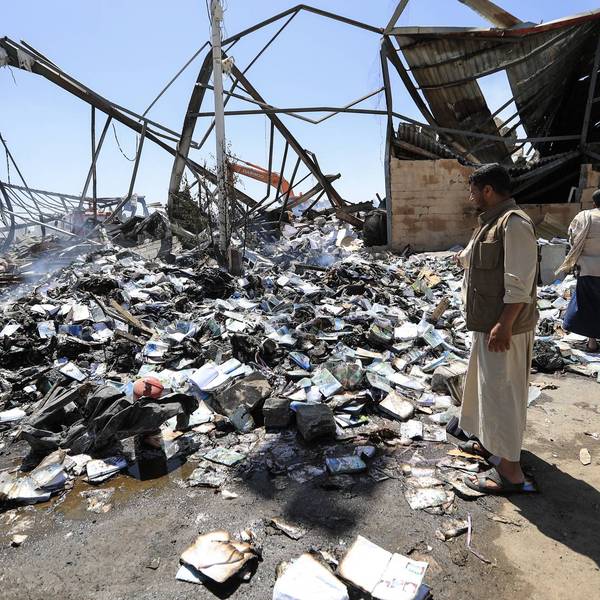
A leading peace group on Monday said a new report detailing the depth of U.S. support for Saudi-led airstrikes in Yemen--hundreds of which have been called war crimes by international legal experts--shows the need for Congress to pass a recently introduced measure to end American complicity in one of the world's worst humanitarian crises.
"Our ongoing complicity is a stain on our nation's soul. Just further reason for Congress to pass the newly introduced Yemen War Powers Resolution."
According to The Washington Post--which along with the Security Force Monitor (SFM) at Columbia Law School's Human Rights Institute analyzed thousands of news reports and images to identify warplanes from Saudi Arabia and the United Arab Emirates that have attacked Yemen--"a substantial portion of the air raids were carried out by jets developed, maintained, and sold by U.S. companies, and by pilots who were trained by the U.S. military."
This, despite a February 2021 pledge by President Joe Biden to end U.S. support for "offensive operations" in the Saudi-led war--a promise that has been repeatedly sidestepped via arms sales and a $500 million maintenance contract.
"This is an absolutely devastating analysis of U.S. support for the Saudi-led war in Yemen," tweeted the Quaker peace group Friends Committee on National Legislation (FCNL). "Our ongoing complicity is a stain on our nation's soul. Just further reason for Congress to pass the newly introduced Yemen War Powers Resolution."
Last week, a bipartisan group of 48 House lawmakers introduced a War Powers Resolution directing "the removal of United States Armed Forces from hostilities in the Republic of Yemen that have not been authorized by Congress."
"It's critical that the Biden administration take the steps necessary to fulfill their promise to end U.S. support for the disastrous Saudi-led war in Yemen," explained Rep. Peter DeFazio (D-Ore.), one of the resolution's lead sponsors.
"We should not be involved in yet another conflict in the Middle East," he added, "especially a brutal war that has created the world's largest humanitarian crisis, and contributed to the deaths of at least 377,000 civilians."
Related Content

Writing for Just Security, Priyanka Motaparthy, director of the Counterterrorism, Armed Conflict, and Human Rights Project at Columbia Law School's Human Rights Institute, and SFM's Tony Wilson noted Saturday that "during seven years of war, coalition airstrikes have killed nearly 9,000 civilians in Yemen."
"Human rights groups and the United Nations-mandated Group of Eminent Experts have documented more than 300 airstrikes that are likely war crimes or violations of the laws of war," they continued. "These strikes have hit hospitals and other medical facilities, markets, a school bus filled with children, and a funeral hall filled with mourners."
"Independent human rights groups, journalists, and U.N. monitoring bodies have found U.S. weapons used in many of these attacks," the pair added.
The Post-SFM investigation comes amid widespread U.S. and Western condemnation of alleged and documented Russian war crimes in Ukraine.
"Thousands of similar strikes have taken place against Yemeni civilians," the report notes. "The indiscriminate bombings have become a hallmark of the Yemen war, drawing international scrutiny of the countries participating in the air campaign, and those arming them, including the United States."
The report also comes as Biden prepares to visit Saudi Arabia in the coming weeks in a bid to boost relations with the oil-rich kingdom amid record fuel prices driven by Russia's invasion of Ukraine--despite a campaign promise to make the nation's leaders "pay the price" for their role in the grisly murder of journalist Jamal Khashoggi.
The president's decision to visit the fundamentalist kingdom, one of the world's worst human rights violators, stands in stark contrast to the U.S.' exclusion of Cuban, Nicaraguan, and Venezuelan leaders from the upcoming Summit of the Americas in Los Angeles--purportedly due to the lack of democracy and respect for human rights in those countries.
Annelle Sheline, a Middle East research fellow at the Quincy Institute for Responsible Statecraft, last week called the introduction of the War Powers Resolution "a key factor in why the warring parties in Yemen decided to extend their ceasefire," which is now in its third month.
Speaking of the resolution on Al Jazeera last week, Sheline said that "if this were to pass, two-thirds of Saudi Arabia's air force would be grounded, because they cannot operate without U.S. military contractors, spare parts, and assistance."
"It very clearly shows," she added, "that the Saudis... don't want to be in the position of losing the ability to fly their own planes if the U.S. does withdraw support."
A leading peace group on Monday said a new report detailing the depth of U.S. support for Saudi-led airstrikes in Yemen--hundreds of which have been called war crimes by international legal experts--shows the need for Congress to pass a recently introduced measure to end American complicity in one of the world's worst humanitarian crises.
"Our ongoing complicity is a stain on our nation's soul. Just further reason for Congress to pass the newly introduced Yemen War Powers Resolution."
According to The Washington Post--which along with the Security Force Monitor (SFM) at Columbia Law School's Human Rights Institute analyzed thousands of news reports and images to identify warplanes from Saudi Arabia and the United Arab Emirates that have attacked Yemen--"a substantial portion of the air raids were carried out by jets developed, maintained, and sold by U.S. companies, and by pilots who were trained by the U.S. military."
This, despite a February 2021 pledge by President Joe Biden to end U.S. support for "offensive operations" in the Saudi-led war--a promise that has been repeatedly sidestepped via arms sales and a $500 million maintenance contract.
"This is an absolutely devastating analysis of U.S. support for the Saudi-led war in Yemen," tweeted the Quaker peace group Friends Committee on National Legislation (FCNL). "Our ongoing complicity is a stain on our nation's soul. Just further reason for Congress to pass the newly introduced Yemen War Powers Resolution."
Last week, a bipartisan group of 48 House lawmakers introduced a War Powers Resolution directing "the removal of United States Armed Forces from hostilities in the Republic of Yemen that have not been authorized by Congress."
"It's critical that the Biden administration take the steps necessary to fulfill their promise to end U.S. support for the disastrous Saudi-led war in Yemen," explained Rep. Peter DeFazio (D-Ore.), one of the resolution's lead sponsors.
"We should not be involved in yet another conflict in the Middle East," he added, "especially a brutal war that has created the world's largest humanitarian crisis, and contributed to the deaths of at least 377,000 civilians."
Related Content
Writing for Just Security, Priyanka Motaparthy, director of the Counterterrorism, Armed Conflict, and Human Rights Project at Columbia Law School's Human Rights Institute, and SFM's Tony Wilson noted Saturday that "during seven years of war, coalition airstrikes have killed nearly 9,000 civilians in Yemen."
"Human rights groups and the United Nations-mandated Group of Eminent Experts have documented more than 300 airstrikes that are likely war crimes or violations of the laws of war," they continued. "These strikes have hit hospitals and other medical facilities, markets, a school bus filled with children, and a funeral hall filled with mourners."
"Independent human rights groups, journalists, and U.N. monitoring bodies have found U.S. weapons used in many of these attacks," the pair added.
The Post-SFM investigation comes amid widespread U.S. and Western condemnation of alleged and documented Russian war crimes in Ukraine.
"Thousands of similar strikes have taken place against Yemeni civilians," the report notes. "The indiscriminate bombings have become a hallmark of the Yemen war, drawing international scrutiny of the countries participating in the air campaign, and those arming them, including the United States."
The report also comes as Biden prepares to visit Saudi Arabia in the coming weeks in a bid to boost relations with the oil-rich kingdom amid record fuel prices driven by Russia's invasion of Ukraine--despite a campaign promise to make the nation's leaders "pay the price" for their role in the grisly murder of journalist Jamal Khashoggi.
The president's decision to visit the fundamentalist kingdom, one of the world's worst human rights violators, stands in stark contrast to the U.S.' exclusion of Cuban, Nicaraguan, and Venezuelan leaders from the upcoming Summit of the Americas in Los Angeles--purportedly due to the lack of democracy and respect for human rights in those countries.
Annelle Sheline, a Middle East research fellow at the Quincy Institute for Responsible Statecraft, last week called the introduction of the War Powers Resolution "a key factor in why the warring parties in Yemen decided to extend their ceasefire," which is now in its third month.
Speaking of the resolution on Al Jazeera last week, Sheline said that "if this were to pass, two-thirds of Saudi Arabia's air force would be grounded, because they cannot operate without U.S. military contractors, spare parts, and assistance."
"It very clearly shows," she added, "that the Saudis... don't want to be in the position of losing the ability to fly their own planes if the U.S. does withdraw support."