SUBSCRIBE TO OUR FREE NEWSLETTER
Daily news & progressive opinion—funded by the people, not the corporations—delivered straight to your inbox.
5
#000000
#FFFFFF
To donate by check, phone, or other method, see our More Ways to Give page.
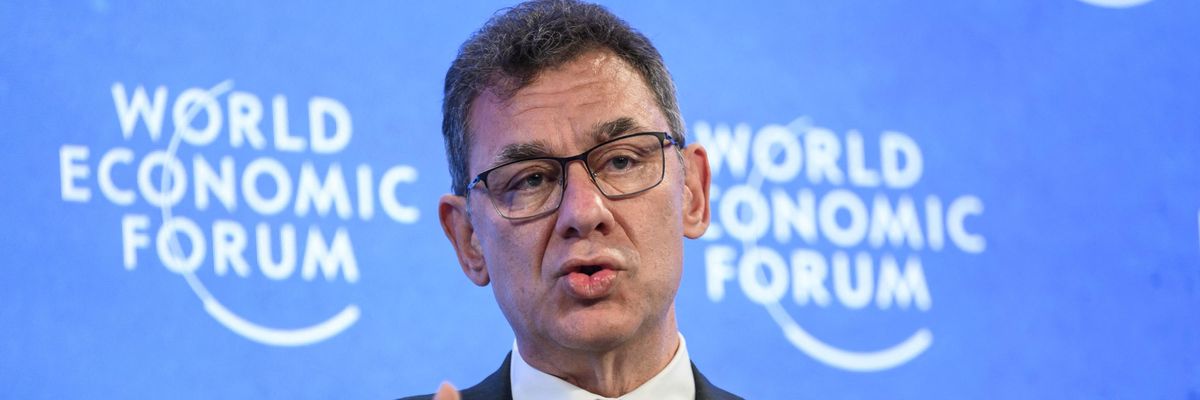
Public health campaigners responded with a mixture of skepticism and outrage to Pfizer's vow Wednesday to sell 23 of its patent-protected medicines and vaccines--including its publicly funded coronavirus shot and pill--to lower-income countries at a not-for-profit price.
"Pfizer has calculated that this move will ease the heat generated by its appalling conduct over the last two years."
Unveiled at the annual gathering of business elites in Davos, Switzerland, Pfizer CEO Albert Bourla's pledge comes more than two years into a pandemic that has killed more than 15 million people worldwide and pushed tens of millions into poverty.
Pfizer--which makes one of the two available mRNA-based coronavirus vaccines--has raked in huge profits during the global public health disaster as the company continues to fight attempts to lift patents and make the lifesaving shots widely available in low-income countries. Earlier this month, Pfizer reported $7.86 billion in net income for the first quarter of 2022.
"This is all too little, too late for the millions who died while Pfizer made record profits," Julia Kosgei, policy adviser at the People's Vaccine Alliance, said in response to the U.S.-based pharmaceutical giant's new pledge, which will include 27 low-income countries and 18 lower-middle-income nations.
Rwanda, Ghana, Malawi, Senegal, and Uganda were the first to join Pfizer's "Accord for a Healthier World," whose stated aim is to make "23 medicines and vaccines that treat infectious diseases, certain cancers, and rare and inflammatory diseases" more "readily available" and affordable in poor countries.
Last year, the People's Vaccine Alliance estimated that Pfizer was charging the African Union roughly six times more than the production cost of its coronavirus vaccine, which was developed with government funding.
Kosgei and other critics suggested that Pfizer's new initiative is motivated more by the company's desire to shake its reputation as a major contributor to inequities in coronavirus vaccine access than by genuine humanitarian goals.
As the Wall Street Journal reported, the project likely won't cost Pfizer much and "could provide long-term benefits for the industry, helping build a potentially large new market for prescription drugs and vaccines."
"After prioritizing selling higher-priced doses to rich countries through the pandemic while millions died without access to Covid-19 vaccines and treatments, Albert Bourla seems keen to improve Pfizer's reputation," said Kosgei. "But taking half-measures on equity won't cut it."
Related Content

According to Our World in Data, just 16.2% of people in low-income countries have received at least one Covid-19 vaccine dose. By contrast, nearly 80% of people in high-income countries have gotten at least one dose.
Despite that massive gap, Pfizer has refused to share its vaccine recipe--a portion of which was revealed in a leaked contract last year--and lobbied aggressively against India and South Africa's original proposal to waive patent protections for vaccines and therapeutics for the duration of the pandemic.
Such a waiver, proponents argue, would empower lower-income countries to produce their own vaccines and treatments without fear of legal retribution from Big Pharma.
"It's right that some countries will not have to pay Pfizer's rip-off prices for certain vaccines and treatments," Kosgei said Wednesday. "But Pfizer is once again gate-keeping who can and can't manufacture and access these lifesaving vaccines and medicines. Many lower-middle and middle-income countries will continue to pay through the nose for lifesaving drugs they can't afford."
"We shouldn't hail pandemic profiteers as heroes, even when they make qualified gestures like this," she added. "We are weeks away from an important vote on pharma intellectual property at the World Trade Organization. And Pfizer has calculated that this move will ease the heat generated by its appalling conduct over the last two years."
The World Trade Organization is currently considering a severely watered-down proposal that has been presented as an alternative to India and South Africa's original patent waiver proposal, which rich nations blocked.
Dimitri Eynikel, an adviser with Doctors Without Borders' Access Campaign, argued Wednesday that patent waiver talks at the WTO over the past year and a half have helped "push pharma companies to do more for global access to medical tools."
"Yet, announcements are often limited, aspirational, and on their terms," Eynikel added. "This should not be the case. Governments need to be equipped with a waiver to ensure supply."
Public health campaigners responded with a mixture of skepticism and outrage to Pfizer's vow Wednesday to sell 23 of its patent-protected medicines and vaccines--including its publicly funded coronavirus shot and pill--to lower-income countries at a not-for-profit price.
"Pfizer has calculated that this move will ease the heat generated by its appalling conduct over the last two years."
Unveiled at the annual gathering of business elites in Davos, Switzerland, Pfizer CEO Albert Bourla's pledge comes more than two years into a pandemic that has killed more than 15 million people worldwide and pushed tens of millions into poverty.
Pfizer--which makes one of the two available mRNA-based coronavirus vaccines--has raked in huge profits during the global public health disaster as the company continues to fight attempts to lift patents and make the lifesaving shots widely available in low-income countries. Earlier this month, Pfizer reported $7.86 billion in net income for the first quarter of 2022.
"This is all too little, too late for the millions who died while Pfizer made record profits," Julia Kosgei, policy adviser at the People's Vaccine Alliance, said in response to the U.S.-based pharmaceutical giant's new pledge, which will include 27 low-income countries and 18 lower-middle-income nations.
Rwanda, Ghana, Malawi, Senegal, and Uganda were the first to join Pfizer's "Accord for a Healthier World," whose stated aim is to make "23 medicines and vaccines that treat infectious diseases, certain cancers, and rare and inflammatory diseases" more "readily available" and affordable in poor countries.
Last year, the People's Vaccine Alliance estimated that Pfizer was charging the African Union roughly six times more than the production cost of its coronavirus vaccine, which was developed with government funding.
Kosgei and other critics suggested that Pfizer's new initiative is motivated more by the company's desire to shake its reputation as a major contributor to inequities in coronavirus vaccine access than by genuine humanitarian goals.
As the Wall Street Journal reported, the project likely won't cost Pfizer much and "could provide long-term benefits for the industry, helping build a potentially large new market for prescription drugs and vaccines."
"After prioritizing selling higher-priced doses to rich countries through the pandemic while millions died without access to Covid-19 vaccines and treatments, Albert Bourla seems keen to improve Pfizer's reputation," said Kosgei. "But taking half-measures on equity won't cut it."
Related Content
According to Our World in Data, just 16.2% of people in low-income countries have received at least one Covid-19 vaccine dose. By contrast, nearly 80% of people in high-income countries have gotten at least one dose.
Despite that massive gap, Pfizer has refused to share its vaccine recipe--a portion of which was revealed in a leaked contract last year--and lobbied aggressively against India and South Africa's original proposal to waive patent protections for vaccines and therapeutics for the duration of the pandemic.
Such a waiver, proponents argue, would empower lower-income countries to produce their own vaccines and treatments without fear of legal retribution from Big Pharma.
"It's right that some countries will not have to pay Pfizer's rip-off prices for certain vaccines and treatments," Kosgei said Wednesday. "But Pfizer is once again gate-keeping who can and can't manufacture and access these lifesaving vaccines and medicines. Many lower-middle and middle-income countries will continue to pay through the nose for lifesaving drugs they can't afford."
"We shouldn't hail pandemic profiteers as heroes, even when they make qualified gestures like this," she added. "We are weeks away from an important vote on pharma intellectual property at the World Trade Organization. And Pfizer has calculated that this move will ease the heat generated by its appalling conduct over the last two years."
The World Trade Organization is currently considering a severely watered-down proposal that has been presented as an alternative to India and South Africa's original patent waiver proposal, which rich nations blocked.
Dimitri Eynikel, an adviser with Doctors Without Borders' Access Campaign, argued Wednesday that patent waiver talks at the WTO over the past year and a half have helped "push pharma companies to do more for global access to medical tools."
"Yet, announcements are often limited, aspirational, and on their terms," Eynikel added. "This should not be the case. Governments need to be equipped with a waiver to ensure supply."
Public health campaigners responded with a mixture of skepticism and outrage to Pfizer's vow Wednesday to sell 23 of its patent-protected medicines and vaccines--including its publicly funded coronavirus shot and pill--to lower-income countries at a not-for-profit price.
"Pfizer has calculated that this move will ease the heat generated by its appalling conduct over the last two years."
Unveiled at the annual gathering of business elites in Davos, Switzerland, Pfizer CEO Albert Bourla's pledge comes more than two years into a pandemic that has killed more than 15 million people worldwide and pushed tens of millions into poverty.
Pfizer--which makes one of the two available mRNA-based coronavirus vaccines--has raked in huge profits during the global public health disaster as the company continues to fight attempts to lift patents and make the lifesaving shots widely available in low-income countries. Earlier this month, Pfizer reported $7.86 billion in net income for the first quarter of 2022.
"This is all too little, too late for the millions who died while Pfizer made record profits," Julia Kosgei, policy adviser at the People's Vaccine Alliance, said in response to the U.S.-based pharmaceutical giant's new pledge, which will include 27 low-income countries and 18 lower-middle-income nations.
Rwanda, Ghana, Malawi, Senegal, and Uganda were the first to join Pfizer's "Accord for a Healthier World," whose stated aim is to make "23 medicines and vaccines that treat infectious diseases, certain cancers, and rare and inflammatory diseases" more "readily available" and affordable in poor countries.
Last year, the People's Vaccine Alliance estimated that Pfizer was charging the African Union roughly six times more than the production cost of its coronavirus vaccine, which was developed with government funding.
Kosgei and other critics suggested that Pfizer's new initiative is motivated more by the company's desire to shake its reputation as a major contributor to inequities in coronavirus vaccine access than by genuine humanitarian goals.
As the Wall Street Journal reported, the project likely won't cost Pfizer much and "could provide long-term benefits for the industry, helping build a potentially large new market for prescription drugs and vaccines."
"After prioritizing selling higher-priced doses to rich countries through the pandemic while millions died without access to Covid-19 vaccines and treatments, Albert Bourla seems keen to improve Pfizer's reputation," said Kosgei. "But taking half-measures on equity won't cut it."
Related Content
According to Our World in Data, just 16.2% of people in low-income countries have received at least one Covid-19 vaccine dose. By contrast, nearly 80% of people in high-income countries have gotten at least one dose.
Despite that massive gap, Pfizer has refused to share its vaccine recipe--a portion of which was revealed in a leaked contract last year--and lobbied aggressively against India and South Africa's original proposal to waive patent protections for vaccines and therapeutics for the duration of the pandemic.
Such a waiver, proponents argue, would empower lower-income countries to produce their own vaccines and treatments without fear of legal retribution from Big Pharma.
"It's right that some countries will not have to pay Pfizer's rip-off prices for certain vaccines and treatments," Kosgei said Wednesday. "But Pfizer is once again gate-keeping who can and can't manufacture and access these lifesaving vaccines and medicines. Many lower-middle and middle-income countries will continue to pay through the nose for lifesaving drugs they can't afford."
"We shouldn't hail pandemic profiteers as heroes, even when they make qualified gestures like this," she added. "We are weeks away from an important vote on pharma intellectual property at the World Trade Organization. And Pfizer has calculated that this move will ease the heat generated by its appalling conduct over the last two years."
The World Trade Organization is currently considering a severely watered-down proposal that has been presented as an alternative to India and South Africa's original patent waiver proposal, which rich nations blocked.
Dimitri Eynikel, an adviser with Doctors Without Borders' Access Campaign, argued Wednesday that patent waiver talks at the WTO over the past year and a half have helped "push pharma companies to do more for global access to medical tools."
"Yet, announcements are often limited, aspirational, and on their terms," Eynikel added. "This should not be the case. Governments need to be equipped with a waiver to ensure supply."