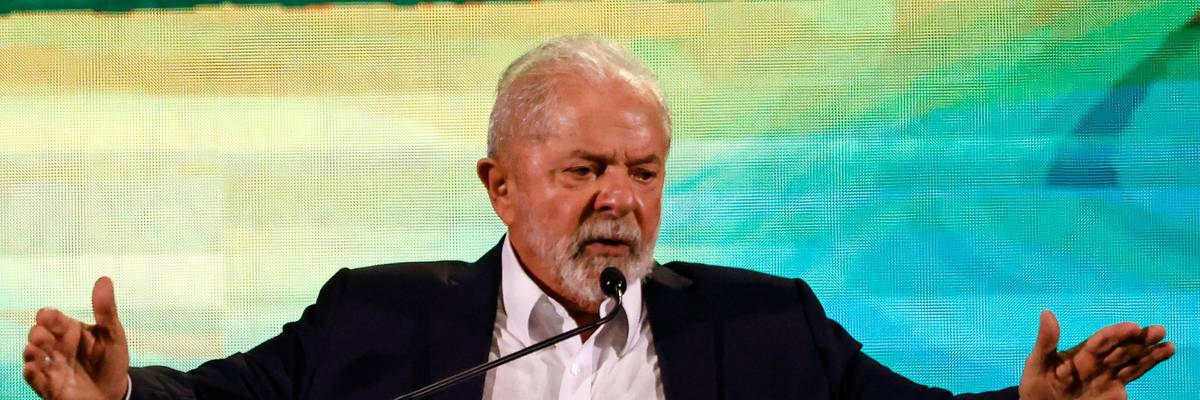
Luiz Inacio Lula da Silva formally launches his presidential campaign in Sao Paulo, Brazil on May 7, 2022. (Photo: Nelson Almeida/AFP via Getty Images)
Lula Launches Campaign to Unseat Far-Right Brazilian President Jair Bolsonaro
"Brazil will have the opportunity to decide which country it will be for the next few years, and for generations to come," said Luiz Inácio Lula da Silva. "The Brazil of democracy or authoritarianism?"
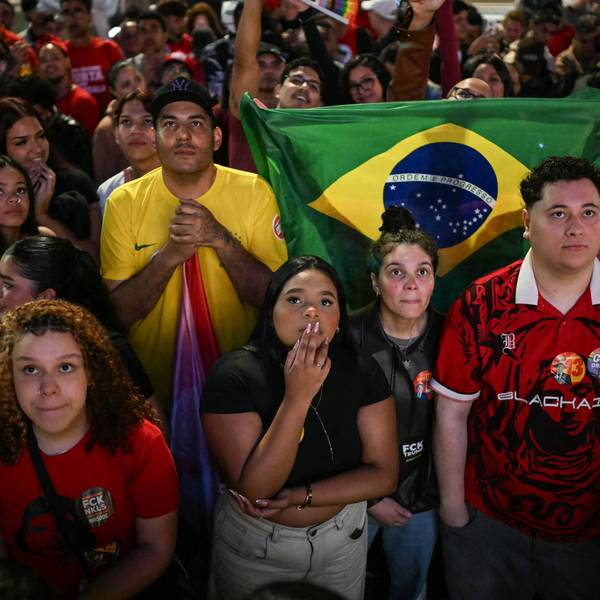
Speaking to a crowd of supporters and allies gathered in Sao Paulo on Saturday, Luiz Inacio Lula da Silva officially launched his campaign to unseat far-right Brazilian President Jair Bolsonaro, whose three-year tenure has accelerated the destruction of the Amazon rainforest and intensified the nation's myriad human rights crises.
"Everything that we did is being destroyed by this government," said Lula, a globally renowned leftist who served as Brazil's president from 2003 to 2010 and departed office with a striking 83% approval rating. Extreme poverty fell sharply during Lula's presidency, owing in large part to his implementation and expansion of safety-net programs that included cash transfers and unemployment insurance.
"There is no greater force than the hope of a people who know they can be happy again."
But today, poverty, hunger, and homelessness remain at alarming levels in Brazil, one of the most unequal countries in the world. The coronavirus pandemic--which Bolsonaro has repeatedly downplayed despite Brazil's staggering death toll--has made the nation's preexisting crises far worse.
While the Bolsonaro government spent billions of dollars on a basic income program in 2020 to help vulnerable people weather the public health emergency, funding for the initiative quickly dried up, hurling millions back into poverty.
Bolsonaro's handling of the pandemic and its reverberating societal impacts has been so catastrophic, according to his critics, that he should be tried for crimes against humanity.
Lula, who was released in 2019 after spending more than a year in prison on politically motivated corruption charges, declared Saturday that with the October presidential election, "Brazil will have the opportunity to decide which country it will be for the next few years, and for generations to come."
"The Brazil of democracy or authoritarianism? Of knowledge and tolerance or of obscurantism and violence? Of education and culture or of revolvers and rifles?" said the former president. "We have a dream. And there is no greater force than the hope of a people who know they can be happy again. That you can eat well again, have a good job, a decent salary, and rights. That you can improve your life and see your children growing up healthy."
Polling conducted in recent weeks indicates that Lula is favored to defeat Bolsonaro in the October election, but fears are mounting that the far-right incumbent could attempt to cast doubt on the legitimacy of the election, following a playbook used by his U.S. ally Donald Trump.
"Will the result be accepted? And, if we win, will there be a peaceful transition?"
"Bolsonaro has said his party will seek an audit of the country's electronic voting system ahead of the upcoming elections in October," Al Jazeera reported Friday. "The move comes as the far-right leader has for months questioned the validity of the country's voting systems, a campaign that has coincided with his plunging approval ratings and directly contradicts election officials and experts."
The Brazilian president's incendiary rhetoric has also put observers on edge. "An armed population will never be enslaved," Bolsonaro said during a recent rally. Late last month, as Reuters reported, Bolsonaro "suggested the military should conduct its own parallel ballot count alongside" Brazil's federal electoral court.
Natalia Bonavides, a congresswoman for Lula's Workers' Party, cautioned against dismissing Bolsonaro's threats as mere bluster.
"I think it's a mistake to think anything Bolsonaro says is simply bravado," Bonavides told The Guardian. "All you have to do is look at what happened in the United States to see how what is supposedly bravado can become action... and can even get people killed."
"These are going to be hard, possibly violent elections--and what happens after them will be really important," she added. "Will the result be accepted? And, if we win, will there be a peaceful transition?"
We are at a crossroads
This country and this world are at a monumental crossroads. In a few short weeks, US voters will have an opportunity to beat back the forces of fascism and confront the billionaires who are rigging the economy, our media system, and our democracy, making it increasingly impossible for ordinary people to get by. We’re not just talking about the election. We’re talking about what must be done once these fascist elements are vanquished from power. We need a bolder set of solutions than what either major party has so far been willing to offer and a working-class movement ready to fight like hell for it. Trump didn't emerge from nowhere. The conditions that fueled MAGA authoritarianism were created by decades of radical neoliberal economic policies and a corrupt political system dominated by corporate interests. They slashed taxes on the super-rich, promising that the benefits would trickle down. They said giveaways to the corporate titans would make life more affordable for the rest of us. It was all bullshit. And when a bitter, betrayed populace searches for someone to blame, right-wing demagogues have little trouble finding scapegoats. People know when they're being lied to, but you won't hear any of this from the corporate media. Only independent journalism—powered and funded by people who believe in building a better world—can deliver truly trustworthy daily news. Our Fall Campaign is underway, and we need your help. To power our newsroom through the rest of the year, we need to raise $125,000 by midnight on October 31. So if you share our vision, please contribute whatever you can to sustain our work. |
Speaking to a crowd of supporters and allies gathered in Sao Paulo on Saturday, Luiz Inacio Lula da Silva officially launched his campaign to unseat far-right Brazilian President Jair Bolsonaro, whose three-year tenure has accelerated the destruction of the Amazon rainforest and intensified the nation's myriad human rights crises.
"Everything that we did is being destroyed by this government," said Lula, a globally renowned leftist who served as Brazil's president from 2003 to 2010 and departed office with a striking 83% approval rating. Extreme poverty fell sharply during Lula's presidency, owing in large part to his implementation and expansion of safety-net programs that included cash transfers and unemployment insurance.
"There is no greater force than the hope of a people who know they can be happy again."
But today, poverty, hunger, and homelessness remain at alarming levels in Brazil, one of the most unequal countries in the world. The coronavirus pandemic--which Bolsonaro has repeatedly downplayed despite Brazil's staggering death toll--has made the nation's preexisting crises far worse.
While the Bolsonaro government spent billions of dollars on a basic income program in 2020 to help vulnerable people weather the public health emergency, funding for the initiative quickly dried up, hurling millions back into poverty.
Bolsonaro's handling of the pandemic and its reverberating societal impacts has been so catastrophic, according to his critics, that he should be tried for crimes against humanity.
Lula, who was released in 2019 after spending more than a year in prison on politically motivated corruption charges, declared Saturday that with the October presidential election, "Brazil will have the opportunity to decide which country it will be for the next few years, and for generations to come."
"The Brazil of democracy or authoritarianism? Of knowledge and tolerance or of obscurantism and violence? Of education and culture or of revolvers and rifles?" said the former president. "We have a dream. And there is no greater force than the hope of a people who know they can be happy again. That you can eat well again, have a good job, a decent salary, and rights. That you can improve your life and see your children growing up healthy."
Polling conducted in recent weeks indicates that Lula is favored to defeat Bolsonaro in the October election, but fears are mounting that the far-right incumbent could attempt to cast doubt on the legitimacy of the election, following a playbook used by his U.S. ally Donald Trump.
"Will the result be accepted? And, if we win, will there be a peaceful transition?"
"Bolsonaro has said his party will seek an audit of the country's electronic voting system ahead of the upcoming elections in October," Al Jazeera reported Friday. "The move comes as the far-right leader has for months questioned the validity of the country's voting systems, a campaign that has coincided with his plunging approval ratings and directly contradicts election officials and experts."
The Brazilian president's incendiary rhetoric has also put observers on edge. "An armed population will never be enslaved," Bolsonaro said during a recent rally. Late last month, as Reuters reported, Bolsonaro "suggested the military should conduct its own parallel ballot count alongside" Brazil's federal electoral court.
Natalia Bonavides, a congresswoman for Lula's Workers' Party, cautioned against dismissing Bolsonaro's threats as mere bluster.
"I think it's a mistake to think anything Bolsonaro says is simply bravado," Bonavides told The Guardian. "All you have to do is look at what happened in the United States to see how what is supposedly bravado can become action... and can even get people killed."
"These are going to be hard, possibly violent elections--and what happens after them will be really important," she added. "Will the result be accepted? And, if we win, will there be a peaceful transition?"
Speaking to a crowd of supporters and allies gathered in Sao Paulo on Saturday, Luiz Inacio Lula da Silva officially launched his campaign to unseat far-right Brazilian President Jair Bolsonaro, whose three-year tenure has accelerated the destruction of the Amazon rainforest and intensified the nation's myriad human rights crises.
"Everything that we did is being destroyed by this government," said Lula, a globally renowned leftist who served as Brazil's president from 2003 to 2010 and departed office with a striking 83% approval rating. Extreme poverty fell sharply during Lula's presidency, owing in large part to his implementation and expansion of safety-net programs that included cash transfers and unemployment insurance.
"There is no greater force than the hope of a people who know they can be happy again."
But today, poverty, hunger, and homelessness remain at alarming levels in Brazil, one of the most unequal countries in the world. The coronavirus pandemic--which Bolsonaro has repeatedly downplayed despite Brazil's staggering death toll--has made the nation's preexisting crises far worse.
While the Bolsonaro government spent billions of dollars on a basic income program in 2020 to help vulnerable people weather the public health emergency, funding for the initiative quickly dried up, hurling millions back into poverty.
Bolsonaro's handling of the pandemic and its reverberating societal impacts has been so catastrophic, according to his critics, that he should be tried for crimes against humanity.
Lula, who was released in 2019 after spending more than a year in prison on politically motivated corruption charges, declared Saturday that with the October presidential election, "Brazil will have the opportunity to decide which country it will be for the next few years, and for generations to come."
"The Brazil of democracy or authoritarianism? Of knowledge and tolerance or of obscurantism and violence? Of education and culture or of revolvers and rifles?" said the former president. "We have a dream. And there is no greater force than the hope of a people who know they can be happy again. That you can eat well again, have a good job, a decent salary, and rights. That you can improve your life and see your children growing up healthy."
Polling conducted in recent weeks indicates that Lula is favored to defeat Bolsonaro in the October election, but fears are mounting that the far-right incumbent could attempt to cast doubt on the legitimacy of the election, following a playbook used by his U.S. ally Donald Trump.
"Will the result be accepted? And, if we win, will there be a peaceful transition?"
"Bolsonaro has said his party will seek an audit of the country's electronic voting system ahead of the upcoming elections in October," Al Jazeera reported Friday. "The move comes as the far-right leader has for months questioned the validity of the country's voting systems, a campaign that has coincided with his plunging approval ratings and directly contradicts election officials and experts."
The Brazilian president's incendiary rhetoric has also put observers on edge. "An armed population will never be enslaved," Bolsonaro said during a recent rally. Late last month, as Reuters reported, Bolsonaro "suggested the military should conduct its own parallel ballot count alongside" Brazil's federal electoral court.
Natalia Bonavides, a congresswoman for Lula's Workers' Party, cautioned against dismissing Bolsonaro's threats as mere bluster.
"I think it's a mistake to think anything Bolsonaro says is simply bravado," Bonavides told The Guardian. "All you have to do is look at what happened in the United States to see how what is supposedly bravado can become action... and can even get people killed."
"These are going to be hard, possibly violent elections--and what happens after them will be really important," she added. "Will the result be accepted? And, if we win, will there be a peaceful transition?"