SUBSCRIBE TO OUR FREE NEWSLETTER
Daily news & progressive opinion—funded by the people, not the corporations—delivered straight to your inbox.
5
#000000
#FFFFFF
To donate by check, phone, or other method, see our More Ways to Give page.
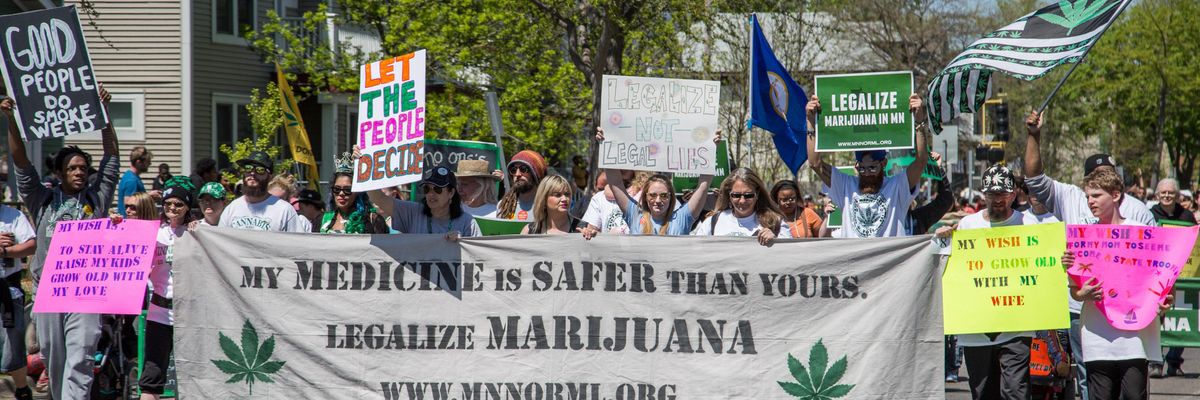
Legalizing recreational marijuana lowers demand for prescription drugs through state Medicaid programs, according to a new study by researchers in New York and Indiana.
"Our results suggest substitution away from prescription drugs and potential cost savings for state Medicaid programs."
Shyam Raman, a doctoral student at the Cornell Jeb E. Brooks School of Public Policy, and Indiana University doctoral student Ashley Bradford reviewed quarterly data for all Medicaid prescriptions from 2011 to 2019 to analyze the association between recreational cannabis laws and prescription drug use.
In an article published last week in the journal Health Economics, the researchers wrote that "we find significant reductions in the volume of prescriptions within the drug classes that align with the medical indications for pain, depression, anxiety, sleep, psychosis, and seizures."
"Our results suggest substitution away from prescription drugs and potential cost savings for state Medicaid programs," they added.
Previous studies have shown reductions in prescription drug use in states with medical marijuana laws. For example, a 2020 paper by researchers at Columbia University's Irving Medical Center revealed a 20% drop in certain opioid prescriptions in states where medical cannabis use was legal compared with states that prohibited it.
However, this is one of the first studies to examine the impact of legal recreational marijuana on a wide range of prescription medications, according to Cornell Chronicle.
"These results have important implications," Raman told the paper. "The reductions in drug utilization that we find could lead to significant cost savings for state Medicaid programs. The results also indicate an opportunity to reduce the harm that can come with the dangerous side effects associated with some prescription drugs."
Related Content

According to the National Conference of State Legislatures, marijuana is legal for adult recreational use in 18 states plus the District of Columbia, while 37 states have legalized medical cannabis. On April 1, the U.S. House of Representatives voted to decriminalize the plant nationwide and expunge federal cannabis convictions and arrests. However, the measure faces an uphill battle in the Senate.
Legalizing recreational marijuana lowers demand for prescription drugs through state Medicaid programs, according to a new study by researchers in New York and Indiana.
"Our results suggest substitution away from prescription drugs and potential cost savings for state Medicaid programs."
Shyam Raman, a doctoral student at the Cornell Jeb E. Brooks School of Public Policy, and Indiana University doctoral student Ashley Bradford reviewed quarterly data for all Medicaid prescriptions from 2011 to 2019 to analyze the association between recreational cannabis laws and prescription drug use.
In an article published last week in the journal Health Economics, the researchers wrote that "we find significant reductions in the volume of prescriptions within the drug classes that align with the medical indications for pain, depression, anxiety, sleep, psychosis, and seizures."
"Our results suggest substitution away from prescription drugs and potential cost savings for state Medicaid programs," they added.
Previous studies have shown reductions in prescription drug use in states with medical marijuana laws. For example, a 2020 paper by researchers at Columbia University's Irving Medical Center revealed a 20% drop in certain opioid prescriptions in states where medical cannabis use was legal compared with states that prohibited it.
However, this is one of the first studies to examine the impact of legal recreational marijuana on a wide range of prescription medications, according to Cornell Chronicle.
"These results have important implications," Raman told the paper. "The reductions in drug utilization that we find could lead to significant cost savings for state Medicaid programs. The results also indicate an opportunity to reduce the harm that can come with the dangerous side effects associated with some prescription drugs."
Related Content
According to the National Conference of State Legislatures, marijuana is legal for adult recreational use in 18 states plus the District of Columbia, while 37 states have legalized medical cannabis. On April 1, the U.S. House of Representatives voted to decriminalize the plant nationwide and expunge federal cannabis convictions and arrests. However, the measure faces an uphill battle in the Senate.
Legalizing recreational marijuana lowers demand for prescription drugs through state Medicaid programs, according to a new study by researchers in New York and Indiana.
"Our results suggest substitution away from prescription drugs and potential cost savings for state Medicaid programs."
Shyam Raman, a doctoral student at the Cornell Jeb E. Brooks School of Public Policy, and Indiana University doctoral student Ashley Bradford reviewed quarterly data for all Medicaid prescriptions from 2011 to 2019 to analyze the association between recreational cannabis laws and prescription drug use.
In an article published last week in the journal Health Economics, the researchers wrote that "we find significant reductions in the volume of prescriptions within the drug classes that align with the medical indications for pain, depression, anxiety, sleep, psychosis, and seizures."
"Our results suggest substitution away from prescription drugs and potential cost savings for state Medicaid programs," they added.
Previous studies have shown reductions in prescription drug use in states with medical marijuana laws. For example, a 2020 paper by researchers at Columbia University's Irving Medical Center revealed a 20% drop in certain opioid prescriptions in states where medical cannabis use was legal compared with states that prohibited it.
However, this is one of the first studies to examine the impact of legal recreational marijuana on a wide range of prescription medications, according to Cornell Chronicle.
"These results have important implications," Raman told the paper. "The reductions in drug utilization that we find could lead to significant cost savings for state Medicaid programs. The results also indicate an opportunity to reduce the harm that can come with the dangerous side effects associated with some prescription drugs."
Related Content
According to the National Conference of State Legislatures, marijuana is legal for adult recreational use in 18 states plus the District of Columbia, while 37 states have legalized medical cannabis. On April 1, the U.S. House of Representatives voted to decriminalize the plant nationwide and expunge federal cannabis convictions and arrests. However, the measure faces an uphill battle in the Senate.