

SUBSCRIBE TO OUR FREE NEWSLETTER
Daily news & progressive opinion—funded by the people, not the corporations—delivered straight to your inbox.
5
#000000
#FFFFFF
To donate by check, phone, or other method, see our More Ways to Give page.
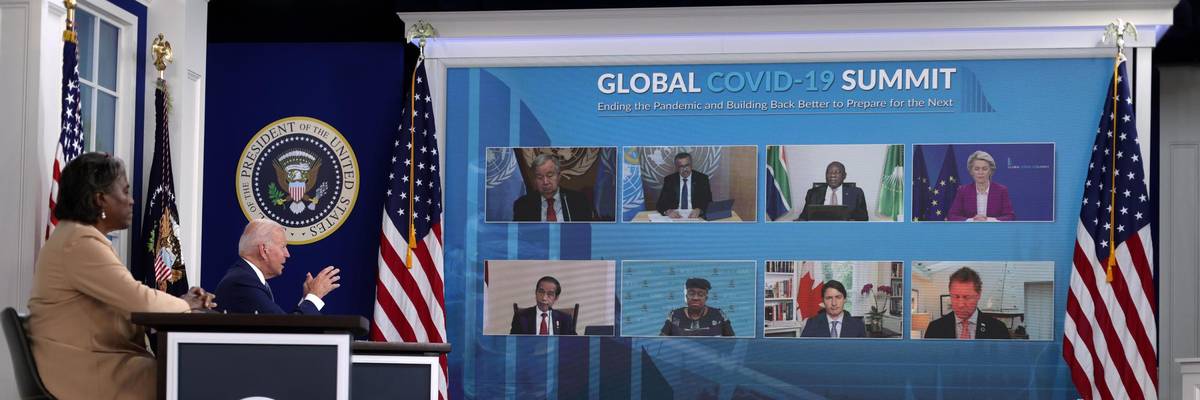
As the White House on Monday announced the convening of a Second Global Covid-19 Summit next month, a leading public health advocate called U.S. President Joe Biden's response to the crisis "late and anemic," while urging his administration to "fight like hell" for congressionally imperiled funding to combat the ongoing pandemic.
"Five billion dollars is the bare minimum; far less than what is needed. The White House needs to fight like hell for that money and much more."
The governments hosting the summit--the United States, Belize, Germany, Indonesia, and Senegal--said in a joint statement that the May 12 virtual conference "will redouble our collective efforts to end the acute phase of the Covid-19 pandemic and prepare for future health threats."
The co-hosts said the conference will "build on the themes and commitments" made at the first Global Covid-19 Summit, which was hosted virtually by Biden last September. Top agenda items include "getting shots in arms," as well as increasing testing and treatment, expanding and protecting health workers, boosting local manufacturing of "medical countermeasures," and funding preparedness for future pandemics.
At last year's summit, Biden promised the United States would become the world's "arsenal for vaccines" and would donate 1.1 billion Covid-19 doses of the inoculations to the developing world by 2023. An analysis published last month by the consumer advocacy group Public Citizen warned that the administration was likely to miss even that modest goal unless it increased donations by 50%.
Peter Maybarduk, director of Public Citizen's Access to Medicines program, asserted Monday that the summit is "late and necessary."
"The U.S. could show up empty-handed to its own summit, making it harder to summon commitments, unless Congress funds the global fight," he warned.
Last month, the House of Representatives slashed $5 billion in proposed global pandemic response funding from an omnibus spending bill, money the administration had requested to carry out its National Covid-19 Preparedness Plan. Without that funding, the administration's program to combat the pandemic around the world is in danger of stalling.
At the time Maybarduk called the cut "a choice to extend the pandemic."
"Five billion dollars is the bare minimum; far less than what is needed," he warned on Monday. "The White House needs to fight like hell for that money and much more."
News of the second summit comes as the World Health Organization reportedly prepares to release an estimate based on more than a year of research that around 15 million people worldwide have died during the pandemic.
Related Content

At last year's summit, Biden called upon the world's nations to work toward vaccinating 70% of the world's population within a year. Experts warned that the summit's goals fell far short of what was needed to end the pandemic and downplayed the obligations of wealthy nations to end vaccine, testing, and treatment apartheid caused by government policies more aligned with the interests of the pharmaceutical industry than with global public health.
According to the Johns Hopkins University Coronavirus Resource Center, 4.4 billion people, or 57.8% of the world's population, have been fully vaccinated against the coronavirus. However, inoculation rates are far lower in much of the Global South. In 16 nations--13 of them in sub-Saharan Africa--less than 10% of the population has been fully vaccinated. In Haiti, the rate is 1.02%. In Burundi, it's less than one-tenth of one percent.
A February 22 Lancet article noted:
Widening gaps in global vaccine equity have led to a two-track pandemic with booster Covid-19 vaccinations proliferating in high-income countries... and first doses not yet reaching all populations in low-income countries. Early in the pandemic, the Covid-19 Vaccines Global Access Facility (COVAX) promised equitable vaccine supplies for all countries. However, with insufficient funds and donations, COVAX has faltered, failing to meet even half of its 2021 target of delivering two billion doses.
"As we enter the third year of the pandemic and the new Omicron variant emerges, we recognize that the pandemic has been prolonged by corporate greed and vaccine inequity endorsed by many of our world leaders," Rhiannon Osborne and Dr. Marie-Claire Wangari wrote in a report published last month.
"The pandemic has been prolonged by corporate greed and vaccine inequity endorsed by many of our world leaders."
"To date, the insufficient vaccine supply to countries in the Global South has led to many preventable deaths," they continued." Rich countries have hoarded vaccine doses, leaving other countries without the protection they need and having to rely on donations. Despite public funding of vaccine research and development, pharma monopolies are still not waiving intellectual property rights for the Covid-19 vaccine, which would save lives."
While more than 100 countries--including a handful of wealthy nations like the United States and France--support a proposal by India and South Africa to waive parts of the Agreement on Trade-Related Aspects of Intellectual Property Rights (TRIPS), the European Union, as well as rich countries such as the United Kingdom, Norway, Singapore, and Switzerland, have fought to block its adoption.
As the White House on Monday announced the convening of a Second Global Covid-19 Summit next month, a leading public health advocate called U.S. President Joe Biden's response to the crisis "late and anemic," while urging his administration to "fight like hell" for congressionally imperiled funding to combat the ongoing pandemic.
"Five billion dollars is the bare minimum; far less than what is needed. The White House needs to fight like hell for that money and much more."
The governments hosting the summit--the United States, Belize, Germany, Indonesia, and Senegal--said in a joint statement that the May 12 virtual conference "will redouble our collective efforts to end the acute phase of the Covid-19 pandemic and prepare for future health threats."
The co-hosts said the conference will "build on the themes and commitments" made at the first Global Covid-19 Summit, which was hosted virtually by Biden last September. Top agenda items include "getting shots in arms," as well as increasing testing and treatment, expanding and protecting health workers, boosting local manufacturing of "medical countermeasures," and funding preparedness for future pandemics.
At last year's summit, Biden promised the United States would become the world's "arsenal for vaccines" and would donate 1.1 billion Covid-19 doses of the inoculations to the developing world by 2023. An analysis published last month by the consumer advocacy group Public Citizen warned that the administration was likely to miss even that modest goal unless it increased donations by 50%.
Peter Maybarduk, director of Public Citizen's Access to Medicines program, asserted Monday that the summit is "late and necessary."
"The U.S. could show up empty-handed to its own summit, making it harder to summon commitments, unless Congress funds the global fight," he warned.
Last month, the House of Representatives slashed $5 billion in proposed global pandemic response funding from an omnibus spending bill, money the administration had requested to carry out its National Covid-19 Preparedness Plan. Without that funding, the administration's program to combat the pandemic around the world is in danger of stalling.
At the time Maybarduk called the cut "a choice to extend the pandemic."
"Five billion dollars is the bare minimum; far less than what is needed," he warned on Monday. "The White House needs to fight like hell for that money and much more."
News of the second summit comes as the World Health Organization reportedly prepares to release an estimate based on more than a year of research that around 15 million people worldwide have died during the pandemic.
Related Content
At last year's summit, Biden called upon the world's nations to work toward vaccinating 70% of the world's population within a year. Experts warned that the summit's goals fell far short of what was needed to end the pandemic and downplayed the obligations of wealthy nations to end vaccine, testing, and treatment apartheid caused by government policies more aligned with the interests of the pharmaceutical industry than with global public health.
According to the Johns Hopkins University Coronavirus Resource Center, 4.4 billion people, or 57.8% of the world's population, have been fully vaccinated against the coronavirus. However, inoculation rates are far lower in much of the Global South. In 16 nations--13 of them in sub-Saharan Africa--less than 10% of the population has been fully vaccinated. In Haiti, the rate is 1.02%. In Burundi, it's less than one-tenth of one percent.
A February 22 Lancet article noted:
Widening gaps in global vaccine equity have led to a two-track pandemic with booster Covid-19 vaccinations proliferating in high-income countries... and first doses not yet reaching all populations in low-income countries. Early in the pandemic, the Covid-19 Vaccines Global Access Facility (COVAX) promised equitable vaccine supplies for all countries. However, with insufficient funds and donations, COVAX has faltered, failing to meet even half of its 2021 target of delivering two billion doses.
"As we enter the third year of the pandemic and the new Omicron variant emerges, we recognize that the pandemic has been prolonged by corporate greed and vaccine inequity endorsed by many of our world leaders," Rhiannon Osborne and Dr. Marie-Claire Wangari wrote in a report published last month.
"The pandemic has been prolonged by corporate greed and vaccine inequity endorsed by many of our world leaders."
"To date, the insufficient vaccine supply to countries in the Global South has led to many preventable deaths," they continued." Rich countries have hoarded vaccine doses, leaving other countries without the protection they need and having to rely on donations. Despite public funding of vaccine research and development, pharma monopolies are still not waiving intellectual property rights for the Covid-19 vaccine, which would save lives."
While more than 100 countries--including a handful of wealthy nations like the United States and France--support a proposal by India and South Africa to waive parts of the Agreement on Trade-Related Aspects of Intellectual Property Rights (TRIPS), the European Union, as well as rich countries such as the United Kingdom, Norway, Singapore, and Switzerland, have fought to block its adoption.
As the White House on Monday announced the convening of a Second Global Covid-19 Summit next month, a leading public health advocate called U.S. President Joe Biden's response to the crisis "late and anemic," while urging his administration to "fight like hell" for congressionally imperiled funding to combat the ongoing pandemic.
"Five billion dollars is the bare minimum; far less than what is needed. The White House needs to fight like hell for that money and much more."
The governments hosting the summit--the United States, Belize, Germany, Indonesia, and Senegal--said in a joint statement that the May 12 virtual conference "will redouble our collective efforts to end the acute phase of the Covid-19 pandemic and prepare for future health threats."
The co-hosts said the conference will "build on the themes and commitments" made at the first Global Covid-19 Summit, which was hosted virtually by Biden last September. Top agenda items include "getting shots in arms," as well as increasing testing and treatment, expanding and protecting health workers, boosting local manufacturing of "medical countermeasures," and funding preparedness for future pandemics.
At last year's summit, Biden promised the United States would become the world's "arsenal for vaccines" and would donate 1.1 billion Covid-19 doses of the inoculations to the developing world by 2023. An analysis published last month by the consumer advocacy group Public Citizen warned that the administration was likely to miss even that modest goal unless it increased donations by 50%.
Peter Maybarduk, director of Public Citizen's Access to Medicines program, asserted Monday that the summit is "late and necessary."
"The U.S. could show up empty-handed to its own summit, making it harder to summon commitments, unless Congress funds the global fight," he warned.
Last month, the House of Representatives slashed $5 billion in proposed global pandemic response funding from an omnibus spending bill, money the administration had requested to carry out its National Covid-19 Preparedness Plan. Without that funding, the administration's program to combat the pandemic around the world is in danger of stalling.
At the time Maybarduk called the cut "a choice to extend the pandemic."
"Five billion dollars is the bare minimum; far less than what is needed," he warned on Monday. "The White House needs to fight like hell for that money and much more."
News of the second summit comes as the World Health Organization reportedly prepares to release an estimate based on more than a year of research that around 15 million people worldwide have died during the pandemic.
Related Content
At last year's summit, Biden called upon the world's nations to work toward vaccinating 70% of the world's population within a year. Experts warned that the summit's goals fell far short of what was needed to end the pandemic and downplayed the obligations of wealthy nations to end vaccine, testing, and treatment apartheid caused by government policies more aligned with the interests of the pharmaceutical industry than with global public health.
According to the Johns Hopkins University Coronavirus Resource Center, 4.4 billion people, or 57.8% of the world's population, have been fully vaccinated against the coronavirus. However, inoculation rates are far lower in much of the Global South. In 16 nations--13 of them in sub-Saharan Africa--less than 10% of the population has been fully vaccinated. In Haiti, the rate is 1.02%. In Burundi, it's less than one-tenth of one percent.
A February 22 Lancet article noted:
Widening gaps in global vaccine equity have led to a two-track pandemic with booster Covid-19 vaccinations proliferating in high-income countries... and first doses not yet reaching all populations in low-income countries. Early in the pandemic, the Covid-19 Vaccines Global Access Facility (COVAX) promised equitable vaccine supplies for all countries. However, with insufficient funds and donations, COVAX has faltered, failing to meet even half of its 2021 target of delivering two billion doses.
"As we enter the third year of the pandemic and the new Omicron variant emerges, we recognize that the pandemic has been prolonged by corporate greed and vaccine inequity endorsed by many of our world leaders," Rhiannon Osborne and Dr. Marie-Claire Wangari wrote in a report published last month.
"The pandemic has been prolonged by corporate greed and vaccine inequity endorsed by many of our world leaders."
"To date, the insufficient vaccine supply to countries in the Global South has led to many preventable deaths," they continued." Rich countries have hoarded vaccine doses, leaving other countries without the protection they need and having to rely on donations. Despite public funding of vaccine research and development, pharma monopolies are still not waiving intellectual property rights for the Covid-19 vaccine, which would save lives."
While more than 100 countries--including a handful of wealthy nations like the United States and France--support a proposal by India and South Africa to waive parts of the Agreement on Trade-Related Aspects of Intellectual Property Rights (TRIPS), the European Union, as well as rich countries such as the United Kingdom, Norway, Singapore, and Switzerland, have fought to block its adoption.

