

SUBSCRIBE TO OUR FREE NEWSLETTER
Daily news & progressive opinion—funded by the people, not the corporations—delivered straight to your inbox.
5
#000000
#FFFFFF
To donate by check, phone, or other method, see our More Ways to Give page.
Daily news & progressive opinion—funded by the people, not the corporations—delivered straight to your inbox.
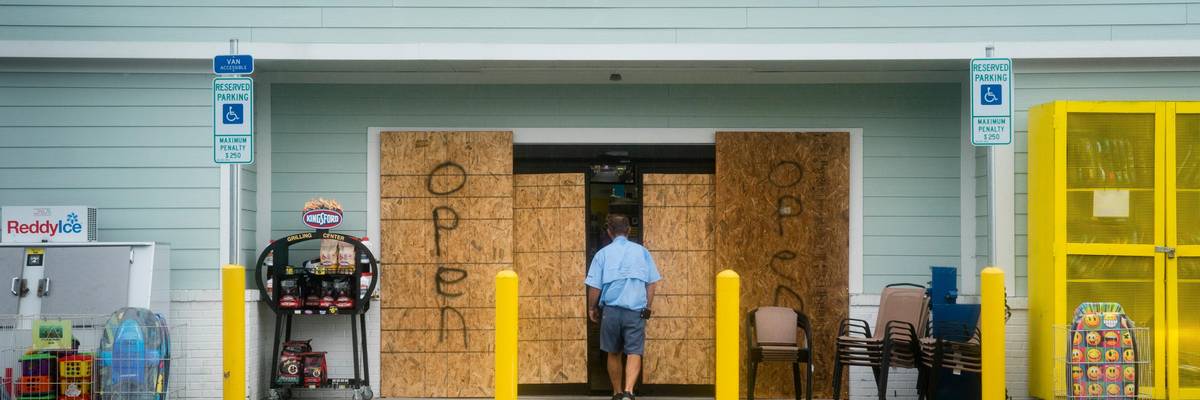
A man walks into a Dollar General on Wednesday, September 4, 2019 in Carolina Beach, N.C.
Dollar stores are exposing their customers to hundreds of hazardous chemicals contained in packaging, cookware, and even children's toys according to a study released Tuesday.
The findings from the Campaign for Healthier Solutions and the Ecology Center's Healthy Stuff Lab come as dollar store chains have expanded across the U.S. in recent years as consumers have relied more heavily on the chains' low-priced goods.
"With their high profit margins, dollar stores must do more to ensure that all of these products are safe."
Researchers analyzed 226 products purchased in 2021 from five popular discount stores including Dollar Tree, Dollar General, Five Below, Family Dollar, and 99 Cents Only, concluding that 120 of the products contained at least one "chemical of concern."
The researchers were especially alarmed by the presence of toxic metals, endocrine-disruptors, and other harmful chemicals in products meant for children.
A musical car toy sold at Dollar Tree in Texas had 174,000 parts per million of lead, while a toy pair of lips sold at Dollar General in California was made with polyvinyl chloride (PVC), a major source of phthalates, which have been linked to damage to reproductive systems and cancers.
Even at low levels, lead and phthalates have been found to cause harm to children who are exposed to them.
"As a parent, I should be able to buy a product without expecting to poison my child," Jose Bravo, national coordinator at the Campaign for Healthier Solutions, told The Guardian.
Marketing their products to low-income families, chains including Dollar Tree and Dollar General have raked in massive profits in recent years.
Dollar General's profits rose by 4% to $678 million in the second quarter of 2021, and it reported $25.6 billion in revenue in 2018. Dollar Tree, which bought Family Dollar in 2015, reported $25.5 billion in sales between early 2020 and January 2021 as well as $1.34 billion in profits.
Out of 7,300 retail stores that opened in 2020 and 2021, 43% of them were dollar stores.
"With their high profit margins, dollar stores must do more to ensure that all of these products are safe," said Bravo in a statement.
Aside from toxins found in children's products, the researchers found:
Particularly considering the chains' high profit margins, the researchers said, the stores must stop exposing families to toxins instead of ensuring their products contain only safe components.
"There are known substitutes for these hormone-disrupting chemical hazards," Jeff Gearhart, research director of Ecology Center Healthy Stuff Lab, told The Guardian. "The fact that they continue to be used in these low cost products that dollar stores sell is a real problem."
The groups noted that Dollar Tree announced in mid-2021 that it would eliminate the use of PVC in its private-brand children's products and would no longer sell private-brand food and beverage products containing phthalates.
"The company now needs to expand their list of restricted chemicals and apply this to a wider scope of products," said Bravo. "We call on other dollar stores to match these efforts and go even further to ensure that products are safe for children and families."
"We should not have to wait this long for dollar stores to adopt safer chemicals policies," he added. "Some chains like 99 Cents Only stores and Five Below have so far shown little to no interest in adopting safer chemicals policies, while Dollar Tree is leading the discount retail sector and Dollar General continues to make slow progress."
Dear Common Dreams reader, It’s been nearly 30 years since I co-founded Common Dreams with my late wife, Lina Newhouser. We had the radical notion that journalism should serve the public good, not corporate profits. It was clear to us from the outset what it would take to build such a project. No paid advertisements. No corporate sponsors. No millionaire publisher telling us what to think or do. Many people said we wouldn't last a year, but we proved those doubters wrong. Together with a tremendous team of journalists and dedicated staff, we built an independent media outlet free from the constraints of profits and corporate control. Our mission has always been simple: To inform. To inspire. To ignite change for the common good. Building Common Dreams was not easy. Our survival was never guaranteed. When you take on the most powerful forces—Wall Street greed, fossil fuel industry destruction, Big Tech lobbyists, and uber-rich oligarchs who have spent billions upon billions rigging the economy and democracy in their favor—the only bulwark you have is supporters who believe in your work. But here’s the urgent message from me today. It's never been this bad out there. And it's never been this hard to keep us going. At the very moment Common Dreams is most needed, the threats we face are intensifying. We need your support now more than ever. We don't accept corporate advertising and never will. We don't have a paywall because we don't think people should be blocked from critical news based on their ability to pay. Everything we do is funded by the donations of readers like you. When everyone does the little they can afford, we are strong. But if that support retreats or dries up, so do we. Will you donate now to make sure Common Dreams not only survives but thrives? —Craig Brown, Co-founder |
Dollar stores are exposing their customers to hundreds of hazardous chemicals contained in packaging, cookware, and even children's toys according to a study released Tuesday.
The findings from the Campaign for Healthier Solutions and the Ecology Center's Healthy Stuff Lab come as dollar store chains have expanded across the U.S. in recent years as consumers have relied more heavily on the chains' low-priced goods.
"With their high profit margins, dollar stores must do more to ensure that all of these products are safe."
Researchers analyzed 226 products purchased in 2021 from five popular discount stores including Dollar Tree, Dollar General, Five Below, Family Dollar, and 99 Cents Only, concluding that 120 of the products contained at least one "chemical of concern."
The researchers were especially alarmed by the presence of toxic metals, endocrine-disruptors, and other harmful chemicals in products meant for children.
A musical car toy sold at Dollar Tree in Texas had 174,000 parts per million of lead, while a toy pair of lips sold at Dollar General in California was made with polyvinyl chloride (PVC), a major source of phthalates, which have been linked to damage to reproductive systems and cancers.
Even at low levels, lead and phthalates have been found to cause harm to children who are exposed to them.
"As a parent, I should be able to buy a product without expecting to poison my child," Jose Bravo, national coordinator at the Campaign for Healthier Solutions, told The Guardian.
Marketing their products to low-income families, chains including Dollar Tree and Dollar General have raked in massive profits in recent years.
Dollar General's profits rose by 4% to $678 million in the second quarter of 2021, and it reported $25.6 billion in revenue in 2018. Dollar Tree, which bought Family Dollar in 2015, reported $25.5 billion in sales between early 2020 and January 2021 as well as $1.34 billion in profits.
Out of 7,300 retail stores that opened in 2020 and 2021, 43% of them were dollar stores.
"With their high profit margins, dollar stores must do more to ensure that all of these products are safe," said Bravo in a statement.
Aside from toxins found in children's products, the researchers found:
Particularly considering the chains' high profit margins, the researchers said, the stores must stop exposing families to toxins instead of ensuring their products contain only safe components.
"There are known substitutes for these hormone-disrupting chemical hazards," Jeff Gearhart, research director of Ecology Center Healthy Stuff Lab, told The Guardian. "The fact that they continue to be used in these low cost products that dollar stores sell is a real problem."
The groups noted that Dollar Tree announced in mid-2021 that it would eliminate the use of PVC in its private-brand children's products and would no longer sell private-brand food and beverage products containing phthalates.
"The company now needs to expand their list of restricted chemicals and apply this to a wider scope of products," said Bravo. "We call on other dollar stores to match these efforts and go even further to ensure that products are safe for children and families."
"We should not have to wait this long for dollar stores to adopt safer chemicals policies," he added. "Some chains like 99 Cents Only stores and Five Below have so far shown little to no interest in adopting safer chemicals policies, while Dollar Tree is leading the discount retail sector and Dollar General continues to make slow progress."
Dollar stores are exposing their customers to hundreds of hazardous chemicals contained in packaging, cookware, and even children's toys according to a study released Tuesday.
The findings from the Campaign for Healthier Solutions and the Ecology Center's Healthy Stuff Lab come as dollar store chains have expanded across the U.S. in recent years as consumers have relied more heavily on the chains' low-priced goods.
"With their high profit margins, dollar stores must do more to ensure that all of these products are safe."
Researchers analyzed 226 products purchased in 2021 from five popular discount stores including Dollar Tree, Dollar General, Five Below, Family Dollar, and 99 Cents Only, concluding that 120 of the products contained at least one "chemical of concern."
The researchers were especially alarmed by the presence of toxic metals, endocrine-disruptors, and other harmful chemicals in products meant for children.
A musical car toy sold at Dollar Tree in Texas had 174,000 parts per million of lead, while a toy pair of lips sold at Dollar General in California was made with polyvinyl chloride (PVC), a major source of phthalates, which have been linked to damage to reproductive systems and cancers.
Even at low levels, lead and phthalates have been found to cause harm to children who are exposed to them.
"As a parent, I should be able to buy a product without expecting to poison my child," Jose Bravo, national coordinator at the Campaign for Healthier Solutions, told The Guardian.
Marketing their products to low-income families, chains including Dollar Tree and Dollar General have raked in massive profits in recent years.
Dollar General's profits rose by 4% to $678 million in the second quarter of 2021, and it reported $25.6 billion in revenue in 2018. Dollar Tree, which bought Family Dollar in 2015, reported $25.5 billion in sales between early 2020 and January 2021 as well as $1.34 billion in profits.
Out of 7,300 retail stores that opened in 2020 and 2021, 43% of them were dollar stores.
"With their high profit margins, dollar stores must do more to ensure that all of these products are safe," said Bravo in a statement.
Aside from toxins found in children's products, the researchers found:
Particularly considering the chains' high profit margins, the researchers said, the stores must stop exposing families to toxins instead of ensuring their products contain only safe components.
"There are known substitutes for these hormone-disrupting chemical hazards," Jeff Gearhart, research director of Ecology Center Healthy Stuff Lab, told The Guardian. "The fact that they continue to be used in these low cost products that dollar stores sell is a real problem."
The groups noted that Dollar Tree announced in mid-2021 that it would eliminate the use of PVC in its private-brand children's products and would no longer sell private-brand food and beverage products containing phthalates.
"The company now needs to expand their list of restricted chemicals and apply this to a wider scope of products," said Bravo. "We call on other dollar stores to match these efforts and go even further to ensure that products are safe for children and families."
"We should not have to wait this long for dollar stores to adopt safer chemicals policies," he added. "Some chains like 99 Cents Only stores and Five Below have so far shown little to no interest in adopting safer chemicals policies, while Dollar Tree is leading the discount retail sector and Dollar General continues to make slow progress."

