SUBSCRIBE TO OUR FREE NEWSLETTER
Daily news & progressive opinion—funded by the people, not the corporations—delivered straight to your inbox.
5
#000000
#FFFFFF
To donate by check, phone, or other method, see our More Ways to Give page.
Daily news & progressive opinion—funded by the people, not the corporations—delivered straight to your inbox.
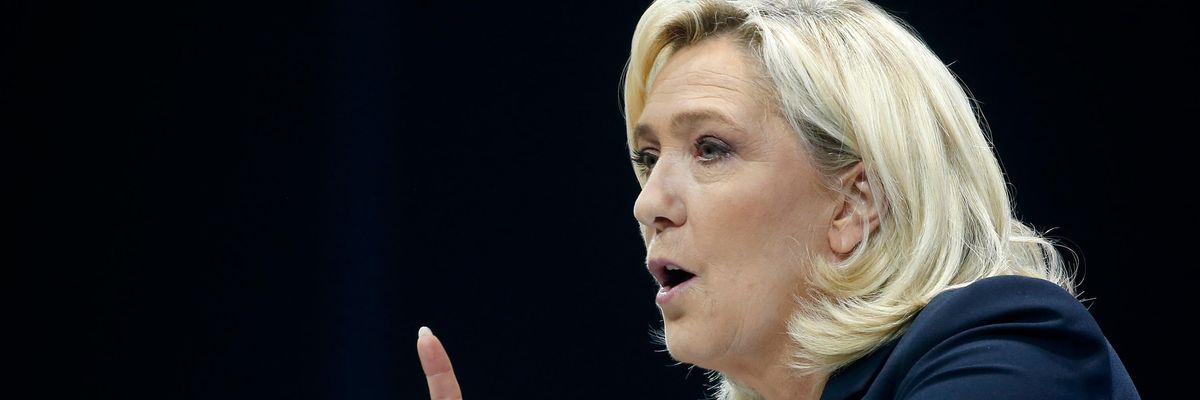
Marine Le Pen of France's National Rally party delivers a speech on April 7, 2022 in Perpignan, France. Le Pen is running for president in the election taking place on April 10. (Photo: Chesnot/Getty Images)
Far-right French presidential candidate Marine Le Pen is closing in on President Emmanuel Macron's lead, according to poll numbers released ahead of Sunday's first-round presidential election.
Polling data collected by French journalist Alexandre Lechenet this week showed that as of Thursday, centrist Macron is leading the presidential field with more than 25% of respondents saying they would support him on Sunday, while Le Pen's support hovers in "the low 20s."
"There was a clear strategy to hide what is brutal in her program. Her fundamentals have not changed: It's a racist program that aims to divide society and is very brutal."
In polls placing Macron in a matchup with only Le Pen, the president has just a two-to-eight point lead.
By contrast, in early March, Le Pen was 10 points behind the president, who beat her by more than 30 points in the 2017 runoff election.
After Sunday's first round, a runoff on April 24 is likely this year, as no candidate is currently expected to win a majority of the vote on Sunday. According to The Economist, Macron has a 98% chance of making it to the runoff while Le Pen has a 93% chance of advancing.
While Le Pen's party is as committed as it was in 2017 to its anti-immigrant and nationalist views and policies, the party's leader has campaigned on issues affecting working French families, who are paying record prices for fuel and are having to cut back on participating in their local economies, according to a recent report by France24.
Le Pen has called for tax cuts on energy, increases to people's pensions, and maintaining the current retirement age of 62--in contrast to Macron's proposal to raise it to 65.
"She's more human, and we understand her when she talks" compared to her aggressive campaign style in the previous election, a waitress named Sophie told the BBC Friday.
Le Pen has attempted to distance herself from her past praise of Russian President Vladimir Putin, whose war in Ukraine has killed more than 1,400 civilians and displaced more than 10 million people, including more than four million who have fled the country. She was quick to welcome Ukrainian refugees, a position which differentiated her from her far-right rival, political commentator Eric Zemmour, who is polling below 10% according to Lechenet.
"I would say that [Zemmour's] campaign was destroyed by Ukraine," Gilles Paris, an election specialist for French daily Le Monde, told the BBC. "His pro-Russian attitude was a burden, while Marine Le Pen was smart enough to pivot to a more moderate point of view. She was ready to accept refugees [immediately], while it took two days for Zemmour to understand that these refugees were well accepted in France."
Despite the welcome for Ukrainian refugees, Le Pen is proposing strict limits on immigration, a ban on headscarves for Muslim women and girls, and a "French-first" system limiting immigrants' access to housing and other benefits, but her focus on economic issues has appeared to contrast with Macron's policies, according to analysts.
"There was a clear strategy to hide what is brutal in her program," Macron told Le Parisien on Friday. "Her fundamentals have not changed: It's a racist program that aims to divide society and is very brutal."
In addition to pushing for a higher retirement age, the president eliminated a wealth tax after taking office as well as reducing social spending and proposing a gas tax hike, which earned him the nickname "president of the rich" and led to nationwide protests in 2018.
Le Pen could be even closer to becoming France's next president than polls are making it seem, according to FiveThirtyEight:
The average error between the poll margin two weeks before the election and the runoff result has been about 4.6 points in French presidential elections from 1969 to 2017, and polling averages produced by Politico and Reuters each put Macron's runoff lead at six points. In other words, a slightly larger-than-normal error could make Le Pen France's next president. And there's still time for the race to tighten further, as the likely runoff will take place two weeks after the first round.
While Macron is in the lead, wrote France-based journalist John Lichfield at The Guardian on Friday, "the opinion polls suggest that if enough leftwing voters stay at home in the second round, refusing to choose between Macron ('the president of the rich') and a seemingly 'kinder, gentler' Le Pen, then she could win."
A Le Pen presidency would leave the French living under an economic program that is "an incoherent mess," Lichfield wrote. "Her European policy is Frexit by stealth--unilaterally reducing payments to the E.U. budget and breaking E.U. laws she does not like. She also wants to ban all Muslim women from wearing veils in public--not just the burqa, which was outlawed in 2010. She plans to discriminate against foreigners, including E.U. nationals, with regards to eligibility for benefits."
Macron "can still win the election," he added. "But it is going to be a scary two weeks for anyone who cares about the wellbeing of France or Europe."
Dear Common Dreams reader, It’s been nearly 30 years since I co-founded Common Dreams with my late wife, Lina Newhouser. We had the radical notion that journalism should serve the public good, not corporate profits. It was clear to us from the outset what it would take to build such a project. No paid advertisements. No corporate sponsors. No millionaire publisher telling us what to think or do. Many people said we wouldn't last a year, but we proved those doubters wrong. Together with a tremendous team of journalists and dedicated staff, we built an independent media outlet free from the constraints of profits and corporate control. Our mission has always been simple: To inform. To inspire. To ignite change for the common good. Building Common Dreams was not easy. Our survival was never guaranteed. When you take on the most powerful forces—Wall Street greed, fossil fuel industry destruction, Big Tech lobbyists, and uber-rich oligarchs who have spent billions upon billions rigging the economy and democracy in their favor—the only bulwark you have is supporters who believe in your work. But here’s the urgent message from me today. It's never been this bad out there. And it's never been this hard to keep us going. At the very moment Common Dreams is most needed, the threats we face are intensifying. We need your support now more than ever. We don't accept corporate advertising and never will. We don't have a paywall because we don't think people should be blocked from critical news based on their ability to pay. Everything we do is funded by the donations of readers like you. When everyone does the little they can afford, we are strong. But if that support retreats or dries up, so do we. Will you donate now to make sure Common Dreams not only survives but thrives? —Craig Brown, Co-founder |
Far-right French presidential candidate Marine Le Pen is closing in on President Emmanuel Macron's lead, according to poll numbers released ahead of Sunday's first-round presidential election.
Polling data collected by French journalist Alexandre Lechenet this week showed that as of Thursday, centrist Macron is leading the presidential field with more than 25% of respondents saying they would support him on Sunday, while Le Pen's support hovers in "the low 20s."
"There was a clear strategy to hide what is brutal in her program. Her fundamentals have not changed: It's a racist program that aims to divide society and is very brutal."
In polls placing Macron in a matchup with only Le Pen, the president has just a two-to-eight point lead.
By contrast, in early March, Le Pen was 10 points behind the president, who beat her by more than 30 points in the 2017 runoff election.
After Sunday's first round, a runoff on April 24 is likely this year, as no candidate is currently expected to win a majority of the vote on Sunday. According to The Economist, Macron has a 98% chance of making it to the runoff while Le Pen has a 93% chance of advancing.
While Le Pen's party is as committed as it was in 2017 to its anti-immigrant and nationalist views and policies, the party's leader has campaigned on issues affecting working French families, who are paying record prices for fuel and are having to cut back on participating in their local economies, according to a recent report by France24.
Le Pen has called for tax cuts on energy, increases to people's pensions, and maintaining the current retirement age of 62--in contrast to Macron's proposal to raise it to 65.
"She's more human, and we understand her when she talks" compared to her aggressive campaign style in the previous election, a waitress named Sophie told the BBC Friday.
Le Pen has attempted to distance herself from her past praise of Russian President Vladimir Putin, whose war in Ukraine has killed more than 1,400 civilians and displaced more than 10 million people, including more than four million who have fled the country. She was quick to welcome Ukrainian refugees, a position which differentiated her from her far-right rival, political commentator Eric Zemmour, who is polling below 10% according to Lechenet.
"I would say that [Zemmour's] campaign was destroyed by Ukraine," Gilles Paris, an election specialist for French daily Le Monde, told the BBC. "His pro-Russian attitude was a burden, while Marine Le Pen was smart enough to pivot to a more moderate point of view. She was ready to accept refugees [immediately], while it took two days for Zemmour to understand that these refugees were well accepted in France."
Despite the welcome for Ukrainian refugees, Le Pen is proposing strict limits on immigration, a ban on headscarves for Muslim women and girls, and a "French-first" system limiting immigrants' access to housing and other benefits, but her focus on economic issues has appeared to contrast with Macron's policies, according to analysts.
"There was a clear strategy to hide what is brutal in her program," Macron told Le Parisien on Friday. "Her fundamentals have not changed: It's a racist program that aims to divide society and is very brutal."
In addition to pushing for a higher retirement age, the president eliminated a wealth tax after taking office as well as reducing social spending and proposing a gas tax hike, which earned him the nickname "president of the rich" and led to nationwide protests in 2018.
Le Pen could be even closer to becoming France's next president than polls are making it seem, according to FiveThirtyEight:
The average error between the poll margin two weeks before the election and the runoff result has been about 4.6 points in French presidential elections from 1969 to 2017, and polling averages produced by Politico and Reuters each put Macron's runoff lead at six points. In other words, a slightly larger-than-normal error could make Le Pen France's next president. And there's still time for the race to tighten further, as the likely runoff will take place two weeks after the first round.
While Macron is in the lead, wrote France-based journalist John Lichfield at The Guardian on Friday, "the opinion polls suggest that if enough leftwing voters stay at home in the second round, refusing to choose between Macron ('the president of the rich') and a seemingly 'kinder, gentler' Le Pen, then she could win."
A Le Pen presidency would leave the French living under an economic program that is "an incoherent mess," Lichfield wrote. "Her European policy is Frexit by stealth--unilaterally reducing payments to the E.U. budget and breaking E.U. laws she does not like. She also wants to ban all Muslim women from wearing veils in public--not just the burqa, which was outlawed in 2010. She plans to discriminate against foreigners, including E.U. nationals, with regards to eligibility for benefits."
Macron "can still win the election," he added. "But it is going to be a scary two weeks for anyone who cares about the wellbeing of France or Europe."
Far-right French presidential candidate Marine Le Pen is closing in on President Emmanuel Macron's lead, according to poll numbers released ahead of Sunday's first-round presidential election.
Polling data collected by French journalist Alexandre Lechenet this week showed that as of Thursday, centrist Macron is leading the presidential field with more than 25% of respondents saying they would support him on Sunday, while Le Pen's support hovers in "the low 20s."
"There was a clear strategy to hide what is brutal in her program. Her fundamentals have not changed: It's a racist program that aims to divide society and is very brutal."
In polls placing Macron in a matchup with only Le Pen, the president has just a two-to-eight point lead.
By contrast, in early March, Le Pen was 10 points behind the president, who beat her by more than 30 points in the 2017 runoff election.
After Sunday's first round, a runoff on April 24 is likely this year, as no candidate is currently expected to win a majority of the vote on Sunday. According to The Economist, Macron has a 98% chance of making it to the runoff while Le Pen has a 93% chance of advancing.
While Le Pen's party is as committed as it was in 2017 to its anti-immigrant and nationalist views and policies, the party's leader has campaigned on issues affecting working French families, who are paying record prices for fuel and are having to cut back on participating in their local economies, according to a recent report by France24.
Le Pen has called for tax cuts on energy, increases to people's pensions, and maintaining the current retirement age of 62--in contrast to Macron's proposal to raise it to 65.
"She's more human, and we understand her when she talks" compared to her aggressive campaign style in the previous election, a waitress named Sophie told the BBC Friday.
Le Pen has attempted to distance herself from her past praise of Russian President Vladimir Putin, whose war in Ukraine has killed more than 1,400 civilians and displaced more than 10 million people, including more than four million who have fled the country. She was quick to welcome Ukrainian refugees, a position which differentiated her from her far-right rival, political commentator Eric Zemmour, who is polling below 10% according to Lechenet.
"I would say that [Zemmour's] campaign was destroyed by Ukraine," Gilles Paris, an election specialist for French daily Le Monde, told the BBC. "His pro-Russian attitude was a burden, while Marine Le Pen was smart enough to pivot to a more moderate point of view. She was ready to accept refugees [immediately], while it took two days for Zemmour to understand that these refugees were well accepted in France."
Despite the welcome for Ukrainian refugees, Le Pen is proposing strict limits on immigration, a ban on headscarves for Muslim women and girls, and a "French-first" system limiting immigrants' access to housing and other benefits, but her focus on economic issues has appeared to contrast with Macron's policies, according to analysts.
"There was a clear strategy to hide what is brutal in her program," Macron told Le Parisien on Friday. "Her fundamentals have not changed: It's a racist program that aims to divide society and is very brutal."
In addition to pushing for a higher retirement age, the president eliminated a wealth tax after taking office as well as reducing social spending and proposing a gas tax hike, which earned him the nickname "president of the rich" and led to nationwide protests in 2018.
Le Pen could be even closer to becoming France's next president than polls are making it seem, according to FiveThirtyEight:
The average error between the poll margin two weeks before the election and the runoff result has been about 4.6 points in French presidential elections from 1969 to 2017, and polling averages produced by Politico and Reuters each put Macron's runoff lead at six points. In other words, a slightly larger-than-normal error could make Le Pen France's next president. And there's still time for the race to tighten further, as the likely runoff will take place two weeks after the first round.
While Macron is in the lead, wrote France-based journalist John Lichfield at The Guardian on Friday, "the opinion polls suggest that if enough leftwing voters stay at home in the second round, refusing to choose between Macron ('the president of the rich') and a seemingly 'kinder, gentler' Le Pen, then she could win."
A Le Pen presidency would leave the French living under an economic program that is "an incoherent mess," Lichfield wrote. "Her European policy is Frexit by stealth--unilaterally reducing payments to the E.U. budget and breaking E.U. laws she does not like. She also wants to ban all Muslim women from wearing veils in public--not just the burqa, which was outlawed in 2010. She plans to discriminate against foreigners, including E.U. nationals, with regards to eligibility for benefits."
Macron "can still win the election," he added. "But it is going to be a scary two weeks for anyone who cares about the wellbeing of France or Europe."