

SUBSCRIBE TO OUR FREE NEWSLETTER
Daily news & progressive opinion—funded by the people, not the corporations—delivered straight to your inbox.
5
#000000
#FFFFFF
To donate by check, phone, or other method, see our More Ways to Give page.
Daily news & progressive opinion—funded by the people, not the corporations—delivered straight to your inbox.
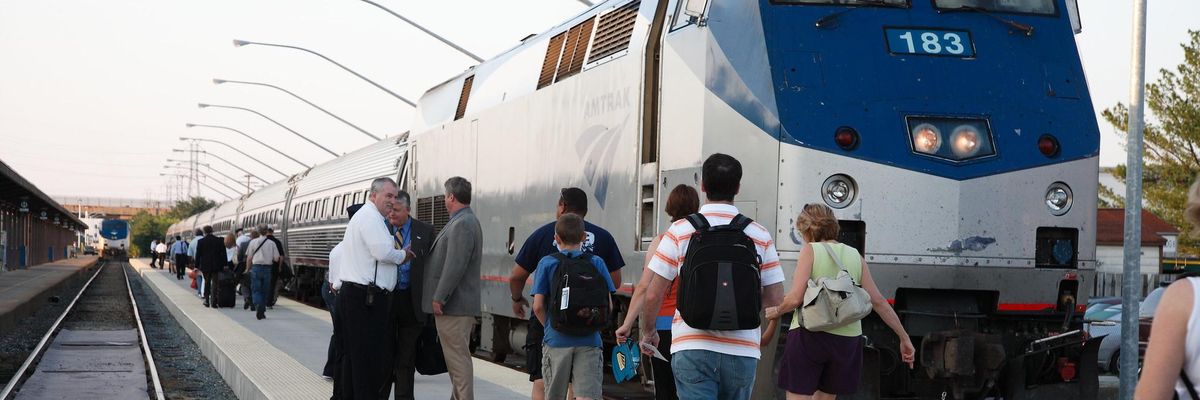
Passengers board a Washington, D.C.-bound Amtrak train in Richmond, Virginia on July 20, 2010. (Photo: Virginia Department of Transportation/Flickr/cc)
Civil liberties defenders sounded the alarm Wednesday after Amtrak asked the Transportation Safety Administration to start screening passengers against the U.S. Department of Homeland Security's federal master terrorism watchlist.
"From our decades of work on the watchlisting system, we know it's a due process nightmare and prone to error."
Hearst Television reports the train service's request is part of the Amtrak Rail Passenger Threat Assessment, by which the Department of Homeland Security (DHS) reviews a targeted individual's "personally identifiable information" against the federal Terrorist Screening Database, commonly called the watchlist.
Personally identifiable information includes but is not limited to Social Security, Alien Registration, and driver's license numbers; financial or medical documents; biometrics; and criminal records. DHS may also collect and review targeted travelers' publicly available social media information.
"This request raises significant civil liberties and rights concerns," ACLU National Security Project director Hina Shamsi said in a statement. "From our decades of work on the watchlisting system, we know it's a due process nightmare and prone to error."
"The standards the government uses to place people on its massive master watchlist are vague, overbroad, and based on secret evidence," she added. "People on the watchlist are disproportionately people of color or immigrants, and can be wrongly stigmatized as terrorism suspects with no notice of their placement on the list or a meaningful opportunity to challenge it. Amtrak's request should be a non-starter and it needs to reverse course."
In an interview with Hearst Television, Saira Hussain, a staff attorney at the digital rights group Electronic Frontier Foundation, called the expanded watchlist surveillance a "terrifying" development that could lead to people "facing some really negative outcomes when it comes to a contact with law enforcement should they be stopped for, you know, for like a broken tail light or something like that."
ACLU senior policy analyst Jay Stanley said that "it's a classic example of mission creep."
"Pretty soon we're going to have people walking through, you know, body scanners to go to a Little League game," he told Hearst Television. "We don't want to turn America into an airport."
Dear Common Dreams reader, It’s been nearly 30 years since I co-founded Common Dreams with my late wife, Lina Newhouser. We had the radical notion that journalism should serve the public good, not corporate profits. It was clear to us from the outset what it would take to build such a project. No paid advertisements. No corporate sponsors. No millionaire publisher telling us what to think or do. Many people said we wouldn't last a year, but we proved those doubters wrong. Together with a tremendous team of journalists and dedicated staff, we built an independent media outlet free from the constraints of profits and corporate control. Our mission has always been simple: To inform. To inspire. To ignite change for the common good. Building Common Dreams was not easy. Our survival was never guaranteed. When you take on the most powerful forces—Wall Street greed, fossil fuel industry destruction, Big Tech lobbyists, and uber-rich oligarchs who have spent billions upon billions rigging the economy and democracy in their favor—the only bulwark you have is supporters who believe in your work. But here’s the urgent message from me today. It's never been this bad out there. And it's never been this hard to keep us going. At the very moment Common Dreams is most needed, the threats we face are intensifying. We need your support now more than ever. We don't accept corporate advertising and never will. We don't have a paywall because we don't think people should be blocked from critical news based on their ability to pay. Everything we do is funded by the donations of readers like you. When everyone does the little they can afford, we are strong. But if that support retreats or dries up, so do we. Will you donate now to make sure Common Dreams not only survives but thrives? —Craig Brown, Co-founder |
Civil liberties defenders sounded the alarm Wednesday after Amtrak asked the Transportation Safety Administration to start screening passengers against the U.S. Department of Homeland Security's federal master terrorism watchlist.
"From our decades of work on the watchlisting system, we know it's a due process nightmare and prone to error."
Hearst Television reports the train service's request is part of the Amtrak Rail Passenger Threat Assessment, by which the Department of Homeland Security (DHS) reviews a targeted individual's "personally identifiable information" against the federal Terrorist Screening Database, commonly called the watchlist.
Personally identifiable information includes but is not limited to Social Security, Alien Registration, and driver's license numbers; financial or medical documents; biometrics; and criminal records. DHS may also collect and review targeted travelers' publicly available social media information.
"This request raises significant civil liberties and rights concerns," ACLU National Security Project director Hina Shamsi said in a statement. "From our decades of work on the watchlisting system, we know it's a due process nightmare and prone to error."
"The standards the government uses to place people on its massive master watchlist are vague, overbroad, and based on secret evidence," she added. "People on the watchlist are disproportionately people of color or immigrants, and can be wrongly stigmatized as terrorism suspects with no notice of their placement on the list or a meaningful opportunity to challenge it. Amtrak's request should be a non-starter and it needs to reverse course."
In an interview with Hearst Television, Saira Hussain, a staff attorney at the digital rights group Electronic Frontier Foundation, called the expanded watchlist surveillance a "terrifying" development that could lead to people "facing some really negative outcomes when it comes to a contact with law enforcement should they be stopped for, you know, for like a broken tail light or something like that."
ACLU senior policy analyst Jay Stanley said that "it's a classic example of mission creep."
"Pretty soon we're going to have people walking through, you know, body scanners to go to a Little League game," he told Hearst Television. "We don't want to turn America into an airport."
Civil liberties defenders sounded the alarm Wednesday after Amtrak asked the Transportation Safety Administration to start screening passengers against the U.S. Department of Homeland Security's federal master terrorism watchlist.
"From our decades of work on the watchlisting system, we know it's a due process nightmare and prone to error."
Hearst Television reports the train service's request is part of the Amtrak Rail Passenger Threat Assessment, by which the Department of Homeland Security (DHS) reviews a targeted individual's "personally identifiable information" against the federal Terrorist Screening Database, commonly called the watchlist.
Personally identifiable information includes but is not limited to Social Security, Alien Registration, and driver's license numbers; financial or medical documents; biometrics; and criminal records. DHS may also collect and review targeted travelers' publicly available social media information.
"This request raises significant civil liberties and rights concerns," ACLU National Security Project director Hina Shamsi said in a statement. "From our decades of work on the watchlisting system, we know it's a due process nightmare and prone to error."
"The standards the government uses to place people on its massive master watchlist are vague, overbroad, and based on secret evidence," she added. "People on the watchlist are disproportionately people of color or immigrants, and can be wrongly stigmatized as terrorism suspects with no notice of their placement on the list or a meaningful opportunity to challenge it. Amtrak's request should be a non-starter and it needs to reverse course."
In an interview with Hearst Television, Saira Hussain, a staff attorney at the digital rights group Electronic Frontier Foundation, called the expanded watchlist surveillance a "terrifying" development that could lead to people "facing some really negative outcomes when it comes to a contact with law enforcement should they be stopped for, you know, for like a broken tail light or something like that."
ACLU senior policy analyst Jay Stanley said that "it's a classic example of mission creep."
"Pretty soon we're going to have people walking through, you know, body scanners to go to a Little League game," he told Hearst Television. "We don't want to turn America into an airport."

