SUBSCRIBE TO OUR FREE NEWSLETTER
Daily news & progressive opinion—funded by the people, not the corporations—delivered straight to your inbox.
5
#000000
#FFFFFF
To donate by check, phone, or other method, see our More Ways to Give page.
Daily news & progressive opinion—funded by the people, not the corporations—delivered straight to your inbox.
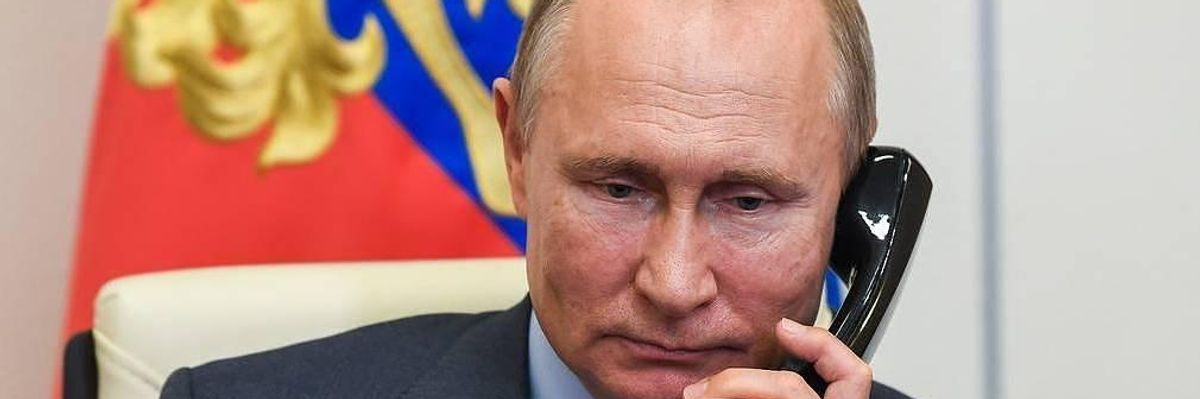
Russian President Vladimir Putin speaks on the phone on February 12, 2022. (Photo: Alexei Nikolsky/Russian Presidential Press and Information Office/TASS)
The International Court of Justice on Wednesday ordered the Russian government to immediately halt its invasion of Ukraine, a legally binding decision that Moscow is likely to ignore as it continues bombarding its neighbor.
"The Russian Federation must, pending the final decision in the case, suspend the military operations that it commenced on 24 February 2022 in the territory of Ukraine," reads the preliminary ruling handed down by the United Nations' top court.
Just days after Russia launched its full-scale attack, the Ukrainian government petitioned the ICJ to take legal action against Moscow, which Kyiv accused of unlawfully justifying its invasion by alleging genocide against ethnic Russians in the Donbas.
In an emergency filing at The Hague, Ukraine said that "contrary to what the Russian Federation claims, no acts of genocide, as defined by Article III of the Genocide Convention, have been committed in the Luhansk and Donetsk oblasts of Ukraine."
Russia boycotted a hearing on Ukraine's filing last week, a signal that Moscow has no intention of complying with the court's decision.
In its 22-page ruling, the ICJ concluded that "at the present stage of the proceedings, it suffices to observe that the court is not in possession of evidence substantiating the allegation of the Russian Federation that genocide has been committed on Ukrainian territory."
Ukrainian President Volodymyr Zelenskyy called the ICJ's decision "a complete victory," noting that "the order is binding under international law."
"Russia must comply immediately," Zelenskyy wrote on Twitter. "Ignoring the order will isolate Russia even further."
The Washington Post reported Wednesday that despite the binding nature of the ICJ's ruling, the court "does not appear to have a viable path to enforce the decision."
" Sanctions could only be imposed by the U.N. Security Council, of which Russia is a permanent member and where it has a veto power," the Post noted. "The court's mission is to settle disputes between sovereign nations, and it cannot charge presidents or military leaders with war crimes, for example."
Ahead of the hearing on Ukraine's emergency filing, Alain Pellet--a French attorney who had previously represented Russia at the ICJ--resigned from Moscow's legal team, declaring in an open letter that "it has become impossible to represent in forums dedicated to the application of the law a country that so cynically despises it."
"There is no justification," Pellet wrote, "for the use of war to impose a political regime change in Kyiv or a territorial dismemberment of Ukraine."
Dear Common Dreams reader, It’s been nearly 30 years since I co-founded Common Dreams with my late wife, Lina Newhouser. We had the radical notion that journalism should serve the public good, not corporate profits. It was clear to us from the outset what it would take to build such a project. No paid advertisements. No corporate sponsors. No millionaire publisher telling us what to think or do. Many people said we wouldn't last a year, but we proved those doubters wrong. Together with a tremendous team of journalists and dedicated staff, we built an independent media outlet free from the constraints of profits and corporate control. Our mission has always been simple: To inform. To inspire. To ignite change for the common good. Building Common Dreams was not easy. Our survival was never guaranteed. When you take on the most powerful forces—Wall Street greed, fossil fuel industry destruction, Big Tech lobbyists, and uber-rich oligarchs who have spent billions upon billions rigging the economy and democracy in their favor—the only bulwark you have is supporters who believe in your work. But here’s the urgent message from me today. It's never been this bad out there. And it's never been this hard to keep us going. At the very moment Common Dreams is most needed, the threats we face are intensifying. We need your support now more than ever. We don't accept corporate advertising and never will. We don't have a paywall because we don't think people should be blocked from critical news based on their ability to pay. Everything we do is funded by the donations of readers like you. When everyone does the little they can afford, we are strong. But if that support retreats or dries up, so do we. Will you donate now to make sure Common Dreams not only survives but thrives? —Craig Brown, Co-founder |
The International Court of Justice on Wednesday ordered the Russian government to immediately halt its invasion of Ukraine, a legally binding decision that Moscow is likely to ignore as it continues bombarding its neighbor.
"The Russian Federation must, pending the final decision in the case, suspend the military operations that it commenced on 24 February 2022 in the territory of Ukraine," reads the preliminary ruling handed down by the United Nations' top court.
Just days after Russia launched its full-scale attack, the Ukrainian government petitioned the ICJ to take legal action against Moscow, which Kyiv accused of unlawfully justifying its invasion by alleging genocide against ethnic Russians in the Donbas.
In an emergency filing at The Hague, Ukraine said that "contrary to what the Russian Federation claims, no acts of genocide, as defined by Article III of the Genocide Convention, have been committed in the Luhansk and Donetsk oblasts of Ukraine."
Russia boycotted a hearing on Ukraine's filing last week, a signal that Moscow has no intention of complying with the court's decision.
In its 22-page ruling, the ICJ concluded that "at the present stage of the proceedings, it suffices to observe that the court is not in possession of evidence substantiating the allegation of the Russian Federation that genocide has been committed on Ukrainian territory."
Ukrainian President Volodymyr Zelenskyy called the ICJ's decision "a complete victory," noting that "the order is binding under international law."
"Russia must comply immediately," Zelenskyy wrote on Twitter. "Ignoring the order will isolate Russia even further."
The Washington Post reported Wednesday that despite the binding nature of the ICJ's ruling, the court "does not appear to have a viable path to enforce the decision."
" Sanctions could only be imposed by the U.N. Security Council, of which Russia is a permanent member and where it has a veto power," the Post noted. "The court's mission is to settle disputes between sovereign nations, and it cannot charge presidents or military leaders with war crimes, for example."
Ahead of the hearing on Ukraine's emergency filing, Alain Pellet--a French attorney who had previously represented Russia at the ICJ--resigned from Moscow's legal team, declaring in an open letter that "it has become impossible to represent in forums dedicated to the application of the law a country that so cynically despises it."
"There is no justification," Pellet wrote, "for the use of war to impose a political regime change in Kyiv or a territorial dismemberment of Ukraine."
The International Court of Justice on Wednesday ordered the Russian government to immediately halt its invasion of Ukraine, a legally binding decision that Moscow is likely to ignore as it continues bombarding its neighbor.
"The Russian Federation must, pending the final decision in the case, suspend the military operations that it commenced on 24 February 2022 in the territory of Ukraine," reads the preliminary ruling handed down by the United Nations' top court.
Just days after Russia launched its full-scale attack, the Ukrainian government petitioned the ICJ to take legal action against Moscow, which Kyiv accused of unlawfully justifying its invasion by alleging genocide against ethnic Russians in the Donbas.
In an emergency filing at The Hague, Ukraine said that "contrary to what the Russian Federation claims, no acts of genocide, as defined by Article III of the Genocide Convention, have been committed in the Luhansk and Donetsk oblasts of Ukraine."
Russia boycotted a hearing on Ukraine's filing last week, a signal that Moscow has no intention of complying with the court's decision.
In its 22-page ruling, the ICJ concluded that "at the present stage of the proceedings, it suffices to observe that the court is not in possession of evidence substantiating the allegation of the Russian Federation that genocide has been committed on Ukrainian territory."
Ukrainian President Volodymyr Zelenskyy called the ICJ's decision "a complete victory," noting that "the order is binding under international law."
"Russia must comply immediately," Zelenskyy wrote on Twitter. "Ignoring the order will isolate Russia even further."
The Washington Post reported Wednesday that despite the binding nature of the ICJ's ruling, the court "does not appear to have a viable path to enforce the decision."
" Sanctions could only be imposed by the U.N. Security Council, of which Russia is a permanent member and where it has a veto power," the Post noted. "The court's mission is to settle disputes between sovereign nations, and it cannot charge presidents or military leaders with war crimes, for example."
Ahead of the hearing on Ukraine's emergency filing, Alain Pellet--a French attorney who had previously represented Russia at the ICJ--resigned from Moscow's legal team, declaring in an open letter that "it has become impossible to represent in forums dedicated to the application of the law a country that so cynically despises it."
"There is no justification," Pellet wrote, "for the use of war to impose a political regime change in Kyiv or a territorial dismemberment of Ukraine."