SUBSCRIBE TO OUR FREE NEWSLETTER
Daily news & progressive opinion—funded by the people, not the corporations—delivered straight to your inbox.
5
#000000
#FFFFFF
To donate by check, phone, or other method, see our More Ways to Give page.
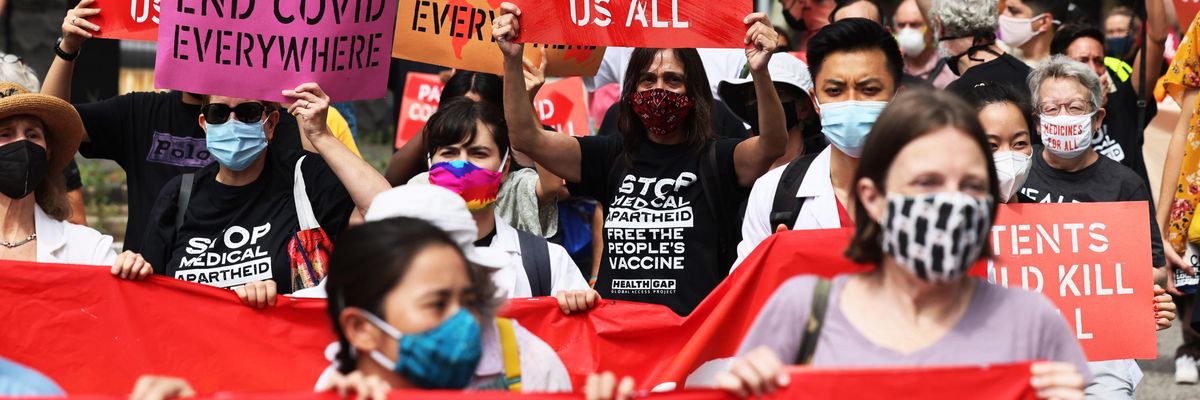
Pfizer projected Tuesday that it will generate a record-shattering $32 billion in revenue from its publicly funded coronavirus vaccine in 2022 as the U.S. pharmaceutical giant refuses to share its technology with other nations, leaving billions of people around the world without access to lifesaving shots as the pandemic continues to rage.
"We've let Pfizer withhold this essential medical innovation from much of the world."
" Big Pharma has made more than enough money from this crisis," said the U.K.-based advocacy group Global Justice Now. "It's time to suspend patents and break vaccine monopolies."
While a portion of Pfizer's mRNA-based vaccine recipe was leaked last year, the pharmaceutical firm and its German partner BioNTech have closely guarded the details of their manufacturing process, allowing the companies to rake in huge profits by selling their Covid-19 shots at a price tag well above the cost of production.
On Tuesday, Pfizer reported that its profits increased roughly fourfold to $3.4 billion in the fourth quarter of 2021, beating analysts' expectations.
"It's nothing short of pandemic profiteering for Pfizer to make a killing while its vaccines have been withheld from so many," Tim Bierley, a pharma campaigner at Global Justice Now, said in a statement. "Pfizer is now richer than most countries; it has made more than enough money from this crisis."
In an analysis published in July, The People's Vaccine Alliance noted that "Pfizer/BioNTech are charging their lowest reported price of $6.75 [per dose] to the African Union, but this is still nearly six times more than the estimated potential production cost of this vaccine."
"One dose of the vaccine costs the same as Uganda spends per citizen on health in a whole year," the coalition observed.
To date, according to the World Health Organization, just 11% of the 1.3 billion people on the African continent have been fully vaccinated against Covid-19.
"The development of mRNA vaccines should have revolutionized the global Covid response," Global Justice Now told The Independent on Tuesday. "But we've let Pfizer withhold this essential medical innovation from much of the world, all while ripping off public health systems with an eye-watering mark-up."
Related Content

Pfizer's fourth-quarter and full-year earnings report for 2021 was released Tuesday morning as the coronavirus pandemic remains a deadly force worldwide, killing an average of 10,600 people each day as rich countries with plentiful vaccine supply continue to lift public health restrictions and "move on" from the crisis.
Meanwhile, poor countries that have been denied the resources necessary to produce vaccines at home struggle to fend off the virus and its fast-spreading mutations. According to the latest figures from Our World in Data, a mere 10.4% of people in low-income countries have received at least one coronavirus vaccine dose two years into the pandemic.
"Pfizer has charged huge mark-ups on its vaccine. Scare-mongered about vaccine hesitancy in low-income countries. Lobbied against those same countries making their own vaccines. And is now profiting handsomely. What a business model!" Bierley tweeted sardonically on Tuesday.
In October 2020, South Africa and India pushed members of the World Trade Organization (WTO) to adopt a patent waiver that would let lower-income countries produce generic coronavirus vaccines without fear of legal retribution by the pharmaceutical industry.
Predictably, Pfizer, Moderna, and other corporations lobbied aggressively against the measure, which remains stalled due to the opposition of Germany, the U.K, and other wealthy WTO members.
The Biden administration, which endorsed a patent waiver last May, has faced growing calls to "use all legal tools" at its disposal to force Pfizer and other U.S.-based vaccine makers to share their recipes with the world, but it has yet to do so.
Without the support of rich-country governments or the pharmaceutical industry, scientists in South Africa have begun the process of replicating Moderna's mRNA vaccine in the hopes of making the shot globally accessible and ending vaccine apartheid.
"This can be a game-changer," said Charles Gore, executive director of the U.N.-backed Medicines Patent Pool.
This story has been updated following the official release of Pfizer's earnings report.
Pfizer projected Tuesday that it will generate a record-shattering $32 billion in revenue from its publicly funded coronavirus vaccine in 2022 as the U.S. pharmaceutical giant refuses to share its technology with other nations, leaving billions of people around the world without access to lifesaving shots as the pandemic continues to rage.
"We've let Pfizer withhold this essential medical innovation from much of the world."
" Big Pharma has made more than enough money from this crisis," said the U.K.-based advocacy group Global Justice Now. "It's time to suspend patents and break vaccine monopolies."
While a portion of Pfizer's mRNA-based vaccine recipe was leaked last year, the pharmaceutical firm and its German partner BioNTech have closely guarded the details of their manufacturing process, allowing the companies to rake in huge profits by selling their Covid-19 shots at a price tag well above the cost of production.
On Tuesday, Pfizer reported that its profits increased roughly fourfold to $3.4 billion in the fourth quarter of 2021, beating analysts' expectations.
"It's nothing short of pandemic profiteering for Pfizer to make a killing while its vaccines have been withheld from so many," Tim Bierley, a pharma campaigner at Global Justice Now, said in a statement. "Pfizer is now richer than most countries; it has made more than enough money from this crisis."
In an analysis published in July, The People's Vaccine Alliance noted that "Pfizer/BioNTech are charging their lowest reported price of $6.75 [per dose] to the African Union, but this is still nearly six times more than the estimated potential production cost of this vaccine."
"One dose of the vaccine costs the same as Uganda spends per citizen on health in a whole year," the coalition observed.
To date, according to the World Health Organization, just 11% of the 1.3 billion people on the African continent have been fully vaccinated against Covid-19.
"The development of mRNA vaccines should have revolutionized the global Covid response," Global Justice Now told The Independent on Tuesday. "But we've let Pfizer withhold this essential medical innovation from much of the world, all while ripping off public health systems with an eye-watering mark-up."
Related Content
Pfizer's fourth-quarter and full-year earnings report for 2021 was released Tuesday morning as the coronavirus pandemic remains a deadly force worldwide, killing an average of 10,600 people each day as rich countries with plentiful vaccine supply continue to lift public health restrictions and "move on" from the crisis.
Meanwhile, poor countries that have been denied the resources necessary to produce vaccines at home struggle to fend off the virus and its fast-spreading mutations. According to the latest figures from Our World in Data, a mere 10.4% of people in low-income countries have received at least one coronavirus vaccine dose two years into the pandemic.
"Pfizer has charged huge mark-ups on its vaccine. Scare-mongered about vaccine hesitancy in low-income countries. Lobbied against those same countries making their own vaccines. And is now profiting handsomely. What a business model!" Bierley tweeted sardonically on Tuesday.
In October 2020, South Africa and India pushed members of the World Trade Organization (WTO) to adopt a patent waiver that would let lower-income countries produce generic coronavirus vaccines without fear of legal retribution by the pharmaceutical industry.
Predictably, Pfizer, Moderna, and other corporations lobbied aggressively against the measure, which remains stalled due to the opposition of Germany, the U.K, and other wealthy WTO members.
The Biden administration, which endorsed a patent waiver last May, has faced growing calls to "use all legal tools" at its disposal to force Pfizer and other U.S.-based vaccine makers to share their recipes with the world, but it has yet to do so.
Without the support of rich-country governments or the pharmaceutical industry, scientists in South Africa have begun the process of replicating Moderna's mRNA vaccine in the hopes of making the shot globally accessible and ending vaccine apartheid.
"This can be a game-changer," said Charles Gore, executive director of the U.N.-backed Medicines Patent Pool.
This story has been updated following the official release of Pfizer's earnings report.
Pfizer projected Tuesday that it will generate a record-shattering $32 billion in revenue from its publicly funded coronavirus vaccine in 2022 as the U.S. pharmaceutical giant refuses to share its technology with other nations, leaving billions of people around the world without access to lifesaving shots as the pandemic continues to rage.
"We've let Pfizer withhold this essential medical innovation from much of the world."
" Big Pharma has made more than enough money from this crisis," said the U.K.-based advocacy group Global Justice Now. "It's time to suspend patents and break vaccine monopolies."
While a portion of Pfizer's mRNA-based vaccine recipe was leaked last year, the pharmaceutical firm and its German partner BioNTech have closely guarded the details of their manufacturing process, allowing the companies to rake in huge profits by selling their Covid-19 shots at a price tag well above the cost of production.
On Tuesday, Pfizer reported that its profits increased roughly fourfold to $3.4 billion in the fourth quarter of 2021, beating analysts' expectations.
"It's nothing short of pandemic profiteering for Pfizer to make a killing while its vaccines have been withheld from so many," Tim Bierley, a pharma campaigner at Global Justice Now, said in a statement. "Pfizer is now richer than most countries; it has made more than enough money from this crisis."
In an analysis published in July, The People's Vaccine Alliance noted that "Pfizer/BioNTech are charging their lowest reported price of $6.75 [per dose] to the African Union, but this is still nearly six times more than the estimated potential production cost of this vaccine."
"One dose of the vaccine costs the same as Uganda spends per citizen on health in a whole year," the coalition observed.
To date, according to the World Health Organization, just 11% of the 1.3 billion people on the African continent have been fully vaccinated against Covid-19.
"The development of mRNA vaccines should have revolutionized the global Covid response," Global Justice Now told The Independent on Tuesday. "But we've let Pfizer withhold this essential medical innovation from much of the world, all while ripping off public health systems with an eye-watering mark-up."
Related Content
Pfizer's fourth-quarter and full-year earnings report for 2021 was released Tuesday morning as the coronavirus pandemic remains a deadly force worldwide, killing an average of 10,600 people each day as rich countries with plentiful vaccine supply continue to lift public health restrictions and "move on" from the crisis.
Meanwhile, poor countries that have been denied the resources necessary to produce vaccines at home struggle to fend off the virus and its fast-spreading mutations. According to the latest figures from Our World in Data, a mere 10.4% of people in low-income countries have received at least one coronavirus vaccine dose two years into the pandemic.
"Pfizer has charged huge mark-ups on its vaccine. Scare-mongered about vaccine hesitancy in low-income countries. Lobbied against those same countries making their own vaccines. And is now profiting handsomely. What a business model!" Bierley tweeted sardonically on Tuesday.
In October 2020, South Africa and India pushed members of the World Trade Organization (WTO) to adopt a patent waiver that would let lower-income countries produce generic coronavirus vaccines without fear of legal retribution by the pharmaceutical industry.
Predictably, Pfizer, Moderna, and other corporations lobbied aggressively against the measure, which remains stalled due to the opposition of Germany, the U.K, and other wealthy WTO members.
The Biden administration, which endorsed a patent waiver last May, has faced growing calls to "use all legal tools" at its disposal to force Pfizer and other U.S.-based vaccine makers to share their recipes with the world, but it has yet to do so.
Without the support of rich-country governments or the pharmaceutical industry, scientists in South Africa have begun the process of replicating Moderna's mRNA vaccine in the hopes of making the shot globally accessible and ending vaccine apartheid.
"This can be a game-changer," said Charles Gore, executive director of the U.N.-backed Medicines Patent Pool.
This story has been updated following the official release of Pfizer's earnings report.