SUBSCRIBE TO OUR FREE NEWSLETTER
Daily news & progressive opinion—funded by the people, not the corporations—delivered straight to your inbox.
5
#000000
#FFFFFF
To donate by check, phone, or other method, see our More Ways to Give page.
Daily news & progressive opinion—funded by the people, not the corporations—delivered straight to your inbox.
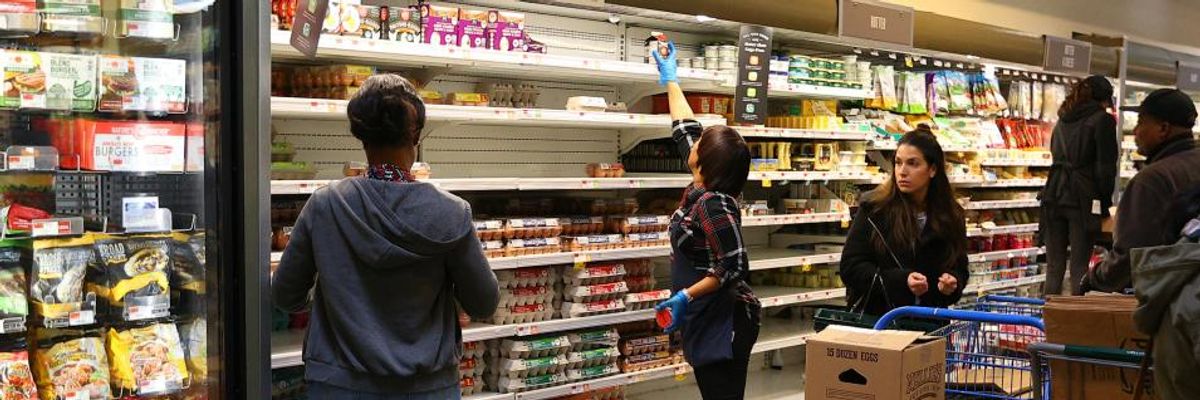
People shop in the egg and dairy case on March 13, 2020 at Whole Foods Market in Vauxhall, New Jersey.
As the U.S. Federal Reserve mulls hiking interest rates in the coming weeks in an effort to curb inflation, progressive economists are warning against such a move--arguing that it will hurt workers and fail to address the real source of rising prices: unmitigated corporate power.
"The last thing average working people need is for the Fed to raise interest rates and slow the economy further."
"A large across-the-board increase in interest rates is a cure worse than the disease," Joseph Stiglitz, a Nobel laureate in economics and Columbia University professor, wrote Monday in Project Syndicate. "We should not attack a supply-side problem by lowering demand and increasing unemployment. That might dampen inflation if it is taken far enough, but it will also ruin people's lives."
Josh Bivens, director of research at the Economic Policy Institute, echoed Stiglitz's message, writing Monday: "The inflation spike of 2021 has been bad for typical families and is a real policy challenge. But it remains the case that an overreaction to it could end up causing the most damage of all."
Stiglitz and Bivens' essays came three days after Robert Reich, professor of public policy at the University of California, Berkeley, made a similar warning.
According to Reich:
Fed policymakers are poised to raise interest rates at their March meeting and then continue raising them, in order to slow the economy. They fear that a labor shortage is pushing up wages, which in turn are pushing up prices--and that this wage-price spiral could get out of control.
It's a huge mistake. Higher interest rates will harm millions of workers who will be involuntarily drafted into the inflation fight by losing jobs or long-overdue pay raises. There's no "labor shortage" pushing up wages. There's a shortage of good jobs paying adequate wages to support working families. Raising interest rates will worsen this shortage.
Although Federal Reserve Chair Jerome Powell "has expressed concern about wage hikes pushing up prices," Reich wrote, "there's no 'wage-price spiral.'"
"To the contrary, workers' real wages have dropped because of inflation," he added. "Even though overall wages have climbed, they've failed to keep up with price increases--making most workers worse off in terms of the purchasing power of their dollars."
Reich conceded that "wage-price spirals used to be a problem" but argued that's no longer the case "because the typical worker today has little or no bargaining power."
Declining union membership and corporations' increased mobility--both key pillars in the ruling class' highly effective assault on workers that has been carried out on a bipartisan basis for more than four decades--"have shifted power from labor to capital," wrote Reich. "Increasing the share of the economic pie going to profits and shrinking the share going to wages... ended wage-price spirals."
It is "totally wrong" to contend that inflation is being fueled by rising wages stemming from a so-called "tight" labor market, Reich argued. He continued:
The January jobs report shows that the U.S. economy is still 2.9 million jobs below what it had in February 2020. Given the growth of the U.S. population, it's 4.5 million short of what it would have by now had there been no pandemic.
Consumers are almost tapped out. Not only are real (inflation-adjusted) incomes down, but pandemic assistance has ended. Extra jobless benefits are gone. Child tax credits have expired. Rent moratoriums are over. Small wonder consumer spending fell 0.6% in December, the first decrease since last February.
"Given all this, the last thing average working people need is for the Fed to raise interest rates and slow the economy further," Reich added. "The problem most people face isn't inflation. It's a lack of good jobs."
When it comes to what is causing inflation, Reich blamed "continuing worldwide bottlenecks in the supply of goods, and the ease with which big corporations (with record profits) are passing these costs to customers in higher prices."
Corporate greed has played a large role in why people are paying higher prices for food and gas, as Common Dreams has reported and a majority of the public appears to understand, based on recent polling. Amid a public health crisis that has claimed the lives of more than 900,000 people in the U.S. and 5.7 million people globally, price-gouging corporations are enjoying mega-profits not seen since 1950.
While pandemic profiteering is evident, the question remains as to what made global supply chains so fragile to disruption in the first place--leading to prolonged shortages of key inputs and increased shipping costs that have been accompanied by price hikes.
According to Rakken Mabud, chief economist and managing director of policy and research at the Groundwork Collaborative, the answer lies in offshoring, financialization, deregulation, just-in-time logistics, and other profit-maximizing policies associated with neoliberalization and globalization.
Mabud made that case last week when testifying at a House Energy and Commerce Committee hearing. She and David Dayen, executive editor of The American Prospect, expanded on that argument in a recent essay introducing a new series on the supply chain crisis.
As a number of economists have warned recently, policymakers on the verge of making life-altering decisions with respect to interest rates may be doing so based on faulty data or misconceptions.
"Among the biggest job gains in January were workers who are normally temporary and paid low wages (leisure and hospitality, retail, transport and warehousing)," Reich cautioned. "This January employers cut fewer of these low-wage temp workers than in most years, because of rising customer demand and the difficulties of hiring during Omicron. Due to the Bureau of Labor Statistics' 'seasonal adjustment,' cutting fewer workers than usual for this time of year appears as 'adding lots of jobs.'"
Stiglitz, meanwhile, noted that "the inflation rate has been volatile. Last month, the media made a big deal out of the 7% annual inflation rate in the United States, while failing to note that the December rate was little more than half that of the October rate."
"Moreover, given that a large proportion of today's inflation stems from global issues--like chip shortages and the behavior of oil cartels--it is a gross exaggeration to blame inflation on excessive fiscal support in the U.S.," Stiglitz continued.
While "the U.S. has slightly higher inflation than Europe," he added, "it also has enjoyed stronger growth. U.S. policies prevented a massive increase in poverty that might have occurred otherwise. Recognizing that the cost of doing too little would be huge, U.S. policymakers did the right thing."
Stiglitz wrote that his "biggest concern is that central banks will overreact, raising interest rates excessively and hampering the nascent recovery. As always, those at the bottom of the income scale would suffer the most in this scenario."
"What we need instead," he argued, "are targeted structural and fiscal policies aimed at unblocking supply bottlenecks and helping people confront today's realities."
For instance, wrote Stiglitz, "food stamps for the needy should be indexed to the price of food, and energy (fuel) subsidies to the price of energy."
"Beyond that, a one-time 'inflation adjustment' tax cut for lower- and middle-income households would help them through the post-pandemic transition," he added. "It could be financed by taxing the monopoly rents of the oil, technology, pharmaceutical, and other corporate giants that made a killing from the crisis."
Dear Common Dreams reader, It’s been nearly 30 years since I co-founded Common Dreams with my late wife, Lina Newhouser. We had the radical notion that journalism should serve the public good, not corporate profits. It was clear to us from the outset what it would take to build such a project. No paid advertisements. No corporate sponsors. No millionaire publisher telling us what to think or do. Many people said we wouldn't last a year, but we proved those doubters wrong. Together with a tremendous team of journalists and dedicated staff, we built an independent media outlet free from the constraints of profits and corporate control. Our mission has always been simple: To inform. To inspire. To ignite change for the common good. Building Common Dreams was not easy. Our survival was never guaranteed. When you take on the most powerful forces—Wall Street greed, fossil fuel industry destruction, Big Tech lobbyists, and uber-rich oligarchs who have spent billions upon billions rigging the economy and democracy in their favor—the only bulwark you have is supporters who believe in your work. But here’s the urgent message from me today. It's never been this bad out there. And it's never been this hard to keep us going. At the very moment Common Dreams is most needed, the threats we face are intensifying. We need your support now more than ever. We don't accept corporate advertising and never will. We don't have a paywall because we don't think people should be blocked from critical news based on their ability to pay. Everything we do is funded by the donations of readers like you. When everyone does the little they can afford, we are strong. But if that support retreats or dries up, so do we. Will you donate now to make sure Common Dreams not only survives but thrives? —Craig Brown, Co-founder |
As the U.S. Federal Reserve mulls hiking interest rates in the coming weeks in an effort to curb inflation, progressive economists are warning against such a move--arguing that it will hurt workers and fail to address the real source of rising prices: unmitigated corporate power.
"The last thing average working people need is for the Fed to raise interest rates and slow the economy further."
"A large across-the-board increase in interest rates is a cure worse than the disease," Joseph Stiglitz, a Nobel laureate in economics and Columbia University professor, wrote Monday in Project Syndicate. "We should not attack a supply-side problem by lowering demand and increasing unemployment. That might dampen inflation if it is taken far enough, but it will also ruin people's lives."
Josh Bivens, director of research at the Economic Policy Institute, echoed Stiglitz's message, writing Monday: "The inflation spike of 2021 has been bad for typical families and is a real policy challenge. But it remains the case that an overreaction to it could end up causing the most damage of all."
Stiglitz and Bivens' essays came three days after Robert Reich, professor of public policy at the University of California, Berkeley, made a similar warning.
According to Reich:
Fed policymakers are poised to raise interest rates at their March meeting and then continue raising them, in order to slow the economy. They fear that a labor shortage is pushing up wages, which in turn are pushing up prices--and that this wage-price spiral could get out of control.
It's a huge mistake. Higher interest rates will harm millions of workers who will be involuntarily drafted into the inflation fight by losing jobs or long-overdue pay raises. There's no "labor shortage" pushing up wages. There's a shortage of good jobs paying adequate wages to support working families. Raising interest rates will worsen this shortage.
Although Federal Reserve Chair Jerome Powell "has expressed concern about wage hikes pushing up prices," Reich wrote, "there's no 'wage-price spiral.'"
"To the contrary, workers' real wages have dropped because of inflation," he added. "Even though overall wages have climbed, they've failed to keep up with price increases--making most workers worse off in terms of the purchasing power of their dollars."
Reich conceded that "wage-price spirals used to be a problem" but argued that's no longer the case "because the typical worker today has little or no bargaining power."
Declining union membership and corporations' increased mobility--both key pillars in the ruling class' highly effective assault on workers that has been carried out on a bipartisan basis for more than four decades--"have shifted power from labor to capital," wrote Reich. "Increasing the share of the economic pie going to profits and shrinking the share going to wages... ended wage-price spirals."
It is "totally wrong" to contend that inflation is being fueled by rising wages stemming from a so-called "tight" labor market, Reich argued. He continued:
The January jobs report shows that the U.S. economy is still 2.9 million jobs below what it had in February 2020. Given the growth of the U.S. population, it's 4.5 million short of what it would have by now had there been no pandemic.
Consumers are almost tapped out. Not only are real (inflation-adjusted) incomes down, but pandemic assistance has ended. Extra jobless benefits are gone. Child tax credits have expired. Rent moratoriums are over. Small wonder consumer spending fell 0.6% in December, the first decrease since last February.
"Given all this, the last thing average working people need is for the Fed to raise interest rates and slow the economy further," Reich added. "The problem most people face isn't inflation. It's a lack of good jobs."
When it comes to what is causing inflation, Reich blamed "continuing worldwide bottlenecks in the supply of goods, and the ease with which big corporations (with record profits) are passing these costs to customers in higher prices."
Corporate greed has played a large role in why people are paying higher prices for food and gas, as Common Dreams has reported and a majority of the public appears to understand, based on recent polling. Amid a public health crisis that has claimed the lives of more than 900,000 people in the U.S. and 5.7 million people globally, price-gouging corporations are enjoying mega-profits not seen since 1950.
While pandemic profiteering is evident, the question remains as to what made global supply chains so fragile to disruption in the first place--leading to prolonged shortages of key inputs and increased shipping costs that have been accompanied by price hikes.
According to Rakken Mabud, chief economist and managing director of policy and research at the Groundwork Collaborative, the answer lies in offshoring, financialization, deregulation, just-in-time logistics, and other profit-maximizing policies associated with neoliberalization and globalization.
Mabud made that case last week when testifying at a House Energy and Commerce Committee hearing. She and David Dayen, executive editor of The American Prospect, expanded on that argument in a recent essay introducing a new series on the supply chain crisis.
As a number of economists have warned recently, policymakers on the verge of making life-altering decisions with respect to interest rates may be doing so based on faulty data or misconceptions.
"Among the biggest job gains in January were workers who are normally temporary and paid low wages (leisure and hospitality, retail, transport and warehousing)," Reich cautioned. "This January employers cut fewer of these low-wage temp workers than in most years, because of rising customer demand and the difficulties of hiring during Omicron. Due to the Bureau of Labor Statistics' 'seasonal adjustment,' cutting fewer workers than usual for this time of year appears as 'adding lots of jobs.'"
Stiglitz, meanwhile, noted that "the inflation rate has been volatile. Last month, the media made a big deal out of the 7% annual inflation rate in the United States, while failing to note that the December rate was little more than half that of the October rate."
"Moreover, given that a large proportion of today's inflation stems from global issues--like chip shortages and the behavior of oil cartels--it is a gross exaggeration to blame inflation on excessive fiscal support in the U.S.," Stiglitz continued.
While "the U.S. has slightly higher inflation than Europe," he added, "it also has enjoyed stronger growth. U.S. policies prevented a massive increase in poverty that might have occurred otherwise. Recognizing that the cost of doing too little would be huge, U.S. policymakers did the right thing."
Stiglitz wrote that his "biggest concern is that central banks will overreact, raising interest rates excessively and hampering the nascent recovery. As always, those at the bottom of the income scale would suffer the most in this scenario."
"What we need instead," he argued, "are targeted structural and fiscal policies aimed at unblocking supply bottlenecks and helping people confront today's realities."
For instance, wrote Stiglitz, "food stamps for the needy should be indexed to the price of food, and energy (fuel) subsidies to the price of energy."
"Beyond that, a one-time 'inflation adjustment' tax cut for lower- and middle-income households would help them through the post-pandemic transition," he added. "It could be financed by taxing the monopoly rents of the oil, technology, pharmaceutical, and other corporate giants that made a killing from the crisis."
As the U.S. Federal Reserve mulls hiking interest rates in the coming weeks in an effort to curb inflation, progressive economists are warning against such a move--arguing that it will hurt workers and fail to address the real source of rising prices: unmitigated corporate power.
"The last thing average working people need is for the Fed to raise interest rates and slow the economy further."
"A large across-the-board increase in interest rates is a cure worse than the disease," Joseph Stiglitz, a Nobel laureate in economics and Columbia University professor, wrote Monday in Project Syndicate. "We should not attack a supply-side problem by lowering demand and increasing unemployment. That might dampen inflation if it is taken far enough, but it will also ruin people's lives."
Josh Bivens, director of research at the Economic Policy Institute, echoed Stiglitz's message, writing Monday: "The inflation spike of 2021 has been bad for typical families and is a real policy challenge. But it remains the case that an overreaction to it could end up causing the most damage of all."
Stiglitz and Bivens' essays came three days after Robert Reich, professor of public policy at the University of California, Berkeley, made a similar warning.
According to Reich:
Fed policymakers are poised to raise interest rates at their March meeting and then continue raising them, in order to slow the economy. They fear that a labor shortage is pushing up wages, which in turn are pushing up prices--and that this wage-price spiral could get out of control.
It's a huge mistake. Higher interest rates will harm millions of workers who will be involuntarily drafted into the inflation fight by losing jobs or long-overdue pay raises. There's no "labor shortage" pushing up wages. There's a shortage of good jobs paying adequate wages to support working families. Raising interest rates will worsen this shortage.
Although Federal Reserve Chair Jerome Powell "has expressed concern about wage hikes pushing up prices," Reich wrote, "there's no 'wage-price spiral.'"
"To the contrary, workers' real wages have dropped because of inflation," he added. "Even though overall wages have climbed, they've failed to keep up with price increases--making most workers worse off in terms of the purchasing power of their dollars."
Reich conceded that "wage-price spirals used to be a problem" but argued that's no longer the case "because the typical worker today has little or no bargaining power."
Declining union membership and corporations' increased mobility--both key pillars in the ruling class' highly effective assault on workers that has been carried out on a bipartisan basis for more than four decades--"have shifted power from labor to capital," wrote Reich. "Increasing the share of the economic pie going to profits and shrinking the share going to wages... ended wage-price spirals."
It is "totally wrong" to contend that inflation is being fueled by rising wages stemming from a so-called "tight" labor market, Reich argued. He continued:
The January jobs report shows that the U.S. economy is still 2.9 million jobs below what it had in February 2020. Given the growth of the U.S. population, it's 4.5 million short of what it would have by now had there been no pandemic.
Consumers are almost tapped out. Not only are real (inflation-adjusted) incomes down, but pandemic assistance has ended. Extra jobless benefits are gone. Child tax credits have expired. Rent moratoriums are over. Small wonder consumer spending fell 0.6% in December, the first decrease since last February.
"Given all this, the last thing average working people need is for the Fed to raise interest rates and slow the economy further," Reich added. "The problem most people face isn't inflation. It's a lack of good jobs."
When it comes to what is causing inflation, Reich blamed "continuing worldwide bottlenecks in the supply of goods, and the ease with which big corporations (with record profits) are passing these costs to customers in higher prices."
Corporate greed has played a large role in why people are paying higher prices for food and gas, as Common Dreams has reported and a majority of the public appears to understand, based on recent polling. Amid a public health crisis that has claimed the lives of more than 900,000 people in the U.S. and 5.7 million people globally, price-gouging corporations are enjoying mega-profits not seen since 1950.
While pandemic profiteering is evident, the question remains as to what made global supply chains so fragile to disruption in the first place--leading to prolonged shortages of key inputs and increased shipping costs that have been accompanied by price hikes.
According to Rakken Mabud, chief economist and managing director of policy and research at the Groundwork Collaborative, the answer lies in offshoring, financialization, deregulation, just-in-time logistics, and other profit-maximizing policies associated with neoliberalization and globalization.
Mabud made that case last week when testifying at a House Energy and Commerce Committee hearing. She and David Dayen, executive editor of The American Prospect, expanded on that argument in a recent essay introducing a new series on the supply chain crisis.
As a number of economists have warned recently, policymakers on the verge of making life-altering decisions with respect to interest rates may be doing so based on faulty data or misconceptions.
"Among the biggest job gains in January were workers who are normally temporary and paid low wages (leisure and hospitality, retail, transport and warehousing)," Reich cautioned. "This January employers cut fewer of these low-wage temp workers than in most years, because of rising customer demand and the difficulties of hiring during Omicron. Due to the Bureau of Labor Statistics' 'seasonal adjustment,' cutting fewer workers than usual for this time of year appears as 'adding lots of jobs.'"
Stiglitz, meanwhile, noted that "the inflation rate has been volatile. Last month, the media made a big deal out of the 7% annual inflation rate in the United States, while failing to note that the December rate was little more than half that of the October rate."
"Moreover, given that a large proportion of today's inflation stems from global issues--like chip shortages and the behavior of oil cartels--it is a gross exaggeration to blame inflation on excessive fiscal support in the U.S.," Stiglitz continued.
While "the U.S. has slightly higher inflation than Europe," he added, "it also has enjoyed stronger growth. U.S. policies prevented a massive increase in poverty that might have occurred otherwise. Recognizing that the cost of doing too little would be huge, U.S. policymakers did the right thing."
Stiglitz wrote that his "biggest concern is that central banks will overreact, raising interest rates excessively and hampering the nascent recovery. As always, those at the bottom of the income scale would suffer the most in this scenario."
"What we need instead," he argued, "are targeted structural and fiscal policies aimed at unblocking supply bottlenecks and helping people confront today's realities."
For instance, wrote Stiglitz, "food stamps for the needy should be indexed to the price of food, and energy (fuel) subsidies to the price of energy."
"Beyond that, a one-time 'inflation adjustment' tax cut for lower- and middle-income households would help them through the post-pandemic transition," he added. "It could be financed by taxing the monopoly rents of the oil, technology, pharmaceutical, and other corporate giants that made a killing from the crisis."