SUBSCRIBE TO OUR FREE NEWSLETTER
Daily news & progressive opinion—funded by the people, not the corporations—delivered straight to your inbox.
5
#000000
#FFFFFF
To donate by check, phone, or other method, see our More Ways to Give page.
Daily news & progressive opinion—funded by the people, not the corporations—delivered straight to your inbox.
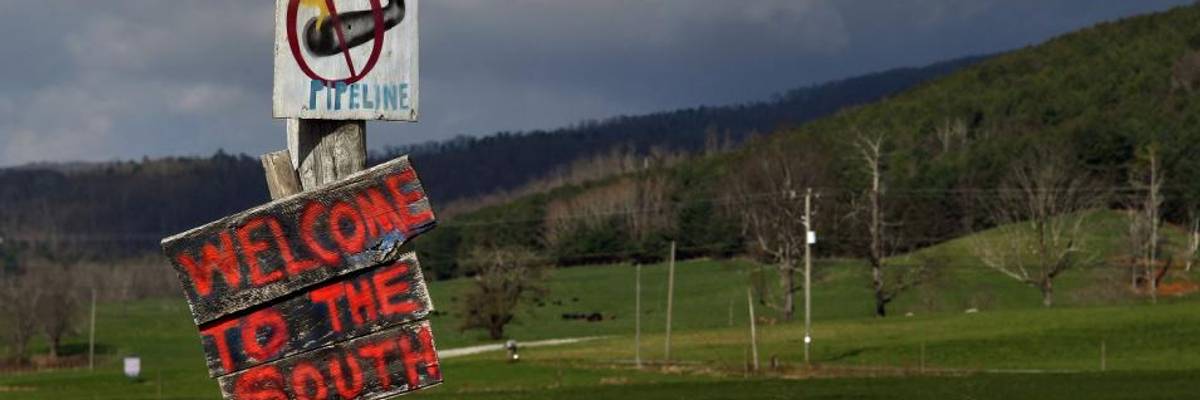
Opposition to the Mountain Valley Pipeline Project is visible on a roadside sign in Bent Mountain, Virginia. (Photo: Michael S. Williamson/The Washington Post via Getty Images)
Climate campaigners celebrated Thursday after the U.S. Court of Appeals for the Fourth Circuit delivered yet another blow to a controversial gas project spanning over 300 miles in Virginia and West Virginia.
"This decision again reinforces the truth that this destructive project must not be allowed to continue."
"At a time when we need to urgently move away from fracked-gas pipelines and all the harms they bring--from impacts to endangered species to damage to water quality to climate change--the law and science prevailed in this case," declared Anne Havemann, general counsel of the Chesapeake Climate Action Network.
A three-judge panel from the Richmond-based federal appeals court threw out the U.S. Fish and Wildlife Services' assessment of how the Mountain Valley Pipeline (MVP) would impact two endangered fish species: the Roanoke logperch and the candy darter.
"If a species is already speeding toward the extinction cliff, an agency may not press on the gas. We urge the Fish and Wildlife Service to consider this directive carefully while reassessing impacts to the two endangered fish at issue, especially the apparently not-long-for-this-world candy darter," Judge James Wynn wrote in the court's opinion.
"We recognize that this decision will further delay the completion of an already mostly finished pipeline," Wynn added, "but the Endangered Species Act's directive to federal agencies could not be clearer: 'halt and reverse the trend toward species extinction, whatever the cost.'"
While the five companies behind the pipeline said that "we remain committed to completing the MVP project and believe the concerns associated with MVP's biological opinion can be addressed by the agency," climate campaigners expressed hope this will help kill the project.
"Sacred life prevailed today with the court's acknowledgment of the harmful impact MVP has on everything in its path, specifically endangered and threatened species," said Russell Chisholm, co-chair of the Protect Our Water, Heritage, Rights (POWHR) Coalition. "Holding MVP accountable to the law is key to the ultimate cancellation of this noxious fracked gas pipeline."
"This decision not only protects the candy darter and other endangered species," he continued, "it sets us on course to stop MVP, decisively transition away from deadly fossil fuels, and reroute towards a renewable economy on a livable planet."
Calling the court's move a "sweetly welcome decision in our fight to stop the ravage of MVP," Roberta Bondurant of Preserve Bent Mountain--which is part of the POWHR Coalition--pointed out that the local opponents along the pipeline's route "have fought relentlessly, and at unspeakable costs, to protect forest, meadow, and waters of our venerable Appalachians."
Peter Anderson, Virginia policy director for Appalachian Voices, noted that "communities in this region rely on its rich biodiversity to support many recreational and economic opportunities."
While lambasting the failure of "agencies that should be guardians of our most precious resources and the public interest, Wild Virginia conservation director David Sligh welcomed the win for "sensitive and valuable species, which have already been harmed by MVP's pollution."
"This decision again reinforces the truth that this destructive project must not be allowed to continue," Sligh said. "The company needs to face that fact now and should be forced to help heal the wounds it has inflicted."
Along with cheering the "incredible victory" in court, Jared Margolis, senior attorney at the Center for Biological Diversity, put the controversial project into a broader context.
"The Mountain Valley Pipeline is a fossil fuel nightmare that threatens the essential habitat of imperiled wildlife," he said. "These projects lock us into an unsustainable spiral of climate change that inflicts incredible damage to vulnerable species. That cycle must end."
"The Mountain Valley Pipeline is a fossil fuel nightmare that threatens the essential habitat of imperiled wildlife."
Thursday's decision is "the third blow the pipeline has received in just over a week," Virginia Mercury reported, noting that on January 25, the same court "yanked the project's Forest Service and Bureau of Land Management approvals, finding that those agencies' evaluations of impacts had been inadequate."
Acknowledging the project's recent setbacks, Sierra Club senior director of energy campaigns Kelly Sheehan--whose group argued the case on behalf of conservation groups--said that "the previous administration's rushed, shoddy permitting put the entire project in question."
"Now, the Biden administration must fulfill the commitments it has made on climate and environmental justice by taking a meaningful, thorough review of this project and its permitting," she said. "When they do, they will see the science is clear: MVP is not compatible with a healthy planet and livable communities. MVP must not move forward."
Dear Common Dreams reader, It’s been nearly 30 years since I co-founded Common Dreams with my late wife, Lina Newhouser. We had the radical notion that journalism should serve the public good, not corporate profits. It was clear to us from the outset what it would take to build such a project. No paid advertisements. No corporate sponsors. No millionaire publisher telling us what to think or do. Many people said we wouldn't last a year, but we proved those doubters wrong. Together with a tremendous team of journalists and dedicated staff, we built an independent media outlet free from the constraints of profits and corporate control. Our mission has always been simple: To inform. To inspire. To ignite change for the common good. Building Common Dreams was not easy. Our survival was never guaranteed. When you take on the most powerful forces—Wall Street greed, fossil fuel industry destruction, Big Tech lobbyists, and uber-rich oligarchs who have spent billions upon billions rigging the economy and democracy in their favor—the only bulwark you have is supporters who believe in your work. But here’s the urgent message from me today. It's never been this bad out there. And it's never been this hard to keep us going. At the very moment Common Dreams is most needed, the threats we face are intensifying. We need your support now more than ever. We don't accept corporate advertising and never will. We don't have a paywall because we don't think people should be blocked from critical news based on their ability to pay. Everything we do is funded by the donations of readers like you. When everyone does the little they can afford, we are strong. But if that support retreats or dries up, so do we. Will you donate now to make sure Common Dreams not only survives but thrives? —Craig Brown, Co-founder |
Climate campaigners celebrated Thursday after the U.S. Court of Appeals for the Fourth Circuit delivered yet another blow to a controversial gas project spanning over 300 miles in Virginia and West Virginia.
"This decision again reinforces the truth that this destructive project must not be allowed to continue."
"At a time when we need to urgently move away from fracked-gas pipelines and all the harms they bring--from impacts to endangered species to damage to water quality to climate change--the law and science prevailed in this case," declared Anne Havemann, general counsel of the Chesapeake Climate Action Network.
A three-judge panel from the Richmond-based federal appeals court threw out the U.S. Fish and Wildlife Services' assessment of how the Mountain Valley Pipeline (MVP) would impact two endangered fish species: the Roanoke logperch and the candy darter.
"If a species is already speeding toward the extinction cliff, an agency may not press on the gas. We urge the Fish and Wildlife Service to consider this directive carefully while reassessing impacts to the two endangered fish at issue, especially the apparently not-long-for-this-world candy darter," Judge James Wynn wrote in the court's opinion.
"We recognize that this decision will further delay the completion of an already mostly finished pipeline," Wynn added, "but the Endangered Species Act's directive to federal agencies could not be clearer: 'halt and reverse the trend toward species extinction, whatever the cost.'"
While the five companies behind the pipeline said that "we remain committed to completing the MVP project and believe the concerns associated with MVP's biological opinion can be addressed by the agency," climate campaigners expressed hope this will help kill the project.
"Sacred life prevailed today with the court's acknowledgment of the harmful impact MVP has on everything in its path, specifically endangered and threatened species," said Russell Chisholm, co-chair of the Protect Our Water, Heritage, Rights (POWHR) Coalition. "Holding MVP accountable to the law is key to the ultimate cancellation of this noxious fracked gas pipeline."
"This decision not only protects the candy darter and other endangered species," he continued, "it sets us on course to stop MVP, decisively transition away from deadly fossil fuels, and reroute towards a renewable economy on a livable planet."
Calling the court's move a "sweetly welcome decision in our fight to stop the ravage of MVP," Roberta Bondurant of Preserve Bent Mountain--which is part of the POWHR Coalition--pointed out that the local opponents along the pipeline's route "have fought relentlessly, and at unspeakable costs, to protect forest, meadow, and waters of our venerable Appalachians."
Peter Anderson, Virginia policy director for Appalachian Voices, noted that "communities in this region rely on its rich biodiversity to support many recreational and economic opportunities."
While lambasting the failure of "agencies that should be guardians of our most precious resources and the public interest, Wild Virginia conservation director David Sligh welcomed the win for "sensitive and valuable species, which have already been harmed by MVP's pollution."
"This decision again reinforces the truth that this destructive project must not be allowed to continue," Sligh said. "The company needs to face that fact now and should be forced to help heal the wounds it has inflicted."
Along with cheering the "incredible victory" in court, Jared Margolis, senior attorney at the Center for Biological Diversity, put the controversial project into a broader context.
"The Mountain Valley Pipeline is a fossil fuel nightmare that threatens the essential habitat of imperiled wildlife," he said. "These projects lock us into an unsustainable spiral of climate change that inflicts incredible damage to vulnerable species. That cycle must end."
"The Mountain Valley Pipeline is a fossil fuel nightmare that threatens the essential habitat of imperiled wildlife."
Thursday's decision is "the third blow the pipeline has received in just over a week," Virginia Mercury reported, noting that on January 25, the same court "yanked the project's Forest Service and Bureau of Land Management approvals, finding that those agencies' evaluations of impacts had been inadequate."
Acknowledging the project's recent setbacks, Sierra Club senior director of energy campaigns Kelly Sheehan--whose group argued the case on behalf of conservation groups--said that "the previous administration's rushed, shoddy permitting put the entire project in question."
"Now, the Biden administration must fulfill the commitments it has made on climate and environmental justice by taking a meaningful, thorough review of this project and its permitting," she said. "When they do, they will see the science is clear: MVP is not compatible with a healthy planet and livable communities. MVP must not move forward."
Climate campaigners celebrated Thursday after the U.S. Court of Appeals for the Fourth Circuit delivered yet another blow to a controversial gas project spanning over 300 miles in Virginia and West Virginia.
"This decision again reinforces the truth that this destructive project must not be allowed to continue."
"At a time when we need to urgently move away from fracked-gas pipelines and all the harms they bring--from impacts to endangered species to damage to water quality to climate change--the law and science prevailed in this case," declared Anne Havemann, general counsel of the Chesapeake Climate Action Network.
A three-judge panel from the Richmond-based federal appeals court threw out the U.S. Fish and Wildlife Services' assessment of how the Mountain Valley Pipeline (MVP) would impact two endangered fish species: the Roanoke logperch and the candy darter.
"If a species is already speeding toward the extinction cliff, an agency may not press on the gas. We urge the Fish and Wildlife Service to consider this directive carefully while reassessing impacts to the two endangered fish at issue, especially the apparently not-long-for-this-world candy darter," Judge James Wynn wrote in the court's opinion.
"We recognize that this decision will further delay the completion of an already mostly finished pipeline," Wynn added, "but the Endangered Species Act's directive to federal agencies could not be clearer: 'halt and reverse the trend toward species extinction, whatever the cost.'"
While the five companies behind the pipeline said that "we remain committed to completing the MVP project and believe the concerns associated with MVP's biological opinion can be addressed by the agency," climate campaigners expressed hope this will help kill the project.
"Sacred life prevailed today with the court's acknowledgment of the harmful impact MVP has on everything in its path, specifically endangered and threatened species," said Russell Chisholm, co-chair of the Protect Our Water, Heritage, Rights (POWHR) Coalition. "Holding MVP accountable to the law is key to the ultimate cancellation of this noxious fracked gas pipeline."
"This decision not only protects the candy darter and other endangered species," he continued, "it sets us on course to stop MVP, decisively transition away from deadly fossil fuels, and reroute towards a renewable economy on a livable planet."
Calling the court's move a "sweetly welcome decision in our fight to stop the ravage of MVP," Roberta Bondurant of Preserve Bent Mountain--which is part of the POWHR Coalition--pointed out that the local opponents along the pipeline's route "have fought relentlessly, and at unspeakable costs, to protect forest, meadow, and waters of our venerable Appalachians."
Peter Anderson, Virginia policy director for Appalachian Voices, noted that "communities in this region rely on its rich biodiversity to support many recreational and economic opportunities."
While lambasting the failure of "agencies that should be guardians of our most precious resources and the public interest, Wild Virginia conservation director David Sligh welcomed the win for "sensitive and valuable species, which have already been harmed by MVP's pollution."
"This decision again reinforces the truth that this destructive project must not be allowed to continue," Sligh said. "The company needs to face that fact now and should be forced to help heal the wounds it has inflicted."
Along with cheering the "incredible victory" in court, Jared Margolis, senior attorney at the Center for Biological Diversity, put the controversial project into a broader context.
"The Mountain Valley Pipeline is a fossil fuel nightmare that threatens the essential habitat of imperiled wildlife," he said. "These projects lock us into an unsustainable spiral of climate change that inflicts incredible damage to vulnerable species. That cycle must end."
"The Mountain Valley Pipeline is a fossil fuel nightmare that threatens the essential habitat of imperiled wildlife."
Thursday's decision is "the third blow the pipeline has received in just over a week," Virginia Mercury reported, noting that on January 25, the same court "yanked the project's Forest Service and Bureau of Land Management approvals, finding that those agencies' evaluations of impacts had been inadequate."
Acknowledging the project's recent setbacks, Sierra Club senior director of energy campaigns Kelly Sheehan--whose group argued the case on behalf of conservation groups--said that "the previous administration's rushed, shoddy permitting put the entire project in question."
"Now, the Biden administration must fulfill the commitments it has made on climate and environmental justice by taking a meaningful, thorough review of this project and its permitting," she said. "When they do, they will see the science is clear: MVP is not compatible with a healthy planet and livable communities. MVP must not move forward."