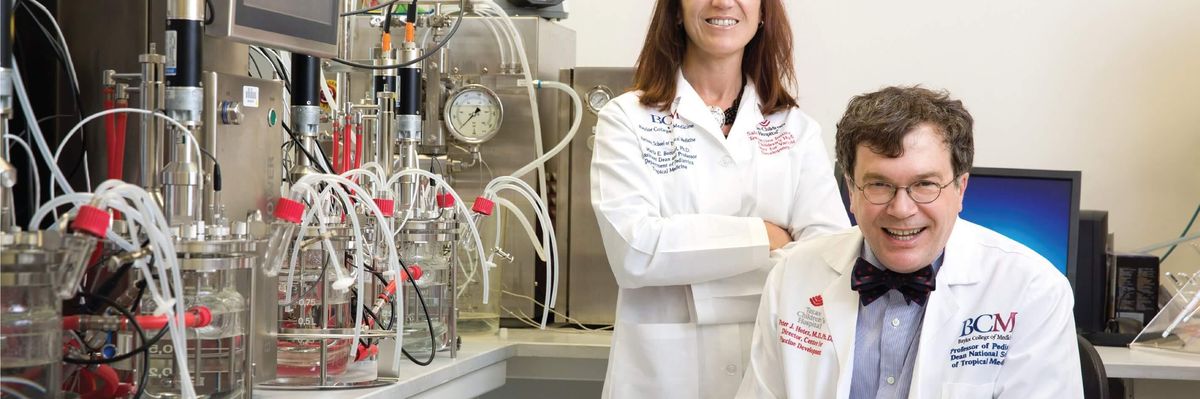
Texas researchers Maria Elena Bottazzi and Peter Hotez led development of the Corbevax patent-free Covid-19 vaccine. (Photo: Texas Medical Center)
Texas Team Applauded for Giving What Big Pharma Refuses: A Patent-Free Vaccine to the World
"We're not trying to make money. We just want to see people get vaccinated."
A small team of Texas researchers is being hailed for developing an unpatented Covid-19 vaccine to share with the world without personal profit, with some advocates asking, if they can do it, why can't Big Pharma?
"If we had even a fraction of the support that Moderna had, who knows, maybe the world would be vaccinated by now."
Dubbed "the World's Covid vaccine," the inoculation--formally called Corbevax--is an open-source alternative to Big Pharma's patent-protected vaccines. Instead of being produced for profit, this shot could ultimately be manufactured around the world and made cheaply available to all without governmental or private legal retribution.
Common Dreams reported this week that Corbevax--developed jointly by Texas Children's Hospital, Houston's Baylor College, and the Indian pharmaceutical company Biological E. Limited--was authorized for emergency use in India amid a surge in infections driven by the highly contagious Omicron variant. Texas Children's Hospital says the new vaccine is at least 90% effective against the SARS-CoV-2 virus, and 80% or more effective against its Delta variant.
"We're not trying to make money," Peter Hotez, who led the Texas Children's Hospital team, told The Washington Post. "We just want to see people get vaccinated."
According to the Post, "Biological E. has ambitious plans to produce more than one billion doses of the vaccine in 2022." And while Hotez and Maria Elena Bottazzi at Baylor won't personally profit from vaccine they were instrumental in developing, the Post reports Baylor will take a fee.
Hotez said the Hyderabad-based pharma firm has about 150 million Corbevax doses ready to distribute, with 300 million more doses pre-ordered by the Indian government. The company hopes to ramp up production to 100 million monthly doses in order to better serve a nation in which only around 40% of the population are fully vaccinated.
Peter Maybarduk, director of the consumer advocacy group Public Citizen, said Thursday that "Texas Children's Hospital's commitment to sharing technology is a challenge to the pharma giants and the false narrative that vaccine production and medical innovation thrive through secrecy and exclusivity."
"If Texas Children's Hospital can do it," he asked, "why can't Pfizer and Moderna?"
The Post continued:
Unlike the vaccines of big-name manufacturers such as Pfizer-BioNTech and Moderna, the Texas Children's Hospital vaccine... is being shared patent-free... The ambition is to create a low-cost, open-source alternative to expensive and limited-supply mRNA vaccines for developing and under-vaccinated countries. And it won't stop at India: Hotez and Bottazzi are talking to other manufacturers around the world and have consulted with the World Health Organization to see how they can share the vaccine globally.
If everything goes to plan, manufacturers all around the world could produce their own versions of the Texas Children's Hospital vaccine, which uses older recombinant protein technology that many manufacturers already have experience with, rather than newer and potentially more complicated technology. Some advocates hope it could be a model for how vaccines should be developed and shared globally during a pandemic.
"This vaccine can be made locally all over the world, and we've now technology-transferred our Texas Children's vaccine to producers in India, Indonesia, Bangladesh, [and] Botswana," Hotez tweeted Tuesday. "Our Texas Children's Center does not plan to make money on this, it's a gift to the world."
While Big Pharma corporations took billions of dollars in public funding to help develop vaccines from which they then reaped enormous profits while often charging exorbitant prices, Hotez and Battazzi created Corbevax with $7 million, mostly from private investors. One of these, Austin vodka distiller Tito's, contributed $1 million to the effort.
"If we had even a fraction of the support that Moderna had, who knows, maybe the world would be vaccinated by now," Hotez told the Post. "We wouldn't be having a discussion about Omicron."
We are at a crossroads
This country and this world are at a monumental crossroads. In a few short weeks, US voters will have an opportunity to beat back the forces of fascism and confront the billionaires who are rigging the economy, our media system, and our democracy, making it increasingly impossible for ordinary people to get by. We’re not just talking about the election. We’re talking about what must be done once these fascist elements are vanquished from power. We need a bolder set of solutions than what either major party has so far been willing to offer and a working-class movement ready to fight like hell for it. Trump didn't emerge from nowhere. The conditions that fueled MAGA authoritarianism were created by decades of radical neoliberal economic policies and a corrupt political system dominated by corporate interests. They slashed taxes on the super-rich, promising that the benefits would trickle down. They said giveaways to the corporate titans would make life more affordable for the rest of us. It was all bullshit. And when a bitter, betrayed populace searches for someone to blame, right-wing demagogues have little trouble finding scapegoats. People know when they're being lied to, but you won't hear any of this from the corporate media. Only independent journalism—powered and funded by people who believe in building a better world—can deliver truly trustworthy daily news. Our Fall Campaign is underway, and we need your help. To power our newsroom through the rest of the year, we need to raise $125,000 by midnight on October 31. So if you share our vision, please contribute whatever you can to sustain our work. |
A small team of Texas researchers is being hailed for developing an unpatented Covid-19 vaccine to share with the world without personal profit, with some advocates asking, if they can do it, why can't Big Pharma?
"If we had even a fraction of the support that Moderna had, who knows, maybe the world would be vaccinated by now."
Dubbed "the World's Covid vaccine," the inoculation--formally called Corbevax--is an open-source alternative to Big Pharma's patent-protected vaccines. Instead of being produced for profit, this shot could ultimately be manufactured around the world and made cheaply available to all without governmental or private legal retribution.
Common Dreams reported this week that Corbevax--developed jointly by Texas Children's Hospital, Houston's Baylor College, and the Indian pharmaceutical company Biological E. Limited--was authorized for emergency use in India amid a surge in infections driven by the highly contagious Omicron variant. Texas Children's Hospital says the new vaccine is at least 90% effective against the SARS-CoV-2 virus, and 80% or more effective against its Delta variant.
"We're not trying to make money," Peter Hotez, who led the Texas Children's Hospital team, told The Washington Post. "We just want to see people get vaccinated."
According to the Post, "Biological E. has ambitious plans to produce more than one billion doses of the vaccine in 2022." And while Hotez and Maria Elena Bottazzi at Baylor won't personally profit from vaccine they were instrumental in developing, the Post reports Baylor will take a fee.
Hotez said the Hyderabad-based pharma firm has about 150 million Corbevax doses ready to distribute, with 300 million more doses pre-ordered by the Indian government. The company hopes to ramp up production to 100 million monthly doses in order to better serve a nation in which only around 40% of the population are fully vaccinated.
Peter Maybarduk, director of the consumer advocacy group Public Citizen, said Thursday that "Texas Children's Hospital's commitment to sharing technology is a challenge to the pharma giants and the false narrative that vaccine production and medical innovation thrive through secrecy and exclusivity."
"If Texas Children's Hospital can do it," he asked, "why can't Pfizer and Moderna?"
The Post continued:
Unlike the vaccines of big-name manufacturers such as Pfizer-BioNTech and Moderna, the Texas Children's Hospital vaccine... is being shared patent-free... The ambition is to create a low-cost, open-source alternative to expensive and limited-supply mRNA vaccines for developing and under-vaccinated countries. And it won't stop at India: Hotez and Bottazzi are talking to other manufacturers around the world and have consulted with the World Health Organization to see how they can share the vaccine globally.
If everything goes to plan, manufacturers all around the world could produce their own versions of the Texas Children's Hospital vaccine, which uses older recombinant protein technology that many manufacturers already have experience with, rather than newer and potentially more complicated technology. Some advocates hope it could be a model for how vaccines should be developed and shared globally during a pandemic.
"This vaccine can be made locally all over the world, and we've now technology-transferred our Texas Children's vaccine to producers in India, Indonesia, Bangladesh, [and] Botswana," Hotez tweeted Tuesday. "Our Texas Children's Center does not plan to make money on this, it's a gift to the world."
While Big Pharma corporations took billions of dollars in public funding to help develop vaccines from which they then reaped enormous profits while often charging exorbitant prices, Hotez and Battazzi created Corbevax with $7 million, mostly from private investors. One of these, Austin vodka distiller Tito's, contributed $1 million to the effort.
"If we had even a fraction of the support that Moderna had, who knows, maybe the world would be vaccinated by now," Hotez told the Post. "We wouldn't be having a discussion about Omicron."
A small team of Texas researchers is being hailed for developing an unpatented Covid-19 vaccine to share with the world without personal profit, with some advocates asking, if they can do it, why can't Big Pharma?
"If we had even a fraction of the support that Moderna had, who knows, maybe the world would be vaccinated by now."
Dubbed "the World's Covid vaccine," the inoculation--formally called Corbevax--is an open-source alternative to Big Pharma's patent-protected vaccines. Instead of being produced for profit, this shot could ultimately be manufactured around the world and made cheaply available to all without governmental or private legal retribution.
Common Dreams reported this week that Corbevax--developed jointly by Texas Children's Hospital, Houston's Baylor College, and the Indian pharmaceutical company Biological E. Limited--was authorized for emergency use in India amid a surge in infections driven by the highly contagious Omicron variant. Texas Children's Hospital says the new vaccine is at least 90% effective against the SARS-CoV-2 virus, and 80% or more effective against its Delta variant.
"We're not trying to make money," Peter Hotez, who led the Texas Children's Hospital team, told The Washington Post. "We just want to see people get vaccinated."
According to the Post, "Biological E. has ambitious plans to produce more than one billion doses of the vaccine in 2022." And while Hotez and Maria Elena Bottazzi at Baylor won't personally profit from vaccine they were instrumental in developing, the Post reports Baylor will take a fee.
Hotez said the Hyderabad-based pharma firm has about 150 million Corbevax doses ready to distribute, with 300 million more doses pre-ordered by the Indian government. The company hopes to ramp up production to 100 million monthly doses in order to better serve a nation in which only around 40% of the population are fully vaccinated.
Peter Maybarduk, director of the consumer advocacy group Public Citizen, said Thursday that "Texas Children's Hospital's commitment to sharing technology is a challenge to the pharma giants and the false narrative that vaccine production and medical innovation thrive through secrecy and exclusivity."
"If Texas Children's Hospital can do it," he asked, "why can't Pfizer and Moderna?"
The Post continued:
Unlike the vaccines of big-name manufacturers such as Pfizer-BioNTech and Moderna, the Texas Children's Hospital vaccine... is being shared patent-free... The ambition is to create a low-cost, open-source alternative to expensive and limited-supply mRNA vaccines for developing and under-vaccinated countries. And it won't stop at India: Hotez and Bottazzi are talking to other manufacturers around the world and have consulted with the World Health Organization to see how they can share the vaccine globally.
If everything goes to plan, manufacturers all around the world could produce their own versions of the Texas Children's Hospital vaccine, which uses older recombinant protein technology that many manufacturers already have experience with, rather than newer and potentially more complicated technology. Some advocates hope it could be a model for how vaccines should be developed and shared globally during a pandemic.
"This vaccine can be made locally all over the world, and we've now technology-transferred our Texas Children's vaccine to producers in India, Indonesia, Bangladesh, [and] Botswana," Hotez tweeted Tuesday. "Our Texas Children's Center does not plan to make money on this, it's a gift to the world."
While Big Pharma corporations took billions of dollars in public funding to help develop vaccines from which they then reaped enormous profits while often charging exorbitant prices, Hotez and Battazzi created Corbevax with $7 million, mostly from private investors. One of these, Austin vodka distiller Tito's, contributed $1 million to the effort.
"If we had even a fraction of the support that Moderna had, who knows, maybe the world would be vaccinated by now," Hotez told the Post. "We wouldn't be having a discussion about Omicron."