SUBSCRIBE TO OUR FREE NEWSLETTER
Daily news & progressive opinion—funded by the people, not the corporations—delivered straight to your inbox.
5
#000000
#FFFFFF
To donate by check, phone, or other method, see our More Ways to Give page.
Daily news & progressive opinion—funded by the people, not the corporations—delivered straight to your inbox.
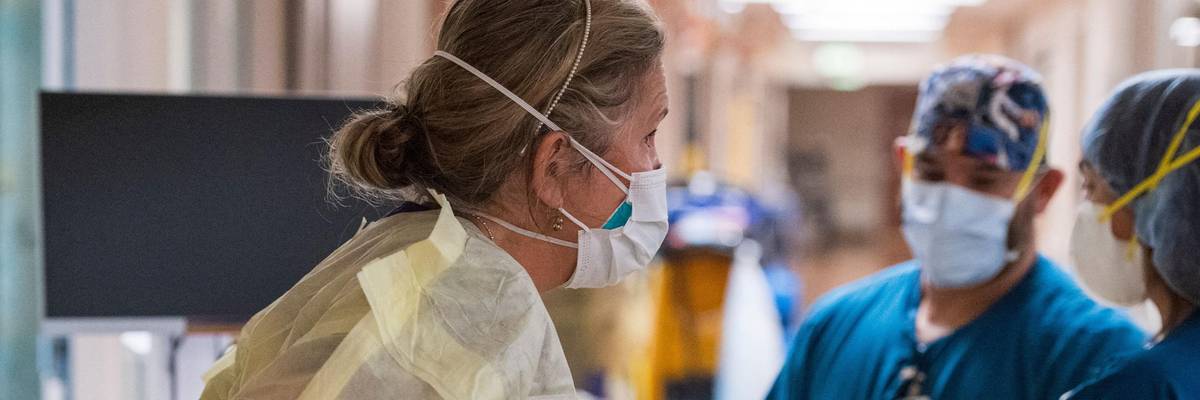
A registered nurse puts on personal protective equipment before tending to a Covid-19 patient inside the intensive care unit at Adventist Health in Sonora, California on August 27, 2021. (Photo: Nic Coury / AFP via Getty Images)
The largest nurses' union in the United States is condemning the Centers for Disease Control and Prevention's decision to shorten the recommended isolation period for healthcare workers who test positive for Covid-19, saying the move could be "dangerous" for both workers and patients.
National Nurses United (NNU) released a statement Friday, a day after the CDC released new guidelines saying healthcare workers who test positive for the disease will be able to return to work after seven days instead of 10 as long as they are asymptomatic and have a negative test.
"A more effective response to the rapidly spreading Omicron variant would be for the CDC to improve existing post-exposure guidance to fully recognize that this virus is airborne, and to strike the false equivalency between face masks and respirators."
The "isolation time can be cut further if there are staffing shortages," according to the agency.
The loosened guidelines are the result of healthcare companies' desire to maintain "business operations, revenues, and profits, without regard for science or the health of employees and the public," said NNU president Zenei Triunfo-Cortez, a registered nurse.
"Weakening Covid-19 guidance now, in the face of what could be the most devastating Covid-19 surge yet, will only result in further transmission, illness, and death," said Triunfo-Cortez, referring to the Omicron variant which is now driving infections in the United States.
The seven-day average of new daily cases topped 197,000 on Friday, skyrocketing by 65% over the previous 14 days. Hospitalizations have also increased by 10% over the past two weeks, with officials in Massachusetts and other states calling in the National Guard to help overwhelmed hospital staff.
The outbreak is "significantly diminishing" the healthcare workforce as nurses and other personnel become ill, Georges Benjamin, executive director of the American Public Health Association, told The Guardian last week. The American Nurses Association has called on the Biden administration to declare the current shortage of nurses a national emergency.
Under the CDC's new guidance, in crisis conditions caused by a severe shortage of workers, infected healthcare workers could face "no work restriction" if they test positive for Covid-19.
The agency also indicated that fully vaccinated healthcare workers who have had booster shots will not be required to quarantine after a high-risk exposure, guidance which "ignores basic tenets of infection control and the precautionary principle," said NNU.
"A more effective response to the rapidly spreading Omicron variant would be for the CDC to improve existing post-exposure guidance to fully recognize that this virus is airborne, and to strike the false equivalency between face masks and respirators," the union added.
Dr. Abraar Karan, an infectious diseases doctor at Stanford University, echoed NNU's call.
Some public health experts have expressed support for the CDC's new isolation guidelines, but workers' advocates are concerned that other industries will begin pushing for shorter quarantine periods--as some airlines have.
Sara Nelson, president of the Association of Flight Attendants, on Thursday denounced a request to the CDC by Delta Airlines to shorten the 10-day isolation period for vaccinated airline workers who become infected with breakthrough cases to just five days. JetBlue Airways made a similar request last week.
Cutting the isolation period in half in the interest of protecting airlines' operations "may put flight attendants in a position to be forced to come back before they feel better," Nelson told CNBC.
"Flight attendants should not be expected to return to work until they test negative and do not exhibit symptoms," Nelson wrote to CDC Director Dr. Rochelle Walensky on Thursday. "We do not know if 10 days represents that 'magic number' but we do not see the justification for reducing the number of days at this time."
Hundreds of flights were canceled in the U.S. on Sunday, a day after the Omicron surge was linked to the cancellation of thousands of flights on Christmas Eve and Christmas Day, with crew members calling in sick.
"This is Omicron," tweeted health reporter Helen Branswell of Stat News. "When everyone gets sick at once, systems can't cope."
Dear Common Dreams reader, It’s been nearly 30 years since I co-founded Common Dreams with my late wife, Lina Newhouser. We had the radical notion that journalism should serve the public good, not corporate profits. It was clear to us from the outset what it would take to build such a project. No paid advertisements. No corporate sponsors. No millionaire publisher telling us what to think or do. Many people said we wouldn't last a year, but we proved those doubters wrong. Together with a tremendous team of journalists and dedicated staff, we built an independent media outlet free from the constraints of profits and corporate control. Our mission has always been simple: To inform. To inspire. To ignite change for the common good. Building Common Dreams was not easy. Our survival was never guaranteed. When you take on the most powerful forces—Wall Street greed, fossil fuel industry destruction, Big Tech lobbyists, and uber-rich oligarchs who have spent billions upon billions rigging the economy and democracy in their favor—the only bulwark you have is supporters who believe in your work. But here’s the urgent message from me today. It's never been this bad out there. And it's never been this hard to keep us going. At the very moment Common Dreams is most needed, the threats we face are intensifying. We need your support now more than ever. We don't accept corporate advertising and never will. We don't have a paywall because we don't think people should be blocked from critical news based on their ability to pay. Everything we do is funded by the donations of readers like you. When everyone does the little they can afford, we are strong. But if that support retreats or dries up, so do we. Will you donate now to make sure Common Dreams not only survives but thrives? —Craig Brown, Co-founder |
The largest nurses' union in the United States is condemning the Centers for Disease Control and Prevention's decision to shorten the recommended isolation period for healthcare workers who test positive for Covid-19, saying the move could be "dangerous" for both workers and patients.
National Nurses United (NNU) released a statement Friday, a day after the CDC released new guidelines saying healthcare workers who test positive for the disease will be able to return to work after seven days instead of 10 as long as they are asymptomatic and have a negative test.
"A more effective response to the rapidly spreading Omicron variant would be for the CDC to improve existing post-exposure guidance to fully recognize that this virus is airborne, and to strike the false equivalency between face masks and respirators."
The "isolation time can be cut further if there are staffing shortages," according to the agency.
The loosened guidelines are the result of healthcare companies' desire to maintain "business operations, revenues, and profits, without regard for science or the health of employees and the public," said NNU president Zenei Triunfo-Cortez, a registered nurse.
"Weakening Covid-19 guidance now, in the face of what could be the most devastating Covid-19 surge yet, will only result in further transmission, illness, and death," said Triunfo-Cortez, referring to the Omicron variant which is now driving infections in the United States.
The seven-day average of new daily cases topped 197,000 on Friday, skyrocketing by 65% over the previous 14 days. Hospitalizations have also increased by 10% over the past two weeks, with officials in Massachusetts and other states calling in the National Guard to help overwhelmed hospital staff.
The outbreak is "significantly diminishing" the healthcare workforce as nurses and other personnel become ill, Georges Benjamin, executive director of the American Public Health Association, told The Guardian last week. The American Nurses Association has called on the Biden administration to declare the current shortage of nurses a national emergency.
Under the CDC's new guidance, in crisis conditions caused by a severe shortage of workers, infected healthcare workers could face "no work restriction" if they test positive for Covid-19.
The agency also indicated that fully vaccinated healthcare workers who have had booster shots will not be required to quarantine after a high-risk exposure, guidance which "ignores basic tenets of infection control and the precautionary principle," said NNU.
"A more effective response to the rapidly spreading Omicron variant would be for the CDC to improve existing post-exposure guidance to fully recognize that this virus is airborne, and to strike the false equivalency between face masks and respirators," the union added.
Dr. Abraar Karan, an infectious diseases doctor at Stanford University, echoed NNU's call.
Some public health experts have expressed support for the CDC's new isolation guidelines, but workers' advocates are concerned that other industries will begin pushing for shorter quarantine periods--as some airlines have.
Sara Nelson, president of the Association of Flight Attendants, on Thursday denounced a request to the CDC by Delta Airlines to shorten the 10-day isolation period for vaccinated airline workers who become infected with breakthrough cases to just five days. JetBlue Airways made a similar request last week.
Cutting the isolation period in half in the interest of protecting airlines' operations "may put flight attendants in a position to be forced to come back before they feel better," Nelson told CNBC.
"Flight attendants should not be expected to return to work until they test negative and do not exhibit symptoms," Nelson wrote to CDC Director Dr. Rochelle Walensky on Thursday. "We do not know if 10 days represents that 'magic number' but we do not see the justification for reducing the number of days at this time."
Hundreds of flights were canceled in the U.S. on Sunday, a day after the Omicron surge was linked to the cancellation of thousands of flights on Christmas Eve and Christmas Day, with crew members calling in sick.
"This is Omicron," tweeted health reporter Helen Branswell of Stat News. "When everyone gets sick at once, systems can't cope."
The largest nurses' union in the United States is condemning the Centers for Disease Control and Prevention's decision to shorten the recommended isolation period for healthcare workers who test positive for Covid-19, saying the move could be "dangerous" for both workers and patients.
National Nurses United (NNU) released a statement Friday, a day after the CDC released new guidelines saying healthcare workers who test positive for the disease will be able to return to work after seven days instead of 10 as long as they are asymptomatic and have a negative test.
"A more effective response to the rapidly spreading Omicron variant would be for the CDC to improve existing post-exposure guidance to fully recognize that this virus is airborne, and to strike the false equivalency between face masks and respirators."
The "isolation time can be cut further if there are staffing shortages," according to the agency.
The loosened guidelines are the result of healthcare companies' desire to maintain "business operations, revenues, and profits, without regard for science or the health of employees and the public," said NNU president Zenei Triunfo-Cortez, a registered nurse.
"Weakening Covid-19 guidance now, in the face of what could be the most devastating Covid-19 surge yet, will only result in further transmission, illness, and death," said Triunfo-Cortez, referring to the Omicron variant which is now driving infections in the United States.
The seven-day average of new daily cases topped 197,000 on Friday, skyrocketing by 65% over the previous 14 days. Hospitalizations have also increased by 10% over the past two weeks, with officials in Massachusetts and other states calling in the National Guard to help overwhelmed hospital staff.
The outbreak is "significantly diminishing" the healthcare workforce as nurses and other personnel become ill, Georges Benjamin, executive director of the American Public Health Association, told The Guardian last week. The American Nurses Association has called on the Biden administration to declare the current shortage of nurses a national emergency.
Under the CDC's new guidance, in crisis conditions caused by a severe shortage of workers, infected healthcare workers could face "no work restriction" if they test positive for Covid-19.
The agency also indicated that fully vaccinated healthcare workers who have had booster shots will not be required to quarantine after a high-risk exposure, guidance which "ignores basic tenets of infection control and the precautionary principle," said NNU.
"A more effective response to the rapidly spreading Omicron variant would be for the CDC to improve existing post-exposure guidance to fully recognize that this virus is airborne, and to strike the false equivalency between face masks and respirators," the union added.
Dr. Abraar Karan, an infectious diseases doctor at Stanford University, echoed NNU's call.
Some public health experts have expressed support for the CDC's new isolation guidelines, but workers' advocates are concerned that other industries will begin pushing for shorter quarantine periods--as some airlines have.
Sara Nelson, president of the Association of Flight Attendants, on Thursday denounced a request to the CDC by Delta Airlines to shorten the 10-day isolation period for vaccinated airline workers who become infected with breakthrough cases to just five days. JetBlue Airways made a similar request last week.
Cutting the isolation period in half in the interest of protecting airlines' operations "may put flight attendants in a position to be forced to come back before they feel better," Nelson told CNBC.
"Flight attendants should not be expected to return to work until they test negative and do not exhibit symptoms," Nelson wrote to CDC Director Dr. Rochelle Walensky on Thursday. "We do not know if 10 days represents that 'magic number' but we do not see the justification for reducing the number of days at this time."
Hundreds of flights were canceled in the U.S. on Sunday, a day after the Omicron surge was linked to the cancellation of thousands of flights on Christmas Eve and Christmas Day, with crew members calling in sick.
"This is Omicron," tweeted health reporter Helen Branswell of Stat News. "When everyone gets sick at once, systems can't cope."