SUBSCRIBE TO OUR FREE NEWSLETTER
Daily news & progressive opinion—funded by the people, not the corporations—delivered straight to your inbox.
5
#000000
#FFFFFF
To donate by check, phone, or other method, see our More Ways to Give page.
Daily news & progressive opinion—funded by the people, not the corporations—delivered straight to your inbox.
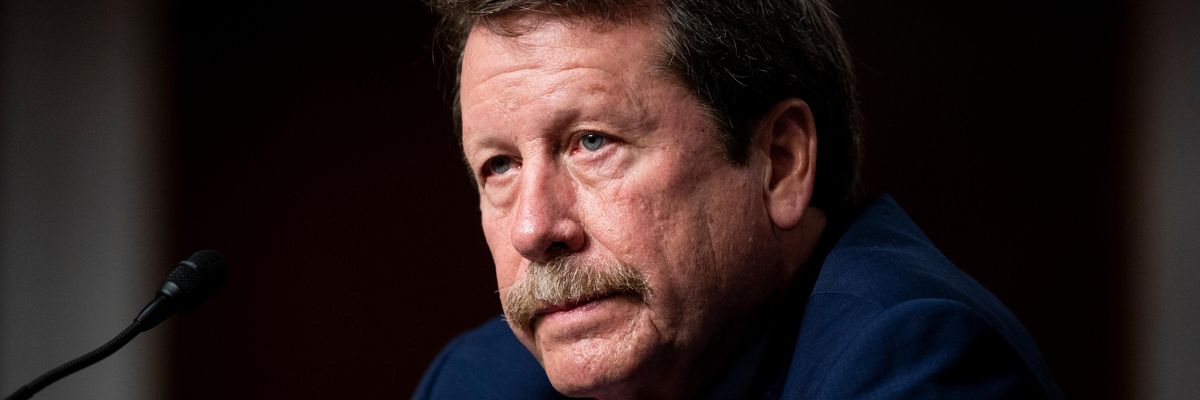
Robert Califf, President Joe Biden's nominee to head the U.S. Food and Drug Administration, testifies before the Senate Health, Education, Labor, and Pensions Committee during his confirmation hearing on December 14, 2021. (Photo: Bill Clark/CQ-Roll Call, Inc. via Getty Images)
Sen. Bernie Sanders on Tuesday said he would oppose President Joe Biden's nomination of Dr. Robert Califf to lead the U.S. Food and Drug Administration for the second time, citing the cardiologist's multimillion-dollar ties to Big Pharma.
"One of the major reasons the pharmaceutical industry, among many others, is so powerful is its close relationship with the FDA and other regulators in Washington."
Califf--who served as FDA commissioner during the final 11 months of the Obama administration--mostly skated through a congenial Senate confirmation hearing Tuesday. According to STAT, his only stumble occurred when he was pressed about the FDA's role and failings in the opioid crisis.
The Associated Press reports Senate Health, Education, Labor, and Pensions Committee Chair Patty Murray (D-Wash.) and the ranking Republican member, Sen. Richard Burr of North Carolina, both said they would vote to confirm Califf.
Sanders (I-Vt.), however, reprised his 2015 confirmation grilling of Califf over his lucrative ties to Big Pharma.
"One of the major reasons the pharmaceutical industry, among many others, is so powerful is its close relationship with the FDA and other regulators in Washington," the democratic socialist, who twice ran for president on a Medicare for All platform, said during the hearing. "What kind of comfort can you give to the American people when you have been so closely tied to the pharmaceutical industry yourself?"
Califf--who has made millions of dollars as a consultant for more than a dozen pharmaceutical corporations and who holds millions more in Big Pharma investments--replied that he was "totally with" Sanders, agreeing that "the price of pharmaceuticals is way too high in this country."
Sanders said he would once again vote to reject Califf's nomination.
"Nine out of the last 10 FDA commissioners went on to work for the pharmaceutical industry or to serve on a prescription drug company's board of directors."
"At a time when the American people pay the highest prices in the world for prescription drugs and as drug companies continue to be the most powerful special interest in Washington, we need leadership at the FDA that is finally willing to stand up to the greed and power of the pharmaceutical industry," Sanders said in a statement.
"Not only have the drug companies spent over $4.5 billion on lobbying and hundreds of millions of dollars in campaign contributions over the past 20 years, they also have created a revolving door between the FDA and the industry," he continued. "Shockingly, nine out of the last 10 FDA commissioners went on to work for the pharmaceutical industry or to serve on a prescription drug company's board of directors."
"Unfortunately, Dr. Califf is not the exception to that rule," Sanders said. "After leaving the FDA in 2017, he received consulting fees from Merck, Biogen, and Eli Lilly. According to his financial disclosure form, he owns up to $8 million in the stocks of major drug companies."
"That is exactly the close relationship Big Pharma has exploited to regulate the FDA, instead of the FDA regulating them," he added. "The Covid-19 pandemic has made clearer than ever the choice between pharmaceutical profits and the health of our people. In this critical moment, Dr. Califf is not the leader Americans need at the FDA and I will oppose his nomination."
Sixty-nine current senators voted for Califf's previous nomination.
In addition to Sanders, at least two other members of the Democratic caucus oppose his appointment: Sens. Richard Blumenthal (D-Ct.), who cites his industry ties, and Joe Manchin (D-W.Va.), who last month said that the nomination "makes no sense as the opioid epidemic continues to wreak havoc on families across this country with no end in sight."
Dear Common Dreams reader, It’s been nearly 30 years since I co-founded Common Dreams with my late wife, Lina Newhouser. We had the radical notion that journalism should serve the public good, not corporate profits. It was clear to us from the outset what it would take to build such a project. No paid advertisements. No corporate sponsors. No millionaire publisher telling us what to think or do. Many people said we wouldn't last a year, but we proved those doubters wrong. Together with a tremendous team of journalists and dedicated staff, we built an independent media outlet free from the constraints of profits and corporate control. Our mission has always been simple: To inform. To inspire. To ignite change for the common good. Building Common Dreams was not easy. Our survival was never guaranteed. When you take on the most powerful forces—Wall Street greed, fossil fuel industry destruction, Big Tech lobbyists, and uber-rich oligarchs who have spent billions upon billions rigging the economy and democracy in their favor—the only bulwark you have is supporters who believe in your work. But here’s the urgent message from me today. It's never been this bad out there. And it's never been this hard to keep us going. At the very moment Common Dreams is most needed, the threats we face are intensifying. We need your support now more than ever. We don't accept corporate advertising and never will. We don't have a paywall because we don't think people should be blocked from critical news based on their ability to pay. Everything we do is funded by the donations of readers like you. When everyone does the little they can afford, we are strong. But if that support retreats or dries up, so do we. Will you donate now to make sure Common Dreams not only survives but thrives? —Craig Brown, Co-founder |
Sen. Bernie Sanders on Tuesday said he would oppose President Joe Biden's nomination of Dr. Robert Califf to lead the U.S. Food and Drug Administration for the second time, citing the cardiologist's multimillion-dollar ties to Big Pharma.
"One of the major reasons the pharmaceutical industry, among many others, is so powerful is its close relationship with the FDA and other regulators in Washington."
Califf--who served as FDA commissioner during the final 11 months of the Obama administration--mostly skated through a congenial Senate confirmation hearing Tuesday. According to STAT, his only stumble occurred when he was pressed about the FDA's role and failings in the opioid crisis.
The Associated Press reports Senate Health, Education, Labor, and Pensions Committee Chair Patty Murray (D-Wash.) and the ranking Republican member, Sen. Richard Burr of North Carolina, both said they would vote to confirm Califf.
Sanders (I-Vt.), however, reprised his 2015 confirmation grilling of Califf over his lucrative ties to Big Pharma.
"One of the major reasons the pharmaceutical industry, among many others, is so powerful is its close relationship with the FDA and other regulators in Washington," the democratic socialist, who twice ran for president on a Medicare for All platform, said during the hearing. "What kind of comfort can you give to the American people when you have been so closely tied to the pharmaceutical industry yourself?"
Califf--who has made millions of dollars as a consultant for more than a dozen pharmaceutical corporations and who holds millions more in Big Pharma investments--replied that he was "totally with" Sanders, agreeing that "the price of pharmaceuticals is way too high in this country."
Sanders said he would once again vote to reject Califf's nomination.
"Nine out of the last 10 FDA commissioners went on to work for the pharmaceutical industry or to serve on a prescription drug company's board of directors."
"At a time when the American people pay the highest prices in the world for prescription drugs and as drug companies continue to be the most powerful special interest in Washington, we need leadership at the FDA that is finally willing to stand up to the greed and power of the pharmaceutical industry," Sanders said in a statement.
"Not only have the drug companies spent over $4.5 billion on lobbying and hundreds of millions of dollars in campaign contributions over the past 20 years, they also have created a revolving door between the FDA and the industry," he continued. "Shockingly, nine out of the last 10 FDA commissioners went on to work for the pharmaceutical industry or to serve on a prescription drug company's board of directors."
"Unfortunately, Dr. Califf is not the exception to that rule," Sanders said. "After leaving the FDA in 2017, he received consulting fees from Merck, Biogen, and Eli Lilly. According to his financial disclosure form, he owns up to $8 million in the stocks of major drug companies."
"That is exactly the close relationship Big Pharma has exploited to regulate the FDA, instead of the FDA regulating them," he added. "The Covid-19 pandemic has made clearer than ever the choice between pharmaceutical profits and the health of our people. In this critical moment, Dr. Califf is not the leader Americans need at the FDA and I will oppose his nomination."
Sixty-nine current senators voted for Califf's previous nomination.
In addition to Sanders, at least two other members of the Democratic caucus oppose his appointment: Sens. Richard Blumenthal (D-Ct.), who cites his industry ties, and Joe Manchin (D-W.Va.), who last month said that the nomination "makes no sense as the opioid epidemic continues to wreak havoc on families across this country with no end in sight."
Sen. Bernie Sanders on Tuesday said he would oppose President Joe Biden's nomination of Dr. Robert Califf to lead the U.S. Food and Drug Administration for the second time, citing the cardiologist's multimillion-dollar ties to Big Pharma.
"One of the major reasons the pharmaceutical industry, among many others, is so powerful is its close relationship with the FDA and other regulators in Washington."
Califf--who served as FDA commissioner during the final 11 months of the Obama administration--mostly skated through a congenial Senate confirmation hearing Tuesday. According to STAT, his only stumble occurred when he was pressed about the FDA's role and failings in the opioid crisis.
The Associated Press reports Senate Health, Education, Labor, and Pensions Committee Chair Patty Murray (D-Wash.) and the ranking Republican member, Sen. Richard Burr of North Carolina, both said they would vote to confirm Califf.
Sanders (I-Vt.), however, reprised his 2015 confirmation grilling of Califf over his lucrative ties to Big Pharma.
"One of the major reasons the pharmaceutical industry, among many others, is so powerful is its close relationship with the FDA and other regulators in Washington," the democratic socialist, who twice ran for president on a Medicare for All platform, said during the hearing. "What kind of comfort can you give to the American people when you have been so closely tied to the pharmaceutical industry yourself?"
Califf--who has made millions of dollars as a consultant for more than a dozen pharmaceutical corporations and who holds millions more in Big Pharma investments--replied that he was "totally with" Sanders, agreeing that "the price of pharmaceuticals is way too high in this country."
Sanders said he would once again vote to reject Califf's nomination.
"Nine out of the last 10 FDA commissioners went on to work for the pharmaceutical industry or to serve on a prescription drug company's board of directors."
"At a time when the American people pay the highest prices in the world for prescription drugs and as drug companies continue to be the most powerful special interest in Washington, we need leadership at the FDA that is finally willing to stand up to the greed and power of the pharmaceutical industry," Sanders said in a statement.
"Not only have the drug companies spent over $4.5 billion on lobbying and hundreds of millions of dollars in campaign contributions over the past 20 years, they also have created a revolving door between the FDA and the industry," he continued. "Shockingly, nine out of the last 10 FDA commissioners went on to work for the pharmaceutical industry or to serve on a prescription drug company's board of directors."
"Unfortunately, Dr. Califf is not the exception to that rule," Sanders said. "After leaving the FDA in 2017, he received consulting fees from Merck, Biogen, and Eli Lilly. According to his financial disclosure form, he owns up to $8 million in the stocks of major drug companies."
"That is exactly the close relationship Big Pharma has exploited to regulate the FDA, instead of the FDA regulating them," he added. "The Covid-19 pandemic has made clearer than ever the choice between pharmaceutical profits and the health of our people. In this critical moment, Dr. Califf is not the leader Americans need at the FDA and I will oppose his nomination."
Sixty-nine current senators voted for Califf's previous nomination.
In addition to Sanders, at least two other members of the Democratic caucus oppose his appointment: Sens. Richard Blumenthal (D-Ct.), who cites his industry ties, and Joe Manchin (D-W.Va.), who last month said that the nomination "makes no sense as the opioid epidemic continues to wreak havoc on families across this country with no end in sight."