SUBSCRIBE TO OUR FREE NEWSLETTER
Daily news & progressive opinion—funded by the people, not the corporations—delivered straight to your inbox.
5
#000000
#FFFFFF
To donate by check, phone, or other method, see our More Ways to Give page.
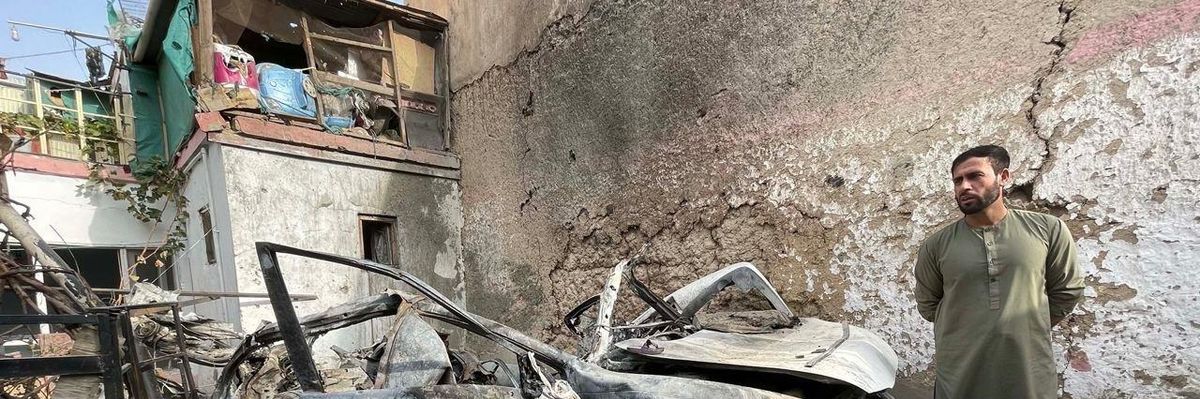
In a continuation of a long history of impunity for U.S. troops who harm noncombatants during wartime, the Pentagon said Monday that none of the military personnel involved in an unmanned aerial drone strike that killed 10 civilians--seven of them children--during the final days of the war in Afghanistan would be punished.
"How can our military wrongly take the lives of 10 precious Afghan people and hold no one accountable in any way?"
When asked if anyone would be held accountable for the August 29 strike that killed aid worker Zamairi Ahmadi and nine of his relatives, including children as young as two years old, Pentagon spokesperson John Kirby said during a Monday press conference that he does "not anticipate there being issues of personal accountability to be had" regarding the attack.
Kathy Kelly of the advocacy group Ban Killer Drones said in a statement that "U.S. attacks slaughtering civilians have been routine."
"The unusual aspect of the August 29th attack was that international media exposed the murder of civilians and the pernicious initial claim that this was a 'righteous attack,'" she added.
Following a long-established pattern of initially denying that U.S. airstrikes harm civilians, Joint Chiefs of Staff Chair Gen. Mark Milley first described the botched bombardment as a "righteous strike" that targeted a vehicle believed to be transporting explosives. U.S. Central Command claimed the strike triggered "significant secondary explosions from the vehicle," which "indicated the presence of a substantial amount of explosive material."
"We are confident we successfully hit the target," a Pentagon spokesperson asserted, claiming the attack thwarted "an imminent ISIS-K threat to Hamad Karzai International Airport"--a reference to the so-called Islamic States' Khorasan branch.
However, investigations by The New York Times and The Washington Post revealed that there were no explosives in Ahmadi's car and that the "suspicious"-looking man and the people with him were loading containers of water into the vehicle.
Ahmadi, who worked for the California-based nonprofit Nutrition and Education International (NEI), had applied to resettle in the United States as the Taliban re-conquered Afghanistan after 20 years of U.S.-led war and occupation.
In an interview with the Times, NEI founder and president Steven Kwon called the Pentagon's decision to not punish anyone for the strike "shocking."
He asked, "How can our military wrongly take the lives of 10 precious Afghan people and hold no one accountable in any way?"
Accountability and punishment for civilian casualties are the rare exception to the rule in the U.S. military, which has killed an estimated 900,000 men, women, and children during the 20-year so-called War on Terror and millions of noncombatants since waging nuclear war against Japan in 1945.
"The broader context the Pentagon should acknowledge was clarified by Daniel Hale, the drone whistleblower who disclosed that innocent Afghan civilians were killed in 90% of the U.S. drone attacks during a five-month period," said Kelly.
Hale was sentenced in July to nearly four years behind bars for sharing classified information about the U.S. drone assassination program with a journalist. He was the latest in a long line of whistleblowers from Daniel Ellsberg to Julian Assange, John Kiriakou, Chelsea Manning, and numerous others who have been imprisoned for exposing war crimes whose perpetrators almost always go unpunished--and are sometimes even rewarded.
Nick Mottern, also of Ban Killer Drones, said that "if the Pentagon wants to come clean about this horrific event, it will release documents and videotapes that show who was responsible for key decisions and what technological failings were responsible."
Mottern added that if President Joe Biden "was involved in the decision, we must know that."
Related Content

The Pentagon's announcement came a day after the Times revealed the existence of a secret U.S. military airstrike unit called Talon Anvil, which one former Pentagon and State Department adviser said killed Syrian civilians at a rate 10 times higher than in comparable theaters of the so-called War on Terror.
In a continuation of a long history of impunity for U.S. troops who harm noncombatants during wartime, the Pentagon said Monday that none of the military personnel involved in an unmanned aerial drone strike that killed 10 civilians--seven of them children--during the final days of the war in Afghanistan would be punished.
"How can our military wrongly take the lives of 10 precious Afghan people and hold no one accountable in any way?"
When asked if anyone would be held accountable for the August 29 strike that killed aid worker Zamairi Ahmadi and nine of his relatives, including children as young as two years old, Pentagon spokesperson John Kirby said during a Monday press conference that he does "not anticipate there being issues of personal accountability to be had" regarding the attack.
Kathy Kelly of the advocacy group Ban Killer Drones said in a statement that "U.S. attacks slaughtering civilians have been routine."
"The unusual aspect of the August 29th attack was that international media exposed the murder of civilians and the pernicious initial claim that this was a 'righteous attack,'" she added.
Following a long-established pattern of initially denying that U.S. airstrikes harm civilians, Joint Chiefs of Staff Chair Gen. Mark Milley first described the botched bombardment as a "righteous strike" that targeted a vehicle believed to be transporting explosives. U.S. Central Command claimed the strike triggered "significant secondary explosions from the vehicle," which "indicated the presence of a substantial amount of explosive material."
"We are confident we successfully hit the target," a Pentagon spokesperson asserted, claiming the attack thwarted "an imminent ISIS-K threat to Hamad Karzai International Airport"--a reference to the so-called Islamic States' Khorasan branch.
However, investigations by The New York Times and The Washington Post revealed that there were no explosives in Ahmadi's car and that the "suspicious"-looking man and the people with him were loading containers of water into the vehicle.
Ahmadi, who worked for the California-based nonprofit Nutrition and Education International (NEI), had applied to resettle in the United States as the Taliban re-conquered Afghanistan after 20 years of U.S.-led war and occupation.
In an interview with the Times, NEI founder and president Steven Kwon called the Pentagon's decision to not punish anyone for the strike "shocking."
He asked, "How can our military wrongly take the lives of 10 precious Afghan people and hold no one accountable in any way?"
Accountability and punishment for civilian casualties are the rare exception to the rule in the U.S. military, which has killed an estimated 900,000 men, women, and children during the 20-year so-called War on Terror and millions of noncombatants since waging nuclear war against Japan in 1945.
"The broader context the Pentagon should acknowledge was clarified by Daniel Hale, the drone whistleblower who disclosed that innocent Afghan civilians were killed in 90% of the U.S. drone attacks during a five-month period," said Kelly.
Hale was sentenced in July to nearly four years behind bars for sharing classified information about the U.S. drone assassination program with a journalist. He was the latest in a long line of whistleblowers from Daniel Ellsberg to Julian Assange, John Kiriakou, Chelsea Manning, and numerous others who have been imprisoned for exposing war crimes whose perpetrators almost always go unpunished--and are sometimes even rewarded.
Nick Mottern, also of Ban Killer Drones, said that "if the Pentagon wants to come clean about this horrific event, it will release documents and videotapes that show who was responsible for key decisions and what technological failings were responsible."
Mottern added that if President Joe Biden "was involved in the decision, we must know that."
Related Content
The Pentagon's announcement came a day after the Times revealed the existence of a secret U.S. military airstrike unit called Talon Anvil, which one former Pentagon and State Department adviser said killed Syrian civilians at a rate 10 times higher than in comparable theaters of the so-called War on Terror.
In a continuation of a long history of impunity for U.S. troops who harm noncombatants during wartime, the Pentagon said Monday that none of the military personnel involved in an unmanned aerial drone strike that killed 10 civilians--seven of them children--during the final days of the war in Afghanistan would be punished.
"How can our military wrongly take the lives of 10 precious Afghan people and hold no one accountable in any way?"
When asked if anyone would be held accountable for the August 29 strike that killed aid worker Zamairi Ahmadi and nine of his relatives, including children as young as two years old, Pentagon spokesperson John Kirby said during a Monday press conference that he does "not anticipate there being issues of personal accountability to be had" regarding the attack.
Kathy Kelly of the advocacy group Ban Killer Drones said in a statement that "U.S. attacks slaughtering civilians have been routine."
"The unusual aspect of the August 29th attack was that international media exposed the murder of civilians and the pernicious initial claim that this was a 'righteous attack,'" she added.
Following a long-established pattern of initially denying that U.S. airstrikes harm civilians, Joint Chiefs of Staff Chair Gen. Mark Milley first described the botched bombardment as a "righteous strike" that targeted a vehicle believed to be transporting explosives. U.S. Central Command claimed the strike triggered "significant secondary explosions from the vehicle," which "indicated the presence of a substantial amount of explosive material."
"We are confident we successfully hit the target," a Pentagon spokesperson asserted, claiming the attack thwarted "an imminent ISIS-K threat to Hamad Karzai International Airport"--a reference to the so-called Islamic States' Khorasan branch.
However, investigations by The New York Times and The Washington Post revealed that there were no explosives in Ahmadi's car and that the "suspicious"-looking man and the people with him were loading containers of water into the vehicle.
Ahmadi, who worked for the California-based nonprofit Nutrition and Education International (NEI), had applied to resettle in the United States as the Taliban re-conquered Afghanistan after 20 years of U.S.-led war and occupation.
In an interview with the Times, NEI founder and president Steven Kwon called the Pentagon's decision to not punish anyone for the strike "shocking."
He asked, "How can our military wrongly take the lives of 10 precious Afghan people and hold no one accountable in any way?"
Accountability and punishment for civilian casualties are the rare exception to the rule in the U.S. military, which has killed an estimated 900,000 men, women, and children during the 20-year so-called War on Terror and millions of noncombatants since waging nuclear war against Japan in 1945.
"The broader context the Pentagon should acknowledge was clarified by Daniel Hale, the drone whistleblower who disclosed that innocent Afghan civilians were killed in 90% of the U.S. drone attacks during a five-month period," said Kelly.
Hale was sentenced in July to nearly four years behind bars for sharing classified information about the U.S. drone assassination program with a journalist. He was the latest in a long line of whistleblowers from Daniel Ellsberg to Julian Assange, John Kiriakou, Chelsea Manning, and numerous others who have been imprisoned for exposing war crimes whose perpetrators almost always go unpunished--and are sometimes even rewarded.
Nick Mottern, also of Ban Killer Drones, said that "if the Pentagon wants to come clean about this horrific event, it will release documents and videotapes that show who was responsible for key decisions and what technological failings were responsible."
Mottern added that if President Joe Biden "was involved in the decision, we must know that."
Related Content
The Pentagon's announcement came a day after the Times revealed the existence of a secret U.S. military airstrike unit called Talon Anvil, which one former Pentagon and State Department adviser said killed Syrian civilians at a rate 10 times higher than in comparable theaters of the so-called War on Terror.