

SUBSCRIBE TO OUR FREE NEWSLETTER
Daily news & progressive opinion—funded by the people, not the corporations—delivered straight to your inbox.
5
#000000
#FFFFFF
To donate by check, phone, or other method, see our More Ways to Give page.
Daily news & progressive opinion—funded by the people, not the corporations—delivered straight to your inbox.
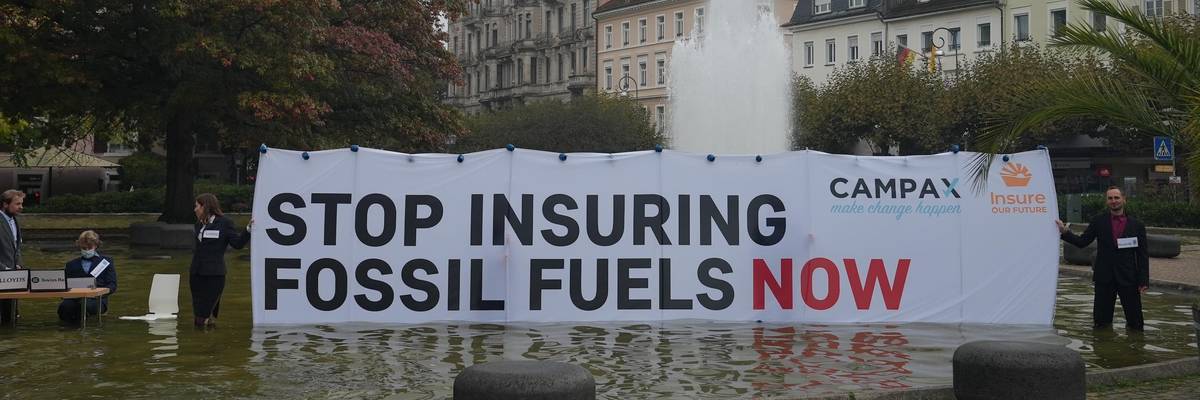
Activists dressed up as CEOs from Swiss Re, Lloyd's, and Munich Re protest outside the Baden-Baden Reinsurance Conference center on Oct. 18, 2021, demanding attendees rule out coal and new oil and gas projects. (Photo: Insure Our Future)
A new analysis of how the insurance industry is managing its policies related to fossil fuels and the climate crisis reveals that major U.S. insurers continue to underwrite "the reckless expansion of oil and gas infrastructure."
"With the climate in crisis, U.S. insurers are pouring gasoline on the fire," tweeted the Insure Our Future campaign.
"As the global climate crisis escalates rapidly, U.S. insurers have fallen starkly behind their global peers when it comes to taking responsibility for their central role in the fossil fuel economy."
The campaign--an effort supported by global groups including Switzerland's Campax and Europe Beyond Coal as well as U.S. groups like Rainforest Action Network and Sierra Club--on Wednesday released its latest annual scorecard that evaluates 30 of the world's top insurers, including 10 North American companies. The analysis relied on questionnaires returned by 18 of the companies and publicly available information.
The publication says insurers must step away from propping up oil, gas, and coal activities especially in light of the growing climate emergency exemplified by this year's extreme weather events worldwide.
"When the world wasn't on fire, it flooded," the report states, "with extreme rainfall causing deadly emergencies across six continents." The report also points to recent warnings from the U.N. that keeping warming below the 1.5degC threshold would be impossible barring "immediate, rapid, and large-scale reductions" in CO2 emissions, and from the International Energy Agency that capping warming to 1.5degC necessitates no new oil and gas fields.
"Insurers are uniquely positioned to accelerate the phase-out of fossil fuels and transition to a low-carbon economy" because of their key role in providing needed underwriting for such projects, the report says, and those insurers "not aligning their business with the Paris Agreement are undermining global climate targets, contributing to mounting economic and social chaos, and threatening their own businesses."
Topping the scorecard for good marks in fossil fuel insurance policy were two European companies. Allianz, the German insurer, was praised for improvements on its coal exit plan and new tar sands exclusion policies. France's AXA was close behind in second place for fossil fuel insurance, with its recent adoption of an oil and gas exit policy welcomed.
A bright spot in the report is that most insurers have ruled out backing new coal, with such projects now "nearly uninsurable." The same cannot be said, however, of new oil and gas projects, even though "moving away from underwriting oil and gas would not only have benefits for the climate but could also create financial value for insurance companies," according to the analysis.
"Although all major insurers in Europe and Australia have now acted on coal and many on tar sands," the report stated, "few have made progress on oil and gas more broadly."
For the U.S. insurance industry, the findings were particularly damning.
"None of the U.S. insurers made any new commitments to withdraw from coal this year," the report states. "By underwriting the expansion of coal and other fossil fuels, companies such as AIG, Berkshire Hathaway, Travelers, and W.R. Berkley are ignoring the growing public concerns about climate change in the U.S. and undermining the diplomatic efforts of the Biden administration to accelerate the phasing out of coal ahead of COP26."
The analysis found that none of the U.S. insurers examined have specific policies on providing insurance for new oil and gas projects, nor have any in that group made commitments to ensure their clients respect Indigenous Peoples' right to Free, Prior, and Informed Consent.
Related Content
Another troubling finding was that six out of the 10 U.S. insurers--AIG, Berkshire Hathaway, Travelers, W.R. Berkley, Everest Re, and Convex--continue to back fossil fuel projects without any restrictions, according to the report.
"As the global climate crisis escalates rapidly, U.S. insurers have fallen starkly behind their global peers when it comes to taking responsibility for their central role in the fossil fuel economy," said Ginger Cassady, executive director of Rainforest Action Network, in a statement. "While leading global peers are exiting the coal sector and starting to restrict oil and gas business, AIG, Liberty Mutual, Travelers, and other U.S. companies continue to prop up the struggling coal industry and support the reckless expansion of oil and gas infrastructure."
Peter Bosshard, global coordinator for Insure Our Future, said the insurance industry could play a key role in averting in further climate chaos.
"The scientific consensus is clear: there is no way to avoid a climate catastrophe if we expand fossil fuel production," he said. "Most insurers recognize the threat of climate change. Action by only a few major players on oil and gas could have a significant impact."
Dear Common Dreams reader, It’s been nearly 30 years since I co-founded Common Dreams with my late wife, Lina Newhouser. We had the radical notion that journalism should serve the public good, not corporate profits. It was clear to us from the outset what it would take to build such a project. No paid advertisements. No corporate sponsors. No millionaire publisher telling us what to think or do. Many people said we wouldn't last a year, but we proved those doubters wrong. Together with a tremendous team of journalists and dedicated staff, we built an independent media outlet free from the constraints of profits and corporate control. Our mission has always been simple: To inform. To inspire. To ignite change for the common good. Building Common Dreams was not easy. Our survival was never guaranteed. When you take on the most powerful forces—Wall Street greed, fossil fuel industry destruction, Big Tech lobbyists, and uber-rich oligarchs who have spent billions upon billions rigging the economy and democracy in their favor—the only bulwark you have is supporters who believe in your work. But here’s the urgent message from me today. It's never been this bad out there. And it's never been this hard to keep us going. At the very moment Common Dreams is most needed, the threats we face are intensifying. We need your support now more than ever. We don't accept corporate advertising and never will. We don't have a paywall because we don't think people should be blocked from critical news based on their ability to pay. Everything we do is funded by the donations of readers like you. When everyone does the little they can afford, we are strong. But if that support retreats or dries up, so do we. Will you donate now to make sure Common Dreams not only survives but thrives? —Craig Brown, Co-founder |
A new analysis of how the insurance industry is managing its policies related to fossil fuels and the climate crisis reveals that major U.S. insurers continue to underwrite "the reckless expansion of oil and gas infrastructure."
"With the climate in crisis, U.S. insurers are pouring gasoline on the fire," tweeted the Insure Our Future campaign.
"As the global climate crisis escalates rapidly, U.S. insurers have fallen starkly behind their global peers when it comes to taking responsibility for their central role in the fossil fuel economy."
The campaign--an effort supported by global groups including Switzerland's Campax and Europe Beyond Coal as well as U.S. groups like Rainforest Action Network and Sierra Club--on Wednesday released its latest annual scorecard that evaluates 30 of the world's top insurers, including 10 North American companies. The analysis relied on questionnaires returned by 18 of the companies and publicly available information.
The publication says insurers must step away from propping up oil, gas, and coal activities especially in light of the growing climate emergency exemplified by this year's extreme weather events worldwide.
"When the world wasn't on fire, it flooded," the report states, "with extreme rainfall causing deadly emergencies across six continents." The report also points to recent warnings from the U.N. that keeping warming below the 1.5degC threshold would be impossible barring "immediate, rapid, and large-scale reductions" in CO2 emissions, and from the International Energy Agency that capping warming to 1.5degC necessitates no new oil and gas fields.
"Insurers are uniquely positioned to accelerate the phase-out of fossil fuels and transition to a low-carbon economy" because of their key role in providing needed underwriting for such projects, the report says, and those insurers "not aligning their business with the Paris Agreement are undermining global climate targets, contributing to mounting economic and social chaos, and threatening their own businesses."
Topping the scorecard for good marks in fossil fuel insurance policy were two European companies. Allianz, the German insurer, was praised for improvements on its coal exit plan and new tar sands exclusion policies. France's AXA was close behind in second place for fossil fuel insurance, with its recent adoption of an oil and gas exit policy welcomed.
A bright spot in the report is that most insurers have ruled out backing new coal, with such projects now "nearly uninsurable." The same cannot be said, however, of new oil and gas projects, even though "moving away from underwriting oil and gas would not only have benefits for the climate but could also create financial value for insurance companies," according to the analysis.
"Although all major insurers in Europe and Australia have now acted on coal and many on tar sands," the report stated, "few have made progress on oil and gas more broadly."
For the U.S. insurance industry, the findings were particularly damning.
"None of the U.S. insurers made any new commitments to withdraw from coal this year," the report states. "By underwriting the expansion of coal and other fossil fuels, companies such as AIG, Berkshire Hathaway, Travelers, and W.R. Berkley are ignoring the growing public concerns about climate change in the U.S. and undermining the diplomatic efforts of the Biden administration to accelerate the phasing out of coal ahead of COP26."
The analysis found that none of the U.S. insurers examined have specific policies on providing insurance for new oil and gas projects, nor have any in that group made commitments to ensure their clients respect Indigenous Peoples' right to Free, Prior, and Informed Consent.
Related Content
Another troubling finding was that six out of the 10 U.S. insurers--AIG, Berkshire Hathaway, Travelers, W.R. Berkley, Everest Re, and Convex--continue to back fossil fuel projects without any restrictions, according to the report.
"As the global climate crisis escalates rapidly, U.S. insurers have fallen starkly behind their global peers when it comes to taking responsibility for their central role in the fossil fuel economy," said Ginger Cassady, executive director of Rainforest Action Network, in a statement. "While leading global peers are exiting the coal sector and starting to restrict oil and gas business, AIG, Liberty Mutual, Travelers, and other U.S. companies continue to prop up the struggling coal industry and support the reckless expansion of oil and gas infrastructure."
Peter Bosshard, global coordinator for Insure Our Future, said the insurance industry could play a key role in averting in further climate chaos.
"The scientific consensus is clear: there is no way to avoid a climate catastrophe if we expand fossil fuel production," he said. "Most insurers recognize the threat of climate change. Action by only a few major players on oil and gas could have a significant impact."
A new analysis of how the insurance industry is managing its policies related to fossil fuels and the climate crisis reveals that major U.S. insurers continue to underwrite "the reckless expansion of oil and gas infrastructure."
"With the climate in crisis, U.S. insurers are pouring gasoline on the fire," tweeted the Insure Our Future campaign.
"As the global climate crisis escalates rapidly, U.S. insurers have fallen starkly behind their global peers when it comes to taking responsibility for their central role in the fossil fuel economy."
The campaign--an effort supported by global groups including Switzerland's Campax and Europe Beyond Coal as well as U.S. groups like Rainforest Action Network and Sierra Club--on Wednesday released its latest annual scorecard that evaluates 30 of the world's top insurers, including 10 North American companies. The analysis relied on questionnaires returned by 18 of the companies and publicly available information.
The publication says insurers must step away from propping up oil, gas, and coal activities especially in light of the growing climate emergency exemplified by this year's extreme weather events worldwide.
"When the world wasn't on fire, it flooded," the report states, "with extreme rainfall causing deadly emergencies across six continents." The report also points to recent warnings from the U.N. that keeping warming below the 1.5degC threshold would be impossible barring "immediate, rapid, and large-scale reductions" in CO2 emissions, and from the International Energy Agency that capping warming to 1.5degC necessitates no new oil and gas fields.
"Insurers are uniquely positioned to accelerate the phase-out of fossil fuels and transition to a low-carbon economy" because of their key role in providing needed underwriting for such projects, the report says, and those insurers "not aligning their business with the Paris Agreement are undermining global climate targets, contributing to mounting economic and social chaos, and threatening their own businesses."
Topping the scorecard for good marks in fossil fuel insurance policy were two European companies. Allianz, the German insurer, was praised for improvements on its coal exit plan and new tar sands exclusion policies. France's AXA was close behind in second place for fossil fuel insurance, with its recent adoption of an oil and gas exit policy welcomed.
A bright spot in the report is that most insurers have ruled out backing new coal, with such projects now "nearly uninsurable." The same cannot be said, however, of new oil and gas projects, even though "moving away from underwriting oil and gas would not only have benefits for the climate but could also create financial value for insurance companies," according to the analysis.
"Although all major insurers in Europe and Australia have now acted on coal and many on tar sands," the report stated, "few have made progress on oil and gas more broadly."
For the U.S. insurance industry, the findings were particularly damning.
"None of the U.S. insurers made any new commitments to withdraw from coal this year," the report states. "By underwriting the expansion of coal and other fossil fuels, companies such as AIG, Berkshire Hathaway, Travelers, and W.R. Berkley are ignoring the growing public concerns about climate change in the U.S. and undermining the diplomatic efforts of the Biden administration to accelerate the phasing out of coal ahead of COP26."
The analysis found that none of the U.S. insurers examined have specific policies on providing insurance for new oil and gas projects, nor have any in that group made commitments to ensure their clients respect Indigenous Peoples' right to Free, Prior, and Informed Consent.
Related Content
Another troubling finding was that six out of the 10 U.S. insurers--AIG, Berkshire Hathaway, Travelers, W.R. Berkley, Everest Re, and Convex--continue to back fossil fuel projects without any restrictions, according to the report.
"As the global climate crisis escalates rapidly, U.S. insurers have fallen starkly behind their global peers when it comes to taking responsibility for their central role in the fossil fuel economy," said Ginger Cassady, executive director of Rainforest Action Network, in a statement. "While leading global peers are exiting the coal sector and starting to restrict oil and gas business, AIG, Liberty Mutual, Travelers, and other U.S. companies continue to prop up the struggling coal industry and support the reckless expansion of oil and gas infrastructure."
Peter Bosshard, global coordinator for Insure Our Future, said the insurance industry could play a key role in averting in further climate chaos.
"The scientific consensus is clear: there is no way to avoid a climate catastrophe if we expand fossil fuel production," he said. "Most insurers recognize the threat of climate change. Action by only a few major players on oil and gas could have a significant impact."

