SUBSCRIBE TO OUR FREE NEWSLETTER
Daily news & progressive opinion—funded by the people, not the corporations—delivered straight to your inbox.
5
#000000
#FFFFFF
To donate by check, phone, or other method, see our More Ways to Give page.
Daily news & progressive opinion—funded by the people, not the corporations—delivered straight to your inbox.
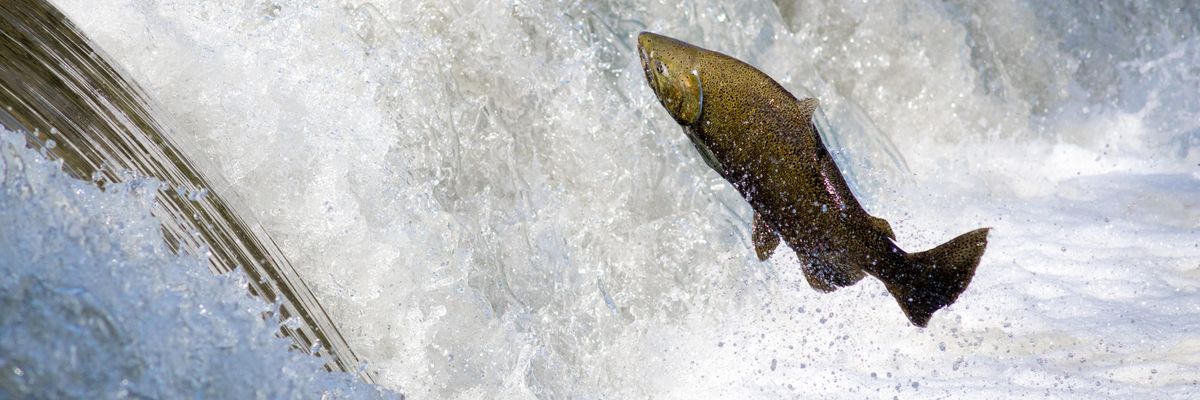
A salmon jumps as it swims upstream against a waterfall. (Photo: josullivan.59/Flickr/cc)
Environmental and Indigenous advocates on Friday cheered as a federal judge rejected a Biden administration request to temporarily keep in place a Trump-era Clean Water Act rule that one attorney said would have "devastated" states' ability to manage their rivers.
"The Trump administration took an industry wish list and ran with it, trampling over state and tribal authority and public rights to clean water in the process."
On Thursday, Judge William H. Alsup of the United States District Court for the Northern District of California in San Francisco threw out a June 2020 Environmental Protection Agency (EPA) rule changing the Clean Water Act Section 401 certification process to allow federal agencies to approve large projects--including fossil fuel pipelines, hydroelectric dams, industrial plants, wetland developments, and municipal facilities--against the wishes of states and Native American tribes.
In July 2020, 20 states and the District of Columbia sued the Trump administration over the rule change. That September, Indigenous tribes and green groups also filed suit against the administration, claiming the new rule would jeopardize tribal and state efforts to protect their water quality.
"We feel vindicated by this win today," Western Environmental Law Center (WELC) attorney Sangye Ince-Johannsen said in a statement following the ruling. "The court's order immediately restores an essential clean water safeguard--and the careful balance of state and federal power to protect clean water--that Congress intended when it wrote the Clean Water Act."
Ince-Johannsen added that "the Trump administration took an industry wish list and ran with it, trampling over state and tribal authority and public rights to clean water in the process."
The rule change, which was first proposed in 2019 and finalized in June 2020 during the tenure of former coal lobbyist and then-EPA Administrator Andrew Wheeler, set a one-year deadline for permitting decisions and limited the factors that state and tribal officials could consider.
At the time, Food & Water Action executive director Wenonah Hauter called the move--part of a broader regulatory rollback aggressively pursued during the administration of former President Donald Trump--"vindictive, spiteful, and capricious."
The Biden administration in July asked the California federal court to keep its predecessor's controversial rule in place until 2023 pending revision. Alsup found that "plaintiffs have established that significant environmental harms will likely transpire" if he granted the administration's request.
Alsup wrote:
This order finds particularly persuasive the state of Washington's example concerning three hydropower dams on the Skagit River. These dams will each require Section 401 certifications prior to EPA's promulgation of a replacement for the current certification rule.
As noted in the state of Washington's brief, "because [Federal Energy Regulatory Commission] licenses for dams will last between 30-50 years, the lack of adequate water quality conditions attached to these licenses will have adverse impacts for a generation"...
The new certification rule curtails restrictions certifying authorities can impose on dams to limit increases in water temperature. The threatened Chinook salmon that reside in the Skagit River are vulnerable to these changes in water temperature, which puts at risk a primary food source for the endangered southern resident orca population in Puget Sound, of which there are currently only 73, the lowest number in over four decades.
According to WELC, Alsup's ruling "restores the broad authority of states and tribes to halt such projects, and alternatively to impose conditions on them, and restores opportunities for robust public participation in permit decisions."
Washington Attorney General and case co-plaintiff Bob Ferguson welcomed the ruling, contending in a statement that the Trump administration "did everything it could to yield to the interests of polluting industries."
"Today's ruling stopped one of his most egregious attempts to strip states' ability to protect their communities against threats to water quality," he added.
California Attorney General Rob Bonta, also a plaintiff in the case, said that "as the state records its driest year in nearly a century, Californians are acutely aware of the value of water and its critical importance to sustaining our communities, ecosystems, and agriculture."
"We're pleased that the district court agreed to vacate this unlawful Trump-era rule and restore California's authority under Section 401 of the Clean Water Act," Bonta added. "State agencies rely on Section 401 to safeguard our precious resources by ensuring that federal projects meet the state's robust water quality requirements."
Jennifer Marshall, general counsel for American Rivers, said that "the Trump administration's unlawful 401 rules abandoned the Clean Water Act's commitment to provide a voice for states and communities to protect and manage their rivers and streams, allowing potentially harmful projects to escape critical local review."
"We're proud to have played a role in protecting the rights of states and tribes to defend clean water safeguards," she added.
Redgie Collins, legal and policy director at California Trout, asserted that "the rule changes would have devastated California's ability to manage its rivers. We are relieved hydroelectric projects must still comply with local and state rules to provide flowing water and protect fish."
American Whitewater legal director Bob Nasdor said his organization is "thrilled to have defended the Clean Water Act from an attack that would have undermined the public's ability to protect rivers and communities from harms to the environment and recreation opportunity at hydropower dams and other federally-licensed energy projects."
Nasdor added that "this victory restores our access to information, time for review, and ability of the states to protect water quality that we've counted on for the past 50 years to ensure our rivers are safe, healthy, and accessible."
Dear Common Dreams reader, It’s been nearly 30 years since I co-founded Common Dreams with my late wife, Lina Newhouser. We had the radical notion that journalism should serve the public good, not corporate profits. It was clear to us from the outset what it would take to build such a project. No paid advertisements. No corporate sponsors. No millionaire publisher telling us what to think or do. Many people said we wouldn't last a year, but we proved those doubters wrong. Together with a tremendous team of journalists and dedicated staff, we built an independent media outlet free from the constraints of profits and corporate control. Our mission has always been simple: To inform. To inspire. To ignite change for the common good. Building Common Dreams was not easy. Our survival was never guaranteed. When you take on the most powerful forces—Wall Street greed, fossil fuel industry destruction, Big Tech lobbyists, and uber-rich oligarchs who have spent billions upon billions rigging the economy and democracy in their favor—the only bulwark you have is supporters who believe in your work. But here’s the urgent message from me today. It's never been this bad out there. And it's never been this hard to keep us going. At the very moment Common Dreams is most needed, the threats we face are intensifying. We need your support now more than ever. We don't accept corporate advertising and never will. We don't have a paywall because we don't think people should be blocked from critical news based on their ability to pay. Everything we do is funded by the donations of readers like you. When everyone does the little they can afford, we are strong. But if that support retreats or dries up, so do we. Will you donate now to make sure Common Dreams not only survives but thrives? —Craig Brown, Co-founder |
Environmental and Indigenous advocates on Friday cheered as a federal judge rejected a Biden administration request to temporarily keep in place a Trump-era Clean Water Act rule that one attorney said would have "devastated" states' ability to manage their rivers.
"The Trump administration took an industry wish list and ran with it, trampling over state and tribal authority and public rights to clean water in the process."
On Thursday, Judge William H. Alsup of the United States District Court for the Northern District of California in San Francisco threw out a June 2020 Environmental Protection Agency (EPA) rule changing the Clean Water Act Section 401 certification process to allow federal agencies to approve large projects--including fossil fuel pipelines, hydroelectric dams, industrial plants, wetland developments, and municipal facilities--against the wishes of states and Native American tribes.
In July 2020, 20 states and the District of Columbia sued the Trump administration over the rule change. That September, Indigenous tribes and green groups also filed suit against the administration, claiming the new rule would jeopardize tribal and state efforts to protect their water quality.
"We feel vindicated by this win today," Western Environmental Law Center (WELC) attorney Sangye Ince-Johannsen said in a statement following the ruling. "The court's order immediately restores an essential clean water safeguard--and the careful balance of state and federal power to protect clean water--that Congress intended when it wrote the Clean Water Act."
Ince-Johannsen added that "the Trump administration took an industry wish list and ran with it, trampling over state and tribal authority and public rights to clean water in the process."
The rule change, which was first proposed in 2019 and finalized in June 2020 during the tenure of former coal lobbyist and then-EPA Administrator Andrew Wheeler, set a one-year deadline for permitting decisions and limited the factors that state and tribal officials could consider.
At the time, Food & Water Action executive director Wenonah Hauter called the move--part of a broader regulatory rollback aggressively pursued during the administration of former President Donald Trump--"vindictive, spiteful, and capricious."
The Biden administration in July asked the California federal court to keep its predecessor's controversial rule in place until 2023 pending revision. Alsup found that "plaintiffs have established that significant environmental harms will likely transpire" if he granted the administration's request.
Alsup wrote:
This order finds particularly persuasive the state of Washington's example concerning three hydropower dams on the Skagit River. These dams will each require Section 401 certifications prior to EPA's promulgation of a replacement for the current certification rule.
As noted in the state of Washington's brief, "because [Federal Energy Regulatory Commission] licenses for dams will last between 30-50 years, the lack of adequate water quality conditions attached to these licenses will have adverse impacts for a generation"...
The new certification rule curtails restrictions certifying authorities can impose on dams to limit increases in water temperature. The threatened Chinook salmon that reside in the Skagit River are vulnerable to these changes in water temperature, which puts at risk a primary food source for the endangered southern resident orca population in Puget Sound, of which there are currently only 73, the lowest number in over four decades.
According to WELC, Alsup's ruling "restores the broad authority of states and tribes to halt such projects, and alternatively to impose conditions on them, and restores opportunities for robust public participation in permit decisions."
Washington Attorney General and case co-plaintiff Bob Ferguson welcomed the ruling, contending in a statement that the Trump administration "did everything it could to yield to the interests of polluting industries."
"Today's ruling stopped one of his most egregious attempts to strip states' ability to protect their communities against threats to water quality," he added.
California Attorney General Rob Bonta, also a plaintiff in the case, said that "as the state records its driest year in nearly a century, Californians are acutely aware of the value of water and its critical importance to sustaining our communities, ecosystems, and agriculture."
"We're pleased that the district court agreed to vacate this unlawful Trump-era rule and restore California's authority under Section 401 of the Clean Water Act," Bonta added. "State agencies rely on Section 401 to safeguard our precious resources by ensuring that federal projects meet the state's robust water quality requirements."
Jennifer Marshall, general counsel for American Rivers, said that "the Trump administration's unlawful 401 rules abandoned the Clean Water Act's commitment to provide a voice for states and communities to protect and manage their rivers and streams, allowing potentially harmful projects to escape critical local review."
"We're proud to have played a role in protecting the rights of states and tribes to defend clean water safeguards," she added.
Redgie Collins, legal and policy director at California Trout, asserted that "the rule changes would have devastated California's ability to manage its rivers. We are relieved hydroelectric projects must still comply with local and state rules to provide flowing water and protect fish."
American Whitewater legal director Bob Nasdor said his organization is "thrilled to have defended the Clean Water Act from an attack that would have undermined the public's ability to protect rivers and communities from harms to the environment and recreation opportunity at hydropower dams and other federally-licensed energy projects."
Nasdor added that "this victory restores our access to information, time for review, and ability of the states to protect water quality that we've counted on for the past 50 years to ensure our rivers are safe, healthy, and accessible."
Environmental and Indigenous advocates on Friday cheered as a federal judge rejected a Biden administration request to temporarily keep in place a Trump-era Clean Water Act rule that one attorney said would have "devastated" states' ability to manage their rivers.
"The Trump administration took an industry wish list and ran with it, trampling over state and tribal authority and public rights to clean water in the process."
On Thursday, Judge William H. Alsup of the United States District Court for the Northern District of California in San Francisco threw out a June 2020 Environmental Protection Agency (EPA) rule changing the Clean Water Act Section 401 certification process to allow federal agencies to approve large projects--including fossil fuel pipelines, hydroelectric dams, industrial plants, wetland developments, and municipal facilities--against the wishes of states and Native American tribes.
In July 2020, 20 states and the District of Columbia sued the Trump administration over the rule change. That September, Indigenous tribes and green groups also filed suit against the administration, claiming the new rule would jeopardize tribal and state efforts to protect their water quality.
"We feel vindicated by this win today," Western Environmental Law Center (WELC) attorney Sangye Ince-Johannsen said in a statement following the ruling. "The court's order immediately restores an essential clean water safeguard--and the careful balance of state and federal power to protect clean water--that Congress intended when it wrote the Clean Water Act."
Ince-Johannsen added that "the Trump administration took an industry wish list and ran with it, trampling over state and tribal authority and public rights to clean water in the process."
The rule change, which was first proposed in 2019 and finalized in June 2020 during the tenure of former coal lobbyist and then-EPA Administrator Andrew Wheeler, set a one-year deadline for permitting decisions and limited the factors that state and tribal officials could consider.
At the time, Food & Water Action executive director Wenonah Hauter called the move--part of a broader regulatory rollback aggressively pursued during the administration of former President Donald Trump--"vindictive, spiteful, and capricious."
The Biden administration in July asked the California federal court to keep its predecessor's controversial rule in place until 2023 pending revision. Alsup found that "plaintiffs have established that significant environmental harms will likely transpire" if he granted the administration's request.
Alsup wrote:
This order finds particularly persuasive the state of Washington's example concerning three hydropower dams on the Skagit River. These dams will each require Section 401 certifications prior to EPA's promulgation of a replacement for the current certification rule.
As noted in the state of Washington's brief, "because [Federal Energy Regulatory Commission] licenses for dams will last between 30-50 years, the lack of adequate water quality conditions attached to these licenses will have adverse impacts for a generation"...
The new certification rule curtails restrictions certifying authorities can impose on dams to limit increases in water temperature. The threatened Chinook salmon that reside in the Skagit River are vulnerable to these changes in water temperature, which puts at risk a primary food source for the endangered southern resident orca population in Puget Sound, of which there are currently only 73, the lowest number in over four decades.
According to WELC, Alsup's ruling "restores the broad authority of states and tribes to halt such projects, and alternatively to impose conditions on them, and restores opportunities for robust public participation in permit decisions."
Washington Attorney General and case co-plaintiff Bob Ferguson welcomed the ruling, contending in a statement that the Trump administration "did everything it could to yield to the interests of polluting industries."
"Today's ruling stopped one of his most egregious attempts to strip states' ability to protect their communities against threats to water quality," he added.
California Attorney General Rob Bonta, also a plaintiff in the case, said that "as the state records its driest year in nearly a century, Californians are acutely aware of the value of water and its critical importance to sustaining our communities, ecosystems, and agriculture."
"We're pleased that the district court agreed to vacate this unlawful Trump-era rule and restore California's authority under Section 401 of the Clean Water Act," Bonta added. "State agencies rely on Section 401 to safeguard our precious resources by ensuring that federal projects meet the state's robust water quality requirements."
Jennifer Marshall, general counsel for American Rivers, said that "the Trump administration's unlawful 401 rules abandoned the Clean Water Act's commitment to provide a voice for states and communities to protect and manage their rivers and streams, allowing potentially harmful projects to escape critical local review."
"We're proud to have played a role in protecting the rights of states and tribes to defend clean water safeguards," she added.
Redgie Collins, legal and policy director at California Trout, asserted that "the rule changes would have devastated California's ability to manage its rivers. We are relieved hydroelectric projects must still comply with local and state rules to provide flowing water and protect fish."
American Whitewater legal director Bob Nasdor said his organization is "thrilled to have defended the Clean Water Act from an attack that would have undermined the public's ability to protect rivers and communities from harms to the environment and recreation opportunity at hydropower dams and other federally-licensed energy projects."
Nasdor added that "this victory restores our access to information, time for review, and ability of the states to protect water quality that we've counted on for the past 50 years to ensure our rivers are safe, healthy, and accessible."