SUBSCRIBE TO OUR FREE NEWSLETTER
Daily news & progressive opinion—funded by the people, not the corporations—delivered straight to your inbox.
5
#000000
#FFFFFF
To donate by check, phone, or other method, see our More Ways to Give page.
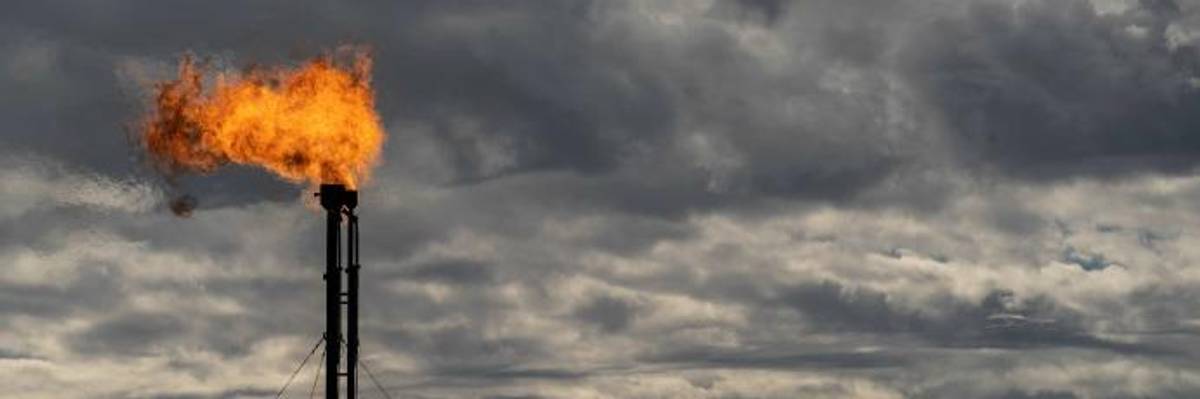
With oil and gas executives looking to increase fossil fuel production in the Permian Basin in the coming years despite the climate crisis, a new multimedia report out Tuesday reveals how a major fracking boom in Texas endangers vulnerable communities from New Mexico to the Gulf Coast--and ultimately poses a threat to life on Earth.
"To head off climate catastrophe, oil and gas production and consumption must decline."
Entitled The Permian Basin Climate Bomb, the six-part series--produced by Oil Change International, Earthworks, and the Center for International Environmental Law--analyzes the public health, ecological, and economic impacts of expanded drilling in the basin, following "the flow of Permian hydrocarbons from extraction to export" and drawing attention the fossil fuel industry's devastating consequences.
Part 1 of the series features an introductory video that explains how the Permian Basin--home to two million people in west Texas and southeast New Mexico--"emerged as the world's single most prolific oil and gas field" over the past decade. By early 2020, the basin was generating over six million barrels of oil per day--the same amount as Iraq and trailing only Russia and Saudi Arabia in terms of daily yield.
"Spread over a mostly remote area the size of Kansas or Britain, drilling in the basin is barely regulated," the narrator states. "Tens of thousands of wells have been drilled and fracked in the past decade, covering an area of nearly 6,000 square miles."
"The climate impacts, the exports and infrastructure, the petrochemical expansion, the lack of regulations, and the impacts on frontline communities in the region are, in themselves, strong enough reasons to stop extraction in the Permian," the video continues.
"Together, they form something even more terrifying--the Permian Climate Bomb."
Watch:
Echoing the International Energy Agency's recent message that fossil fuels must remain underground for humanity to have a fighting chance of limiting global warming to 1.5degC by the end of the century, the report emphasizes that "to head off climate catastrophe, oil and gas production and consumption must decline."
And yet, even though the Intergovernmental Panel on Climate Change has repeatedly warned that averting the planetary emergency's worst consequences requires rapidly curbing fossil fuel use, among other far-reaching political-economic transformations, "the opposite is happening in the Permian Basin," the report continues.
Fossil fuel "production has more than quadrupled in the past decade, and despite the Covid crisis, is still expected to grow aggressively in the coming decade," says the report. "Weaning America and the world off oil and gas is much harder if production keeps growing. Yet, the Permian Basin could produce more oil, gas, and gas liquids in the next 30 years than it has in the past century."
According to Lorne Stockman, research co-director at Oil Change International, "Oil exports fuel Permian production growth, and today they constitute around 30% of U.S. oil production. While climate science tells us that we must consume 40% less oil in 2030, Permian producers plan to grow production more than 50%."
"This must not happen," said Stockman.
Miguel Escoto, Earthworks West Texas field advocate and a resident of El Paso, said in a statement that "unless President [Joe] Biden defuses the Permian climate bomb exploding in my backyard, we won't prevent catastrophic climate change or meet our national climate commitments."
"A 'code red,' demands emergency action, not business as usual."
"A 'code red,'" he said, alluding to Biden's recent comments after a wave of deadly extreme weather disasters, "demands emergency action, not business as usual."
The report gives viewers a chance to donate to groups fighting against the exploitation of the Permian Basin and to take action.
Specifically, it asks people to tell the Department of Interior to end new fossil fuel leases on public lands, one of Biden's broken campaign promises that has led to a surge in drilling permits; tell Biden to stop approving permits for pipelines, export terminals, refineries, petrochemical facilities, and other oil and gas infrastructure; and tell Congress to "ban fracking nationwide, which would make a tremendous impact limiting harms in the Permian."
Looking ahead to COP 26, the United Nations climate change conference that starts at the end of the month, Steven Feit, senior attorney at the Center for International Environmental Law, said that "if the Biden Administration wants to be serious about its promise to demonstrate U.S. climate leadership, it must first clean up its own backyard."
Related Content

"The Permian Basin is the single largest fracking basin globally," he added, "and the continued reckless pursuit of oil extraction from New Mexico to the Gulf Coast is the ultimate display of hypocrisy."
At the conclusion of the video, the narrator says that "as the world grapples with the Covid-19 crisis, it faces an even bigger challenge to build a fairer, healthier, and more sustainable and resilient economy."
"This puts the Permian Basin and Gulf Coast at a crossroads," the narrator adds. "We can either manage a phase-out of the toxic reliance on hydrocarbon production and processing, one that supports workers and communities through this difficult but necessary transition, or we can have communities continue to experience pollution, environmental injustice, fear and boom-bust cycles, along with the inevitable and devastating reality that climate change will surely bring."
With oil and gas executives looking to increase fossil fuel production in the Permian Basin in the coming years despite the climate crisis, a new multimedia report out Tuesday reveals how a major fracking boom in Texas endangers vulnerable communities from New Mexico to the Gulf Coast--and ultimately poses a threat to life on Earth.
"To head off climate catastrophe, oil and gas production and consumption must decline."
Entitled The Permian Basin Climate Bomb, the six-part series--produced by Oil Change International, Earthworks, and the Center for International Environmental Law--analyzes the public health, ecological, and economic impacts of expanded drilling in the basin, following "the flow of Permian hydrocarbons from extraction to export" and drawing attention the fossil fuel industry's devastating consequences.
Part 1 of the series features an introductory video that explains how the Permian Basin--home to two million people in west Texas and southeast New Mexico--"emerged as the world's single most prolific oil and gas field" over the past decade. By early 2020, the basin was generating over six million barrels of oil per day--the same amount as Iraq and trailing only Russia and Saudi Arabia in terms of daily yield.
"Spread over a mostly remote area the size of Kansas or Britain, drilling in the basin is barely regulated," the narrator states. "Tens of thousands of wells have been drilled and fracked in the past decade, covering an area of nearly 6,000 square miles."
"The climate impacts, the exports and infrastructure, the petrochemical expansion, the lack of regulations, and the impacts on frontline communities in the region are, in themselves, strong enough reasons to stop extraction in the Permian," the video continues.
"Together, they form something even more terrifying--the Permian Climate Bomb."
Watch:
Echoing the International Energy Agency's recent message that fossil fuels must remain underground for humanity to have a fighting chance of limiting global warming to 1.5degC by the end of the century, the report emphasizes that "to head off climate catastrophe, oil and gas production and consumption must decline."
And yet, even though the Intergovernmental Panel on Climate Change has repeatedly warned that averting the planetary emergency's worst consequences requires rapidly curbing fossil fuel use, among other far-reaching political-economic transformations, "the opposite is happening in the Permian Basin," the report continues.
Fossil fuel "production has more than quadrupled in the past decade, and despite the Covid crisis, is still expected to grow aggressively in the coming decade," says the report. "Weaning America and the world off oil and gas is much harder if production keeps growing. Yet, the Permian Basin could produce more oil, gas, and gas liquids in the next 30 years than it has in the past century."
According to Lorne Stockman, research co-director at Oil Change International, "Oil exports fuel Permian production growth, and today they constitute around 30% of U.S. oil production. While climate science tells us that we must consume 40% less oil in 2030, Permian producers plan to grow production more than 50%."
"This must not happen," said Stockman.
Miguel Escoto, Earthworks West Texas field advocate and a resident of El Paso, said in a statement that "unless President [Joe] Biden defuses the Permian climate bomb exploding in my backyard, we won't prevent catastrophic climate change or meet our national climate commitments."
"A 'code red,' demands emergency action, not business as usual."
"A 'code red,'" he said, alluding to Biden's recent comments after a wave of deadly extreme weather disasters, "demands emergency action, not business as usual."
The report gives viewers a chance to donate to groups fighting against the exploitation of the Permian Basin and to take action.
Specifically, it asks people to tell the Department of Interior to end new fossil fuel leases on public lands, one of Biden's broken campaign promises that has led to a surge in drilling permits; tell Biden to stop approving permits for pipelines, export terminals, refineries, petrochemical facilities, and other oil and gas infrastructure; and tell Congress to "ban fracking nationwide, which would make a tremendous impact limiting harms in the Permian."
Looking ahead to COP 26, the United Nations climate change conference that starts at the end of the month, Steven Feit, senior attorney at the Center for International Environmental Law, said that "if the Biden Administration wants to be serious about its promise to demonstrate U.S. climate leadership, it must first clean up its own backyard."
Related Content
"The Permian Basin is the single largest fracking basin globally," he added, "and the continued reckless pursuit of oil extraction from New Mexico to the Gulf Coast is the ultimate display of hypocrisy."
At the conclusion of the video, the narrator says that "as the world grapples with the Covid-19 crisis, it faces an even bigger challenge to build a fairer, healthier, and more sustainable and resilient economy."
"This puts the Permian Basin and Gulf Coast at a crossroads," the narrator adds. "We can either manage a phase-out of the toxic reliance on hydrocarbon production and processing, one that supports workers and communities through this difficult but necessary transition, or we can have communities continue to experience pollution, environmental injustice, fear and boom-bust cycles, along with the inevitable and devastating reality that climate change will surely bring."
With oil and gas executives looking to increase fossil fuel production in the Permian Basin in the coming years despite the climate crisis, a new multimedia report out Tuesday reveals how a major fracking boom in Texas endangers vulnerable communities from New Mexico to the Gulf Coast--and ultimately poses a threat to life on Earth.
"To head off climate catastrophe, oil and gas production and consumption must decline."
Entitled The Permian Basin Climate Bomb, the six-part series--produced by Oil Change International, Earthworks, and the Center for International Environmental Law--analyzes the public health, ecological, and economic impacts of expanded drilling in the basin, following "the flow of Permian hydrocarbons from extraction to export" and drawing attention the fossil fuel industry's devastating consequences.
Part 1 of the series features an introductory video that explains how the Permian Basin--home to two million people in west Texas and southeast New Mexico--"emerged as the world's single most prolific oil and gas field" over the past decade. By early 2020, the basin was generating over six million barrels of oil per day--the same amount as Iraq and trailing only Russia and Saudi Arabia in terms of daily yield.
"Spread over a mostly remote area the size of Kansas or Britain, drilling in the basin is barely regulated," the narrator states. "Tens of thousands of wells have been drilled and fracked in the past decade, covering an area of nearly 6,000 square miles."
"The climate impacts, the exports and infrastructure, the petrochemical expansion, the lack of regulations, and the impacts on frontline communities in the region are, in themselves, strong enough reasons to stop extraction in the Permian," the video continues.
"Together, they form something even more terrifying--the Permian Climate Bomb."
Watch:
Echoing the International Energy Agency's recent message that fossil fuels must remain underground for humanity to have a fighting chance of limiting global warming to 1.5degC by the end of the century, the report emphasizes that "to head off climate catastrophe, oil and gas production and consumption must decline."
And yet, even though the Intergovernmental Panel on Climate Change has repeatedly warned that averting the planetary emergency's worst consequences requires rapidly curbing fossil fuel use, among other far-reaching political-economic transformations, "the opposite is happening in the Permian Basin," the report continues.
Fossil fuel "production has more than quadrupled in the past decade, and despite the Covid crisis, is still expected to grow aggressively in the coming decade," says the report. "Weaning America and the world off oil and gas is much harder if production keeps growing. Yet, the Permian Basin could produce more oil, gas, and gas liquids in the next 30 years than it has in the past century."
According to Lorne Stockman, research co-director at Oil Change International, "Oil exports fuel Permian production growth, and today they constitute around 30% of U.S. oil production. While climate science tells us that we must consume 40% less oil in 2030, Permian producers plan to grow production more than 50%."
"This must not happen," said Stockman.
Miguel Escoto, Earthworks West Texas field advocate and a resident of El Paso, said in a statement that "unless President [Joe] Biden defuses the Permian climate bomb exploding in my backyard, we won't prevent catastrophic climate change or meet our national climate commitments."
"A 'code red,' demands emergency action, not business as usual."
"A 'code red,'" he said, alluding to Biden's recent comments after a wave of deadly extreme weather disasters, "demands emergency action, not business as usual."
The report gives viewers a chance to donate to groups fighting against the exploitation of the Permian Basin and to take action.
Specifically, it asks people to tell the Department of Interior to end new fossil fuel leases on public lands, one of Biden's broken campaign promises that has led to a surge in drilling permits; tell Biden to stop approving permits for pipelines, export terminals, refineries, petrochemical facilities, and other oil and gas infrastructure; and tell Congress to "ban fracking nationwide, which would make a tremendous impact limiting harms in the Permian."
Looking ahead to COP 26, the United Nations climate change conference that starts at the end of the month, Steven Feit, senior attorney at the Center for International Environmental Law, said that "if the Biden Administration wants to be serious about its promise to demonstrate U.S. climate leadership, it must first clean up its own backyard."
Related Content
"The Permian Basin is the single largest fracking basin globally," he added, "and the continued reckless pursuit of oil extraction from New Mexico to the Gulf Coast is the ultimate display of hypocrisy."
At the conclusion of the video, the narrator says that "as the world grapples with the Covid-19 crisis, it faces an even bigger challenge to build a fairer, healthier, and more sustainable and resilient economy."
"This puts the Permian Basin and Gulf Coast at a crossroads," the narrator adds. "We can either manage a phase-out of the toxic reliance on hydrocarbon production and processing, one that supports workers and communities through this difficult but necessary transition, or we can have communities continue to experience pollution, environmental injustice, fear and boom-bust cycles, along with the inevitable and devastating reality that climate change will surely bring."