SUBSCRIBE TO OUR FREE NEWSLETTER
Daily news & progressive opinion—funded by the people, not the corporations—delivered straight to your inbox.
5
#000000
#FFFFFF
To donate by check, phone, or other method, see our More Ways to Give page.
Daily news & progressive opinion—funded by the people, not the corporations—delivered straight to your inbox.
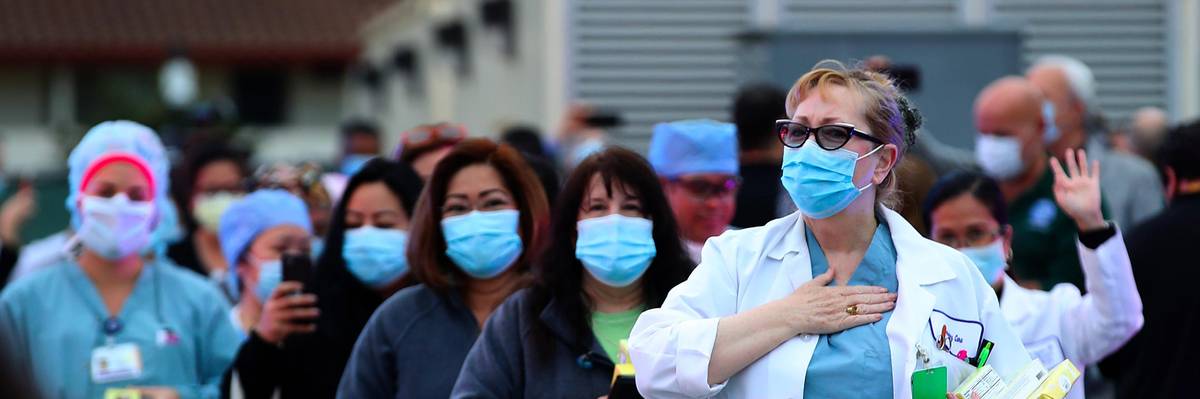
Nurses leave Kaiser Hospital at the end of their shift on May 14, 2020 in South San Francisco, California. Thousands of Kaiser Permanente nurses are among the workers who voted to strike this month. (Photo: Justin Sullivan/Getty Images)
"The so-called 'labor shortage'--which we know is really just a shortage of jobs that pay us enough to live on--is a powerful bit of leverage workers have over employers right now."
Years ago, when I was secretary of labor, I kept meeting working people all over the country who had full-time work but complained that their jobs paid too little and had few benefits, or were unsafe, or required lengthy or unpredictable hours. Many said their employers treated them badly, harassed them, and did not respect them.
Since then, these complaints have only grown louder, according to polls. For many, the pandemic was the last straw. Workers are fed up, wiped out, done-in, and run down. In the wake of so much hardship, illness and death during the past year, they're not going to take it anymore.
"Corporate America wants to frame this as a 'labor shortage,'" wrote Reich. "Wrong. What's really going on is more accurately described as a living-wage shortage, a hazard pay shortage, a childcare shortage, a paid sick leave shortage, and a healthcare shortage. Unless these shortages are rectified, many Americans won't return to work anytime soon."
As IATSE members' potential strike drew near, the union pointed out that some of its members--stagehands and theater tech workers at North Shore Music Theater (NSMT) in Beverly, Massachusetts--secured livable wages after striking for just one day this month.
"NSMT crew were previously paid 60% less than the industry area average but will now be receiving wages starting at $18 per hour," said the union last week.
AFL-CIO president Liz Shuler told The Hill that the Striketober movement shows that with economic inequality "getting worse and worse... unions are the solution."
"This is the capitalist system that has driven us to the brink," Shuler said.
Unite Here, which represents 300,000 hospitality employees, expressed solidarity with the workers taking part in Striketober and urged them to see themselves as in a position of power.
"It is clear that we are in a significant moment for union organizing," said the union. "What we cannot do is lose this moment. The so-called 'labor shortage'--which we know is really just a shortage of jobs that pay us enough to live on--is a powerful bit of leverage workers have over employers right now."
"You know what scares bosses?" added Sara Nelson, president of the Association of Flight Attendants. "Worker solidarity. Striketober is terrifying the bosses."
Dear Common Dreams reader, It’s been nearly 30 years since I co-founded Common Dreams with my late wife, Lina Newhouser. We had the radical notion that journalism should serve the public good, not corporate profits. It was clear to us from the outset what it would take to build such a project. No paid advertisements. No corporate sponsors. No millionaire publisher telling us what to think or do. Many people said we wouldn't last a year, but we proved those doubters wrong. Together with a tremendous team of journalists and dedicated staff, we built an independent media outlet free from the constraints of profits and corporate control. Our mission has always been simple: To inform. To inspire. To ignite change for the common good. Building Common Dreams was not easy. Our survival was never guaranteed. When you take on the most powerful forces—Wall Street greed, fossil fuel industry destruction, Big Tech lobbyists, and uber-rich oligarchs who have spent billions upon billions rigging the economy and democracy in their favor—the only bulwark you have is supporters who believe in your work. But here’s the urgent message from me today. It's never been this bad out there. And it's never been this hard to keep us going. At the very moment Common Dreams is most needed, the threats we face are intensifying. We need your support now more than ever. We don't accept corporate advertising and never will. We don't have a paywall because we don't think people should be blocked from critical news based on their ability to pay. Everything we do is funded by the donations of readers like you. When everyone does the little they can afford, we are strong. But if that support retreats or dries up, so do we. Will you donate now to make sure Common Dreams not only survives but thrives? —Craig Brown, Co-founder |
"The so-called 'labor shortage'--which we know is really just a shortage of jobs that pay us enough to live on--is a powerful bit of leverage workers have over employers right now."
Years ago, when I was secretary of labor, I kept meeting working people all over the country who had full-time work but complained that their jobs paid too little and had few benefits, or were unsafe, or required lengthy or unpredictable hours. Many said their employers treated them badly, harassed them, and did not respect them.
Since then, these complaints have only grown louder, according to polls. For many, the pandemic was the last straw. Workers are fed up, wiped out, done-in, and run down. In the wake of so much hardship, illness and death during the past year, they're not going to take it anymore.
"Corporate America wants to frame this as a 'labor shortage,'" wrote Reich. "Wrong. What's really going on is more accurately described as a living-wage shortage, a hazard pay shortage, a childcare shortage, a paid sick leave shortage, and a healthcare shortage. Unless these shortages are rectified, many Americans won't return to work anytime soon."
As IATSE members' potential strike drew near, the union pointed out that some of its members--stagehands and theater tech workers at North Shore Music Theater (NSMT) in Beverly, Massachusetts--secured livable wages after striking for just one day this month.
"NSMT crew were previously paid 60% less than the industry area average but will now be receiving wages starting at $18 per hour," said the union last week.
AFL-CIO president Liz Shuler told The Hill that the Striketober movement shows that with economic inequality "getting worse and worse... unions are the solution."
"This is the capitalist system that has driven us to the brink," Shuler said.
Unite Here, which represents 300,000 hospitality employees, expressed solidarity with the workers taking part in Striketober and urged them to see themselves as in a position of power.
"It is clear that we are in a significant moment for union organizing," said the union. "What we cannot do is lose this moment. The so-called 'labor shortage'--which we know is really just a shortage of jobs that pay us enough to live on--is a powerful bit of leverage workers have over employers right now."
"You know what scares bosses?" added Sara Nelson, president of the Association of Flight Attendants. "Worker solidarity. Striketober is terrifying the bosses."
"The so-called 'labor shortage'--which we know is really just a shortage of jobs that pay us enough to live on--is a powerful bit of leverage workers have over employers right now."
Years ago, when I was secretary of labor, I kept meeting working people all over the country who had full-time work but complained that their jobs paid too little and had few benefits, or were unsafe, or required lengthy or unpredictable hours. Many said their employers treated them badly, harassed them, and did not respect them.
Since then, these complaints have only grown louder, according to polls. For many, the pandemic was the last straw. Workers are fed up, wiped out, done-in, and run down. In the wake of so much hardship, illness and death during the past year, they're not going to take it anymore.
"Corporate America wants to frame this as a 'labor shortage,'" wrote Reich. "Wrong. What's really going on is more accurately described as a living-wage shortage, a hazard pay shortage, a childcare shortage, a paid sick leave shortage, and a healthcare shortage. Unless these shortages are rectified, many Americans won't return to work anytime soon."
As IATSE members' potential strike drew near, the union pointed out that some of its members--stagehands and theater tech workers at North Shore Music Theater (NSMT) in Beverly, Massachusetts--secured livable wages after striking for just one day this month.
"NSMT crew were previously paid 60% less than the industry area average but will now be receiving wages starting at $18 per hour," said the union last week.
AFL-CIO president Liz Shuler told The Hill that the Striketober movement shows that with economic inequality "getting worse and worse... unions are the solution."
"This is the capitalist system that has driven us to the brink," Shuler said.
Unite Here, which represents 300,000 hospitality employees, expressed solidarity with the workers taking part in Striketober and urged them to see themselves as in a position of power.
"It is clear that we are in a significant moment for union organizing," said the union. "What we cannot do is lose this moment. The so-called 'labor shortage'--which we know is really just a shortage of jobs that pay us enough to live on--is a powerful bit of leverage workers have over employers right now."
"You know what scares bosses?" added Sara Nelson, president of the Association of Flight Attendants. "Worker solidarity. Striketober is terrifying the bosses."