

SUBSCRIBE TO OUR FREE NEWSLETTER
Daily news & progressive opinion—funded by the people, not the corporations—delivered straight to your inbox.
5
#000000
#FFFFFF
To donate by check, phone, or other method, see our More Ways to Give page.
Daily news & progressive opinion—funded by the people, not the corporations—delivered straight to your inbox.
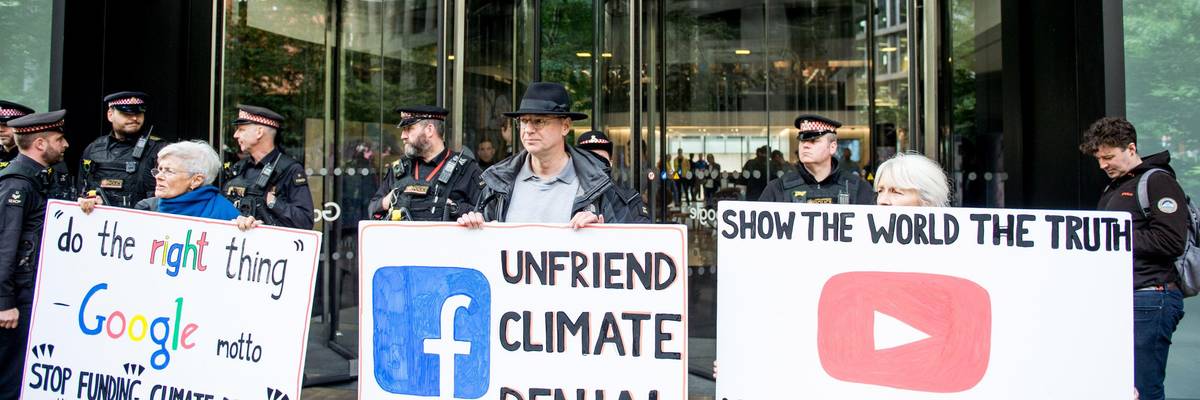
Extinction Rebellion activists protesting outside Google's London offices on October 16, 2019 demand social media companies do more to fight climate change denial. (Photo: Ollie Millington/Getty Images)
Digital rights advocates on Thursday welcomed a report that Google and its YouTube video platform are prohibiting the monetization of climate misinformation.
Google advertisers and publishers and YouTube creators will be banned from receiving advertising revenue that contradicts "well-established scientific consensus around the existence and causes of climate change," company officials said in a statement reported by Axios.
"This includes content referring to climate change as a hoax or a scam, claims denying that long-term trends show the global climate is warming, and claims denying that greenhouse gas emissions or human activity contribute to climate change," the statement explained.
"Advertisers simply don't want their ads to appear next to this content. And publishers and creators don't want ads promoting these claims to appear on their pages or videos," the statement added.
Last year, a study by the advocacy group Avaaz concluded that YouTube's recommendation algorithm was "driving millions of people to watch climate misinformation videos" and that the company was incentivizing such content through its monetization program.
"Some of the largest household brands in the world, including Samsung, L'Oreal, Warner Bros, Carrefour, and Danone, as well as two of the largest environmental groups in the world, Greenpeace International and World Wildlife Fund, have advertisements running on these climate misinformation videos," Avaaz said.
Other social media platforms are also rife with climate lies. Last month, Common Dreams reported that the environmental group Friends of the Earth found that Facebook allows 99% of all climate disinformation to go unchecked. A 2020 InfluenceMap study found that in the first six months of last year, at least eight million people in the U.S. saw 51 Facebook ads containing false climate claims.
Google's move to quash climate misinformation profiteers comes one week after YouTube announced it was banning the accounts of several prominent anti-vaccine personalities.
"There is no place for science denial--whether it's climate, Covid, or anything else--on such influential platforms," Vahid Razavi, founder of the digital rights group Ethics in Tech, told Common Dreams. "Deniers can find someplace else to spread their lies."
Dear Common Dreams reader, It’s been nearly 30 years since I co-founded Common Dreams with my late wife, Lina Newhouser. We had the radical notion that journalism should serve the public good, not corporate profits. It was clear to us from the outset what it would take to build such a project. No paid advertisements. No corporate sponsors. No millionaire publisher telling us what to think or do. Many people said we wouldn't last a year, but we proved those doubters wrong. Together with a tremendous team of journalists and dedicated staff, we built an independent media outlet free from the constraints of profits and corporate control. Our mission has always been simple: To inform. To inspire. To ignite change for the common good. Building Common Dreams was not easy. Our survival was never guaranteed. When you take on the most powerful forces—Wall Street greed, fossil fuel industry destruction, Big Tech lobbyists, and uber-rich oligarchs who have spent billions upon billions rigging the economy and democracy in their favor—the only bulwark you have is supporters who believe in your work. But here’s the urgent message from me today. It's never been this bad out there. And it's never been this hard to keep us going. At the very moment Common Dreams is most needed, the threats we face are intensifying. We need your support now more than ever. We don't accept corporate advertising and never will. We don't have a paywall because we don't think people should be blocked from critical news based on their ability to pay. Everything we do is funded by the donations of readers like you. When everyone does the little they can afford, we are strong. But if that support retreats or dries up, so do we. Will you donate now to make sure Common Dreams not only survives but thrives? —Craig Brown, Co-founder |
Digital rights advocates on Thursday welcomed a report that Google and its YouTube video platform are prohibiting the monetization of climate misinformation.
Google advertisers and publishers and YouTube creators will be banned from receiving advertising revenue that contradicts "well-established scientific consensus around the existence and causes of climate change," company officials said in a statement reported by Axios.
"This includes content referring to climate change as a hoax or a scam, claims denying that long-term trends show the global climate is warming, and claims denying that greenhouse gas emissions or human activity contribute to climate change," the statement explained.
"Advertisers simply don't want their ads to appear next to this content. And publishers and creators don't want ads promoting these claims to appear on their pages or videos," the statement added.
Last year, a study by the advocacy group Avaaz concluded that YouTube's recommendation algorithm was "driving millions of people to watch climate misinformation videos" and that the company was incentivizing such content through its monetization program.
"Some of the largest household brands in the world, including Samsung, L'Oreal, Warner Bros, Carrefour, and Danone, as well as two of the largest environmental groups in the world, Greenpeace International and World Wildlife Fund, have advertisements running on these climate misinformation videos," Avaaz said.
Other social media platforms are also rife with climate lies. Last month, Common Dreams reported that the environmental group Friends of the Earth found that Facebook allows 99% of all climate disinformation to go unchecked. A 2020 InfluenceMap study found that in the first six months of last year, at least eight million people in the U.S. saw 51 Facebook ads containing false climate claims.
Google's move to quash climate misinformation profiteers comes one week after YouTube announced it was banning the accounts of several prominent anti-vaccine personalities.
"There is no place for science denial--whether it's climate, Covid, or anything else--on such influential platforms," Vahid Razavi, founder of the digital rights group Ethics in Tech, told Common Dreams. "Deniers can find someplace else to spread their lies."
Digital rights advocates on Thursday welcomed a report that Google and its YouTube video platform are prohibiting the monetization of climate misinformation.
Google advertisers and publishers and YouTube creators will be banned from receiving advertising revenue that contradicts "well-established scientific consensus around the existence and causes of climate change," company officials said in a statement reported by Axios.
"This includes content referring to climate change as a hoax or a scam, claims denying that long-term trends show the global climate is warming, and claims denying that greenhouse gas emissions or human activity contribute to climate change," the statement explained.
"Advertisers simply don't want their ads to appear next to this content. And publishers and creators don't want ads promoting these claims to appear on their pages or videos," the statement added.
Last year, a study by the advocacy group Avaaz concluded that YouTube's recommendation algorithm was "driving millions of people to watch climate misinformation videos" and that the company was incentivizing such content through its monetization program.
"Some of the largest household brands in the world, including Samsung, L'Oreal, Warner Bros, Carrefour, and Danone, as well as two of the largest environmental groups in the world, Greenpeace International and World Wildlife Fund, have advertisements running on these climate misinformation videos," Avaaz said.
Other social media platforms are also rife with climate lies. Last month, Common Dreams reported that the environmental group Friends of the Earth found that Facebook allows 99% of all climate disinformation to go unchecked. A 2020 InfluenceMap study found that in the first six months of last year, at least eight million people in the U.S. saw 51 Facebook ads containing false climate claims.
Google's move to quash climate misinformation profiteers comes one week after YouTube announced it was banning the accounts of several prominent anti-vaccine personalities.
"There is no place for science denial--whether it's climate, Covid, or anything else--on such influential platforms," Vahid Razavi, founder of the digital rights group Ethics in Tech, told Common Dreams. "Deniers can find someplace else to spread their lies."

