SUBSCRIBE TO OUR FREE NEWSLETTER
Daily news & progressive opinion—funded by the people, not the corporations—delivered straight to your inbox.
5
#000000
#FFFFFF
To donate by check, phone, or other method, see our More Ways to Give page.
Daily news & progressive opinion—funded by the people, not the corporations—delivered straight to your inbox.
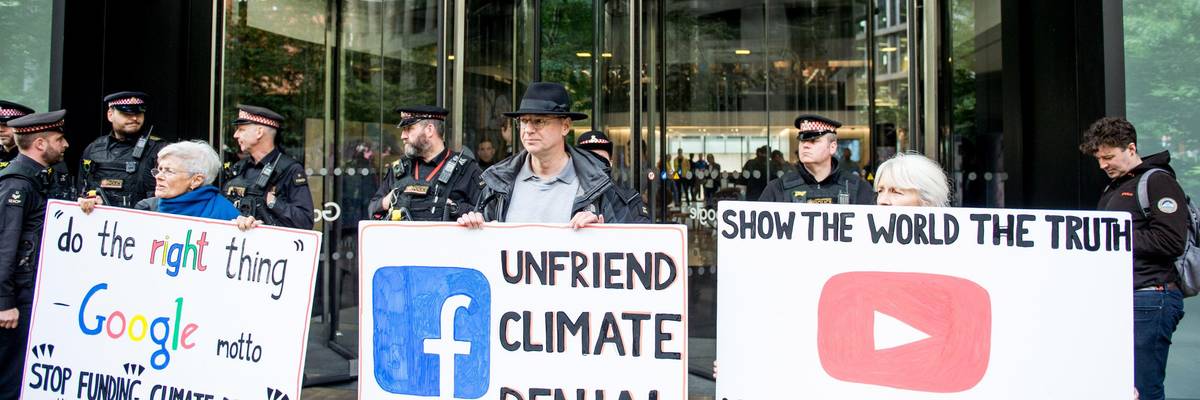
Extinction Rebellion activists protesting outside Google's London offices on October 16, 2019 demand social media companies do more to fight climate change denial. (Photo: Ollie Millington/Getty Images)
Just weeks away from the COP27 summit in Egypt, a report released Wednesday called out major online advertising networks for "actively funding and actively profiting from climate disinformation in the United States."
"Google must stop amplifying and enabling advertising on disinformation sites that pollute conversations on the climate crisis."
The analysis from the Climate Action Against Disinformation coalition, Friends of the Earth (FOE), and Dewey Square Group involved a review of 113 "climate disinformation sites," such as Fox News, Breitbart, Daily Wire, Gateway Pundit, The Epoch Times, Western Journal, TheBlaze, Daily Caller, RedState, and PJ Media.
Researchers found that of the websites reviewed from October 2021 to September 2022, nearly 80% "were displaying some kind of advertising from one or more of the major ad networks," including those owned by the tech giants Amazon and Google.
"Google's various display ad networks (DoubleClick, AdWords, and AdSense) were by far the most widely used on these websites, monetizing 49.6% of all sites and accounting for 97.7% of the projected weekly visits," according to the analysis.
Other key findings include:
"To give a sense of scale: If advertisers bought ads on these climate disinformation sites at an industry median price cost-per-click, then Google would potentially have pulled in $7.67 million in display advertising revenue over the past year from these sites," the report explains.
This despite a company policy announced last October for Google advertisers, publishers, and YouTube creators prohibiting "ads for, and monetization of, content that contradicts well-established scientific consensus around the existence and causes of climate change," including "content referring to climate change as a hoax or a scam, claims denying that long-term trends show the global climate is warming, and claims denying that greenhouse gas emissions or human activity contribute to climate change."
Given Google's outsized role in online advertising, Erika Seiber, a climate disinformation spokesperson for coalition member FOE, stressed the importance of action related to its ad practices.
"We can't solve the climate crisis if Google continues to enable and fund the sites that expose millions of people to climate denial," she asserted. "Google must stop amplifying and enabling advertising on disinformation sites that pollute conversations on the climate crisis."
"We have to stop this industry of opaque ad networks from propping up the dark corners of the internet," Seiber also said, calling the study "further proof that tech companies can't be trusted to self-regulate."
Along with Google and Amazon, the other top ad networks targeted in the report are MGID, Criteo, AdSupply, RTB House, Outbrain, Taboola, Yahoo, Infolinks, Adroll, AdMedia, and Skimlinks.
"Notably, Yahoo is responsible for almost 50% of total outgoing ad visits over the last 12 months, but this is almost entirely due to a single website, Fox News," the report states, adding that the site "appears to have heavily de-emphasized Yahoo advertising since sometime in July 2022."
The analysis highlights that besides Google, "advertising platforms' policies do not explicitly mention climate misinformation but do restrict the display of their advertising on sites that publish 'fake news' or other kinds of false or intentionally misleading content."
The report suggests that "insofar as these platforms and advertisers purport to be good corporate citizens who are having a positive influence on the world, public pressure may lead them to reconsider their brand association with climate denialism, doomerism, and conspiracy theories."
The analysis--just the latest effort by campaigners pressuring Big Tech to use its power to limit climate disinformation--comes not only in the lead-up to COP27 but also during Advertising Week New York.
The group SumOfUs demonstrated outside the industry event in New York City on Tuesday to highlight how "advertisers are unknowingly funding websites spreading disinformation about elections, climate change, and the LGBTQ+ community."
SumOfUs also specifically took aim at Google, calling on the ad giant to fix its "toxic" model.
Dear Common Dreams reader, It’s been nearly 30 years since I co-founded Common Dreams with my late wife, Lina Newhouser. We had the radical notion that journalism should serve the public good, not corporate profits. It was clear to us from the outset what it would take to build such a project. No paid advertisements. No corporate sponsors. No millionaire publisher telling us what to think or do. Many people said we wouldn't last a year, but we proved those doubters wrong. Together with a tremendous team of journalists and dedicated staff, we built an independent media outlet free from the constraints of profits and corporate control. Our mission has always been simple: To inform. To inspire. To ignite change for the common good. Building Common Dreams was not easy. Our survival was never guaranteed. When you take on the most powerful forces—Wall Street greed, fossil fuel industry destruction, Big Tech lobbyists, and uber-rich oligarchs who have spent billions upon billions rigging the economy and democracy in their favor—the only bulwark you have is supporters who believe in your work. But here’s the urgent message from me today. It's never been this bad out there. And it's never been this hard to keep us going. At the very moment Common Dreams is most needed, the threats we face are intensifying. We need your support now more than ever. We don't accept corporate advertising and never will. We don't have a paywall because we don't think people should be blocked from critical news based on their ability to pay. Everything we do is funded by the donations of readers like you. When everyone does the little they can afford, we are strong. But if that support retreats or dries up, so do we. Will you donate now to make sure Common Dreams not only survives but thrives? —Craig Brown, Co-founder |
Just weeks away from the COP27 summit in Egypt, a report released Wednesday called out major online advertising networks for "actively funding and actively profiting from climate disinformation in the United States."
"Google must stop amplifying and enabling advertising on disinformation sites that pollute conversations on the climate crisis."
The analysis from the Climate Action Against Disinformation coalition, Friends of the Earth (FOE), and Dewey Square Group involved a review of 113 "climate disinformation sites," such as Fox News, Breitbart, Daily Wire, Gateway Pundit, The Epoch Times, Western Journal, TheBlaze, Daily Caller, RedState, and PJ Media.
Researchers found that of the websites reviewed from October 2021 to September 2022, nearly 80% "were displaying some kind of advertising from one or more of the major ad networks," including those owned by the tech giants Amazon and Google.
"Google's various display ad networks (DoubleClick, AdWords, and AdSense) were by far the most widely used on these websites, monetizing 49.6% of all sites and accounting for 97.7% of the projected weekly visits," according to the analysis.
Other key findings include:
"To give a sense of scale: If advertisers bought ads on these climate disinformation sites at an industry median price cost-per-click, then Google would potentially have pulled in $7.67 million in display advertising revenue over the past year from these sites," the report explains.
This despite a company policy announced last October for Google advertisers, publishers, and YouTube creators prohibiting "ads for, and monetization of, content that contradicts well-established scientific consensus around the existence and causes of climate change," including "content referring to climate change as a hoax or a scam, claims denying that long-term trends show the global climate is warming, and claims denying that greenhouse gas emissions or human activity contribute to climate change."
Given Google's outsized role in online advertising, Erika Seiber, a climate disinformation spokesperson for coalition member FOE, stressed the importance of action related to its ad practices.
"We can't solve the climate crisis if Google continues to enable and fund the sites that expose millions of people to climate denial," she asserted. "Google must stop amplifying and enabling advertising on disinformation sites that pollute conversations on the climate crisis."
"We have to stop this industry of opaque ad networks from propping up the dark corners of the internet," Seiber also said, calling the study "further proof that tech companies can't be trusted to self-regulate."
Along with Google and Amazon, the other top ad networks targeted in the report are MGID, Criteo, AdSupply, RTB House, Outbrain, Taboola, Yahoo, Infolinks, Adroll, AdMedia, and Skimlinks.
"Notably, Yahoo is responsible for almost 50% of total outgoing ad visits over the last 12 months, but this is almost entirely due to a single website, Fox News," the report states, adding that the site "appears to have heavily de-emphasized Yahoo advertising since sometime in July 2022."
The analysis highlights that besides Google, "advertising platforms' policies do not explicitly mention climate misinformation but do restrict the display of their advertising on sites that publish 'fake news' or other kinds of false or intentionally misleading content."
The report suggests that "insofar as these platforms and advertisers purport to be good corporate citizens who are having a positive influence on the world, public pressure may lead them to reconsider their brand association with climate denialism, doomerism, and conspiracy theories."
The analysis--just the latest effort by campaigners pressuring Big Tech to use its power to limit climate disinformation--comes not only in the lead-up to COP27 but also during Advertising Week New York.
The group SumOfUs demonstrated outside the industry event in New York City on Tuesday to highlight how "advertisers are unknowingly funding websites spreading disinformation about elections, climate change, and the LGBTQ+ community."
SumOfUs also specifically took aim at Google, calling on the ad giant to fix its "toxic" model.
Just weeks away from the COP27 summit in Egypt, a report released Wednesday called out major online advertising networks for "actively funding and actively profiting from climate disinformation in the United States."
"Google must stop amplifying and enabling advertising on disinformation sites that pollute conversations on the climate crisis."
The analysis from the Climate Action Against Disinformation coalition, Friends of the Earth (FOE), and Dewey Square Group involved a review of 113 "climate disinformation sites," such as Fox News, Breitbart, Daily Wire, Gateway Pundit, The Epoch Times, Western Journal, TheBlaze, Daily Caller, RedState, and PJ Media.
Researchers found that of the websites reviewed from October 2021 to September 2022, nearly 80% "were displaying some kind of advertising from one or more of the major ad networks," including those owned by the tech giants Amazon and Google.
"Google's various display ad networks (DoubleClick, AdWords, and AdSense) were by far the most widely used on these websites, monetizing 49.6% of all sites and accounting for 97.7% of the projected weekly visits," according to the analysis.
Other key findings include:
"To give a sense of scale: If advertisers bought ads on these climate disinformation sites at an industry median price cost-per-click, then Google would potentially have pulled in $7.67 million in display advertising revenue over the past year from these sites," the report explains.
This despite a company policy announced last October for Google advertisers, publishers, and YouTube creators prohibiting "ads for, and monetization of, content that contradicts well-established scientific consensus around the existence and causes of climate change," including "content referring to climate change as a hoax or a scam, claims denying that long-term trends show the global climate is warming, and claims denying that greenhouse gas emissions or human activity contribute to climate change."
Given Google's outsized role in online advertising, Erika Seiber, a climate disinformation spokesperson for coalition member FOE, stressed the importance of action related to its ad practices.
"We can't solve the climate crisis if Google continues to enable and fund the sites that expose millions of people to climate denial," she asserted. "Google must stop amplifying and enabling advertising on disinformation sites that pollute conversations on the climate crisis."
"We have to stop this industry of opaque ad networks from propping up the dark corners of the internet," Seiber also said, calling the study "further proof that tech companies can't be trusted to self-regulate."
Along with Google and Amazon, the other top ad networks targeted in the report are MGID, Criteo, AdSupply, RTB House, Outbrain, Taboola, Yahoo, Infolinks, Adroll, AdMedia, and Skimlinks.
"Notably, Yahoo is responsible for almost 50% of total outgoing ad visits over the last 12 months, but this is almost entirely due to a single website, Fox News," the report states, adding that the site "appears to have heavily de-emphasized Yahoo advertising since sometime in July 2022."
The analysis highlights that besides Google, "advertising platforms' policies do not explicitly mention climate misinformation but do restrict the display of their advertising on sites that publish 'fake news' or other kinds of false or intentionally misleading content."
The report suggests that "insofar as these platforms and advertisers purport to be good corporate citizens who are having a positive influence on the world, public pressure may lead them to reconsider their brand association with climate denialism, doomerism, and conspiracy theories."
The analysis--just the latest effort by campaigners pressuring Big Tech to use its power to limit climate disinformation--comes not only in the lead-up to COP27 but also during Advertising Week New York.
The group SumOfUs demonstrated outside the industry event in New York City on Tuesday to highlight how "advertisers are unknowingly funding websites spreading disinformation about elections, climate change, and the LGBTQ+ community."
SumOfUs also specifically took aim at Google, calling on the ad giant to fix its "toxic" model.