SUBSCRIBE TO OUR FREE NEWSLETTER
Daily news & progressive opinion—funded by the people, not the corporations—delivered straight to your inbox.
5
#000000
#FFFFFF
To donate by check, phone, or other method, see our More Ways to Give page.
Daily news & progressive opinion—funded by the people, not the corporations—delivered straight to your inbox.
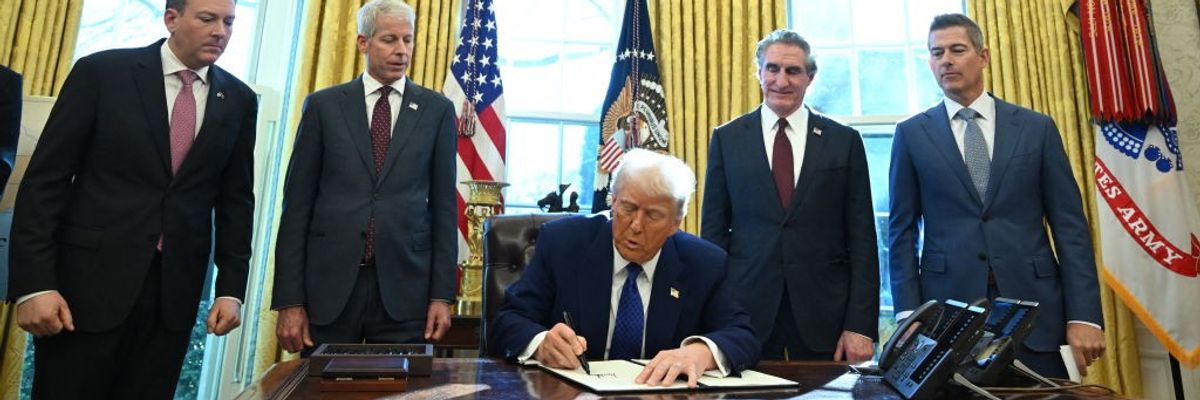
Environmental Protection Agency Administrator Lee Zeldin, Secretary of Energy Chris Wright, Secretary of the Interior Doug Burgum, and Secretary of Transportation Sean Duffy stand around President Donald Trump as he signs an executive order in the Oval Office of the White House in Washington, DC, on February 14, 2025.
"It's like they're trying to cover up a homicide," said the Environmental Voter Project.
President Donald Trump's administration has faced a flood of criticism since Politico reported Sunday that the US Department of Energy has added "climate change" and other related terms to its "list of words to avoid" at a key office.
According to a Friday email obtained by the news outlet, other banned words at the DOE's Office of Energy Efficiency and Renewable Energy include carbon/CO2 "footprint," clean, decarbonization, "dirty" energy, emissions, energy transition, green, sustainability/sustainable, and tax breaks/tax credits/subsidies.
“Please ensure that every member of your team is aware that this is the latest list of words to avoid—and continue to be conscientious about avoiding any terminology that you know to be misaligned with the administration's perspectives and priorities," Rachel Overbey, acting director of external affairs, reportedly wrote.
While the DOE did not respond to Politico's request for comment, critics were quick to blast the administration for yet another anti-science move.
" Censorship can't erase facts: The climate crisis is real, it's human-made, and deadly."
"Welcome to the Donald Trump post-truth world," Dr. Ali Khan, a retired US assistant surgeon general, responded on social media.
Since returning to power in January—after raking in campaign cash from Big Oil by promising to "drill, baby, drill"—Trump has also ditched the Paris Agreement (again), declared an "energy emergency" to benefit the fossil fuel industry, and claimed during his speech to the United Nations General Assembly last week that scientists' predictions about the climate crisis were "wrong" and "made by stupid people."
Trump also nominated climate liar and former fracking CEO Chris Wright as energy secretary. Under his leadership, the department has celebrated planet-wrecking coal on social media while spreading disinformation about solar and wind energy. It also published a July climate report that independent experts said is "biased, full of errors, and not fit to inform policymaking."
The department crafted that report as part of the Environmental Protection Agency's effort to scrap the "endangerment finding," the 2009 legal opinion that greenhouse gases endanger public health and the welfare of the American people, which underpins federal climate policy.
Responding to the DOE's newly revealed directive on banned words, the Environmental Voter Project charged, "It's like they're trying to cover up a homicide."
Paul Dorfman, chair of the Nuclear Consulting Group and a Bennett scholar at the University of Sussex, said, "Death cult does its thing."
Climate Rights International's advocacy director, Lotte Leicht, declared: "Ridiculous! Banning words won't change reality... Censorship can't erase facts: The climate crisis is real, it's human-made, and deadly. Silencing science = endangering lives."
Rakesh Bhandari, associate director of interdisciplinary studies at the University of California, Berkeley, warned of the likely impacts of the DOE's banned words.
"This will not only affect research and policy directly, it will also affect what we see and don't see and what we say and don't say. The state has this power in virtue of its legitimate and cognitive authority," Bhandari said. "Note that the Democrats are pretty silent about what matters most to the GOP: The protection of fossil fuels."
Nodding to the Trump administration's broad assault on First Amendment rights, Ross Seidman, senior counsel for a Democratic state senator in Maryland, said, "More 'banned words' from the party of free speech."
The New York Times in March compiled a list of nearly 200 terms that agencies' leaders have told staff to limit or avoid as part of Trump's purge of "woke" initiatives. They range from clean energy, climate crisis, and climate science to activism, disability, diversity, gender, hate speech, mental health, pregnant people, sexuality, racism, stereotypes, and victim.
Dear Common Dreams reader, It’s been nearly 30 years since I co-founded Common Dreams with my late wife, Lina Newhouser. We had the radical notion that journalism should serve the public good, not corporate profits. It was clear to us from the outset what it would take to build such a project. No paid advertisements. No corporate sponsors. No millionaire publisher telling us what to think or do. Many people said we wouldn't last a year, but we proved those doubters wrong. Together with a tremendous team of journalists and dedicated staff, we built an independent media outlet free from the constraints of profits and corporate control. Our mission has always been simple: To inform. To inspire. To ignite change for the common good. Building Common Dreams was not easy. Our survival was never guaranteed. When you take on the most powerful forces—Wall Street greed, fossil fuel industry destruction, Big Tech lobbyists, and uber-rich oligarchs who have spent billions upon billions rigging the economy and democracy in their favor—the only bulwark you have is supporters who believe in your work. But here’s the urgent message from me today. It's never been this bad out there. And it's never been this hard to keep us going. At the very moment Common Dreams is most needed, the threats we face are intensifying. We need your support now more than ever. We don't accept corporate advertising and never will. We don't have a paywall because we don't think people should be blocked from critical news based on their ability to pay. Everything we do is funded by the donations of readers like you. When everyone does the little they can afford, we are strong. But if that support retreats or dries up, so do we. Will you donate now to make sure Common Dreams not only survives but thrives? —Craig Brown, Co-founder |
President Donald Trump's administration has faced a flood of criticism since Politico reported Sunday that the US Department of Energy has added "climate change" and other related terms to its "list of words to avoid" at a key office.
According to a Friday email obtained by the news outlet, other banned words at the DOE's Office of Energy Efficiency and Renewable Energy include carbon/CO2 "footprint," clean, decarbonization, "dirty" energy, emissions, energy transition, green, sustainability/sustainable, and tax breaks/tax credits/subsidies.
“Please ensure that every member of your team is aware that this is the latest list of words to avoid—and continue to be conscientious about avoiding any terminology that you know to be misaligned with the administration's perspectives and priorities," Rachel Overbey, acting director of external affairs, reportedly wrote.
While the DOE did not respond to Politico's request for comment, critics were quick to blast the administration for yet another anti-science move.
" Censorship can't erase facts: The climate crisis is real, it's human-made, and deadly."
"Welcome to the Donald Trump post-truth world," Dr. Ali Khan, a retired US assistant surgeon general, responded on social media.
Since returning to power in January—after raking in campaign cash from Big Oil by promising to "drill, baby, drill"—Trump has also ditched the Paris Agreement (again), declared an "energy emergency" to benefit the fossil fuel industry, and claimed during his speech to the United Nations General Assembly last week that scientists' predictions about the climate crisis were "wrong" and "made by stupid people."
Trump also nominated climate liar and former fracking CEO Chris Wright as energy secretary. Under his leadership, the department has celebrated planet-wrecking coal on social media while spreading disinformation about solar and wind energy. It also published a July climate report that independent experts said is "biased, full of errors, and not fit to inform policymaking."
The department crafted that report as part of the Environmental Protection Agency's effort to scrap the "endangerment finding," the 2009 legal opinion that greenhouse gases endanger public health and the welfare of the American people, which underpins federal climate policy.
Responding to the DOE's newly revealed directive on banned words, the Environmental Voter Project charged, "It's like they're trying to cover up a homicide."
Paul Dorfman, chair of the Nuclear Consulting Group and a Bennett scholar at the University of Sussex, said, "Death cult does its thing."
Climate Rights International's advocacy director, Lotte Leicht, declared: "Ridiculous! Banning words won't change reality... Censorship can't erase facts: The climate crisis is real, it's human-made, and deadly. Silencing science = endangering lives."
Rakesh Bhandari, associate director of interdisciplinary studies at the University of California, Berkeley, warned of the likely impacts of the DOE's banned words.
"This will not only affect research and policy directly, it will also affect what we see and don't see and what we say and don't say. The state has this power in virtue of its legitimate and cognitive authority," Bhandari said. "Note that the Democrats are pretty silent about what matters most to the GOP: The protection of fossil fuels."
Nodding to the Trump administration's broad assault on First Amendment rights, Ross Seidman, senior counsel for a Democratic state senator in Maryland, said, "More 'banned words' from the party of free speech."
The New York Times in March compiled a list of nearly 200 terms that agencies' leaders have told staff to limit or avoid as part of Trump's purge of "woke" initiatives. They range from clean energy, climate crisis, and climate science to activism, disability, diversity, gender, hate speech, mental health, pregnant people, sexuality, racism, stereotypes, and victim.
President Donald Trump's administration has faced a flood of criticism since Politico reported Sunday that the US Department of Energy has added "climate change" and other related terms to its "list of words to avoid" at a key office.
According to a Friday email obtained by the news outlet, other banned words at the DOE's Office of Energy Efficiency and Renewable Energy include carbon/CO2 "footprint," clean, decarbonization, "dirty" energy, emissions, energy transition, green, sustainability/sustainable, and tax breaks/tax credits/subsidies.
“Please ensure that every member of your team is aware that this is the latest list of words to avoid—and continue to be conscientious about avoiding any terminology that you know to be misaligned with the administration's perspectives and priorities," Rachel Overbey, acting director of external affairs, reportedly wrote.
While the DOE did not respond to Politico's request for comment, critics were quick to blast the administration for yet another anti-science move.
" Censorship can't erase facts: The climate crisis is real, it's human-made, and deadly."
"Welcome to the Donald Trump post-truth world," Dr. Ali Khan, a retired US assistant surgeon general, responded on social media.
Since returning to power in January—after raking in campaign cash from Big Oil by promising to "drill, baby, drill"—Trump has also ditched the Paris Agreement (again), declared an "energy emergency" to benefit the fossil fuel industry, and claimed during his speech to the United Nations General Assembly last week that scientists' predictions about the climate crisis were "wrong" and "made by stupid people."
Trump also nominated climate liar and former fracking CEO Chris Wright as energy secretary. Under his leadership, the department has celebrated planet-wrecking coal on social media while spreading disinformation about solar and wind energy. It also published a July climate report that independent experts said is "biased, full of errors, and not fit to inform policymaking."
The department crafted that report as part of the Environmental Protection Agency's effort to scrap the "endangerment finding," the 2009 legal opinion that greenhouse gases endanger public health and the welfare of the American people, which underpins federal climate policy.
Responding to the DOE's newly revealed directive on banned words, the Environmental Voter Project charged, "It's like they're trying to cover up a homicide."
Paul Dorfman, chair of the Nuclear Consulting Group and a Bennett scholar at the University of Sussex, said, "Death cult does its thing."
Climate Rights International's advocacy director, Lotte Leicht, declared: "Ridiculous! Banning words won't change reality... Censorship can't erase facts: The climate crisis is real, it's human-made, and deadly. Silencing science = endangering lives."
Rakesh Bhandari, associate director of interdisciplinary studies at the University of California, Berkeley, warned of the likely impacts of the DOE's banned words.
"This will not only affect research and policy directly, it will also affect what we see and don't see and what we say and don't say. The state has this power in virtue of its legitimate and cognitive authority," Bhandari said. "Note that the Democrats are pretty silent about what matters most to the GOP: The protection of fossil fuels."
Nodding to the Trump administration's broad assault on First Amendment rights, Ross Seidman, senior counsel for a Democratic state senator in Maryland, said, "More 'banned words' from the party of free speech."
The New York Times in March compiled a list of nearly 200 terms that agencies' leaders have told staff to limit or avoid as part of Trump's purge of "woke" initiatives. They range from clean energy, climate crisis, and climate science to activism, disability, diversity, gender, hate speech, mental health, pregnant people, sexuality, racism, stereotypes, and victim.