SUBSCRIBE TO OUR FREE NEWSLETTER
Daily news & progressive opinion—funded by the people, not the corporations—delivered straight to your inbox.
5
#000000
#FFFFFF
To donate by check, phone, or other method, see our More Ways to Give page.
Daily news & progressive opinion—funded by the people, not the corporations—delivered straight to your inbox.
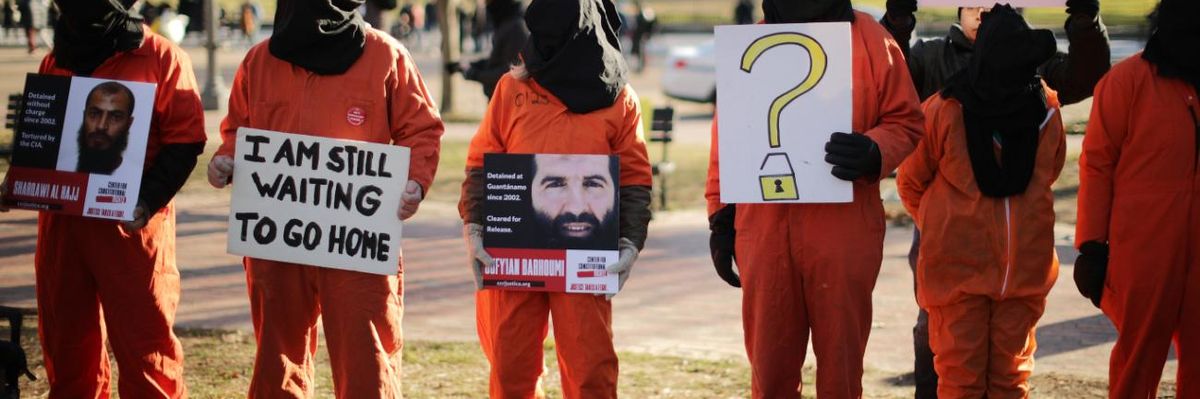
Demonstrators wearing orange jumpsuits and hoods over their heads rally to demand closure of the detention camp at the U.S. Naval Station in Guantanamo Bay, Cuba, outside the White House on January 11, 2019. The Biden administration transferred one inmate on Monday. (Photo by Chip Somodevilla/Getty Images)
While relieved over the transfer of one Guantanamo Bay prisoner on Monday, human rights advocates pressed the Biden administration to speed up the pace of its efforts to release or move all other remaining detainees and shutter the offshore facility once and for all.
The White House announced that after 19 years in detention, 56-year-old Abdul Latif Nasser was repatriated to his home country of Morocco early Monday. Nasser has never been charged with a crime and was held as an indefinite detainee "in the armed conflict against Al Qaeda." He was cleared for release in 2016, but had remained at Guantanamo due to former President Donald Trump's halting of all transfers.
"The administration has much to do to fulfill President Biden's mandate to close the prison and show greater respect for human rights."
--Center for Constitutional Rights
Of the 39 people who remain in U.S. custody at Guantanamo Bay, 28 have never been charged with crimes over nearly two decades of imprisonment. Ten have been recommended for transfers like Nasser's, in which the Moroccan government is expected to monitor him, including five since President Joe Biden took office in January.
Daphne Eviatar, director of the Security With Human Rights program at Amnesty International, called Nasser's release a "welcome step" and urged the Biden administration to take further action to end the era of unlawful Guantanamo Bay imprisonments.
"Now we need to see the remaining ten detainees already cleared for release transferred quickly," said Eviatar in a statement. "And we need to see clear plans for shuttering this unlawful facility once and for all. The detention facility has been allowed to stay open for far too long, now holding 39 people for almost two decades, most without charge or trial."
Nasser's continued detention over the past five years since he was cleared for transfer compounded "years of injustice," said Hina Shamsi, director of the ACLU's National Security Project.
"Bringing an end to two decades of unjust and abusive military detention of Muslim men at Guantanamo is a human rights obligation and a national security necessity," said Shamsi.
Prisoners who remain at Guantanamo include Toffiq al-Bihani, who was tortured by the CIA after being sent to the prison in 2003 and has yet to be charged or put on trial. Al-Bihani was recommended for a transfer to Yemen or another country by U.S. authorities in January 2010. Amnesty International has been campaigning for his release.
The same interagency panel that recommended Nasser's transfer held a hearing on May 18 regarding the possible release of Mohammed al-Qatani, who was also tortured at the prison and has schizophrenia. Officials have not announced a decision in al-Qatani's case yet; a federal lawsuit is also pending over whether he should be repatriated to Saudi Arabia in order to receive adequate care for his condition.
The Center for Constitutional Rights (CCR) called for the release of its clients, Sufyian Barhoumi and Sharqawi al Hajj, "without further delay," calling Nasser's transfer "a step in the right direction."
"The administration has much to do to fulfill President Biden's mandate to close the prison and show greater respect for human rights," said the organization in a statement. "In addition to increasing the pace of transfers, the government must purge torture from all detainee-related proceedings, afford detainees due process rights, and, as the U.S. formally withdraws from Afghanistan, finally abandon the already tenuous legal justification for indefinite 'preventative' detentions that have been premised on preventing a return to an imagined battlefield."
"As we approach the 20th anniversary of 9/11, it is long past time to close Guantanamo and reckon with 20 years of injustice and harm," said CCR.
Dear Common Dreams reader, It’s been nearly 30 years since I co-founded Common Dreams with my late wife, Lina Newhouser. We had the radical notion that journalism should serve the public good, not corporate profits. It was clear to us from the outset what it would take to build such a project. No paid advertisements. No corporate sponsors. No millionaire publisher telling us what to think or do. Many people said we wouldn't last a year, but we proved those doubters wrong. Together with a tremendous team of journalists and dedicated staff, we built an independent media outlet free from the constraints of profits and corporate control. Our mission has always been simple: To inform. To inspire. To ignite change for the common good. Building Common Dreams was not easy. Our survival was never guaranteed. When you take on the most powerful forces—Wall Street greed, fossil fuel industry destruction, Big Tech lobbyists, and uber-rich oligarchs who have spent billions upon billions rigging the economy and democracy in their favor—the only bulwark you have is supporters who believe in your work. But here’s the urgent message from me today. It's never been this bad out there. And it's never been this hard to keep us going. At the very moment Common Dreams is most needed, the threats we face are intensifying. We need your support now more than ever. We don't accept corporate advertising and never will. We don't have a paywall because we don't think people should be blocked from critical news based on their ability to pay. Everything we do is funded by the donations of readers like you. When everyone does the little they can afford, we are strong. But if that support retreats or dries up, so do we. Will you donate now to make sure Common Dreams not only survives but thrives? —Craig Brown, Co-founder |
While relieved over the transfer of one Guantanamo Bay prisoner on Monday, human rights advocates pressed the Biden administration to speed up the pace of its efforts to release or move all other remaining detainees and shutter the offshore facility once and for all.
The White House announced that after 19 years in detention, 56-year-old Abdul Latif Nasser was repatriated to his home country of Morocco early Monday. Nasser has never been charged with a crime and was held as an indefinite detainee "in the armed conflict against Al Qaeda." He was cleared for release in 2016, but had remained at Guantanamo due to former President Donald Trump's halting of all transfers.
"The administration has much to do to fulfill President Biden's mandate to close the prison and show greater respect for human rights."
--Center for Constitutional Rights
Of the 39 people who remain in U.S. custody at Guantanamo Bay, 28 have never been charged with crimes over nearly two decades of imprisonment. Ten have been recommended for transfers like Nasser's, in which the Moroccan government is expected to monitor him, including five since President Joe Biden took office in January.
Daphne Eviatar, director of the Security With Human Rights program at Amnesty International, called Nasser's release a "welcome step" and urged the Biden administration to take further action to end the era of unlawful Guantanamo Bay imprisonments.
"Now we need to see the remaining ten detainees already cleared for release transferred quickly," said Eviatar in a statement. "And we need to see clear plans for shuttering this unlawful facility once and for all. The detention facility has been allowed to stay open for far too long, now holding 39 people for almost two decades, most without charge or trial."
Nasser's continued detention over the past five years since he was cleared for transfer compounded "years of injustice," said Hina Shamsi, director of the ACLU's National Security Project.
"Bringing an end to two decades of unjust and abusive military detention of Muslim men at Guantanamo is a human rights obligation and a national security necessity," said Shamsi.
Prisoners who remain at Guantanamo include Toffiq al-Bihani, who was tortured by the CIA after being sent to the prison in 2003 and has yet to be charged or put on trial. Al-Bihani was recommended for a transfer to Yemen or another country by U.S. authorities in January 2010. Amnesty International has been campaigning for his release.
The same interagency panel that recommended Nasser's transfer held a hearing on May 18 regarding the possible release of Mohammed al-Qatani, who was also tortured at the prison and has schizophrenia. Officials have not announced a decision in al-Qatani's case yet; a federal lawsuit is also pending over whether he should be repatriated to Saudi Arabia in order to receive adequate care for his condition.
The Center for Constitutional Rights (CCR) called for the release of its clients, Sufyian Barhoumi and Sharqawi al Hajj, "without further delay," calling Nasser's transfer "a step in the right direction."
"The administration has much to do to fulfill President Biden's mandate to close the prison and show greater respect for human rights," said the organization in a statement. "In addition to increasing the pace of transfers, the government must purge torture from all detainee-related proceedings, afford detainees due process rights, and, as the U.S. formally withdraws from Afghanistan, finally abandon the already tenuous legal justification for indefinite 'preventative' detentions that have been premised on preventing a return to an imagined battlefield."
"As we approach the 20th anniversary of 9/11, it is long past time to close Guantanamo and reckon with 20 years of injustice and harm," said CCR.
While relieved over the transfer of one Guantanamo Bay prisoner on Monday, human rights advocates pressed the Biden administration to speed up the pace of its efforts to release or move all other remaining detainees and shutter the offshore facility once and for all.
The White House announced that after 19 years in detention, 56-year-old Abdul Latif Nasser was repatriated to his home country of Morocco early Monday. Nasser has never been charged with a crime and was held as an indefinite detainee "in the armed conflict against Al Qaeda." He was cleared for release in 2016, but had remained at Guantanamo due to former President Donald Trump's halting of all transfers.
"The administration has much to do to fulfill President Biden's mandate to close the prison and show greater respect for human rights."
--Center for Constitutional Rights
Of the 39 people who remain in U.S. custody at Guantanamo Bay, 28 have never been charged with crimes over nearly two decades of imprisonment. Ten have been recommended for transfers like Nasser's, in which the Moroccan government is expected to monitor him, including five since President Joe Biden took office in January.
Daphne Eviatar, director of the Security With Human Rights program at Amnesty International, called Nasser's release a "welcome step" and urged the Biden administration to take further action to end the era of unlawful Guantanamo Bay imprisonments.
"Now we need to see the remaining ten detainees already cleared for release transferred quickly," said Eviatar in a statement. "And we need to see clear plans for shuttering this unlawful facility once and for all. The detention facility has been allowed to stay open for far too long, now holding 39 people for almost two decades, most without charge or trial."
Nasser's continued detention over the past five years since he was cleared for transfer compounded "years of injustice," said Hina Shamsi, director of the ACLU's National Security Project.
"Bringing an end to two decades of unjust and abusive military detention of Muslim men at Guantanamo is a human rights obligation and a national security necessity," said Shamsi.
Prisoners who remain at Guantanamo include Toffiq al-Bihani, who was tortured by the CIA after being sent to the prison in 2003 and has yet to be charged or put on trial. Al-Bihani was recommended for a transfer to Yemen or another country by U.S. authorities in January 2010. Amnesty International has been campaigning for his release.
The same interagency panel that recommended Nasser's transfer held a hearing on May 18 regarding the possible release of Mohammed al-Qatani, who was also tortured at the prison and has schizophrenia. Officials have not announced a decision in al-Qatani's case yet; a federal lawsuit is also pending over whether he should be repatriated to Saudi Arabia in order to receive adequate care for his condition.
The Center for Constitutional Rights (CCR) called for the release of its clients, Sufyian Barhoumi and Sharqawi al Hajj, "without further delay," calling Nasser's transfer "a step in the right direction."
"The administration has much to do to fulfill President Biden's mandate to close the prison and show greater respect for human rights," said the organization in a statement. "In addition to increasing the pace of transfers, the government must purge torture from all detainee-related proceedings, afford detainees due process rights, and, as the U.S. formally withdraws from Afghanistan, finally abandon the already tenuous legal justification for indefinite 'preventative' detentions that have been premised on preventing a return to an imagined battlefield."
"As we approach the 20th anniversary of 9/11, it is long past time to close Guantanamo and reckon with 20 years of injustice and harm," said CCR.