SUBSCRIBE TO OUR FREE NEWSLETTER
Daily news & progressive opinion—funded by the people, not the corporations—delivered straight to your inbox.
5
#000000
#FFFFFF
To donate by check, phone, or other method, see our More Ways to Give page.
Daily news & progressive opinion—funded by the people, not the corporations—delivered straight to your inbox.
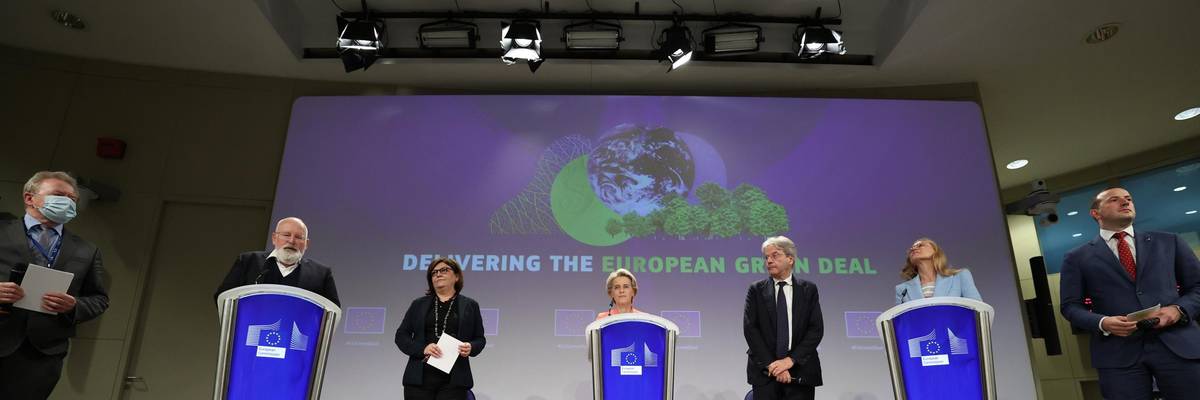
(From L-R) Janusz Wojciechowski, agriculture commissioner of European Union; Frans Timmermans, vice president of the European Commission; Adina Valean, transport commissioner of the E.U.; Ursula von der Leyen, president of the European Commission; Paolo Gentiloni, economy commissioner of the E.U.; Kadri Simson, energy commissioner of the E.U.; and Virginijus Sinkevicius, environment commissioner of the E.U., attend a press conference at the unveiling of a landmark climate plan in Brussels on July 14, 2021. (Photo: Dursun Aydemir/Anadolu Agency via Getty Images)
As officials prepare to introduce sweeping legislation aimed at achieving the European Union's pledge to reduce greenhouse gas emissions 55% from 1990 levels by 2030, environmental and social justice advocates warned Wednesday that the proposed measures could push millions of people into poverty due to high energy costs.
Part of the E.U.'s Green Deal, the European Commission says its Fit for 55 package "will enable the necessary acceleration of greenhouse gas emission reductions in the next decade" to meet the 27-nation bloc's determined contribution under the Paris agreement.
Fit for 55's proposals include:
"The fossil fuel economy has reached its limits," said European Commission President Ursula von der Leyen. "We want to leave the next generation a healthy planet as well as good jobs and growth that does not hurt our nature."
"The European Green Deal is our growth strategy that is moving towards a de-carbonized economy," Von der Leyen added. "Europe was the first continent to declare to be climate neutral in 2050, and now we are the very first ones to put a concrete road map on the table. Europe walks the talk on climate policies through innovation, investment, and social compensation."
However, environmental and social justice advocates said Fit for 55 doesn't go far enough, and could dramatically increase energy costs for low-income Europeans.
Critics say that gains in energy efficiency will be offset by the proposed extension of the E.U. ETS program to include buildings and transport, which Friends of the Earth calls "a move that could push millions more Europeans into energy poverty, unable to pay their energy bills--risking lives and potential social backlash."
Friends of the Earth Europe energy poverty campaigner Martha Myers in a statement: "This Fit for 55 package is unfit for the just energy transition people and the planet desperately need--it will put energy-poor people in jeopardy. Increased targets to cut energy waste will help reduce carbon--but not by enough to halt the climate crisis."
"The commission's move to extend emissions trading to buildings shows a lack of solidarity--it throws low-income people into high energy price waters while offering only a swimming float of support to relieve energy poverty," Myers added.
Freek Spinnewijn, director of the European Federation of the National Organizations Working With the Homeless (FEANTSA), said that "we really hoped the European Commission would live up to its promise of a Green Deal that leaves no one behind, but instead this package gives energy-poor people a punch on the nose."
"It's one step forward, two steps backwards," said Spinnewijn. "While there are some programs for low-income people, it will overall leave them with higher energy bills or in the cold. That's just wrong."
Dear Common Dreams reader, It’s been nearly 30 years since I co-founded Common Dreams with my late wife, Lina Newhouser. We had the radical notion that journalism should serve the public good, not corporate profits. It was clear to us from the outset what it would take to build such a project. No paid advertisements. No corporate sponsors. No millionaire publisher telling us what to think or do. Many people said we wouldn't last a year, but we proved those doubters wrong. Together with a tremendous team of journalists and dedicated staff, we built an independent media outlet free from the constraints of profits and corporate control. Our mission has always been simple: To inform. To inspire. To ignite change for the common good. Building Common Dreams was not easy. Our survival was never guaranteed. When you take on the most powerful forces—Wall Street greed, fossil fuel industry destruction, Big Tech lobbyists, and uber-rich oligarchs who have spent billions upon billions rigging the economy and democracy in their favor—the only bulwark you have is supporters who believe in your work. But here’s the urgent message from me today. It's never been this bad out there. And it's never been this hard to keep us going. At the very moment Common Dreams is most needed, the threats we face are intensifying. We need your support now more than ever. We don't accept corporate advertising and never will. We don't have a paywall because we don't think people should be blocked from critical news based on their ability to pay. Everything we do is funded by the donations of readers like you. When everyone does the little they can afford, we are strong. But if that support retreats or dries up, so do we. Will you donate now to make sure Common Dreams not only survives but thrives? —Craig Brown, Co-founder |
As officials prepare to introduce sweeping legislation aimed at achieving the European Union's pledge to reduce greenhouse gas emissions 55% from 1990 levels by 2030, environmental and social justice advocates warned Wednesday that the proposed measures could push millions of people into poverty due to high energy costs.
Part of the E.U.'s Green Deal, the European Commission says its Fit for 55 package "will enable the necessary acceleration of greenhouse gas emission reductions in the next decade" to meet the 27-nation bloc's determined contribution under the Paris agreement.
Fit for 55's proposals include:
"The fossil fuel economy has reached its limits," said European Commission President Ursula von der Leyen. "We want to leave the next generation a healthy planet as well as good jobs and growth that does not hurt our nature."
"The European Green Deal is our growth strategy that is moving towards a de-carbonized economy," Von der Leyen added. "Europe was the first continent to declare to be climate neutral in 2050, and now we are the very first ones to put a concrete road map on the table. Europe walks the talk on climate policies through innovation, investment, and social compensation."
However, environmental and social justice advocates said Fit for 55 doesn't go far enough, and could dramatically increase energy costs for low-income Europeans.
Critics say that gains in energy efficiency will be offset by the proposed extension of the E.U. ETS program to include buildings and transport, which Friends of the Earth calls "a move that could push millions more Europeans into energy poverty, unable to pay their energy bills--risking lives and potential social backlash."
Friends of the Earth Europe energy poverty campaigner Martha Myers in a statement: "This Fit for 55 package is unfit for the just energy transition people and the planet desperately need--it will put energy-poor people in jeopardy. Increased targets to cut energy waste will help reduce carbon--but not by enough to halt the climate crisis."
"The commission's move to extend emissions trading to buildings shows a lack of solidarity--it throws low-income people into high energy price waters while offering only a swimming float of support to relieve energy poverty," Myers added.
Freek Spinnewijn, director of the European Federation of the National Organizations Working With the Homeless (FEANTSA), said that "we really hoped the European Commission would live up to its promise of a Green Deal that leaves no one behind, but instead this package gives energy-poor people a punch on the nose."
"It's one step forward, two steps backwards," said Spinnewijn. "While there are some programs for low-income people, it will overall leave them with higher energy bills or in the cold. That's just wrong."
As officials prepare to introduce sweeping legislation aimed at achieving the European Union's pledge to reduce greenhouse gas emissions 55% from 1990 levels by 2030, environmental and social justice advocates warned Wednesday that the proposed measures could push millions of people into poverty due to high energy costs.
Part of the E.U.'s Green Deal, the European Commission says its Fit for 55 package "will enable the necessary acceleration of greenhouse gas emission reductions in the next decade" to meet the 27-nation bloc's determined contribution under the Paris agreement.
Fit for 55's proposals include:
"The fossil fuel economy has reached its limits," said European Commission President Ursula von der Leyen. "We want to leave the next generation a healthy planet as well as good jobs and growth that does not hurt our nature."
"The European Green Deal is our growth strategy that is moving towards a de-carbonized economy," Von der Leyen added. "Europe was the first continent to declare to be climate neutral in 2050, and now we are the very first ones to put a concrete road map on the table. Europe walks the talk on climate policies through innovation, investment, and social compensation."
However, environmental and social justice advocates said Fit for 55 doesn't go far enough, and could dramatically increase energy costs for low-income Europeans.
Critics say that gains in energy efficiency will be offset by the proposed extension of the E.U. ETS program to include buildings and transport, which Friends of the Earth calls "a move that could push millions more Europeans into energy poverty, unable to pay their energy bills--risking lives and potential social backlash."
Friends of the Earth Europe energy poverty campaigner Martha Myers in a statement: "This Fit for 55 package is unfit for the just energy transition people and the planet desperately need--it will put energy-poor people in jeopardy. Increased targets to cut energy waste will help reduce carbon--but not by enough to halt the climate crisis."
"The commission's move to extend emissions trading to buildings shows a lack of solidarity--it throws low-income people into high energy price waters while offering only a swimming float of support to relieve energy poverty," Myers added.
Freek Spinnewijn, director of the European Federation of the National Organizations Working With the Homeless (FEANTSA), said that "we really hoped the European Commission would live up to its promise of a Green Deal that leaves no one behind, but instead this package gives energy-poor people a punch on the nose."
"It's one step forward, two steps backwards," said Spinnewijn. "While there are some programs for low-income people, it will overall leave them with higher energy bills or in the cold. That's just wrong."