SUBSCRIBE TO OUR FREE NEWSLETTER
Daily news & progressive opinion—funded by the people, not the corporations—delivered straight to your inbox.
5
#000000
#FFFFFF
To donate by check, phone, or other method, see our More Ways to Give page.
Daily news & progressive opinion—funded by the people, not the corporations—delivered straight to your inbox.
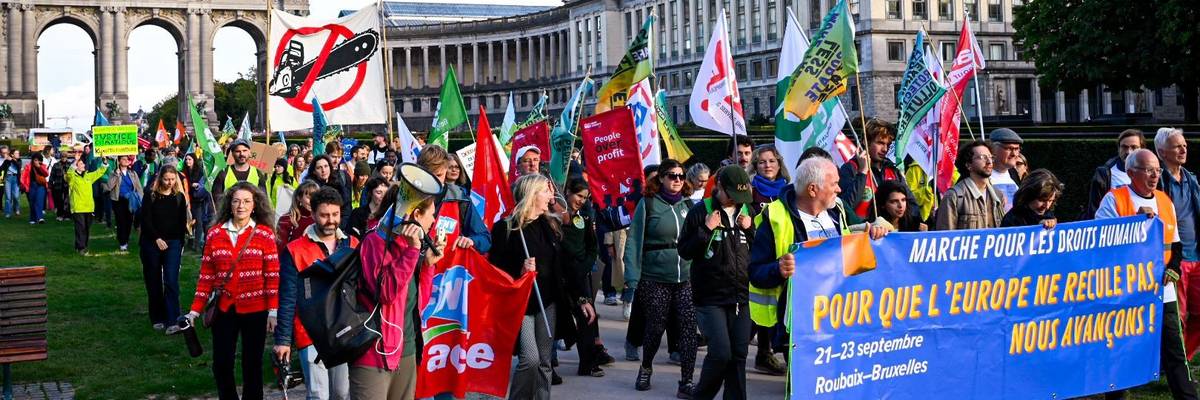
European activists march against deregulation on September 23, 2025 in Brussels, Belgium.
"This outcome reflects a troubling trend in the European Parliament, where the conservative bloc has increasingly aligned with far-right agendas, legitimizing polarizing demands and pushing aside science-based evidence."
Climate and human rights advocates on Tuesday blasted European Union legislators for approving a deregulation package that Amnesty International's Eve Geddie said "undermines vital climate and human rights safeguards, betraying people and the planet at a time when protections are needed most."
Members of the European Parliament (MEPs) voted 428-218 in favor of Omnibus I, which will weaken the Corporate Sustainability Reporting Directive and the Corporate Sustainability Due Diligence Directive, with 17 abstentions. The package still needs final approval from the Council of the EU, after which governments will have until mid-2028 to transpose it into national law.
Under the new text, only EU companies that employ more than 1,000 people on average and have a net annual turnover above €450 million, or $529 million, will have to conduct social and environmental reporting, and only firms with over 5,000 employees and a net annual turnover exceeding €1.5 billion, or $1.76 billion, have to carry out due diligence.
The changes, finalized in negotiations between the European Parliament and member states last week, "are expected to exempt around 80% of companies originally expected to disclose against the rules," reported Responsible Investor.
Anticipating the vote, Sebastien Godinot, senior economist at WWF European Policy Office, said Monday that "under the guise of easing regulatory burdens, the EU engaged in a race to the bottom, rushing to undo necessary safeguards that were set in place to protect our nature and climate, as well as to secure future economic prosperity."
"Instead of focusing on the successful implementation of the laws, decision-makers shifted their focus to short-term political gains, ignoring the strong evidence showing that corporate climate targets are not only feasible, but make a lot of sense for companies," he continued. "After years of positioning itself as a sustainability leader, it is disappointing to see the EU stepping back and ignoring the science meant to guide decision-making."
Mariana Ferreira, who focuses on sustainable finance at the WWF office, noted that "this outcome reflects a troubling trend in the European Parliament, where the conservative bloc has increasingly aligned with far-right agendas, legitimizing polarizing demands and pushing aside science-based evidence and warnings."
After Tuesday's vote, Human Rights Watch senior corporate accountability advocate Hélène de Rengervé lamented: "All that is left of the EU's trailblazing corporate accountability law is a skeleton... The final text means corporate interests are being prioritized over the rights of workers, communities, and environmental protection."
Gaëlle Dusepulchre of the Paris-based International Federation for Human Rights also argued that the vote "sets a serious precedent for EU policymaking by signaling a clear prioritization of corporate interests over the protection of people and the planet."
Geddie, director of Amnesty's European Institutions Office, pointed out that "this rollback is part of a bonfire of regulations and is the result of intense lobbying efforts by powerful industry actors and external pressure, including from the United States. Ignoring widespread criticism from civil society, economists, the [United Nations], and even the European Ombudsman, this rushed and opaque process also flies in the face of public opinion, which clearly shows the majority of Europeans favour human rights and environmental protection."
"Now, EU governments must strengthen key provisions when they incorporate these regulations in national law and use every available avenue to improve protections, ensure access to justice for victims, and urgently prevent further erosion of corporate accountability—especially since other deregulation packages are already in the pipeline," she stressed. "European states must not squander the opportunity to use these regulations to ensure businesses contribute to thriving communities—our future and the future of our planet rely on it."
European Coalition for Corporate Justice director Nele Meyer called the vote "a betrayal of people and communities suffering from corporate abuse around the world," and warned that it "puts member states at risk of breaching their obligation to protect human rights and prevent environmental and climate damage."
"It is deeply alarming to witness how foreign pressure shaped a file that should have been driven by evidence and by the needs of those facing the impacts on the ground," Meyer added. "While the protections have been weakened, the core due diligence duty remains. Now the law must be implemented in a way that delivers real protection for people and the planet."
Dear Common Dreams reader, It’s been nearly 30 years since I co-founded Common Dreams with my late wife, Lina Newhouser. We had the radical notion that journalism should serve the public good, not corporate profits. It was clear to us from the outset what it would take to build such a project. No paid advertisements. No corporate sponsors. No millionaire publisher telling us what to think or do. Many people said we wouldn't last a year, but we proved those doubters wrong. Together with a tremendous team of journalists and dedicated staff, we built an independent media outlet free from the constraints of profits and corporate control. Our mission has always been simple: To inform. To inspire. To ignite change for the common good. Building Common Dreams was not easy. Our survival was never guaranteed. When you take on the most powerful forces—Wall Street greed, fossil fuel industry destruction, Big Tech lobbyists, and uber-rich oligarchs who have spent billions upon billions rigging the economy and democracy in their favor—the only bulwark you have is supporters who believe in your work. But here’s the urgent message from me today. It's never been this bad out there. And it's never been this hard to keep us going. At the very moment Common Dreams is most needed, the threats we face are intensifying. We need your support now more than ever. We don't accept corporate advertising and never will. We don't have a paywall because we don't think people should be blocked from critical news based on their ability to pay. Everything we do is funded by the donations of readers like you. When everyone does the little they can afford, we are strong. But if that support retreats or dries up, so do we. Will you donate now to make sure Common Dreams not only survives but thrives? —Craig Brown, Co-founder |
Climate and human rights advocates on Tuesday blasted European Union legislators for approving a deregulation package that Amnesty International's Eve Geddie said "undermines vital climate and human rights safeguards, betraying people and the planet at a time when protections are needed most."
Members of the European Parliament (MEPs) voted 428-218 in favor of Omnibus I, which will weaken the Corporate Sustainability Reporting Directive and the Corporate Sustainability Due Diligence Directive, with 17 abstentions. The package still needs final approval from the Council of the EU, after which governments will have until mid-2028 to transpose it into national law.
Under the new text, only EU companies that employ more than 1,000 people on average and have a net annual turnover above €450 million, or $529 million, will have to conduct social and environmental reporting, and only firms with over 5,000 employees and a net annual turnover exceeding €1.5 billion, or $1.76 billion, have to carry out due diligence.
The changes, finalized in negotiations between the European Parliament and member states last week, "are expected to exempt around 80% of companies originally expected to disclose against the rules," reported Responsible Investor.
Anticipating the vote, Sebastien Godinot, senior economist at WWF European Policy Office, said Monday that "under the guise of easing regulatory burdens, the EU engaged in a race to the bottom, rushing to undo necessary safeguards that were set in place to protect our nature and climate, as well as to secure future economic prosperity."
"Instead of focusing on the successful implementation of the laws, decision-makers shifted their focus to short-term political gains, ignoring the strong evidence showing that corporate climate targets are not only feasible, but make a lot of sense for companies," he continued. "After years of positioning itself as a sustainability leader, it is disappointing to see the EU stepping back and ignoring the science meant to guide decision-making."
Mariana Ferreira, who focuses on sustainable finance at the WWF office, noted that "this outcome reflects a troubling trend in the European Parliament, where the conservative bloc has increasingly aligned with far-right agendas, legitimizing polarizing demands and pushing aside science-based evidence and warnings."
After Tuesday's vote, Human Rights Watch senior corporate accountability advocate Hélène de Rengervé lamented: "All that is left of the EU's trailblazing corporate accountability law is a skeleton... The final text means corporate interests are being prioritized over the rights of workers, communities, and environmental protection."
Gaëlle Dusepulchre of the Paris-based International Federation for Human Rights also argued that the vote "sets a serious precedent for EU policymaking by signaling a clear prioritization of corporate interests over the protection of people and the planet."
Geddie, director of Amnesty's European Institutions Office, pointed out that "this rollback is part of a bonfire of regulations and is the result of intense lobbying efforts by powerful industry actors and external pressure, including from the United States. Ignoring widespread criticism from civil society, economists, the [United Nations], and even the European Ombudsman, this rushed and opaque process also flies in the face of public opinion, which clearly shows the majority of Europeans favour human rights and environmental protection."
"Now, EU governments must strengthen key provisions when they incorporate these regulations in national law and use every available avenue to improve protections, ensure access to justice for victims, and urgently prevent further erosion of corporate accountability—especially since other deregulation packages are already in the pipeline," she stressed. "European states must not squander the opportunity to use these regulations to ensure businesses contribute to thriving communities—our future and the future of our planet rely on it."
European Coalition for Corporate Justice director Nele Meyer called the vote "a betrayal of people and communities suffering from corporate abuse around the world," and warned that it "puts member states at risk of breaching their obligation to protect human rights and prevent environmental and climate damage."
"It is deeply alarming to witness how foreign pressure shaped a file that should have been driven by evidence and by the needs of those facing the impacts on the ground," Meyer added. "While the protections have been weakened, the core due diligence duty remains. Now the law must be implemented in a way that delivers real protection for people and the planet."
Climate and human rights advocates on Tuesday blasted European Union legislators for approving a deregulation package that Amnesty International's Eve Geddie said "undermines vital climate and human rights safeguards, betraying people and the planet at a time when protections are needed most."
Members of the European Parliament (MEPs) voted 428-218 in favor of Omnibus I, which will weaken the Corporate Sustainability Reporting Directive and the Corporate Sustainability Due Diligence Directive, with 17 abstentions. The package still needs final approval from the Council of the EU, after which governments will have until mid-2028 to transpose it into national law.
Under the new text, only EU companies that employ more than 1,000 people on average and have a net annual turnover above €450 million, or $529 million, will have to conduct social and environmental reporting, and only firms with over 5,000 employees and a net annual turnover exceeding €1.5 billion, or $1.76 billion, have to carry out due diligence.
The changes, finalized in negotiations between the European Parliament and member states last week, "are expected to exempt around 80% of companies originally expected to disclose against the rules," reported Responsible Investor.
Anticipating the vote, Sebastien Godinot, senior economist at WWF European Policy Office, said Monday that "under the guise of easing regulatory burdens, the EU engaged in a race to the bottom, rushing to undo necessary safeguards that were set in place to protect our nature and climate, as well as to secure future economic prosperity."
"Instead of focusing on the successful implementation of the laws, decision-makers shifted their focus to short-term political gains, ignoring the strong evidence showing that corporate climate targets are not only feasible, but make a lot of sense for companies," he continued. "After years of positioning itself as a sustainability leader, it is disappointing to see the EU stepping back and ignoring the science meant to guide decision-making."
Mariana Ferreira, who focuses on sustainable finance at the WWF office, noted that "this outcome reflects a troubling trend in the European Parliament, where the conservative bloc has increasingly aligned with far-right agendas, legitimizing polarizing demands and pushing aside science-based evidence and warnings."
After Tuesday's vote, Human Rights Watch senior corporate accountability advocate Hélène de Rengervé lamented: "All that is left of the EU's trailblazing corporate accountability law is a skeleton... The final text means corporate interests are being prioritized over the rights of workers, communities, and environmental protection."
Gaëlle Dusepulchre of the Paris-based International Federation for Human Rights also argued that the vote "sets a serious precedent for EU policymaking by signaling a clear prioritization of corporate interests over the protection of people and the planet."
Geddie, director of Amnesty's European Institutions Office, pointed out that "this rollback is part of a bonfire of regulations and is the result of intense lobbying efforts by powerful industry actors and external pressure, including from the United States. Ignoring widespread criticism from civil society, economists, the [United Nations], and even the European Ombudsman, this rushed and opaque process also flies in the face of public opinion, which clearly shows the majority of Europeans favour human rights and environmental protection."
"Now, EU governments must strengthen key provisions when they incorporate these regulations in national law and use every available avenue to improve protections, ensure access to justice for victims, and urgently prevent further erosion of corporate accountability—especially since other deregulation packages are already in the pipeline," she stressed. "European states must not squander the opportunity to use these regulations to ensure businesses contribute to thriving communities—our future and the future of our planet rely on it."
European Coalition for Corporate Justice director Nele Meyer called the vote "a betrayal of people and communities suffering from corporate abuse around the world," and warned that it "puts member states at risk of breaching their obligation to protect human rights and prevent environmental and climate damage."
"It is deeply alarming to witness how foreign pressure shaped a file that should have been driven by evidence and by the needs of those facing the impacts on the ground," Meyer added. "While the protections have been weakened, the core due diligence duty remains. Now the law must be implemented in a way that delivers real protection for people and the planet."