

SUBSCRIBE TO OUR FREE NEWSLETTER
Daily news & progressive opinion—funded by the people, not the corporations—delivered straight to your inbox.
5
#000000
#FFFFFF
To donate by check, phone, or other method, see our More Ways to Give page.
Daily news & progressive opinion—funded by the people, not the corporations—delivered straight to your inbox.
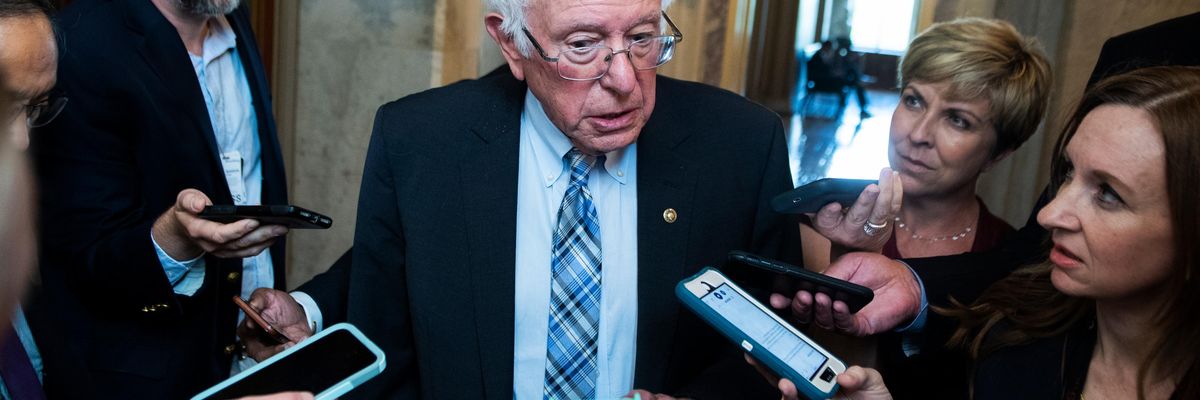
Sen. Bernie Sanders (I-Vt.) talks with reporters after the Senate Democratic policy luncheon in the Capitol on July 13, 2021. (Photo: Tom Williams/CQ-Roll Call, Inc via Getty Images)
The Senate Democratic leadership agreed late Tuesday to push for a $3.5 trillion legislative package that includes substantial investments in green energy, an expansion of Medicare benefits, universal pre-K, and other priorities, funded by tax hikes on the rich and large corporations.
"The wealthy and large corporations are going to start paying their fair share of taxes, so that we can protect the working families of this country."
--Sen. Bernie Sanders
Speaking to reporters late Tuesday, Sen. Bernie Sanders (I-Vt.)--chair of the Senate Budget Committee--celebrated the spending framework as "a big deal" that will begin the process of addressing glaring inequities in the U.S. economy and transitioning the nation's energy system away from planet-warming fossil fuels.
"This is, in our view, a pivotal moment in American history," said Sanders, who characterized the new agreement as "the most significant piece of legislation... since the Great Depression."
"The wealthy and large corporations are going to start paying their fair share of taxes, so that we can protect the working families of this country," the Vermont senator continued. "What this legislation does is says we're going to create millions of good-paying union jobs rebuilding this country not only from physical infrastructure, but dealing with the human needs of our people which are many, and which have long been neglected."
The deal outlined by Senate Democratic leaders on Tuesday sets the stage for the construction of a $3.5 trillion budget resolution, which will establish the spending boundaries for an eventual legislative package that Democrats intend to pass through reconciliation--an arcane process that requires just a simple-majority vote. Democrats in the House and Senate hope to pass a budget resolution before leaving town for August recess.
Approval of a budget resolution will kick off a contentious fight over the details of the reconciliation package, which is aimed at addressing the major shortcomings of a $579 billion bipartisan infrastructure deal that the White House endorsed last month. Democrats plan to pursue passage of the reconciliation bill and the bipartisan package, which together amount to roughly $4 trillion in new spending, at the same time.
While the new Senate agreement is expected to contain many progressive priorities, House Democrats and outside advocacy groups are unlikely to be satisfied with the top-line figure. Sanders himself indicated Monday that he was not happy with the $3.5 trillion ceiling, which falls well short of the $6 trillion package that he was advocating.
Late last month, as Common Dreams reported, more than 200 progressive advocacy groups, think tanks, and labor unions said $6 trillion "should be the floor" of Democrats' ambitions for the reconciliation bill. The youth-led Sunrise Movement, meanwhile, has been demanding at least $10 trillion in spending over the next decade to combat the climate crisis, whose impact is currently being felt across the U.S. and around the world in the form of record-shattering heatwaves, wildfires, and floods.
The details of the forthcoming reconciliation package--including how much Democrats want to spend on climate and other priorities within the confines of the $3.5 trillion framework--remain up in the air.
"Now it's on the House to go bolder and get us to the scale of our communities' needs."
--Ben Beachy, Sierra Club
During a press conference Tuesday evening, Senate Majority Leader Chuck Schumer (D-N.Y.) said that "every major program" in the package will be "funded in a robust way," an apparent nod to Sens. Joe Manchin (D-W.Va.), Mark Warner (D-Va.), and other conservative deficit hawks in the Democratic caucus. It's unclear whether the $3.5 trillion blueprint has the support of all 50 Senate Democrats, which will be necessary to push the package through reconciliation.
As the New York Times reported late Tuesday, "rising concerns among centrist lawmakers had forced Democrats to rethink the scope of that package in recent days."
"Behind the scenes, centrists including Warner had privately warned Schumer and the White House that moderates are not likely to support a reconciliation measure as large as the $6 trillion package that Sanders initially sought," the Times noted. "It became clear Tuesday evening that they were scaling the package back."
Schumer said Tuesday that the reconciliation bill will make "some additions" to the infrastructure and safety-net proposals that President Joe Biden unveiled earlier this year.
"Most important, something that Sen. Sanders has led, and convinced America is so important, which is a robust expansion of Medicare, including money for dental, vision, and hearing," said Schumer.
However, Senate Democrats reportedly did not agree to lower the Medicare eligibility age, a priority for Sanders and other progressives in Congress. That omission is likely to draw pushback in the House.
"When we say Medicare expansion, it's not lowering the eligibility age OR expanding benefits. It's BOTH--and it's popular across America," Rep. Pramila Jayapal (D-Wash.), chair of the Congressional Progressive Caucus, tweeted last week.
Ben Beachy, director of the Sierra Club's Living Economy Program, said following Senate Democrats' announcement that "now it's on the House to go bolder and get us to the scale of our communities' needs."
Dear Common Dreams reader, It’s been nearly 30 years since I co-founded Common Dreams with my late wife, Lina Newhouser. We had the radical notion that journalism should serve the public good, not corporate profits. It was clear to us from the outset what it would take to build such a project. No paid advertisements. No corporate sponsors. No millionaire publisher telling us what to think or do. Many people said we wouldn't last a year, but we proved those doubters wrong. Together with a tremendous team of journalists and dedicated staff, we built an independent media outlet free from the constraints of profits and corporate control. Our mission has always been simple: To inform. To inspire. To ignite change for the common good. Building Common Dreams was not easy. Our survival was never guaranteed. When you take on the most powerful forces—Wall Street greed, fossil fuel industry destruction, Big Tech lobbyists, and uber-rich oligarchs who have spent billions upon billions rigging the economy and democracy in their favor—the only bulwark you have is supporters who believe in your work. But here’s the urgent message from me today. It's never been this bad out there. And it's never been this hard to keep us going. At the very moment Common Dreams is most needed, the threats we face are intensifying. We need your support now more than ever. We don't accept corporate advertising and never will. We don't have a paywall because we don't think people should be blocked from critical news based on their ability to pay. Everything we do is funded by the donations of readers like you. When everyone does the little they can afford, we are strong. But if that support retreats or dries up, so do we. Will you donate now to make sure Common Dreams not only survives but thrives? —Craig Brown, Co-founder |
The Senate Democratic leadership agreed late Tuesday to push for a $3.5 trillion legislative package that includes substantial investments in green energy, an expansion of Medicare benefits, universal pre-K, and other priorities, funded by tax hikes on the rich and large corporations.
"The wealthy and large corporations are going to start paying their fair share of taxes, so that we can protect the working families of this country."
--Sen. Bernie Sanders
Speaking to reporters late Tuesday, Sen. Bernie Sanders (I-Vt.)--chair of the Senate Budget Committee--celebrated the spending framework as "a big deal" that will begin the process of addressing glaring inequities in the U.S. economy and transitioning the nation's energy system away from planet-warming fossil fuels.
"This is, in our view, a pivotal moment in American history," said Sanders, who characterized the new agreement as "the most significant piece of legislation... since the Great Depression."
"The wealthy and large corporations are going to start paying their fair share of taxes, so that we can protect the working families of this country," the Vermont senator continued. "What this legislation does is says we're going to create millions of good-paying union jobs rebuilding this country not only from physical infrastructure, but dealing with the human needs of our people which are many, and which have long been neglected."
The deal outlined by Senate Democratic leaders on Tuesday sets the stage for the construction of a $3.5 trillion budget resolution, which will establish the spending boundaries for an eventual legislative package that Democrats intend to pass through reconciliation--an arcane process that requires just a simple-majority vote. Democrats in the House and Senate hope to pass a budget resolution before leaving town for August recess.
Approval of a budget resolution will kick off a contentious fight over the details of the reconciliation package, which is aimed at addressing the major shortcomings of a $579 billion bipartisan infrastructure deal that the White House endorsed last month. Democrats plan to pursue passage of the reconciliation bill and the bipartisan package, which together amount to roughly $4 trillion in new spending, at the same time.
While the new Senate agreement is expected to contain many progressive priorities, House Democrats and outside advocacy groups are unlikely to be satisfied with the top-line figure. Sanders himself indicated Monday that he was not happy with the $3.5 trillion ceiling, which falls well short of the $6 trillion package that he was advocating.
Late last month, as Common Dreams reported, more than 200 progressive advocacy groups, think tanks, and labor unions said $6 trillion "should be the floor" of Democrats' ambitions for the reconciliation bill. The youth-led Sunrise Movement, meanwhile, has been demanding at least $10 trillion in spending over the next decade to combat the climate crisis, whose impact is currently being felt across the U.S. and around the world in the form of record-shattering heatwaves, wildfires, and floods.
The details of the forthcoming reconciliation package--including how much Democrats want to spend on climate and other priorities within the confines of the $3.5 trillion framework--remain up in the air.
"Now it's on the House to go bolder and get us to the scale of our communities' needs."
--Ben Beachy, Sierra Club
During a press conference Tuesday evening, Senate Majority Leader Chuck Schumer (D-N.Y.) said that "every major program" in the package will be "funded in a robust way," an apparent nod to Sens. Joe Manchin (D-W.Va.), Mark Warner (D-Va.), and other conservative deficit hawks in the Democratic caucus. It's unclear whether the $3.5 trillion blueprint has the support of all 50 Senate Democrats, which will be necessary to push the package through reconciliation.
As the New York Times reported late Tuesday, "rising concerns among centrist lawmakers had forced Democrats to rethink the scope of that package in recent days."
"Behind the scenes, centrists including Warner had privately warned Schumer and the White House that moderates are not likely to support a reconciliation measure as large as the $6 trillion package that Sanders initially sought," the Times noted. "It became clear Tuesday evening that they were scaling the package back."
Schumer said Tuesday that the reconciliation bill will make "some additions" to the infrastructure and safety-net proposals that President Joe Biden unveiled earlier this year.
"Most important, something that Sen. Sanders has led, and convinced America is so important, which is a robust expansion of Medicare, including money for dental, vision, and hearing," said Schumer.
However, Senate Democrats reportedly did not agree to lower the Medicare eligibility age, a priority for Sanders and other progressives in Congress. That omission is likely to draw pushback in the House.
"When we say Medicare expansion, it's not lowering the eligibility age OR expanding benefits. It's BOTH--and it's popular across America," Rep. Pramila Jayapal (D-Wash.), chair of the Congressional Progressive Caucus, tweeted last week.
Ben Beachy, director of the Sierra Club's Living Economy Program, said following Senate Democrats' announcement that "now it's on the House to go bolder and get us to the scale of our communities' needs."
The Senate Democratic leadership agreed late Tuesday to push for a $3.5 trillion legislative package that includes substantial investments in green energy, an expansion of Medicare benefits, universal pre-K, and other priorities, funded by tax hikes on the rich and large corporations.
"The wealthy and large corporations are going to start paying their fair share of taxes, so that we can protect the working families of this country."
--Sen. Bernie Sanders
Speaking to reporters late Tuesday, Sen. Bernie Sanders (I-Vt.)--chair of the Senate Budget Committee--celebrated the spending framework as "a big deal" that will begin the process of addressing glaring inequities in the U.S. economy and transitioning the nation's energy system away from planet-warming fossil fuels.
"This is, in our view, a pivotal moment in American history," said Sanders, who characterized the new agreement as "the most significant piece of legislation... since the Great Depression."
"The wealthy and large corporations are going to start paying their fair share of taxes, so that we can protect the working families of this country," the Vermont senator continued. "What this legislation does is says we're going to create millions of good-paying union jobs rebuilding this country not only from physical infrastructure, but dealing with the human needs of our people which are many, and which have long been neglected."
The deal outlined by Senate Democratic leaders on Tuesday sets the stage for the construction of a $3.5 trillion budget resolution, which will establish the spending boundaries for an eventual legislative package that Democrats intend to pass through reconciliation--an arcane process that requires just a simple-majority vote. Democrats in the House and Senate hope to pass a budget resolution before leaving town for August recess.
Approval of a budget resolution will kick off a contentious fight over the details of the reconciliation package, which is aimed at addressing the major shortcomings of a $579 billion bipartisan infrastructure deal that the White House endorsed last month. Democrats plan to pursue passage of the reconciliation bill and the bipartisan package, which together amount to roughly $4 trillion in new spending, at the same time.
While the new Senate agreement is expected to contain many progressive priorities, House Democrats and outside advocacy groups are unlikely to be satisfied with the top-line figure. Sanders himself indicated Monday that he was not happy with the $3.5 trillion ceiling, which falls well short of the $6 trillion package that he was advocating.
Late last month, as Common Dreams reported, more than 200 progressive advocacy groups, think tanks, and labor unions said $6 trillion "should be the floor" of Democrats' ambitions for the reconciliation bill. The youth-led Sunrise Movement, meanwhile, has been demanding at least $10 trillion in spending over the next decade to combat the climate crisis, whose impact is currently being felt across the U.S. and around the world in the form of record-shattering heatwaves, wildfires, and floods.
The details of the forthcoming reconciliation package--including how much Democrats want to spend on climate and other priorities within the confines of the $3.5 trillion framework--remain up in the air.
"Now it's on the House to go bolder and get us to the scale of our communities' needs."
--Ben Beachy, Sierra Club
During a press conference Tuesday evening, Senate Majority Leader Chuck Schumer (D-N.Y.) said that "every major program" in the package will be "funded in a robust way," an apparent nod to Sens. Joe Manchin (D-W.Va.), Mark Warner (D-Va.), and other conservative deficit hawks in the Democratic caucus. It's unclear whether the $3.5 trillion blueprint has the support of all 50 Senate Democrats, which will be necessary to push the package through reconciliation.
As the New York Times reported late Tuesday, "rising concerns among centrist lawmakers had forced Democrats to rethink the scope of that package in recent days."
"Behind the scenes, centrists including Warner had privately warned Schumer and the White House that moderates are not likely to support a reconciliation measure as large as the $6 trillion package that Sanders initially sought," the Times noted. "It became clear Tuesday evening that they were scaling the package back."
Schumer said Tuesday that the reconciliation bill will make "some additions" to the infrastructure and safety-net proposals that President Joe Biden unveiled earlier this year.
"Most important, something that Sen. Sanders has led, and convinced America is so important, which is a robust expansion of Medicare, including money for dental, vision, and hearing," said Schumer.
However, Senate Democrats reportedly did not agree to lower the Medicare eligibility age, a priority for Sanders and other progressives in Congress. That omission is likely to draw pushback in the House.
"When we say Medicare expansion, it's not lowering the eligibility age OR expanding benefits. It's BOTH--and it's popular across America," Rep. Pramila Jayapal (D-Wash.), chair of the Congressional Progressive Caucus, tweeted last week.
Ben Beachy, director of the Sierra Club's Living Economy Program, said following Senate Democrats' announcement that "now it's on the House to go bolder and get us to the scale of our communities' needs."

