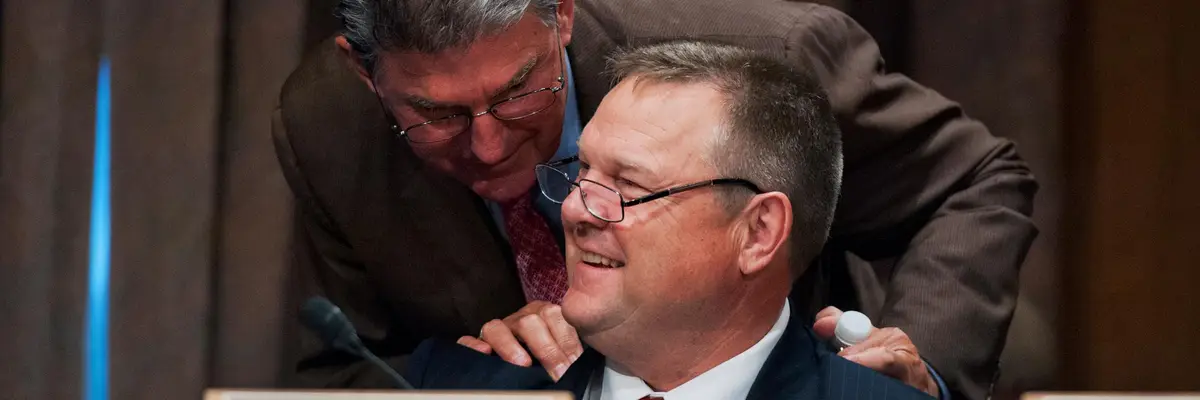
Sens. Jon Tester (D-Mont.) and Joe Manchin (D-W.Va.) confer during a Senate Banking, Housing, and Urban Affairs Committee hearing on June 17, 2014. (Photo: Tom Williams/CQ Roll Call)
Campaign Disclosures Show Senate Dems in ExxonMobil Expose Got Almost $333,000
A separate review of the fossil fuel company's "2020 Worldwide Giving Report" shows that centrist think tanks are also "raking in Exxon cash."
A pair of reports published Tuesday in the wake of a damning expose featuring secretly recorded ExxonMobil lobbyists further illuminated the fossil fuel giant's efforts to influence powerful centrists in Congress and beyond.
The New Republic's Kate Aronoff revealed that "centrist think tanks are raking in Exxon cash," citing a company report, while HuffPost's Alexander Kaufman reviewed an analysis by the advocacy group Oil Change U.S. of campaign contributions to six Democratic U.S. senators named in Unearthed's June expose.
The videos from Unearthed, Greenpeace U.K.'s investigative journalism arm, feature one current and one former ExxonMobil employee, Keith McCoy and Dan Easley, who thought they were discussing the company's lobbying efforts with a recruitment consultant.
While ExxonMobil chairman and CEO Darren Woods claimed that McCoy and Easley made "disturbing and inaccurate comments about our positions on a variety of issues, including climate change policy, and our interaction with elected officials," the reporting has increased scrutiny of the company's lobbying and finances over the past two weeks.
The Oil Change U.S. analysis focuses on campaign disclosures of six Democratic lawmakers McCoy mentioned: Sens. Chris Coons (Del.), Maggie Hassan (N.H.), Mark Kelly (Ariz.), Joe Manchin (W.Va.), Kyrsten Sinema (Ariz.), and Jon Tester (Mont.).
Asked on a May video call which lawmakers ExxonMobil targets, McCoy first named Sen. Shelley Moore Capito (R-W.Va.), ranking member of the Senate Committee on Environment and Public Works. He continued:
Joe Manchin, I talk to his office every week. He is the kingmaker on this because he's a Democrat from West Virginia, which is [a] very conservative state... and he's not shy about sort of staking his claim early and completely changing the debate. On the Democrat side we look for the moderates on these issues. So, it's the Manchins. It's the Sinemas. It's the Testers.
...Sen. Coons... has a very close relationship with [President Joe] Biden, so we've been working with his office--as a matter of fact our CEO is talking to him next Tuesday and having those conversations and just teeing it up, and then that way I can start working with his staff to let them know where we are on some of these issues.
The other Republicans McCoy named were Sens. John Barrasso (Wyo.), John Cornyn (Texas), Steve Daines (Mont.), and Marco Rubio (R-Fla.). He noted that it is easier to have conversations with senators who are up for reelection in 2022--such as Rubio, Kelly, and Hassan--"because they're a captive audience, they know they need you and I need them."
Collin Rees, the senior campaigner at Oil Change U.S. who conducted the new analysis, found that over the past decade, the six Democrats collectively received nearly $333,000 from lobbyists, political action committees (PACs), and lobbying firms affiliated with ExxonMobil.
"This is a story about how lobbyists curry favor, and specifically about how Exxon's current lobbyists have spent decades currying the favor of these six Democrats to position themselves to do things like safeguard fossil fuel subsidies and pare down infrastructure packages," Rees told Kaufman. "Exxon has hired these firms and lobbyists because they've contributed hundreds of thousands of dollars to these Democrats, both before and after they were hired by Exxon."
Tester--whose office didn't comment on the story--led the group with $99,783, followed by Sinema ($70,800), Coons ($68,650), Manchin ($64,864), Hassan ($26,699), and Kelly ($1,500).
Kelly, a newcomer to the Senate, doesn't accept corporate PAC money--which his spokesperson highlighted Tuesday, telling HuffPost that he "has not met with the individual in the original Exxon video, and hasn't spoken with anyone from this company in the Senate."
Hassan's spokesperson said "the video only says that Sen. Hassan is up for reelection... it isn't for her support of their policies but simply because she is up for reelection," while spokespeople for Sinema and Coons told Kaufman that the analysis' totals are "inaccurate" and "incredibly misleading."
"To the Exxon 11--here's your chance to show that you stand with the people who elected you, not Big Oil."
--Janet Redman, Greenpeace USA
An ExxonMobil spokesperson said the company "complies with all federal and state regulations and lobbying laws," and has "a responsibility to our customers, employees, communities, and shareholders to represent their interests in public policy discussions that impact our business."
Echoing Woods' statement earlier this month in response to the expose, the spokesperson added that McCoy's recorded remarks "do not represent the company's position on a variety of issues, including comments regarding interactions with elected officials."
Janet Redman, Greenpeace USA Climate Campaign director, said Tuesday in a statement responding to the analysis that the six Democratic senators "can say they aren't influenced by Big Oil, but those are empty words until they prove it."
"To gain back the public trust, the Exxon 11--and especially the six Democrats who accepted money from Exxon--must commit to no more meetings with fossil fuel companies while they craft the infrastructure and reconciliation bills," Redman continued.
"They must also stop taking $15 billion out of the pockets of hard working Americans and giving it to fossil fuel companies in the form of subsidies," she added. "To the Exxon 11--here's your chance to show that you stand with the people who elected you, not Big Oil."
Meanwhile, The New Republic report began by highlighting that Brookings Institution executive vice president Darrell M. West criticized Unearthed's expose in a blog post. As Aronoff wrote:
West didn't mention that Brookings received $100,000 from ExxonMobil last year, according to the oil company's own disclosures. He also didn't mention that, in parts of the transcript Unearthed did not publish but which they subsequently provided to The New Republic, Brookings is mentioned explicitly by McCoy as one of two think tanks his company is "actively involved in."
Pointing to previous reviews by researcher Connor Gibson, Aronoff noted that Brookings got $250,000 from ExxonMobil in 2019, $250,000 in 2018, $240,000 in 2017, and $380,000 in 2016.
A Brookings spokesperson pointed to the institution's research independence guidelines and said that "Exxon has made no direct contributions to support specific scholars or specific research projects, and its funding is not directed toward Brookings's carbon tax or climate change related research."
The other think tank McCoy mentioned is the Center for Strategic and International Studies (CSIS), which last year got $175,000 in general support funding and $500,000 for its Securing Our Future Capital Campaign.
A CSIS communications officer told Aronoff that no one there dealt with McCoy and that "we have not had any discussions with ExxonMobil concerning a carbon tax." However, the officer added that "we routinely invite Exxon, other oil and gas companies, and other companies more generally to our conferences and events. Exxon representatives attend these events. In that sense, we communicate with them."
Other recipients of money from ExxonMobil, according to the "Public Information and Policy Research" section of its 2020 Worldwide Giving Report (pdf), include the American Enterprise Institute ($100,000), Bipartisan Policy Center ($200,000), Council on Foreign Relations' Corporate Program ($100,000), and U.S. Chamber of Commerce Foundation ($250,000).
An ExxonMobil spokesperson repeated Woods' claim that McCoy's comments don't reflect the company's positions, acknowledged that Woods is on CSIS's board of trustees, and said: "AEI, BPC, Brookings, and CSIS are known for their collaborative approach and assembling a diversity of views to develop and research domestic and global policies on a variety of issues. We support those efforts."
Aronoff wrote that "how you interpret this set of facts depends on how you think about financial incentives and corporate giving. ExxonMobil, at the end of the day, is a company; presumably, it is not pouring hundreds of thousands of dollars a year into centrist think tanks for fun."
"The oil giant already maintains an impressive official lobbying operation, and donates generously to politicians," she noted. "But by funding the institutions that help define ideas about what constitutes a reasonable climate debate, the company may be exerting more influence over public discourse than the public realizes."
We are at a crossroads
This country and this world are at a monumental crossroads. In a few short weeks, US voters will have an opportunity to beat back the forces of fascism and confront the billionaires who are rigging the economy, our media system, and our democracy, making it increasingly impossible for ordinary people to get by. We’re not just talking about the election. We’re talking about what must be done once these fascist elements are vanquished from power. We need a bolder set of solutions than what either major party has so far been willing to offer and a working-class movement ready to fight like hell for it. Trump didn't emerge from nowhere. The conditions that fueled MAGA authoritarianism were created by decades of radical neoliberal economic policies and a corrupt political system dominated by corporate interests. They slashed taxes on the super-rich, promising that the benefits would trickle down. They said giveaways to the corporate titans would make life more affordable for the rest of us. It was all bullshit. And when a bitter, betrayed populace searches for someone to blame, right-wing demagogues have little trouble finding scapegoats. People know when they're being lied to, but you won't hear any of this from the corporate media. Only independent journalism—powered and funded by people who believe in building a better world—can deliver truly trustworthy daily news. Our Fall Campaign is underway, and we need your help. To power our newsroom through the rest of the year, we need to raise $125,000 by midnight on October 31. So if you share our vision, please contribute whatever you can to sustain our work. |
A pair of reports published Tuesday in the wake of a damning expose featuring secretly recorded ExxonMobil lobbyists further illuminated the fossil fuel giant's efforts to influence powerful centrists in Congress and beyond.
The New Republic's Kate Aronoff revealed that "centrist think tanks are raking in Exxon cash," citing a company report, while HuffPost's Alexander Kaufman reviewed an analysis by the advocacy group Oil Change U.S. of campaign contributions to six Democratic U.S. senators named in Unearthed's June expose.
The videos from Unearthed, Greenpeace U.K.'s investigative journalism arm, feature one current and one former ExxonMobil employee, Keith McCoy and Dan Easley, who thought they were discussing the company's lobbying efforts with a recruitment consultant.
While ExxonMobil chairman and CEO Darren Woods claimed that McCoy and Easley made "disturbing and inaccurate comments about our positions on a variety of issues, including climate change policy, and our interaction with elected officials," the reporting has increased scrutiny of the company's lobbying and finances over the past two weeks.
The Oil Change U.S. analysis focuses on campaign disclosures of six Democratic lawmakers McCoy mentioned: Sens. Chris Coons (Del.), Maggie Hassan (N.H.), Mark Kelly (Ariz.), Joe Manchin (W.Va.), Kyrsten Sinema (Ariz.), and Jon Tester (Mont.).
Asked on a May video call which lawmakers ExxonMobil targets, McCoy first named Sen. Shelley Moore Capito (R-W.Va.), ranking member of the Senate Committee on Environment and Public Works. He continued:
Joe Manchin, I talk to his office every week. He is the kingmaker on this because he's a Democrat from West Virginia, which is [a] very conservative state... and he's not shy about sort of staking his claim early and completely changing the debate. On the Democrat side we look for the moderates on these issues. So, it's the Manchins. It's the Sinemas. It's the Testers.
...Sen. Coons... has a very close relationship with [President Joe] Biden, so we've been working with his office--as a matter of fact our CEO is talking to him next Tuesday and having those conversations and just teeing it up, and then that way I can start working with his staff to let them know where we are on some of these issues.
The other Republicans McCoy named were Sens. John Barrasso (Wyo.), John Cornyn (Texas), Steve Daines (Mont.), and Marco Rubio (R-Fla.). He noted that it is easier to have conversations with senators who are up for reelection in 2022--such as Rubio, Kelly, and Hassan--"because they're a captive audience, they know they need you and I need them."
Collin Rees, the senior campaigner at Oil Change U.S. who conducted the new analysis, found that over the past decade, the six Democrats collectively received nearly $333,000 from lobbyists, political action committees (PACs), and lobbying firms affiliated with ExxonMobil.
"This is a story about how lobbyists curry favor, and specifically about how Exxon's current lobbyists have spent decades currying the favor of these six Democrats to position themselves to do things like safeguard fossil fuel subsidies and pare down infrastructure packages," Rees told Kaufman. "Exxon has hired these firms and lobbyists because they've contributed hundreds of thousands of dollars to these Democrats, both before and after they were hired by Exxon."
Tester--whose office didn't comment on the story--led the group with $99,783, followed by Sinema ($70,800), Coons ($68,650), Manchin ($64,864), Hassan ($26,699), and Kelly ($1,500).
Kelly, a newcomer to the Senate, doesn't accept corporate PAC money--which his spokesperson highlighted Tuesday, telling HuffPost that he "has not met with the individual in the original Exxon video, and hasn't spoken with anyone from this company in the Senate."
Hassan's spokesperson said "the video only says that Sen. Hassan is up for reelection... it isn't for her support of their policies but simply because she is up for reelection," while spokespeople for Sinema and Coons told Kaufman that the analysis' totals are "inaccurate" and "incredibly misleading."
"To the Exxon 11--here's your chance to show that you stand with the people who elected you, not Big Oil."
--Janet Redman, Greenpeace USA
An ExxonMobil spokesperson said the company "complies with all federal and state regulations and lobbying laws," and has "a responsibility to our customers, employees, communities, and shareholders to represent their interests in public policy discussions that impact our business."
Echoing Woods' statement earlier this month in response to the expose, the spokesperson added that McCoy's recorded remarks "do not represent the company's position on a variety of issues, including comments regarding interactions with elected officials."
Janet Redman, Greenpeace USA Climate Campaign director, said Tuesday in a statement responding to the analysis that the six Democratic senators "can say they aren't influenced by Big Oil, but those are empty words until they prove it."
"To gain back the public trust, the Exxon 11--and especially the six Democrats who accepted money from Exxon--must commit to no more meetings with fossil fuel companies while they craft the infrastructure and reconciliation bills," Redman continued.
"They must also stop taking $15 billion out of the pockets of hard working Americans and giving it to fossil fuel companies in the form of subsidies," she added. "To the Exxon 11--here's your chance to show that you stand with the people who elected you, not Big Oil."
Meanwhile, The New Republic report began by highlighting that Brookings Institution executive vice president Darrell M. West criticized Unearthed's expose in a blog post. As Aronoff wrote:
West didn't mention that Brookings received $100,000 from ExxonMobil last year, according to the oil company's own disclosures. He also didn't mention that, in parts of the transcript Unearthed did not publish but which they subsequently provided to The New Republic, Brookings is mentioned explicitly by McCoy as one of two think tanks his company is "actively involved in."
Pointing to previous reviews by researcher Connor Gibson, Aronoff noted that Brookings got $250,000 from ExxonMobil in 2019, $250,000 in 2018, $240,000 in 2017, and $380,000 in 2016.
A Brookings spokesperson pointed to the institution's research independence guidelines and said that "Exxon has made no direct contributions to support specific scholars or specific research projects, and its funding is not directed toward Brookings's carbon tax or climate change related research."
The other think tank McCoy mentioned is the Center for Strategic and International Studies (CSIS), which last year got $175,000 in general support funding and $500,000 for its Securing Our Future Capital Campaign.
A CSIS communications officer told Aronoff that no one there dealt with McCoy and that "we have not had any discussions with ExxonMobil concerning a carbon tax." However, the officer added that "we routinely invite Exxon, other oil and gas companies, and other companies more generally to our conferences and events. Exxon representatives attend these events. In that sense, we communicate with them."
Other recipients of money from ExxonMobil, according to the "Public Information and Policy Research" section of its 2020 Worldwide Giving Report (pdf), include the American Enterprise Institute ($100,000), Bipartisan Policy Center ($200,000), Council on Foreign Relations' Corporate Program ($100,000), and U.S. Chamber of Commerce Foundation ($250,000).
An ExxonMobil spokesperson repeated Woods' claim that McCoy's comments don't reflect the company's positions, acknowledged that Woods is on CSIS's board of trustees, and said: "AEI, BPC, Brookings, and CSIS are known for their collaborative approach and assembling a diversity of views to develop and research domestic and global policies on a variety of issues. We support those efforts."
Aronoff wrote that "how you interpret this set of facts depends on how you think about financial incentives and corporate giving. ExxonMobil, at the end of the day, is a company; presumably, it is not pouring hundreds of thousands of dollars a year into centrist think tanks for fun."
"The oil giant already maintains an impressive official lobbying operation, and donates generously to politicians," she noted. "But by funding the institutions that help define ideas about what constitutes a reasonable climate debate, the company may be exerting more influence over public discourse than the public realizes."
A pair of reports published Tuesday in the wake of a damning expose featuring secretly recorded ExxonMobil lobbyists further illuminated the fossil fuel giant's efforts to influence powerful centrists in Congress and beyond.
The New Republic's Kate Aronoff revealed that "centrist think tanks are raking in Exxon cash," citing a company report, while HuffPost's Alexander Kaufman reviewed an analysis by the advocacy group Oil Change U.S. of campaign contributions to six Democratic U.S. senators named in Unearthed's June expose.
The videos from Unearthed, Greenpeace U.K.'s investigative journalism arm, feature one current and one former ExxonMobil employee, Keith McCoy and Dan Easley, who thought they were discussing the company's lobbying efforts with a recruitment consultant.
While ExxonMobil chairman and CEO Darren Woods claimed that McCoy and Easley made "disturbing and inaccurate comments about our positions on a variety of issues, including climate change policy, and our interaction with elected officials," the reporting has increased scrutiny of the company's lobbying and finances over the past two weeks.
The Oil Change U.S. analysis focuses on campaign disclosures of six Democratic lawmakers McCoy mentioned: Sens. Chris Coons (Del.), Maggie Hassan (N.H.), Mark Kelly (Ariz.), Joe Manchin (W.Va.), Kyrsten Sinema (Ariz.), and Jon Tester (Mont.).
Asked on a May video call which lawmakers ExxonMobil targets, McCoy first named Sen. Shelley Moore Capito (R-W.Va.), ranking member of the Senate Committee on Environment and Public Works. He continued:
Joe Manchin, I talk to his office every week. He is the kingmaker on this because he's a Democrat from West Virginia, which is [a] very conservative state... and he's not shy about sort of staking his claim early and completely changing the debate. On the Democrat side we look for the moderates on these issues. So, it's the Manchins. It's the Sinemas. It's the Testers.
...Sen. Coons... has a very close relationship with [President Joe] Biden, so we've been working with his office--as a matter of fact our CEO is talking to him next Tuesday and having those conversations and just teeing it up, and then that way I can start working with his staff to let them know where we are on some of these issues.
The other Republicans McCoy named were Sens. John Barrasso (Wyo.), John Cornyn (Texas), Steve Daines (Mont.), and Marco Rubio (R-Fla.). He noted that it is easier to have conversations with senators who are up for reelection in 2022--such as Rubio, Kelly, and Hassan--"because they're a captive audience, they know they need you and I need them."
Collin Rees, the senior campaigner at Oil Change U.S. who conducted the new analysis, found that over the past decade, the six Democrats collectively received nearly $333,000 from lobbyists, political action committees (PACs), and lobbying firms affiliated with ExxonMobil.
"This is a story about how lobbyists curry favor, and specifically about how Exxon's current lobbyists have spent decades currying the favor of these six Democrats to position themselves to do things like safeguard fossil fuel subsidies and pare down infrastructure packages," Rees told Kaufman. "Exxon has hired these firms and lobbyists because they've contributed hundreds of thousands of dollars to these Democrats, both before and after they were hired by Exxon."
Tester--whose office didn't comment on the story--led the group with $99,783, followed by Sinema ($70,800), Coons ($68,650), Manchin ($64,864), Hassan ($26,699), and Kelly ($1,500).
Kelly, a newcomer to the Senate, doesn't accept corporate PAC money--which his spokesperson highlighted Tuesday, telling HuffPost that he "has not met with the individual in the original Exxon video, and hasn't spoken with anyone from this company in the Senate."
Hassan's spokesperson said "the video only says that Sen. Hassan is up for reelection... it isn't for her support of their policies but simply because she is up for reelection," while spokespeople for Sinema and Coons told Kaufman that the analysis' totals are "inaccurate" and "incredibly misleading."
"To the Exxon 11--here's your chance to show that you stand with the people who elected you, not Big Oil."
--Janet Redman, Greenpeace USA
An ExxonMobil spokesperson said the company "complies with all federal and state regulations and lobbying laws," and has "a responsibility to our customers, employees, communities, and shareholders to represent their interests in public policy discussions that impact our business."
Echoing Woods' statement earlier this month in response to the expose, the spokesperson added that McCoy's recorded remarks "do not represent the company's position on a variety of issues, including comments regarding interactions with elected officials."
Janet Redman, Greenpeace USA Climate Campaign director, said Tuesday in a statement responding to the analysis that the six Democratic senators "can say they aren't influenced by Big Oil, but those are empty words until they prove it."
"To gain back the public trust, the Exxon 11--and especially the six Democrats who accepted money from Exxon--must commit to no more meetings with fossil fuel companies while they craft the infrastructure and reconciliation bills," Redman continued.
"They must also stop taking $15 billion out of the pockets of hard working Americans and giving it to fossil fuel companies in the form of subsidies," she added. "To the Exxon 11--here's your chance to show that you stand with the people who elected you, not Big Oil."
Meanwhile, The New Republic report began by highlighting that Brookings Institution executive vice president Darrell M. West criticized Unearthed's expose in a blog post. As Aronoff wrote:
West didn't mention that Brookings received $100,000 from ExxonMobil last year, according to the oil company's own disclosures. He also didn't mention that, in parts of the transcript Unearthed did not publish but which they subsequently provided to The New Republic, Brookings is mentioned explicitly by McCoy as one of two think tanks his company is "actively involved in."
Pointing to previous reviews by researcher Connor Gibson, Aronoff noted that Brookings got $250,000 from ExxonMobil in 2019, $250,000 in 2018, $240,000 in 2017, and $380,000 in 2016.
A Brookings spokesperson pointed to the institution's research independence guidelines and said that "Exxon has made no direct contributions to support specific scholars or specific research projects, and its funding is not directed toward Brookings's carbon tax or climate change related research."
The other think tank McCoy mentioned is the Center for Strategic and International Studies (CSIS), which last year got $175,000 in general support funding and $500,000 for its Securing Our Future Capital Campaign.
A CSIS communications officer told Aronoff that no one there dealt with McCoy and that "we have not had any discussions with ExxonMobil concerning a carbon tax." However, the officer added that "we routinely invite Exxon, other oil and gas companies, and other companies more generally to our conferences and events. Exxon representatives attend these events. In that sense, we communicate with them."
Other recipients of money from ExxonMobil, according to the "Public Information and Policy Research" section of its 2020 Worldwide Giving Report (pdf), include the American Enterprise Institute ($100,000), Bipartisan Policy Center ($200,000), Council on Foreign Relations' Corporate Program ($100,000), and U.S. Chamber of Commerce Foundation ($250,000).
An ExxonMobil spokesperson repeated Woods' claim that McCoy's comments don't reflect the company's positions, acknowledged that Woods is on CSIS's board of trustees, and said: "AEI, BPC, Brookings, and CSIS are known for their collaborative approach and assembling a diversity of views to develop and research domestic and global policies on a variety of issues. We support those efforts."
Aronoff wrote that "how you interpret this set of facts depends on how you think about financial incentives and corporate giving. ExxonMobil, at the end of the day, is a company; presumably, it is not pouring hundreds of thousands of dollars a year into centrist think tanks for fun."
"The oil giant already maintains an impressive official lobbying operation, and donates generously to politicians," she noted. "But by funding the institutions that help define ideas about what constitutes a reasonable climate debate, the company may be exerting more influence over public discourse than the public realizes."