
SUBSCRIBE TO OUR FREE NEWSLETTER
Daily news & progressive opinion—funded by the people, not the corporations—delivered straight to your inbox.
5
#000000
#FFFFFF
To donate by check, phone, or other method, see our More Ways to Give page.


Daily news & progressive opinion—funded by the people, not the corporations—delivered straight to your inbox.
"The language of the constitutional amendment... makes it clear that no, he is not eligible for a third term," Sen. Chris Coons informed one Trump judicial nominee.
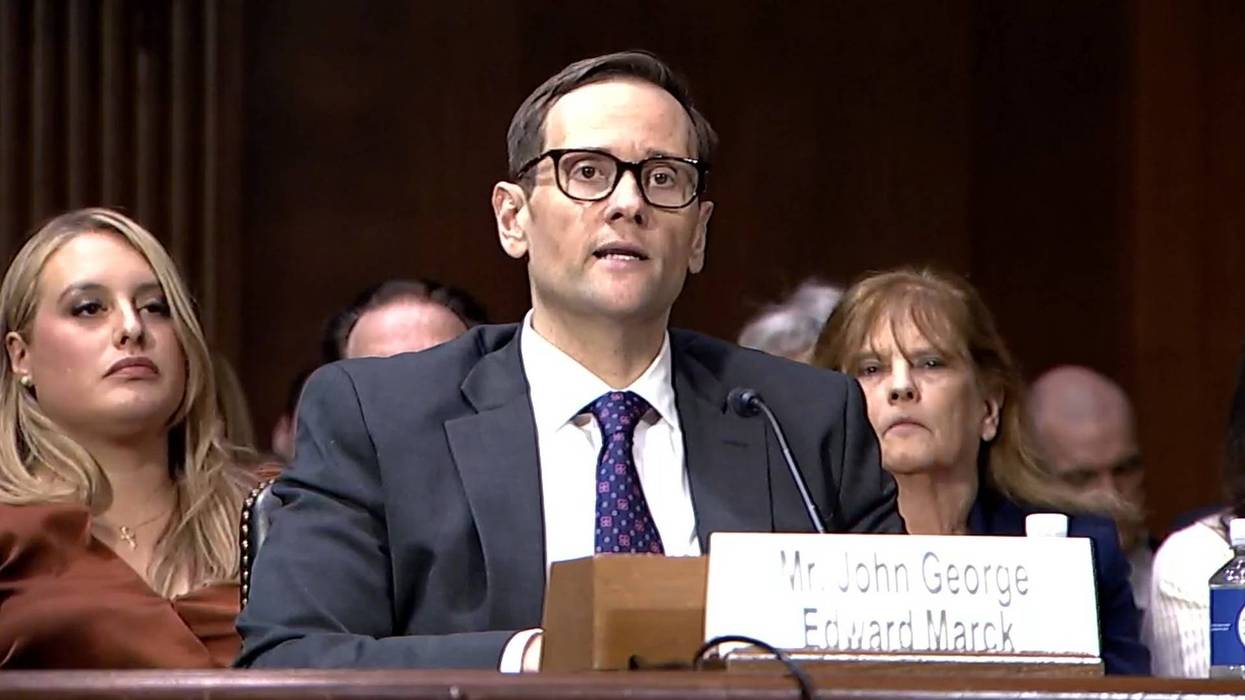
Political observers are expressing alarm after several of President Donald Trump's lifetime judicial nominees refused to say whether he is eligible to run for a third term.
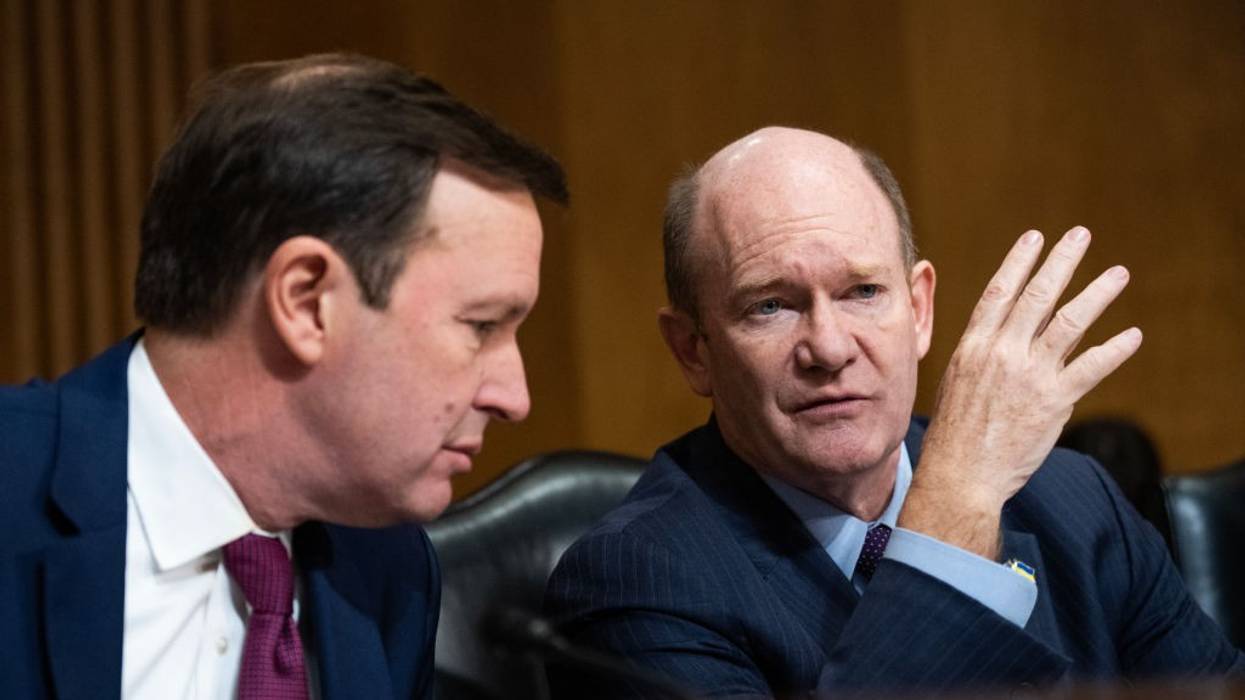
During a Senate Judiciary Committee hearing on Thursday, Sen. Chris Coons (D-Del.) asked Trump judicial nominee John Marck to describe the 22nd Amendment of the US Constitution, which states that "no person shall be elected to the office of the president more than twice."
"The 22nd Amendment... senator, my career has mostly been in criminal prosecution, I haven't had an opportunity to use that one, specifically," Marck replied.
JUST IN: A Trump judicial nominee was asked point blank: is Trump eligible to run for a third term?
Their answer: “I would have to review the actual wording…”
Sen. Chris Coons then asked every nominee in the room to confirm the Constitution bars a third term.
Silence.
Every… pic.twitter.com/LzUZxFzaOL
— Brian Allen (@allenanalysis) May 4, 2026
"Anyone able to help on the 22nd Amendment?" Coons asked the other judicial nominees at the hearing, one of whom explained that it was the amendment that sets a two-term limit for the presidency.
"Correct," Coons replied. "It states that no person shall be elected to the office of the president more than twice. Mr. Marck, is President Trump eligible to run again for president in 2028?"
"Senator, without considering all the facts and looking at everything, depending on what the situation is, this, to me, strikes as something more of a hypothetical..."
"It's not a hypothetical," Coons interjected. "Has President Trump been elected president twice?"
"President Trump has been certified as president of the United States two times," Marck acknowledged.
"Is he eligible to run for a third term under our Constitution?" Coons asked.
"Uhm, I would have to review the..." Marck began before Coons again interjected.
"All I need to tell you is the language of the constitutional amendment that makes it clear that no, he is not eligible for a third term," the senator said.
Coons then challenged other Trump judicial nominees at the hearing—Southern District of Florida nominee Jeffrey Kuntz, Southern District of Texas nominee Arthur Roberts Jones, and Northern District of Ohio nominee Michael Hendershot—to say if they believed the Constitution barred Trump from running for a third term, and none of them did.
After watching video of Coons' exchange with Trump judicial nominees, investigative journalist and author Nick Bryant declared the whole episode to be "really chilling."
"Like a scene from a dystopian movie, and alarming for anyone who cares about democracy," Bryant wrote in a Monday social media post. "A judicial nominee flagrantly flouting the Constitution about Trump's eligibility for a third term. The Constitution is unambiguous. He is not eligible."
Former Democratic presidential candidate Marianne Williamson noted that the Trump nominees were "not even pretending to honor the Constitution" during the hearing, while former Rep. Adam Kinzinger (R-Ill.) simply declared the entire exchange "unreal."
While the chances of Trump being allowed to stand for an unconstitutional third term at the moment are very low, the president has repeatedly teased plans to run for president again in 2028, telling an audience on Monday that he would be leaving the White House "eight or nine years from now."
Joyce Vance, a former federal prosecutor and current professor at the University of Alabama School of Law, said that Trump's declared intention to run for a third term should not be brushed off as mere trolling.
"This is how he started with the whole 'if I lose the election is fraudulent' shtick," she wrote. "If we don’t listen to this, shame on us. That man isn’t building a ballroom for the next guy."
"The U.S. Attorney General should be the American people's lawyer—not a corporate lobbyist with a closet full of conflicted clients," said the head of the watchdog Accountable.US.
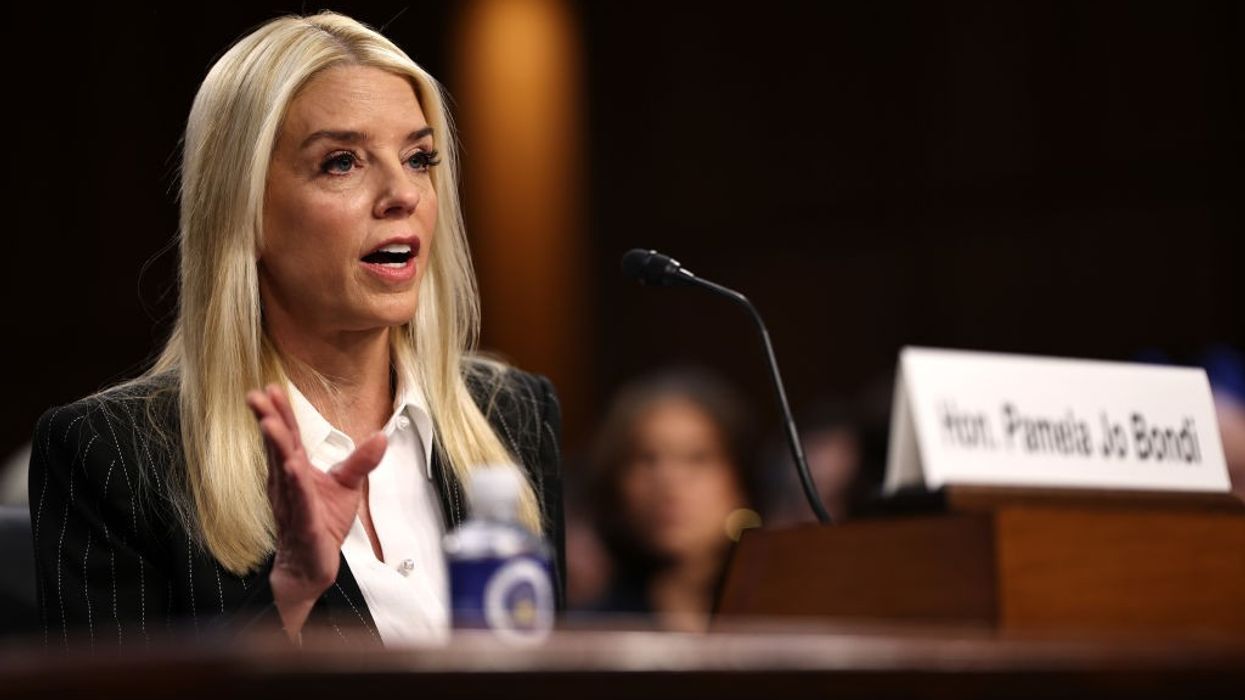
As President-elect Donald Trump's attorney general pick Pam Bondi faced Senate questioning on Wednesday, progressive critics opposed to her nomination cited her record as a lobbyist, her role in amplifying Trump's claims of election fraud in 2020, and her history of catering to corporate interests to argue she is unfit to lead the U.S. Justice Department.
Bondi, for her part, told senators in the first of two scheduled hearings that her Justice Department would not be used to target people based on their politics—though she stopped short of saying that the agency would not investigate foes of Trump. She also spent much of her confirmation answering questions about Kash Patel, Trump's controversial pick for FBI director whom she repeatedly defended, according to Politico.
Jon Golinger, democracy advocate for the watchdog group Public Citizen, was among Bondi's detractors who argued Wednesday that she is deeply unqualified to be the nation's top law enforcement officer.
"The U.S. Attorney General should be the American people's lawyer—not a corporate lobbyist with a closet full of conflicted clients, many of whom seek government contracts or are being investigated by the very Justice Department Bondi now seeks to lead," Golinger said in a statement.
After eight years as Florida's attorney general, Pam Bondi left that post in 2019 and joined Ballard Partners, a corporate lobbying firm that has also employed Trump's pick for White House chief of staff, Susie Wiles. At Ballard Partners, Bondi worked on behalf of numerous corporate clients, including the private prison firm the Geo Group, Uber, and Amazon.
Bondi also served as a lawyer for Trump during his first impeachment trial and pushed Trump's claims of election fraud in 2020.
Tony Carrk, the executive director of the watchdog Accountable.US, went after Bondi's time as Florida Attorney General, writing that she "frequently played favorites with big corporate donors and political insiders at the expense of everyday consumers, patients, and the public good" while she held that office and that "nothing indicates Bondi would change her office-peddling modus operandi as America's top justice official."
Public Citizen co-president Lisa Gilbert, who will testify as an outside witness Thursday at day two of Bondi's hearing, said Wednesday that Bondi's record could lead to a politicization of the agency and called her "unsuitable" for the role given her ties to powerful corporations.
Meanwhile, the civil rights coalition the Leadership Conference on Civil and Human Rights, joined the pile on in a statement submitted Wednesday to the Senate Judiciary Committee. "Ms. Bondi lacks the commitment to defending the core tenets of our democracy and the civil and human rights of all people. Indeed, her active participation in and support of Trump's efforts to overturn the 2020 election ought to be disqualifying in itself," the group wrote.
But Bondi—who "acquitted herself coolly," according to press account—appears on track for likely confirmation.
Raising the specter of the pressure Trump has placed on his Department of Justice in the past, Sen. Chris Coons (D-Del.) asked, "let's imagine Trump issues a directive or order to you or to the FBI director that is outside the boundaries of ethics or law. What will you do?"
"I will never speak on a hypothetical, especially one saying that the president would do something illegal. What I can tell you is my duty, if confirmed as the Attorney General, will be to the Constitution and the United States," said Bondi.
Bondi would not answer directly when asked whether Trump lost the election in 2020 and also would not denounce some of the former president's extreme stances, like calling those arrested for participating in the January 6 insurrection "hostages" or "patriots."
"Over the last year, for every single political prisoner Egypt has released, it has jailed two more," lamented U.S. Sen. Chris Murphy.
Several Democratic U.S. senators on Thursday denounced the Biden administration's decision to send $1.3 billion in military aid to Egypt despite enduring human rights abuses by the Middle Eastern country's authoritarian regime.
U.S. State Antony Blinken this week waived human rights conditions attached to $225 million of the aid package, citing Egypt's strategic importance and the country's role in attempts to broker a cease-fire agreement that would halt the assault on Gaza by Israel, which is on trial for genocide at the International Court of Justice.
"It's no secret that Egypt remains a deeply repressive autocratic state."
"This decision waives requirements on an additional $225 million of military aid to Egypt that is tied to broader improvements on democracy and human rights," Sen. Chris Murphy (D-Ct.) said in a statement on Thursday.
"It's no secret that Egypt remains a deeply repressive autocratic state, and I see no good reason to ignore that fact by waiving these requirements," the senator added. "We have previously withheld this portion of Egypt's military aid package, while still maintaining our strategic relationship, and we should continue to do so."
On Wednesday, Murphy and Sen. Chris Coons (D-Del.) issued a joint statement decrying Biden's decision to fully fund Egypt, focusing on a separate $95 million share of aid released by the administration.
"The law is clear: Egypt is required to make 'clear and consistent progress' in releasing political prisoners in order to receive $95 million—a small portion—of its $1.3 billion military aid package this year," the senators wrote. "The Egyptian government has failed that test."
"Over the last year, for every single political prisoner Egypt has released, it has jailed two more," Murphy and Coons noted. "That's not clear and consistent progress—it's one step forward and two steps back. And among the thousands and thousands of political prisoners the government has continued to refuse to release are two U.S. legal permanent residents, Hosam Khalaf and Salah Soltan."
Last week, Murphy and Coons were among the nine Democratic senators and Sen. Bernie Sanders (I-Vt.) who urged Blinken to "enforce the conditions set forth by Congress on holding Egypt accountable for progress on human rights" by withholding aid "until Egypt's human rights record improves."
According to the most recent State Department annual country report, "there were no significant changes in the human rights situation in Egypt" between 2022-23.
The report cited violations including:
Credible reports of arbitrary or unlawful killings, including extrajudicial killings; enforced disappearance; torture or cruel, inhuman, or degrading treatment or punishment by the government; harsh and life-threatening prison conditions; arbitrary arrest and detention; serious problems with the independence of the judiciary; political prisoners or detainees; transnational repression against individuals in another country; arbitrary or unlawful interference with privacy; punishment of family members for alleged offenses by a relative.
"Egypt has failed to make consistent progress, yet the State Department has decided to release additional military aid," Sen. Peter Welch (D-Vt.) said on Thursday. "The administration should use the leverage Congress provided to defend the fundamental rights of Egyptian political prisoners and dissidents. That's what the Egyptian people, and people everywhere, rightly expect of the United States."
Sen. Tim Kaine warned that the status quo in Israel's war on Gaza "is not working."
U.S. Sen. Tim Kaine on Friday became the latest centrist Democrat to display a shift in tone regarding the Biden administration's continued support for Israel—and despite months of intensifying demands from progressive lawmakers and the international community for President Joe Biden to push for a change in policy from Israel, the newly minted critics have appeared to have more success.
The Virginia Democrat, who serves on both the Senate Foreign Relations and Armed Services committees, cited the killing of seven World Central Kitchen aid workers this week in a lengthy statement in which he said Israel's "current approach is not working" and pushed back against the White House's opposition to an independent investigation into the attack.
"The United States should join in the call for an independent and international investigation into Monday's strike on World Central Kitchen volunteers, in which an American was killed," said Kaine. The senator also renewed his call for the administration to "prioritize the transfer of defensive weapons in all arms sales to Israel while withholding bombs and other offensive weapons that can kill and wound civilians and humanitarian aid workers."
Kaine's comments came a day after Sen. Chris Coons (D-Del.)—said to be Biden's closest ally in the Senate—told CNN that the U.S. is approaching a point at which it must consider placing conditions on military aid to the Israel Defense Forces (IDF).
"If [Israeli Prime Minister] Benjamin Netanyahu were to order the IDF into Rafah at scale... and make no provision for civilians or for humanitarian aid, I would vote to condition aid to Israel," Coons said, referring to the southern Gaza city where Israel has threatened to start a ground offensive and where 1.5 million displaced Palestinians are staying in shelters and makeshift tents. "I've never said that before, I've never been here before."
Late Thursday, Biden for the first time warned Netanyahu that the U.S. could condition military aid—of which the White House has provided billions of dollars in weapons since October in addition to nearly $4 billion annually—based on whether humanitarian aid is reaching Gazans, who have been starved by Israel's near-total blockade.
As Common Dreams reported, Israeli officials approved the reopening of the Erez crossing between Israel and northern Gaza soon after the call.
Also this week, former George W. Bush administration official Richard Haass told MSNBC that Biden's previous warnings to Netanyahu about ensuring civilians are protected from strikes sound "empty" and demanded to know why the White House hasn't responded to Israel's push for settlement expansion in the West Bank as he questioned the level of aid the administration has provided.
"Why does Israel need 2,000-pound bombs to be used in high-density populated areas?" Haass asked, echoing progressive outrage over the administration's repeated weapons transfers even as the death toll in Gaza has surged past 33,000.
"It may seem wrong that, after more than 30,000 Palestinians in Gaza have perished, it took the deaths of just seven international aid workers to stir Western governments into a sense of outrage, but that is the reality," read the opening lines of The Independent's leading editorial on Thursday.
"The least that can be asked is that Israel, as a member of the United Nations, complies with the resolutions of the Security Council and the instructions of the International Court of Justice," wrote the paper's editorial board. "That means no more massacres of innocent civilians or aid workers; a cease-fire now; no ground or aerial assault on Rafah; and full assistance afforded to the shipments of humanitarian aid."
White Europeans now being killed, wounded, or rendered homeless by Russian troops are victims worthy of media attention, while Sudanese facing similar fates aren’t.
It’s been devastating, even if no one’s paying attention.
Three months of fighting in Sudan between the army and a paramilitary group called the Rapid Support Force (RSF) has left at least 3,000 people dead and wounded at least 6,000 more. Over 2 million people have been displaced within the country, while another 700,000 have fled to neighboring nations. According to the World Health Organization, two-thirds of the health facilities in Khartoum, the capital, and other combat zones are now out of service, so the numbers of dead and injured are believed to be far higher than recorded, and bodies have been rotting for days in the streets of the capital, as well as in the towns and villages of the Darfur region.
Almost all foreign nationals, including diplomats and embassy staff, are long gone and so, according to Al Jazeera, hundreds or thousands of Sudanese who had visa applications pending have instead found themselves marooned in the crossfire with their passports locked away inside now-abandoned embassies. In the Darfur region, according to non-Arab tribal leaders, the RSF and local Arab militias have been carrying out mass killings, raping women and girls, and looting and burning homes and hospitals. Earlier this month, United Nations humanitarian chief Martin Griffiths told The Associated Press, “If I were Sudanese, I’d find it hard to imagine that this isn’t a civil war… of the most brutal kind.”
We’ve had to do a lot of searching to find significant information in the U.S. major media about the struggle in Sudan, no less the plight of its refugees.
According to the United Nations, half the country’s population, a record 25 million people, is now in need of humanitarian aid. And worse yet, half of those are children, many of whom were in dire need even before this war broke out. Tragically, global warming will only compound their misery. Among 185 nations ranked by the Notre Dame Global Adaptation Initiative, Sudan is considered the sixth most susceptible to harm from climate change.
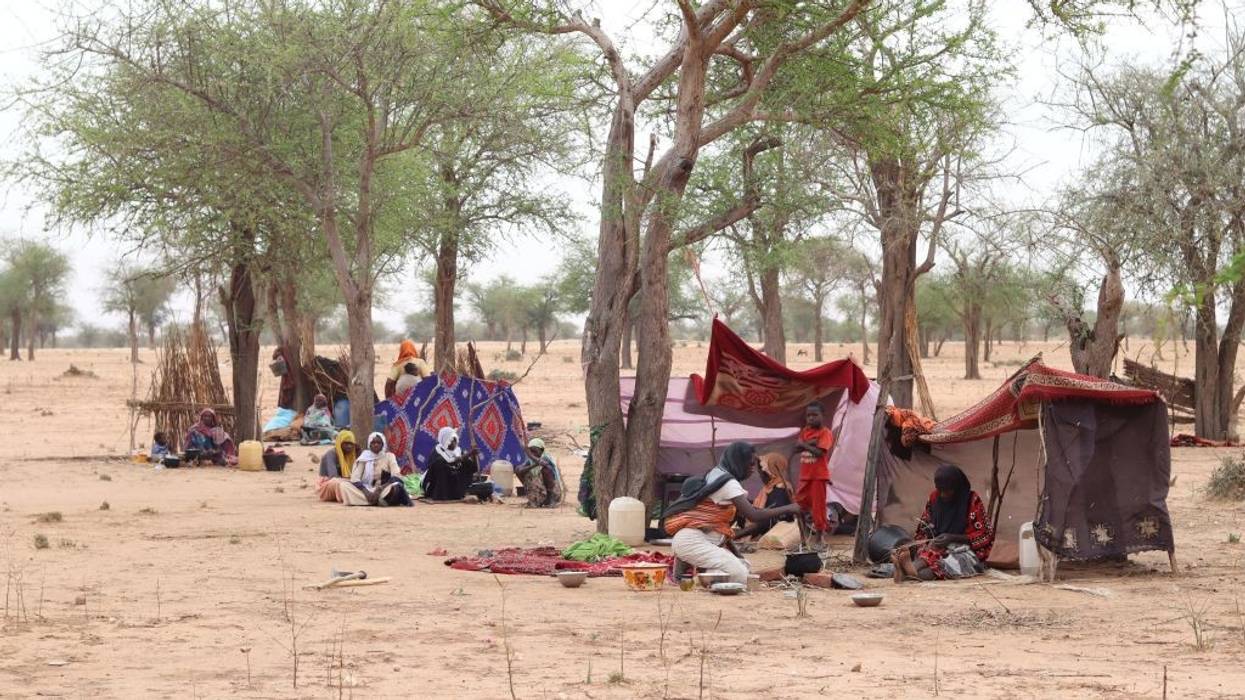
Heat waves, drought, and flooding are projected to become ever more frequent and intense as the atmosphere above Sudan warms further. This summer war and weather have been converging in strikingly deadly ways. With cloudless skies, water and electricity services largely knocked out, and daily temperature highs in the capital recently ranging from 109° to 111°F, the misery is only intensifying. Meanwhile, in the Darfur region and across the border in eastern Chad, the season of torrential rains is about to begin. The country director for Concern Worldwide in Chad says that many of the quarter-million Sudanese refugees there “are living in makeshift tents made from sticks and any material they can find, which means they are not protected from the heavy rains. The situation is catastrophic.”
Among the refugees from this war are some of our own relatives and in-laws, part of an extended Indian-Sudanese family who have lived in Khartoum all their lives. In May, they fled the escalating violence, some via a perilous, hair-raising 500-mile road trip across the Nubian Desert to Port Sudan. There, they caught a ship across the Red Sea to Jeddah, Saudi Arabia. Their goal, as they informed us in June through voice messages, was Egypt—so far, the most common destination for Sudanese refugees over the past three months. And mind you, desperate as they may be, our relatives are in a far less perilous situation than people fleeing the Darfur region for Chad. Still, they are leaving behind a life built up over decades, without knowing if they will ever be able to return to Khartoum.
And here—for us—is a disturbing reality. We’ve had to do a lot of searching to find significant information in the U.S. major media about the struggle in Sudan, no less the plight of its refugees—though recently there were finally substantive reports at NPR and in The Washington Post. Still, the contrast with 16 months of breathless, daily, top-of-the-hour reporting on the Ukraine war and the millions of people it’s displaced has been striking indeed.
There’s a major difference as well between Washington’s responses to each of those wars. Before the fighting broke out in Sudan, the country had about 30% fewer people living in need of humanitarian assistance than Ukraine. Now, it has almost 50% more than Ukraine. Given those relative needs, U.S. humanitarian aid to Sudan in Fiscal Year 2023 ($536 million) was not all that skimpy compared with the humanitarian aid going to Ukraine ($605 million)—not, at least, until you add in the $49 billion in military aid Washington has been sending to Kyiv—80 times the civilian aid, to which has only recently been added fundamentally anti-humanitarian cluster bombs. In the past year, in other words, Ukraine got 13% more humanitarian aid than Sudan but 93 times more total aid when you count war assistance.
And the U.S. is not alone. The entire world is lagging badly in its response to the humanitarian tragedy in Sudan. William Carter of the Norwegian Refugee Council recently lamented, “I haven’t seen it treated with urgency. It’s not ignorance; it’s a case of apathy.” Admittedly, conditions in Sudan and Chad make aid delivery difficult now, but Western powers, Carter pointed out, are simply “not willing to stick their necks out.”
Washington has assisted Ukraine massively since the war there began. In contrast, its actions in the months leading up to Sudan’s current conflict were not only ineffective but may even have made war more likely.
Some background: Four years ago, a popular uprising overthrew the country’s longtime autocratic president, Omar al-Bashir. A Sovereignty Council was formed to negotiate a transition to democracy. Susan Page, who served as the first U.S. ambassador to the Republic of South Sudan, has written that the council’s designation as a “civilian-led transitional government” was “always a bit of a fig leaf,” given that its membership included more military officials than civilians. The transition was even led by military officials, including the two men who command the forces now locked in battle, Sudanese army chief General Abdel-Fattah Burhan and General Mohamed Hamdan, who leads the RSF paramilitary group.
After two years of obstructing the work of the Sovereignty Council, that odd duo joined forces in an October 2021 coup and took control of Sudan. The negotiations over a democratic transition, mediated by the United States, Great Britain, the United Arab Emirates, and Saudi Arabia nonetheless went on for another 18 months, while those generals continued to stonewall. According to Democratic Senator Chris Coons of Delaware, the generals even stooped to outright extortion, hinting that if they didn’t get full backing from the West, they’d create a fresh migration crisis in Europe by kicking out hundreds of thousands of their fellow Sudanese and sending them northward. Still, last February, with military-civilian negotiations bogged down, Coons remained hopeful, writing,
“The Sudanese people… are not backing down in the defense of their political gains. Even in the face of persistent killings, sexual violence, and arrests by the regime, a massive, nationwide pro-democracy movement has for months maintained nonviolent street protests. The determination these thousands of people have shown as they risk their lives against heavily armed security forces should serve as a reminder the world over of how precious democracy truly is.”
Coons urged the Biden administration to throw its weight behind the pro-democracy movement, with sanctions that would hit the military leaders hard while sparing civil society: “A modern, comprehensive set of sanctions on the coup leaders and their networks,” he wrote, “will disrupt the military’s revenue streams and their grip on power, creating an opening for the nation’s nascent democracy movement to grow.” As is now painfully obvious, Biden didn’t take Coons’s advice and, six weeks later, the shooting started.
In an article published soon after the outbreak of fighting, Edward Wong and three colleagues at The New York Times reported that some of the people who played a part in the negotiations told them “the Biden administration, rather than empowering civilian leaders, prioritized working with the two rival generals,” even after they’d seized power in that coup. A high-level government adviser assured the Times that senior American diplomats “made the mistake of coddling the generals, accepting their irrational demands, and treating them as natural political actors. This fed their lust for power and their illusion of legitimacy.”
The broad lack of concern for the Sudanese people in the U.S. and other rich countries also contrasts sharply with the intense geopolitical interest in Sudan of certain regional powers. Mohammad Salami of the International Institute for Global Strategic Analysis observes that Washington’s Persian Gulf allies have big plans for Sudan, thanks to its strategically important Red Sea coastline, its wealth in mineral resources, and its potential for tourism and agricultural production. (We can’t help wondering if they’re taking into account the degree to which its farming may, in the future, be clobbered by climate change.) Looking ahead, Salami writes, “The United Arab Emirates and Saudi Arabia have long-term plans for Africa, and for Sudan as their gateway to it.”
Until the recent chaos began, Sudan had also been a gateway for refugees from Asia, the Middle East, and other parts of Africa. Writing less than three weeks into the Sudan conflict, MSNBC columnist Nayyera Haq observed that many of the people then fleeing the country were, in fact, repeat refugees, having fled previous conflicts in Syria, Yemen, and Myanmar, among other places. As Western diplomats and embassy staff across Khartoum rushed for the exits (echoes of Kabul and Kandahar two summers ago!), Haq concluded,
“Sudan, once considered a far-off nation, is now a critical puzzle piece in this era of great power competition among global economies. As boundaries continue to blur because of technology and climate change, forced migration is more common: Millions flee north from Latin America to the U.S., from Syria to Europe, and now across East Africa. But the same countries eager to extract oil and minerals from Africa are quick to shut down, only watching out for their own as Sudan devolves into chaos.”
Sudan is indeed rich in mineral resources that span the alphabet: aluminum, chromium, cobalt, iron, manganese, nickel, rare earths, silver, and zinc. All of those are important to the world’s renewable energy and battery industries. But Sudan’s biggest source of wealth lies in its gold deposits. The gold-mining industry is largely owned by a Russian-Sudanese joint venture headquartered in the northeast of the country. The wealth it’s generated hasn’t benefited the Sudanese people. Before the recent chaos, in fact, it was being split by the military regime, the Russian government, and none other than the infamous warlord Yevgeny Prigozhin’s Wagner Group, which had been managing the joint venture’s gold-mining and processing operations since 2017. And Wagner being Wagner, they also have now taken sides in Sudan’s war, according to the U.S. Treasury Department, by providing surface-to-air missiles to the RSF paramilitary forces.
The paucity of attention paid to civilian victims of the conflict in Sudan compared to Ukrainian civilians brings to mind the contrast between “worthy” and “unworthy” victims drawn by Edward Herman and Noam Chomsky in their 1988 book Manufacturing Consent. They contrasted the extensive mass-media coverage of the 1984 murder of a Polish priest, Jerzy Popieluszko, during the Cold War with the lack of the same when it came to more than two dozen priests and other religious people slaughtered by governments and death squads in El Salvador and Guatemala in those years., Having been murdered by agents of a Communist government. Popieluszko was regarded as worthy of attention in the American media of the time, while his counterparts slaughtered by Central American governments allied with the U.S. weren’t. In a similar fashion, white Europeans now being killed, wounded, or rendered homeless by Russian troops are victims worthy of media attention, while Sudanese facing similar fates aren’t.
To be fair, a previous horrific conflict that gripped Sudan’s Darfur region from 2003 to 2008 did receive significant coverage in the Western media thanks to a convergence of unusual circumstances. The chief among them: the massive attention it received from celebrities of the time, including Angelina Jolie, George Clooney, Lady Gaga, and Mia Farrow. Sudan’s media appeal of 15 years ago was, however, an exception to the rules of this world of ours. Today, such celebrities and the media seem to be gripped by a kind of compassion fatigue.
Of course, like most Americans, we were paying no attention whatsoever to developments in Sudan before the fighting started—and before we learned that our own kinfolk were in danger. Now, what choice do we have but to keep up with the latest developments?
For weeks, our relatives were in limbo, trying to reach Egypt. Some were already in Jeddah, Saudi Arabia, but stuck there. Others had made it to Addis Ababa, Ethiopia. We were by then in touch and they acknowledged that they were “better off than most,” meaning they weren’t being pinned down in a deadly 110°F war zone without passports, electricity, or running water, nor were they, like so many Sudanese, trapped in squalid refugee camps.
Only the other day, we finally learned that they had arrived safely in Egypt. Back in Khartoum they’d operated a small school, and they’re now hoping, if they can work their way through Cairo’s bureaucracy, that, as one of them put it, “Next year, Inshallah, we can start our school here, if we are still here and still war-driven.” Their futures have indeed been driven by war into a hard-to-imagine future. As one put it, “Nothing seems to be settling down in Sudan anytime soon.”
Sadly, their assessment seems all too accurate. Since April, at least 10 ceasefires between the army and that paramilitary outfit have broken down more or less instantly. In mid-July, leaders of the six countries bordering Sudan met, in the impressive-sounding words of Egyptian President Abdel Fattah el-Sissi, to formulate “an executive action plan to reach a comprehensive solution to the Sudanese crisis.”
Not so surprisingly, though, no such plan has yet emerged. Given its resources and its geographical centrality, an assortment of richer, stronger countries all want a piece of Sudan, but none of those plans include the war’s victims. To make matters worse, in this war (as in others to come), climate disruption will be a “threat multiplier.” Worse yet, as long as our media fails to see the Sudanese conflict or, more importantly, the Sudanese people as worthy of extensive reporting, the realities of the ongoing war there will continue to lie somewhere beyond the horizon.
As President Joe Biden aims to assure the world that the United States will fulfill its promise to slash its greenhouse gas emissions in half from 2005 levels by the end of the decade, a new report published Friday reveals that the members of the U.S. Senate who would have to pass climate legislation are heavily invested in the fossil fuel industry.
Sludge reports the households of at least 28 U.S. senators--in both the Democratic and Republican caucuses--hold a combined minimum of $3.7 million and as much as $12.6 million in fossil fuel investments.
According to the report:
Of the 28 senators, at least 20 hold publicly traded stocks in companies like oil supermajor Chevron, pipeline giant Enterprise Products, or electric utility NextEra that belong to trade associations that are lobbying Congress against taking up strong legislation to curb polluting emissions.
Five senators are invested in energy funds built around oil and gas assets, and three own nonpublic stock in private fossil fuel companies. The investments, held by the senators, their spouse, jointly, or a dependent, are disclosed to the Senate Office of Public Records in very broad ranges and often buried in hundreds of pages of scanned paper forms, making a more precise count of their total value impossible.
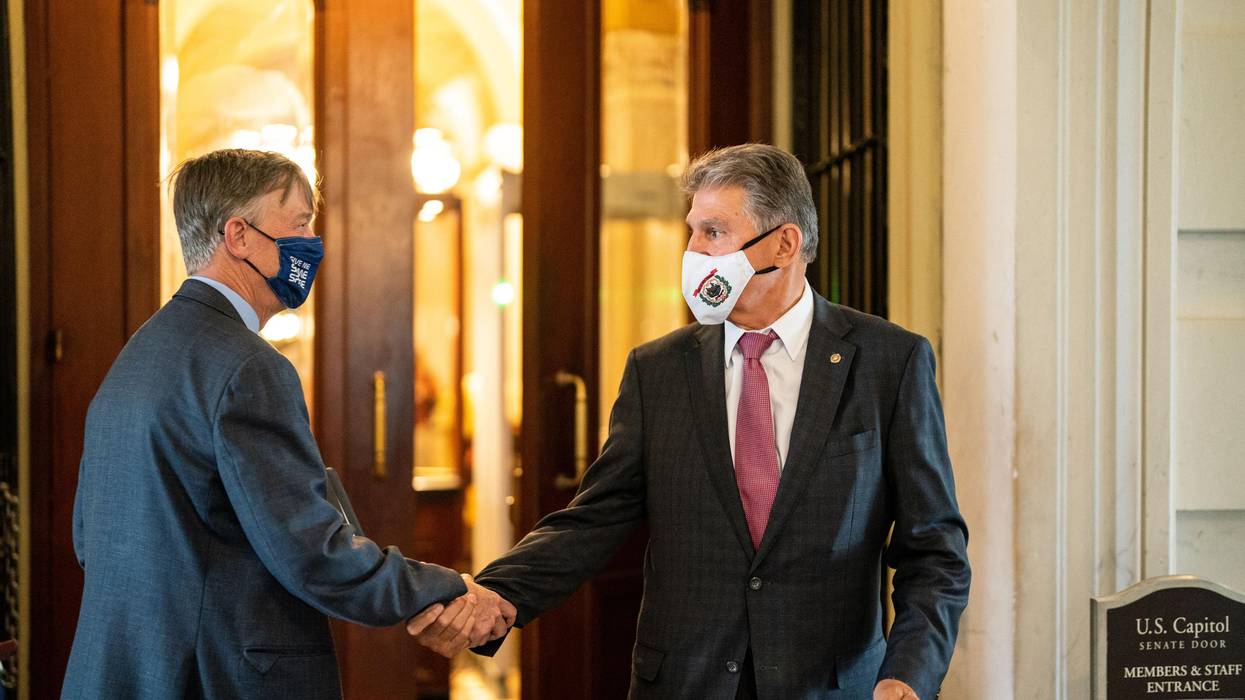
At least half a dozen of the senators sit on environment- or climate-related committees. The household of Senate Energy and Natural Resources Committee Chair Joe Manchin (D-W.Va.)--who has worked incessantly to destroy or dilute climate action in the Build Back Better Act and beyond--has received over $1 million in income from Enersystems, a coal brokerage firm the senator founded in the 1980s.
According to Sludge, Manchin "has stripped the Democrats' budget reconciliation bill of major climate programs that would have transitioned coal-fired plants like the one where the company, now run by his son, holds a prime fuel services contract," while the committee he chairs "also added more than $11.3 billion in funding to the bipartisan infrastructure bill that could benefit his family company's niche waste coal industry."
Other Democratic senators whose households are heavily invested in fossil fuels include:
Earlier this year, Common Dreams reported that six Democratic senators--Manchin, Chris Coons (Del.), Maggie Hassan (N.H.), Mark Kelly (Ariz.), Kyrsten Sinema (Ariz.), and Jon Tester (Mont.)--have received hundreds of thousands of dollars in combined campaign contributions from fossil fuel corporations, some of which have touted their purported support for climate action, over the past decade.
Underscoring the yawning chasm between progressives' demands for a $3.5 trillion Build Back Better package and right-wing Democrats' refusal to accept such spending, U.S. Sens. Joe Manchin and Bernie Sanders wrangled over the bill's price tag behind closed Senate doors Wednesday, according to colleagues present during the fracas.
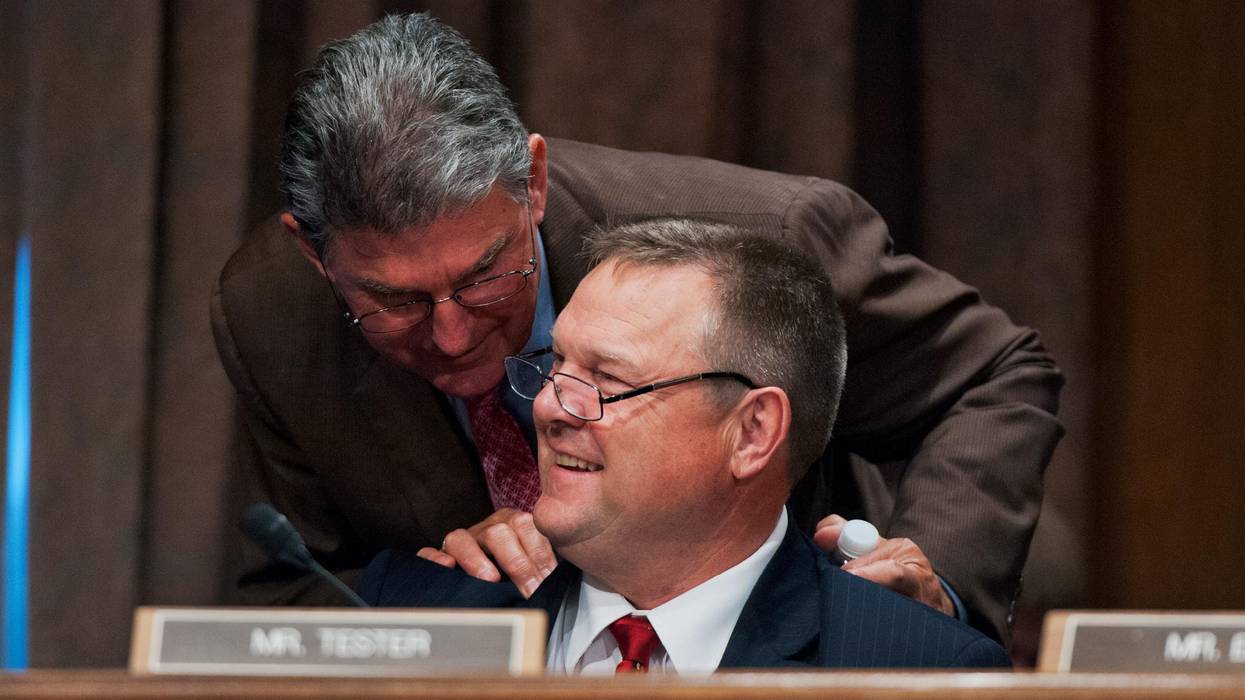
According to Axios, Sen. Jon Tester (D-Mont.), who witnessed the exchange, recounted that "Joe said, 'I'm comfortable with nothing,'" while "Bernie said, 'We need to do three-and-a-half [trillion dollars].'"
"The truth is both of them are in different spots," said Tester.
Sen. Chris Coons (D-Del.), who was also in the room, said Manchin argued, "We shouldn't do it at all," and that the $3.5 trillion proposal "will contribute to inflation."
"We've already passed the American Rescue Plan. We should just pass the infrastructure bill and, you know, pause for six months," Manchin reportedly argued, referring to the $1.2 trillion bipartisan legislation passed by the Senate in August before being indefinitely delayed by House progressives who insist upon first passing the reconciliation package.
Last month, Manchin admitted that it had been his plan all along to secure passage of the corporate-backed bipartisan infrastructure bill and then scupper the more ambitious $3.5 trillion package.
Coons claimed that "significant progress" was made in the meeting, despite the tension between Manchin and Sanders. The two senators have tussled in recent weeks, with Sanders calling Manchin's obstruction "absolutely not acceptable" and the West Virginian lashing out after the democratic socialist published an op-ed in a Charleston paper criticizing his intransigence.
While Coons and Tester both said they remain hopeful that Democrats will agree upon a top-line figure for the reconciliation package by the end of Thursday, Manchin threw cold water on the notion, warning that "this is not gonna happen any time soon."
On Thursday, West Virginia activists traveled to Manchin's houseboat in Washington, D.C., where they urged him not to sink his party's agenda while asking, "Who will you throw overboard?"
A pair of reports published Tuesday in the wake of a damning expose featuring secretly recorded ExxonMobil lobbyists further illuminated the fossil fuel giant's efforts to influence powerful centrists in Congress and beyond.
The New Republic's Kate Aronoff revealed that "centrist think tanks are raking in Exxon cash," citing a company report, while HuffPost's Alexander Kaufman reviewed an analysis by the advocacy group Oil Change U.S. of campaign contributions to six Democratic U.S. senators named in Unearthed's June expose.
The videos from Unearthed, Greenpeace U.K.'s investigative journalism arm, feature one current and one former ExxonMobil employee, Keith McCoy and Dan Easley, who thought they were discussing the company's lobbying efforts with a recruitment consultant.
While ExxonMobil chairman and CEO Darren Woods claimed that McCoy and Easley made "disturbing and inaccurate comments about our positions on a variety of issues, including climate change policy, and our interaction with elected officials," the reporting has increased scrutiny of the company's lobbying and finances over the past two weeks.
The Oil Change U.S. analysis focuses on campaign disclosures of six Democratic lawmakers McCoy mentioned: Sens. Chris Coons (Del.), Maggie Hassan (N.H.), Mark Kelly (Ariz.), Joe Manchin (W.Va.), Kyrsten Sinema (Ariz.), and Jon Tester (Mont.).
Asked on a May video call which lawmakers ExxonMobil targets, McCoy first named Sen. Shelley Moore Capito (R-W.Va.), ranking member of the Senate Committee on Environment and Public Works. He continued:
Joe Manchin, I talk to his office every week. He is the kingmaker on this because he's a Democrat from West Virginia, which is [a] very conservative state... and he's not shy about sort of staking his claim early and completely changing the debate. On the Democrat side we look for the moderates on these issues. So, it's the Manchins. It's the Sinemas. It's the Testers.
...Sen. Coons... has a very close relationship with [President Joe] Biden, so we've been working with his office--as a matter of fact our CEO is talking to him next Tuesday and having those conversations and just teeing it up, and then that way I can start working with his staff to let them know where we are on some of these issues.
The other Republicans McCoy named were Sens. John Barrasso (Wyo.), John Cornyn (Texas), Steve Daines (Mont.), and Marco Rubio (R-Fla.). He noted that it is easier to have conversations with senators who are up for reelection in 2022--such as Rubio, Kelly, and Hassan--"because they're a captive audience, they know they need you and I need them."
Collin Rees, the senior campaigner at Oil Change U.S. who conducted the new analysis, found that over the past decade, the six Democrats collectively received nearly $333,000 from lobbyists, political action committees (PACs), and lobbying firms affiliated with ExxonMobil.
"This is a story about how lobbyists curry favor, and specifically about how Exxon's current lobbyists have spent decades currying the favor of these six Democrats to position themselves to do things like safeguard fossil fuel subsidies and pare down infrastructure packages," Rees told Kaufman. "Exxon has hired these firms and lobbyists because they've contributed hundreds of thousands of dollars to these Democrats, both before and after they were hired by Exxon."
Tester--whose office didn't comment on the story--led the group with $99,783, followed by Sinema ($70,800), Coons ($68,650), Manchin ($64,864), Hassan ($26,699), and Kelly ($1,500).
Kelly, a newcomer to the Senate, doesn't accept corporate PAC money--which his spokesperson highlighted Tuesday, telling HuffPost that he "has not met with the individual in the original Exxon video, and hasn't spoken with anyone from this company in the Senate."
Hassan's spokesperson said "the video only says that Sen. Hassan is up for reelection... it isn't for her support of their policies but simply because she is up for reelection," while spokespeople for Sinema and Coons told Kaufman that the analysis' totals are "inaccurate" and "incredibly misleading."
"To the Exxon 11--here's your chance to show that you stand with the people who elected you, not Big Oil."
--Janet Redman, Greenpeace USA
An ExxonMobil spokesperson said the company "complies with all federal and state regulations and lobbying laws," and has "a responsibility to our customers, employees, communities, and shareholders to represent their interests in public policy discussions that impact our business."
Echoing Woods' statement earlier this month in response to the expose, the spokesperson added that McCoy's recorded remarks "do not represent the company's position on a variety of issues, including comments regarding interactions with elected officials."
Janet Redman, Greenpeace USA Climate Campaign director, said Tuesday in a statement responding to the analysis that the six Democratic senators "can say they aren't influenced by Big Oil, but those are empty words until they prove it."
"To gain back the public trust, the Exxon 11--and especially the six Democrats who accepted money from Exxon--must commit to no more meetings with fossil fuel companies while they craft the infrastructure and reconciliation bills," Redman continued.
"They must also stop taking $15 billion out of the pockets of hard working Americans and giving it to fossil fuel companies in the form of subsidies," she added. "To the Exxon 11--here's your chance to show that you stand with the people who elected you, not Big Oil."
Meanwhile, The New Republic report began by highlighting that Brookings Institution executive vice president Darrell M. West criticized Unearthed's expose in a blog post. As Aronoff wrote:
West didn't mention that Brookings received $100,000 from ExxonMobil last year, according to the oil company's own disclosures. He also didn't mention that, in parts of the transcript Unearthed did not publish but which they subsequently provided to The New Republic, Brookings is mentioned explicitly by McCoy as one of two think tanks his company is "actively involved in."
Pointing to previous reviews by researcher Connor Gibson, Aronoff noted that Brookings got $250,000 from ExxonMobil in 2019, $250,000 in 2018, $240,000 in 2017, and $380,000 in 2016.
A Brookings spokesperson pointed to the institution's research independence guidelines and said that "Exxon has made no direct contributions to support specific scholars or specific research projects, and its funding is not directed toward Brookings's carbon tax or climate change related research."
The other think tank McCoy mentioned is the Center for Strategic and International Studies (CSIS), which last year got $175,000 in general support funding and $500,000 for its Securing Our Future Capital Campaign.
A CSIS communications officer told Aronoff that no one there dealt with McCoy and that "we have not had any discussions with ExxonMobil concerning a carbon tax." However, the officer added that "we routinely invite Exxon, other oil and gas companies, and other companies more generally to our conferences and events. Exxon representatives attend these events. In that sense, we communicate with them."
Other recipients of money from ExxonMobil, according to the "Public Information and Policy Research" section of its 2020 Worldwide Giving Report (pdf), include the American Enterprise Institute ($100,000), Bipartisan Policy Center ($200,000), Council on Foreign Relations' Corporate Program ($100,000), and U.S. Chamber of Commerce Foundation ($250,000).
An ExxonMobil spokesperson repeated Woods' claim that McCoy's comments don't reflect the company's positions, acknowledged that Woods is on CSIS's board of trustees, and said: "AEI, BPC, Brookings, and CSIS are known for their collaborative approach and assembling a diversity of views to develop and research domestic and global policies on a variety of issues. We support those efforts."
Aronoff wrote that "how you interpret this set of facts depends on how you think about financial incentives and corporate giving. ExxonMobil, at the end of the day, is a company; presumably, it is not pouring hundreds of thousands of dollars a year into centrist think tanks for fun."
"The oil giant already maintains an impressive official lobbying operation, and donates generously to politicians," she noted. "But by funding the institutions that help define ideas about what constitutes a reasonable climate debate, the company may be exerting more influence over public discourse than the public realizes."
Democratic Sen. Chris Coons is facing backlash for invoking the January 6 insurrection at the U.S. Capitol to justify his opposition to a temporary waiver of coronavirus vaccine patents, a measure that would help enable generic manufacturers to ramp up global production of the life-saving shots.
Speaking last week at an event hosted by the Center for Strategic and International Studies, Coons--a close ally of President Joe Biden--said that upholding the global intellectual property regime amid the deadly pandemic is essential to U.S. standing around the world.
"January 6th was a moment that was challenging, divisive, difficult for all of us here in Congress, and it was a wake-up call that our country is badly divided," said the Delaware senator. "All of this is a wake-up call for us that we need to have another Sputnik-like moment of reinvestment in American innovation and competitiveness. A central part of being successful in this competition is continuing with our constitutionally created protected-property right of a patent, something I've long believed in."
Watch:
Coons' remarks, reported by the Washington Post on Friday, prompted a torrent of outrage from progressives who argue that a patent waiver is an essential step toward increasing vaccine manufacturing to meet the dire needs of poor nations, which are going largely without access to shots as rich countries hoard doses and essential technology.
South Africa and India first introduced the patent waiver at the World Trade Organization in October, but rich nations--including the U.S. and the European Union--have repeatedly blocked the proposal, leaving vaccine production under the control of profit-driven pharmaceutical companies.
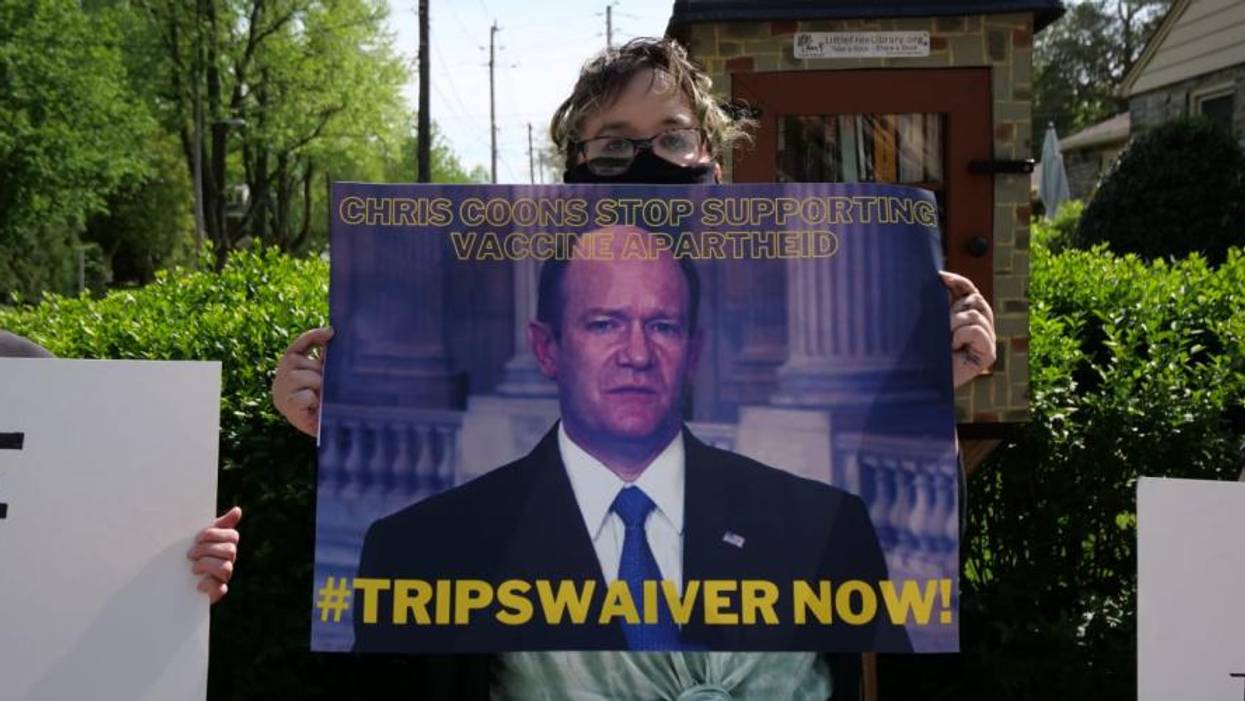
On Sunday, activists gathered outside of Coons' Delaware home to protest his dismissal of the patent waiver, which is backed by more than 100 countries, the head of the World Health Organization (WHO), Nobel Prize-winning economists, and a growing number of U.S. members of Congress.
This week, the WTO is set to consider the patent waiver proposal once more amid a global surge in coronavirus cases driven largely by a catastrophic wave in India, which has recorded more than 300,000 new infections for 12 consecutive days.
Experts fear that the deadly surge in the world's second-most populous country--which has vaccinated less than two percent of its residents--is being fueled at least in part by a highly contagious variant, heightening concerns about the emergence and spread of vaccine-resistant strains of the virus.
"We can ban all the flights we want but there is literally zero way we can keep these highly contagious variants out of our country," Dr. Ashish Jha, the dean of the Brown University School of Public Health, told the New York Times on Sunday. "If we want to put this pandemic behind us, we can't let the virus run wild in other parts of the world."
The threat of variants that can dodge existing vaccines has intensified the urgency behind India and South Africa's proposed patent waiver, which would remove a key legal barrier preventing manufacturers around the world from accelerating vaccine production for the developing world. According to the WHO, people in low-income countries have received just 0.3% of the total vaccine doses administered worldwide.
As staggering inequities persist, the Post reported last week that the Biden White House remains divided over whether to throw U.S. support behind the intellectual property waiver. One anonymous official involved in the discussions told the newspaper that "the people whose job it is to protect the property of U.S. businesses are up in arms that it's a bad idea."
"The people whose job is to defeat the pandemic," the official added, "are much more receptive to it."
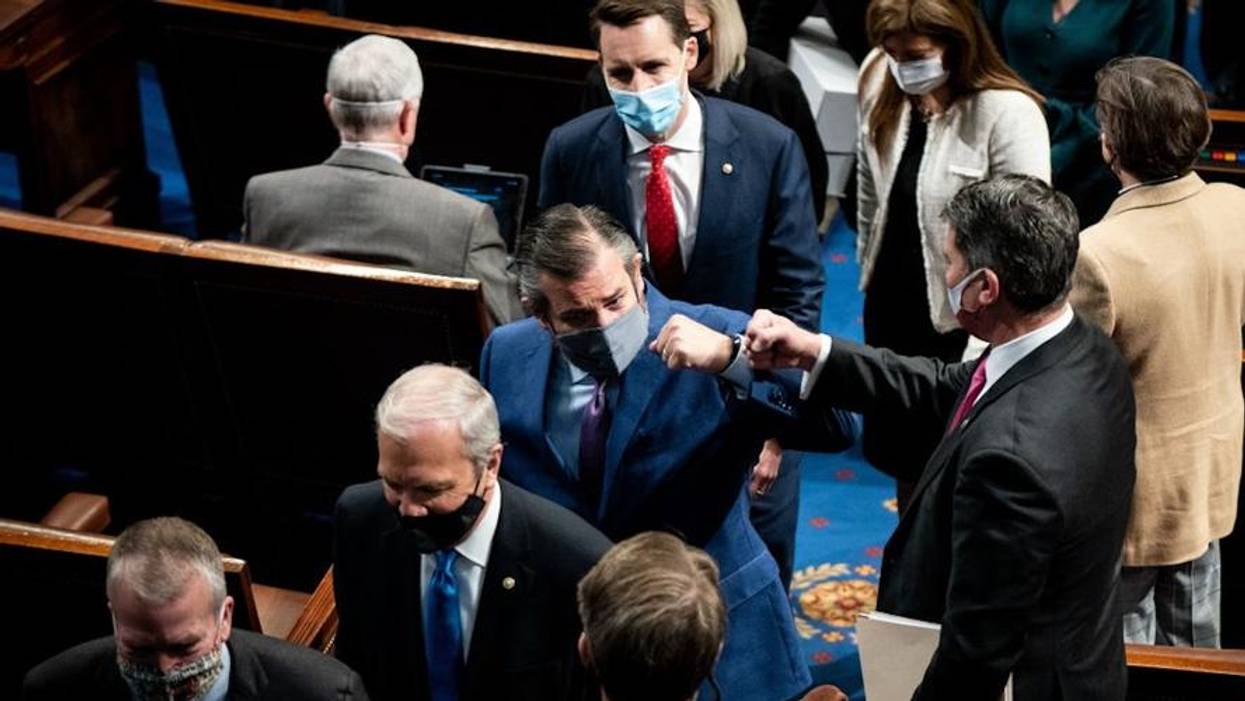
A petition circulating among lawyers and law students calling for the disbarment of Republican Sens. Josh Hawley and Ted Cruz for their roles in inciting last week's deadly attack on the U.S. Capitol has received more than 7,000 signatures as of Monday afternoon, including over 1,000 members of the Missouri and Texas bar associations.
"In leading the efforts to undermine the peaceful transition of power after a free and fair election, Sens. Hawley [Mo.] and Cruz [Texas] attacked the foundations of our democracy," the petition reads. "Hawley and Cruz directly incited the January 6th insurrection, repeating dangerous and unsubstantiated statements regarding the election and abetting the lawless behavior of President [Donald] Trump."
"In leading the efforts to undermine the peaceful transition of power after a free and fair election, Sens. Hawley and Cruz attacked the foundations of our democracy."
--Lawyers' and law students' petition
"A violent mob attacked the U.S. Capitol," the petition continues. "Five people have died. The nation and the world watched as rioters took over the very halls and chambers that embody our democracy."
"Yet after the violence and terror of the day's events, Sens. Hawley and Cruz still chose to stand in the chamber of the U.S. Senate and persist in their baseless objections to the will of the people," it adds.
The Washington Post reports prominent signatories of the petition include former U.S. Sen. Russ Feingold (D-Wis.) and constitutional scholar Lawrence Tribe, a professor at Harvard Law School, Cruz's alma mater.
In less than 72 hours, thousands of lawyers and law students have called for the disbarment of Sens. Hawley and Cruz.
Lawyers--even U.S. Senators--must defend our democracy, not sabotage it. Join the movement, sign the petition, and share widely.https://t.co/mYcXJ2VWhh
-- Daniel Ki (@danielrki) January 10, 2021
The petition was started by seven students at Yale Law School, where Hawley earned his juris doctorate. One of the students, Daniel Ki, told the Post that "we thought it was important to speak up."
"We decided to ask other law students and members of the bar to join in the call to begin immediate disbarment proceedings against Sens. Hawley and Cruz and have been inspired and heartened by the overwhelming response," said Ki.
The petition follows calls by Democratic Sens. Sherrod Brown (Ohio), Chris Coons (Del.), Patty Murray (Wash.), and Ron Wyden (Ore.) for Hawley and Cruz to step down. Murray on Friday accused the pair of having "broken their oath of office."
Even Republicans have strongly condemned the senators, with Sen. Pat Toomey (R-Pa.) on Sunday calling them "complicit in the big lie" that the 2020 presidential election was "stolen" or plagued with "widespread fraud." Toomey, however, stopped short of calling on the senators to resign.
Across the nation, people still reeling from what they saw unfold last week on live television joined in the chorus of condemnation of the senators and demanded their immediate resignation. Several hundred protesters braved subfreezing temperatures and the Covid-19 pandemic to take to the streets of downtown St. Louis on Saturday, chanting, "No Hawley. No KKK. No fascist USA" and painting "RESIGN HAWLEY" in the street in front of the historic Old Courthouse.
The petition comes as the House of Representatives on Monday moved closer to impeaching Trump for inciting insurrection after Republican lawmakers blocked a House resolution calling on Vice President Mike Pence to invoke the 25th Amendment to remove the president from office.
The vice president--who was apparently marked by some of the Capitol insurrectionists for possible execution due to his perceived disloyalty to Trump--has given no indication that he would consider such a constitutional remedy.