

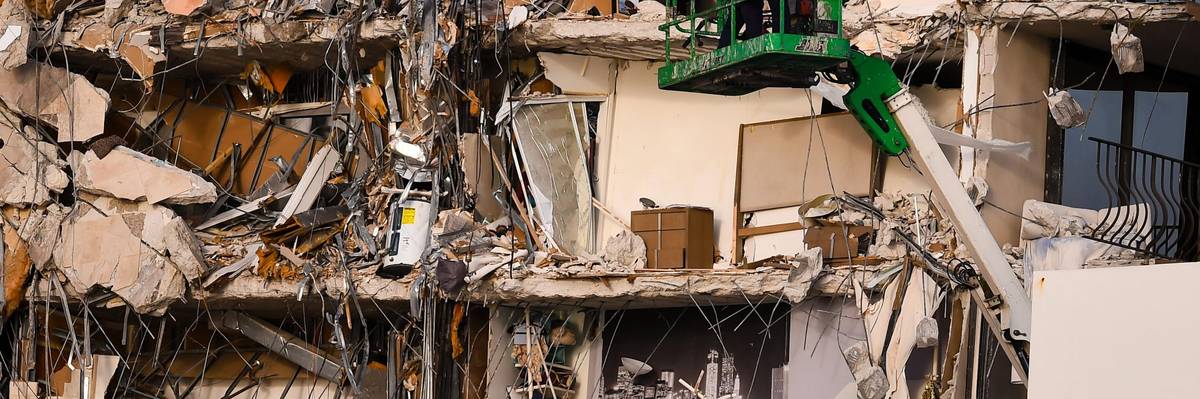
Rescue workers on a crane inspect the wreckage of a partially collapsed building in Surfside, north of Miami Beach, Florida on June 25, 2021. (Photo: Eva Marie Uzcategui/AFP via Getty Images)
'Appalling': DeSantis Refuses to Back Calls for Inspection of Aging Florida Buildings After Condo Collapse
The Miami Tenants Union said the Florida governor's position virtually ensures that "Surfside will not be an isolated incident."
As the known death toll from the collapse of a high-rise condo in Surfside near Miami continues to rise, Florida Gov. Ron DeSantis' refusal on Wednesday to commit to a statewide review of aging buildings provoked cries of outrage and fears of repeat disasters.
"For those who are missing, who have been identified as being deceased, the impact that they've had, not just on Florida but through folks all across the country and the world, has really been profound," DeSantis said Wednesday after a briefing on Tropical Storm Elsa at the state's Emergency Operations Center in Tallahassee, according to reporting by the Tampa Bay Times.
Although DeSantis, a Republican who is seen as an early contender for the GOP's 2024 presidential nomination, said that the victims of last month's tragedy have had a "profound" impact, the deaths of dozens of individuals who lived in Champlain Towers don't appear to have convinced the right-wing politician of the utility of requiring the recertification of aging buildings throughout the state to prevent future catastrophic failures.
As the Tampa Bay Times noted, the 136-story residential building in Surfside "was going through its 40-year recertification process when it crumbled at about 1:20 a.m. on June 24. Experts say the tragedy has exposed weaknesses in the state's building inspection process, and some state legislators, structural engineers, and insurance agents have suggested that it's time for the state to update laws that apply to coastal high rises."
DeSantis, for his part, said Wednesday that condominiums in the Sunshine State are "kind of a dime a dozen, particularly in southern Florida," and suggested that the collapsed building "had problems from the start."
"We obviously want to be able to identify why did this happen," the governor said. "Is this something that was unique to this building? Is it something that was unique to the person that maybe developed it--because obviously there are sister properties? Is it something [about] buildings of that age, that would have implications beyond that, whether southern Florida or the entire state of Florida? I think we need to get those definitive answers."
While DeSantis said that "if there is something identified that would have implications broader than Champlain Towers, then obviously we're going to take that and act as appropriate," he still refused to mandate a statewide review of aging buildings.
DeSantis' remarks came on the same day officials ended the search for survivors with nearly 90 people still missing.
The Miami Tenants Union (MTU) described DeSantis' rejection of calls to improve the state's building inspection process following the deadly collapse as an "appalling example of how Florida politicians won't say a single word that jeopardizes real estate interests."
According to MTU, the governor's "weak answers all but ensure that Surfside will not be an isolated incident."
Since the collapse of Champlain Towers and amid DeSantis' deflection of responsibility, Miami-Dade County and several coastal cities in the county have initiated their own reviews of aging buildings, the Tampa Bay Times reported.
According to the newspaper:
On Friday, the city of North Miami Beach ordered the evacuation of Crestview Towers Condominium after a building inspection report found it to have unsafe structural and electrical conditions, and on Saturday firefighters ordered residents to evacuate a low-rise condominium complex in Miami Beach after a building inspector flagged a flooring system failure in a vacant unit and damage to exterior walls.
Miami-Dade and Broward counties are the only Florida counties that require aging high-rises to go through a reinspection after they reach 40 years of age. No other Florida counties mandate routine inspection after a building is built.
Deciphering the precise causes of the collapse of the 40-year old building is likely to take years, and experts have cautioned against attributing the disaster to any single source, including factors related to the climate crisis. A 2018 engineering report (pdf) indicated that millions of dollars worth of "major structural damage" was present in Champlain Towers.
Nevertheless, scientists have also argued that rising sea levels and more intense tidal flooding may have contributed to the collapse of the high-rise condo and warned that regardless of the extent to which global warming played a role in last month's disaster, the event should be treated as a "wake-up call" to urgently strengthen urban infrastructure, plan for relocation, and reduce the emission of heat-trapping greenhouse gases--the key driver of the planetary emergency.
The Surfside disaster is already affecting Florida's real estate market and insurance industry, according to the Tampa Bay Times.
The newspaper reported that the "collapse is expected to dampen sales of existing condos in Miami, particularly in older buildings." Meanwhile, "in the absence of broader state and county regulation, the insurance industry in Florida has begun its own assessment of its liability in the condominium market."
While insurers "had already considered older condos on the coast--with their hurricane exposure, their common ownership structure, and reputation for delaying maintenance--a high risk," the newspaper noted that "insurance companies sent letters to owners of condominiums 40 years and older in South Florida last week, asking for proof that their buildings have passed all inspections or they will lose their coverage."
Sen. Jason Pizzo, a Miami Democrat whose district includes Surfside, told the Tampa Bay Times that Florida needs to bolster its building reinspection process, particularly for structures in close proximity to the shoreline and flood zones.
Given their "exposure to corrosive sea salt and vulnerability to sea-level rise," the lawmaker called for coastal condos to "be the subject of increased scrutiny in Florida," the newspaper noted.
We are at a crossroads
This country and this world are at a monumental crossroads. In a few short weeks, US voters will have an opportunity to beat back the forces of fascism and confront the billionaires who are rigging the economy, our media system, and our democracy, making it increasingly impossible for ordinary people to get by. We’re not just talking about the election. We’re talking about what must be done once these fascist elements are vanquished from power. We need a bolder set of solutions than what either major party has so far been willing to offer and a working-class movement ready to fight like hell for it. Trump didn't emerge from nowhere. The conditions that fueled MAGA authoritarianism were created by decades of radical neoliberal economic policies and a corrupt political system dominated by corporate interests. They slashed taxes on the super-rich, promising that the benefits would trickle down. They said giveaways to the corporate titans would make life more affordable for the rest of us. It was all bullshit. And when a bitter, betrayed populace searches for someone to blame, right-wing demagogues have little trouble finding scapegoats. People know when they're being lied to, but you won't hear any of this from the corporate media. Only independent journalism—powered and funded by people who believe in building a better world—can deliver truly trustworthy daily news. Our Fall Campaign is underway, and we need your help. To power our newsroom through the rest of the year, we need to raise $125,000 by midnight on October 31. So if you share our vision, please contribute whatever you can to sustain our work. |
As the known death toll from the collapse of a high-rise condo in Surfside near Miami continues to rise, Florida Gov. Ron DeSantis' refusal on Wednesday to commit to a statewide review of aging buildings provoked cries of outrage and fears of repeat disasters.
"For those who are missing, who have been identified as being deceased, the impact that they've had, not just on Florida but through folks all across the country and the world, has really been profound," DeSantis said Wednesday after a briefing on Tropical Storm Elsa at the state's Emergency Operations Center in Tallahassee, according to reporting by the Tampa Bay Times.
Although DeSantis, a Republican who is seen as an early contender for the GOP's 2024 presidential nomination, said that the victims of last month's tragedy have had a "profound" impact, the deaths of dozens of individuals who lived in Champlain Towers don't appear to have convinced the right-wing politician of the utility of requiring the recertification of aging buildings throughout the state to prevent future catastrophic failures.
As the Tampa Bay Times noted, the 136-story residential building in Surfside "was going through its 40-year recertification process when it crumbled at about 1:20 a.m. on June 24. Experts say the tragedy has exposed weaknesses in the state's building inspection process, and some state legislators, structural engineers, and insurance agents have suggested that it's time for the state to update laws that apply to coastal high rises."
DeSantis, for his part, said Wednesday that condominiums in the Sunshine State are "kind of a dime a dozen, particularly in southern Florida," and suggested that the collapsed building "had problems from the start."
"We obviously want to be able to identify why did this happen," the governor said. "Is this something that was unique to this building? Is it something that was unique to the person that maybe developed it--because obviously there are sister properties? Is it something [about] buildings of that age, that would have implications beyond that, whether southern Florida or the entire state of Florida? I think we need to get those definitive answers."
While DeSantis said that "if there is something identified that would have implications broader than Champlain Towers, then obviously we're going to take that and act as appropriate," he still refused to mandate a statewide review of aging buildings.
DeSantis' remarks came on the same day officials ended the search for survivors with nearly 90 people still missing.
The Miami Tenants Union (MTU) described DeSantis' rejection of calls to improve the state's building inspection process following the deadly collapse as an "appalling example of how Florida politicians won't say a single word that jeopardizes real estate interests."
According to MTU, the governor's "weak answers all but ensure that Surfside will not be an isolated incident."
Since the collapse of Champlain Towers and amid DeSantis' deflection of responsibility, Miami-Dade County and several coastal cities in the county have initiated their own reviews of aging buildings, the Tampa Bay Times reported.
According to the newspaper:
On Friday, the city of North Miami Beach ordered the evacuation of Crestview Towers Condominium after a building inspection report found it to have unsafe structural and electrical conditions, and on Saturday firefighters ordered residents to evacuate a low-rise condominium complex in Miami Beach after a building inspector flagged a flooring system failure in a vacant unit and damage to exterior walls.
Miami-Dade and Broward counties are the only Florida counties that require aging high-rises to go through a reinspection after they reach 40 years of age. No other Florida counties mandate routine inspection after a building is built.
Deciphering the precise causes of the collapse of the 40-year old building is likely to take years, and experts have cautioned against attributing the disaster to any single source, including factors related to the climate crisis. A 2018 engineering report (pdf) indicated that millions of dollars worth of "major structural damage" was present in Champlain Towers.
Nevertheless, scientists have also argued that rising sea levels and more intense tidal flooding may have contributed to the collapse of the high-rise condo and warned that regardless of the extent to which global warming played a role in last month's disaster, the event should be treated as a "wake-up call" to urgently strengthen urban infrastructure, plan for relocation, and reduce the emission of heat-trapping greenhouse gases--the key driver of the planetary emergency.
The Surfside disaster is already affecting Florida's real estate market and insurance industry, according to the Tampa Bay Times.
The newspaper reported that the "collapse is expected to dampen sales of existing condos in Miami, particularly in older buildings." Meanwhile, "in the absence of broader state and county regulation, the insurance industry in Florida has begun its own assessment of its liability in the condominium market."
While insurers "had already considered older condos on the coast--with their hurricane exposure, their common ownership structure, and reputation for delaying maintenance--a high risk," the newspaper noted that "insurance companies sent letters to owners of condominiums 40 years and older in South Florida last week, asking for proof that their buildings have passed all inspections or they will lose their coverage."
Sen. Jason Pizzo, a Miami Democrat whose district includes Surfside, told the Tampa Bay Times that Florida needs to bolster its building reinspection process, particularly for structures in close proximity to the shoreline and flood zones.
Given their "exposure to corrosive sea salt and vulnerability to sea-level rise," the lawmaker called for coastal condos to "be the subject of increased scrutiny in Florida," the newspaper noted.
As the known death toll from the collapse of a high-rise condo in Surfside near Miami continues to rise, Florida Gov. Ron DeSantis' refusal on Wednesday to commit to a statewide review of aging buildings provoked cries of outrage and fears of repeat disasters.
"For those who are missing, who have been identified as being deceased, the impact that they've had, not just on Florida but through folks all across the country and the world, has really been profound," DeSantis said Wednesday after a briefing on Tropical Storm Elsa at the state's Emergency Operations Center in Tallahassee, according to reporting by the Tampa Bay Times.
Although DeSantis, a Republican who is seen as an early contender for the GOP's 2024 presidential nomination, said that the victims of last month's tragedy have had a "profound" impact, the deaths of dozens of individuals who lived in Champlain Towers don't appear to have convinced the right-wing politician of the utility of requiring the recertification of aging buildings throughout the state to prevent future catastrophic failures.
As the Tampa Bay Times noted, the 136-story residential building in Surfside "was going through its 40-year recertification process when it crumbled at about 1:20 a.m. on June 24. Experts say the tragedy has exposed weaknesses in the state's building inspection process, and some state legislators, structural engineers, and insurance agents have suggested that it's time for the state to update laws that apply to coastal high rises."
DeSantis, for his part, said Wednesday that condominiums in the Sunshine State are "kind of a dime a dozen, particularly in southern Florida," and suggested that the collapsed building "had problems from the start."
"We obviously want to be able to identify why did this happen," the governor said. "Is this something that was unique to this building? Is it something that was unique to the person that maybe developed it--because obviously there are sister properties? Is it something [about] buildings of that age, that would have implications beyond that, whether southern Florida or the entire state of Florida? I think we need to get those definitive answers."
While DeSantis said that "if there is something identified that would have implications broader than Champlain Towers, then obviously we're going to take that and act as appropriate," he still refused to mandate a statewide review of aging buildings.
DeSantis' remarks came on the same day officials ended the search for survivors with nearly 90 people still missing.
The Miami Tenants Union (MTU) described DeSantis' rejection of calls to improve the state's building inspection process following the deadly collapse as an "appalling example of how Florida politicians won't say a single word that jeopardizes real estate interests."
According to MTU, the governor's "weak answers all but ensure that Surfside will not be an isolated incident."
Since the collapse of Champlain Towers and amid DeSantis' deflection of responsibility, Miami-Dade County and several coastal cities in the county have initiated their own reviews of aging buildings, the Tampa Bay Times reported.
According to the newspaper:
On Friday, the city of North Miami Beach ordered the evacuation of Crestview Towers Condominium after a building inspection report found it to have unsafe structural and electrical conditions, and on Saturday firefighters ordered residents to evacuate a low-rise condominium complex in Miami Beach after a building inspector flagged a flooring system failure in a vacant unit and damage to exterior walls.
Miami-Dade and Broward counties are the only Florida counties that require aging high-rises to go through a reinspection after they reach 40 years of age. No other Florida counties mandate routine inspection after a building is built.
Deciphering the precise causes of the collapse of the 40-year old building is likely to take years, and experts have cautioned against attributing the disaster to any single source, including factors related to the climate crisis. A 2018 engineering report (pdf) indicated that millions of dollars worth of "major structural damage" was present in Champlain Towers.
Nevertheless, scientists have also argued that rising sea levels and more intense tidal flooding may have contributed to the collapse of the high-rise condo and warned that regardless of the extent to which global warming played a role in last month's disaster, the event should be treated as a "wake-up call" to urgently strengthen urban infrastructure, plan for relocation, and reduce the emission of heat-trapping greenhouse gases--the key driver of the planetary emergency.
The Surfside disaster is already affecting Florida's real estate market and insurance industry, according to the Tampa Bay Times.
The newspaper reported that the "collapse is expected to dampen sales of existing condos in Miami, particularly in older buildings." Meanwhile, "in the absence of broader state and county regulation, the insurance industry in Florida has begun its own assessment of its liability in the condominium market."
While insurers "had already considered older condos on the coast--with their hurricane exposure, their common ownership structure, and reputation for delaying maintenance--a high risk," the newspaper noted that "insurance companies sent letters to owners of condominiums 40 years and older in South Florida last week, asking for proof that their buildings have passed all inspections or they will lose their coverage."
Sen. Jason Pizzo, a Miami Democrat whose district includes Surfside, told the Tampa Bay Times that Florida needs to bolster its building reinspection process, particularly for structures in close proximity to the shoreline and flood zones.
Given their "exposure to corrosive sea salt and vulnerability to sea-level rise," the lawmaker called for coastal condos to "be the subject of increased scrutiny in Florida," the newspaper noted.