SUBSCRIBE TO OUR FREE NEWSLETTER
Daily news & progressive opinion—funded by the people, not the corporations—delivered straight to your inbox.
5
#000000
#FFFFFF
To donate by check, phone, or other method, see our More Ways to Give page.
Daily news & progressive opinion—funded by the people, not the corporations—delivered straight to your inbox.
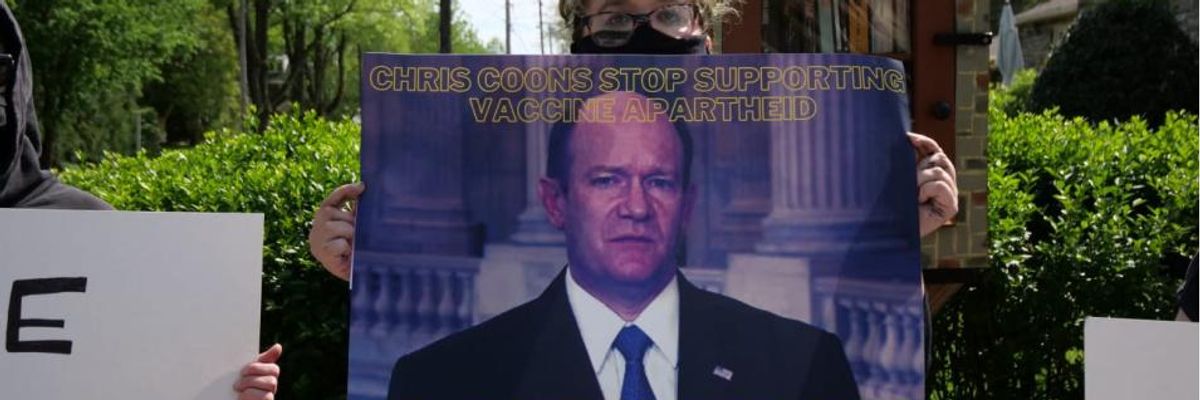
Activists protest outside of the home of Sen. Chris Coons (D-Del.) to denounce his comments opposing a coronavirus vaccine patent waiver on Sunday, May 3, 2021. (Photo: Justice Is Global/Twitter)
Democratic Sen. Chris Coons is facing backlash for invoking the January 6 insurrection at the U.S. Capitol to justify his opposition to a temporary waiver of coronavirus vaccine patents, a measure that would help enable generic manufacturers to ramp up global production of the life-saving shots.
Speaking last week at an event hosted by the Center for Strategic and International Studies, Coons--a close ally of President Joe Biden--said that upholding the global intellectual property regime amid the deadly pandemic is essential to U.S. standing around the world.
"January 6th was a moment that was challenging, divisive, difficult for all of us here in Congress, and it was a wake-up call that our country is badly divided," said the Delaware senator. "All of this is a wake-up call for us that we need to have another Sputnik-like moment of reinvestment in American innovation and competitiveness. A central part of being successful in this competition is continuing with our constitutionally created protected-property right of a patent, something I've long believed in."
Watch:
Coons' remarks, reported by the Washington Post on Friday, prompted a torrent of outrage from progressives who argue that a patent waiver is an essential step toward increasing vaccine manufacturing to meet the dire needs of poor nations, which are going largely without access to shots as rich countries hoard doses and essential technology.
South Africa and India first introduced the patent waiver at the World Trade Organization in October, but rich nations--including the U.S. and the European Union--have repeatedly blocked the proposal, leaving vaccine production under the control of profit-driven pharmaceutical companies.
On Sunday, activists gathered outside of Coons' Delaware home to protest his dismissal of the patent waiver, which is backed by more than 100 countries, the head of the World Health Organization (WHO), Nobel Prize-winning economists, and a growing number of U.S. members of Congress.
This week, the WTO is set to consider the patent waiver proposal once more amid a global surge in coronavirus cases driven largely by a catastrophic wave in India, which has recorded more than 300,000 new infections for 12 consecutive days.
Experts fear that the deadly surge in the world's second-most populous country--which has vaccinated less than two percent of its residents--is being fueled at least in part by a highly contagious variant, heightening concerns about the emergence and spread of vaccine-resistant strains of the virus.
"We can ban all the flights we want but there is literally zero way we can keep these highly contagious variants out of our country," Dr. Ashish Jha, the dean of the Brown University School of Public Health, told the New York Times on Sunday. "If we want to put this pandemic behind us, we can't let the virus run wild in other parts of the world."
The threat of variants that can dodge existing vaccines has intensified the urgency behind India and South Africa's proposed patent waiver, which would remove a key legal barrier preventing manufacturers around the world from accelerating vaccine production for the developing world. According to the WHO, people in low-income countries have received just 0.3% of the total vaccine doses administered worldwide.
As staggering inequities persist, the Post reported last week that the Biden White House remains divided over whether to throw U.S. support behind the intellectual property waiver. One anonymous official involved in the discussions told the newspaper that "the people whose job it is to protect the property of U.S. businesses are up in arms that it's a bad idea."
"The people whose job is to defeat the pandemic," the official added, "are much more receptive to it."
Dear Common Dreams reader, It’s been nearly 30 years since I co-founded Common Dreams with my late wife, Lina Newhouser. We had the radical notion that journalism should serve the public good, not corporate profits. It was clear to us from the outset what it would take to build such a project. No paid advertisements. No corporate sponsors. No millionaire publisher telling us what to think or do. Many people said we wouldn't last a year, but we proved those doubters wrong. Together with a tremendous team of journalists and dedicated staff, we built an independent media outlet free from the constraints of profits and corporate control. Our mission has always been simple: To inform. To inspire. To ignite change for the common good. Building Common Dreams was not easy. Our survival was never guaranteed. When you take on the most powerful forces—Wall Street greed, fossil fuel industry destruction, Big Tech lobbyists, and uber-rich oligarchs who have spent billions upon billions rigging the economy and democracy in their favor—the only bulwark you have is supporters who believe in your work. But here’s the urgent message from me today. It's never been this bad out there. And it's never been this hard to keep us going. At the very moment Common Dreams is most needed, the threats we face are intensifying. We need your support now more than ever. We don't accept corporate advertising and never will. We don't have a paywall because we don't think people should be blocked from critical news based on their ability to pay. Everything we do is funded by the donations of readers like you. When everyone does the little they can afford, we are strong. But if that support retreats or dries up, so do we. Will you donate now to make sure Common Dreams not only survives but thrives? —Craig Brown, Co-founder |
Democratic Sen. Chris Coons is facing backlash for invoking the January 6 insurrection at the U.S. Capitol to justify his opposition to a temporary waiver of coronavirus vaccine patents, a measure that would help enable generic manufacturers to ramp up global production of the life-saving shots.
Speaking last week at an event hosted by the Center for Strategic and International Studies, Coons--a close ally of President Joe Biden--said that upholding the global intellectual property regime amid the deadly pandemic is essential to U.S. standing around the world.
"January 6th was a moment that was challenging, divisive, difficult for all of us here in Congress, and it was a wake-up call that our country is badly divided," said the Delaware senator. "All of this is a wake-up call for us that we need to have another Sputnik-like moment of reinvestment in American innovation and competitiveness. A central part of being successful in this competition is continuing with our constitutionally created protected-property right of a patent, something I've long believed in."
Watch:
Coons' remarks, reported by the Washington Post on Friday, prompted a torrent of outrage from progressives who argue that a patent waiver is an essential step toward increasing vaccine manufacturing to meet the dire needs of poor nations, which are going largely without access to shots as rich countries hoard doses and essential technology.
South Africa and India first introduced the patent waiver at the World Trade Organization in October, but rich nations--including the U.S. and the European Union--have repeatedly blocked the proposal, leaving vaccine production under the control of profit-driven pharmaceutical companies.
On Sunday, activists gathered outside of Coons' Delaware home to protest his dismissal of the patent waiver, which is backed by more than 100 countries, the head of the World Health Organization (WHO), Nobel Prize-winning economists, and a growing number of U.S. members of Congress.
This week, the WTO is set to consider the patent waiver proposal once more amid a global surge in coronavirus cases driven largely by a catastrophic wave in India, which has recorded more than 300,000 new infections for 12 consecutive days.
Experts fear that the deadly surge in the world's second-most populous country--which has vaccinated less than two percent of its residents--is being fueled at least in part by a highly contagious variant, heightening concerns about the emergence and spread of vaccine-resistant strains of the virus.
"We can ban all the flights we want but there is literally zero way we can keep these highly contagious variants out of our country," Dr. Ashish Jha, the dean of the Brown University School of Public Health, told the New York Times on Sunday. "If we want to put this pandemic behind us, we can't let the virus run wild in other parts of the world."
The threat of variants that can dodge existing vaccines has intensified the urgency behind India and South Africa's proposed patent waiver, which would remove a key legal barrier preventing manufacturers around the world from accelerating vaccine production for the developing world. According to the WHO, people in low-income countries have received just 0.3% of the total vaccine doses administered worldwide.
As staggering inequities persist, the Post reported last week that the Biden White House remains divided over whether to throw U.S. support behind the intellectual property waiver. One anonymous official involved in the discussions told the newspaper that "the people whose job it is to protect the property of U.S. businesses are up in arms that it's a bad idea."
"The people whose job is to defeat the pandemic," the official added, "are much more receptive to it."
Democratic Sen. Chris Coons is facing backlash for invoking the January 6 insurrection at the U.S. Capitol to justify his opposition to a temporary waiver of coronavirus vaccine patents, a measure that would help enable generic manufacturers to ramp up global production of the life-saving shots.
Speaking last week at an event hosted by the Center for Strategic and International Studies, Coons--a close ally of President Joe Biden--said that upholding the global intellectual property regime amid the deadly pandemic is essential to U.S. standing around the world.
"January 6th was a moment that was challenging, divisive, difficult for all of us here in Congress, and it was a wake-up call that our country is badly divided," said the Delaware senator. "All of this is a wake-up call for us that we need to have another Sputnik-like moment of reinvestment in American innovation and competitiveness. A central part of being successful in this competition is continuing with our constitutionally created protected-property right of a patent, something I've long believed in."
Watch:
Coons' remarks, reported by the Washington Post on Friday, prompted a torrent of outrage from progressives who argue that a patent waiver is an essential step toward increasing vaccine manufacturing to meet the dire needs of poor nations, which are going largely without access to shots as rich countries hoard doses and essential technology.
South Africa and India first introduced the patent waiver at the World Trade Organization in October, but rich nations--including the U.S. and the European Union--have repeatedly blocked the proposal, leaving vaccine production under the control of profit-driven pharmaceutical companies.
On Sunday, activists gathered outside of Coons' Delaware home to protest his dismissal of the patent waiver, which is backed by more than 100 countries, the head of the World Health Organization (WHO), Nobel Prize-winning economists, and a growing number of U.S. members of Congress.
This week, the WTO is set to consider the patent waiver proposal once more amid a global surge in coronavirus cases driven largely by a catastrophic wave in India, which has recorded more than 300,000 new infections for 12 consecutive days.
Experts fear that the deadly surge in the world's second-most populous country--which has vaccinated less than two percent of its residents--is being fueled at least in part by a highly contagious variant, heightening concerns about the emergence and spread of vaccine-resistant strains of the virus.
"We can ban all the flights we want but there is literally zero way we can keep these highly contagious variants out of our country," Dr. Ashish Jha, the dean of the Brown University School of Public Health, told the New York Times on Sunday. "If we want to put this pandemic behind us, we can't let the virus run wild in other parts of the world."
The threat of variants that can dodge existing vaccines has intensified the urgency behind India and South Africa's proposed patent waiver, which would remove a key legal barrier preventing manufacturers around the world from accelerating vaccine production for the developing world. According to the WHO, people in low-income countries have received just 0.3% of the total vaccine doses administered worldwide.
As staggering inequities persist, the Post reported last week that the Biden White House remains divided over whether to throw U.S. support behind the intellectual property waiver. One anonymous official involved in the discussions told the newspaper that "the people whose job it is to protect the property of U.S. businesses are up in arms that it's a bad idea."
"The people whose job is to defeat the pandemic," the official added, "are much more receptive to it."