SUBSCRIBE TO OUR FREE NEWSLETTER
Daily news & progressive opinion—funded by the people, not the corporations—delivered straight to your inbox.
5
#000000
#FFFFFF
To donate by check, phone, or other method, see our More Ways to Give page.
Daily news & progressive opinion—funded by the people, not the corporations—delivered straight to your inbox.
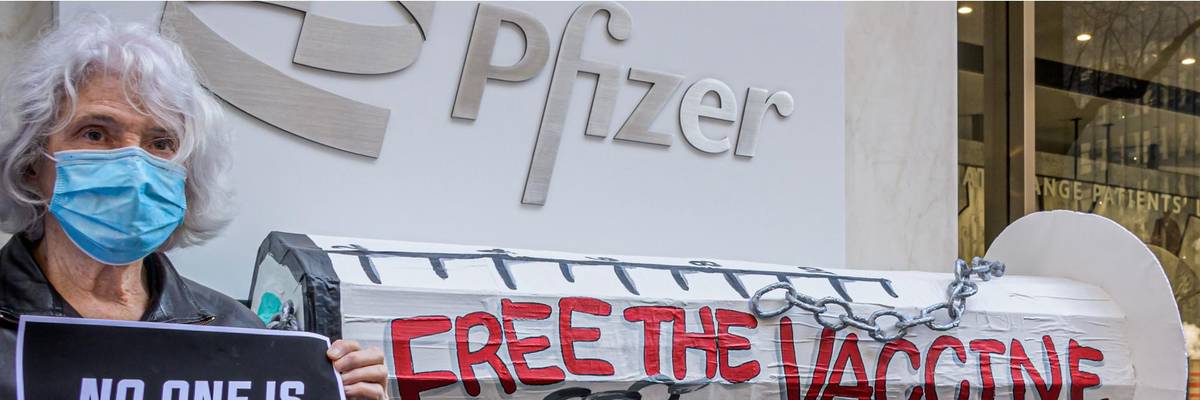
A woman demands Pfizer "free the vaccine" at a March 11, 2021 demonstration outside the company's world headquarters in New York City. (Photo: Erik McGregor/LightRocket via Getty Images)
As Covid-19 hospitalizations and deaths continue to soar in India, a group of Democratic U.S. senators on Wednesday sent letters to three Big Pharma CEOs urging them to expand global vaccine access by sharing technology and by lifting intellectual property barriers to allow countries to locally produce vaccines.
"Increasing Covid-19 vaccinations in India is urgently needed to reduce human suffering and prevent unnecessary deaths. It could also help halt the spread of coronavirus variants that could prolong the pandemic across the globe."
--Senators' letter
"Covid-19 has infected over 148 million people and killed over three million globally, with hundreds of thousands of new cases and thousands of deaths being reported daily," write Democratic Sens. Elizabeth Warren (Mass.), Ed Markey (Mass.), Tammy Baldwin (Wis.), Jeff Merkley (Ore.), and Chris Murphy (Conn.) to the CEOs of Pfizer, Moderna, and Johnson & Johnson.
The senators warn that although these "and other companies have developed safe and effective Covid-19 vaccines, the uncontrolled spread of coronavirus poses significant risks to global vaccination efforts. As the virus proliferates, it evolves, increasing the risk of a variant developing that renders vaccinations ineffective."
"Though wealthier countries, including the United States, have successfully secured vaccines and have made significant strides in vaccinating their populations, many middle- and lower-income nations have less access to vaccine doses," the letter continues. "A recent study estimates that unequal global vaccine distribution could result in a gross domestic product loss of $1.2 trillion annually for the global economy."
The senators highlight the acute crisis in India, where over 360,000 new coronavirus cases--the most ever recorded in a country in a single day during the pandemic--and 3,293 deaths were reported Wednesday as the nation passed the grim milestone of 200,000 Covid-19 fatalities.
Although noting that India is a "major producer" of the Oxford/AstraZeneca coronavirus vaccine, and that it has exported over 66 million doses this year, the senators write that "it is still struggling to vaccinate people quickly enough to quell the outbreak."
"Addressing the spread of Covid-19 in India is critical," they assert, adding that there are steps the pharma giants can take "to increase global vaccine access."
"Increasing Covid-19 vaccinations in India is urgently needed to reduce human suffering and prevent unnecessary deaths," the letter states. "It could also help halt the spread of coronavirus variants that could prolong the pandemic across the globe."
Sharing technology, "such as vaccine recipes and manufacturing information," could "drastically expand vaccine development and access," it adds.
"This technology transfer could take place voluntarily, underpinned by open, non-exclusive, and transparent agreements done in collaboration with the World Health Organization," the senators argue, pointing to the WHO's Covid-19 Technology Access Pool (C-TAP) and its mRNA vaccine technology transfer hub, through which the United Nations agency and its partners are "seeking to expand the capacity of low- and middle-income countries to produce Covid-19 vaccines and scale up manufacturing to increase global access to these critical tools."
The lawmakers also note that experts have "called for the U.S. to support the temporary waiver of some Trade-Related Aspects of Intellectual Property Rights (TRIPS) rules proposed by India and South Africa at the World Trade Organization (WTO), which would temporarily lift certain intellectual property barriers and allow countries to locally manufacture Covid-19 diagnostics, treatments, and vaccines."
Earlier this month, Sen. Bernie Sanders (I-Vt.) led a group of 10 senators including Baldwin, Markey, Merkley, Murphy, and Warren in calling on President Joe Biden to back a global effort for a temporary WTO TRIPS waiver.
Wednesday's letter asks each of the companies if they have taken any of these or other steps, and if not, why.
"Now is the time to use every single opportunity in every single corner of the world. These companies should make deals with as many countries as possible."
--Abdul Muktadir,
Bangladeshi pharma CEO
The pharmaceutical industry has dismissed efforts to permit the sharing of intellectual property to create generic coronavirus vaccines, claiming that some countries lack the facilities in which to safely manufacture them. Powerful global players like billionaire businessman and philanthropist Bill Gates, whose software fortune is largely dependent upon stringent intellectual property protection laws, have echoed this assertion--which factory owners around the world roundly refute.
"Now is the time to use every single opportunity in every single corner of the world," Abdul Muktadir, CEO of the Bangladeshi pharmaceutical company Incepta, told the Washington Post. Muktadir said he emailed executives at Moderna, Johnson & Johnson, and Novavax to offer help--he said his company can produce as many as 800 million vaccine doses per year--but none of them wrote back.
"These companies should make deals with as many countries as possible," he said.
Dear Common Dreams reader, It’s been nearly 30 years since I co-founded Common Dreams with my late wife, Lina Newhouser. We had the radical notion that journalism should serve the public good, not corporate profits. It was clear to us from the outset what it would take to build such a project. No paid advertisements. No corporate sponsors. No millionaire publisher telling us what to think or do. Many people said we wouldn't last a year, but we proved those doubters wrong. Together with a tremendous team of journalists and dedicated staff, we built an independent media outlet free from the constraints of profits and corporate control. Our mission has always been simple: To inform. To inspire. To ignite change for the common good. Building Common Dreams was not easy. Our survival was never guaranteed. When you take on the most powerful forces—Wall Street greed, fossil fuel industry destruction, Big Tech lobbyists, and uber-rich oligarchs who have spent billions upon billions rigging the economy and democracy in their favor—the only bulwark you have is supporters who believe in your work. But here’s the urgent message from me today. It's never been this bad out there. And it's never been this hard to keep us going. At the very moment Common Dreams is most needed, the threats we face are intensifying. We need your support now more than ever. We don't accept corporate advertising and never will. We don't have a paywall because we don't think people should be blocked from critical news based on their ability to pay. Everything we do is funded by the donations of readers like you. When everyone does the little they can afford, we are strong. But if that support retreats or dries up, so do we. Will you donate now to make sure Common Dreams not only survives but thrives? —Craig Brown, Co-founder |
As Covid-19 hospitalizations and deaths continue to soar in India, a group of Democratic U.S. senators on Wednesday sent letters to three Big Pharma CEOs urging them to expand global vaccine access by sharing technology and by lifting intellectual property barriers to allow countries to locally produce vaccines.
"Increasing Covid-19 vaccinations in India is urgently needed to reduce human suffering and prevent unnecessary deaths. It could also help halt the spread of coronavirus variants that could prolong the pandemic across the globe."
--Senators' letter
"Covid-19 has infected over 148 million people and killed over three million globally, with hundreds of thousands of new cases and thousands of deaths being reported daily," write Democratic Sens. Elizabeth Warren (Mass.), Ed Markey (Mass.), Tammy Baldwin (Wis.), Jeff Merkley (Ore.), and Chris Murphy (Conn.) to the CEOs of Pfizer, Moderna, and Johnson & Johnson.
The senators warn that although these "and other companies have developed safe and effective Covid-19 vaccines, the uncontrolled spread of coronavirus poses significant risks to global vaccination efforts. As the virus proliferates, it evolves, increasing the risk of a variant developing that renders vaccinations ineffective."
"Though wealthier countries, including the United States, have successfully secured vaccines and have made significant strides in vaccinating their populations, many middle- and lower-income nations have less access to vaccine doses," the letter continues. "A recent study estimates that unequal global vaccine distribution could result in a gross domestic product loss of $1.2 trillion annually for the global economy."
The senators highlight the acute crisis in India, where over 360,000 new coronavirus cases--the most ever recorded in a country in a single day during the pandemic--and 3,293 deaths were reported Wednesday as the nation passed the grim milestone of 200,000 Covid-19 fatalities.
Although noting that India is a "major producer" of the Oxford/AstraZeneca coronavirus vaccine, and that it has exported over 66 million doses this year, the senators write that "it is still struggling to vaccinate people quickly enough to quell the outbreak."
"Addressing the spread of Covid-19 in India is critical," they assert, adding that there are steps the pharma giants can take "to increase global vaccine access."
"Increasing Covid-19 vaccinations in India is urgently needed to reduce human suffering and prevent unnecessary deaths," the letter states. "It could also help halt the spread of coronavirus variants that could prolong the pandemic across the globe."
Sharing technology, "such as vaccine recipes and manufacturing information," could "drastically expand vaccine development and access," it adds.
"This technology transfer could take place voluntarily, underpinned by open, non-exclusive, and transparent agreements done in collaboration with the World Health Organization," the senators argue, pointing to the WHO's Covid-19 Technology Access Pool (C-TAP) and its mRNA vaccine technology transfer hub, through which the United Nations agency and its partners are "seeking to expand the capacity of low- and middle-income countries to produce Covid-19 vaccines and scale up manufacturing to increase global access to these critical tools."
The lawmakers also note that experts have "called for the U.S. to support the temporary waiver of some Trade-Related Aspects of Intellectual Property Rights (TRIPS) rules proposed by India and South Africa at the World Trade Organization (WTO), which would temporarily lift certain intellectual property barriers and allow countries to locally manufacture Covid-19 diagnostics, treatments, and vaccines."
Earlier this month, Sen. Bernie Sanders (I-Vt.) led a group of 10 senators including Baldwin, Markey, Merkley, Murphy, and Warren in calling on President Joe Biden to back a global effort for a temporary WTO TRIPS waiver.
Wednesday's letter asks each of the companies if they have taken any of these or other steps, and if not, why.
"Now is the time to use every single opportunity in every single corner of the world. These companies should make deals with as many countries as possible."
--Abdul Muktadir,
Bangladeshi pharma CEO
The pharmaceutical industry has dismissed efforts to permit the sharing of intellectual property to create generic coronavirus vaccines, claiming that some countries lack the facilities in which to safely manufacture them. Powerful global players like billionaire businessman and philanthropist Bill Gates, whose software fortune is largely dependent upon stringent intellectual property protection laws, have echoed this assertion--which factory owners around the world roundly refute.
"Now is the time to use every single opportunity in every single corner of the world," Abdul Muktadir, CEO of the Bangladeshi pharmaceutical company Incepta, told the Washington Post. Muktadir said he emailed executives at Moderna, Johnson & Johnson, and Novavax to offer help--he said his company can produce as many as 800 million vaccine doses per year--but none of them wrote back.
"These companies should make deals with as many countries as possible," he said.
As Covid-19 hospitalizations and deaths continue to soar in India, a group of Democratic U.S. senators on Wednesday sent letters to three Big Pharma CEOs urging them to expand global vaccine access by sharing technology and by lifting intellectual property barriers to allow countries to locally produce vaccines.
"Increasing Covid-19 vaccinations in India is urgently needed to reduce human suffering and prevent unnecessary deaths. It could also help halt the spread of coronavirus variants that could prolong the pandemic across the globe."
--Senators' letter
"Covid-19 has infected over 148 million people and killed over three million globally, with hundreds of thousands of new cases and thousands of deaths being reported daily," write Democratic Sens. Elizabeth Warren (Mass.), Ed Markey (Mass.), Tammy Baldwin (Wis.), Jeff Merkley (Ore.), and Chris Murphy (Conn.) to the CEOs of Pfizer, Moderna, and Johnson & Johnson.
The senators warn that although these "and other companies have developed safe and effective Covid-19 vaccines, the uncontrolled spread of coronavirus poses significant risks to global vaccination efforts. As the virus proliferates, it evolves, increasing the risk of a variant developing that renders vaccinations ineffective."
"Though wealthier countries, including the United States, have successfully secured vaccines and have made significant strides in vaccinating their populations, many middle- and lower-income nations have less access to vaccine doses," the letter continues. "A recent study estimates that unequal global vaccine distribution could result in a gross domestic product loss of $1.2 trillion annually for the global economy."
The senators highlight the acute crisis in India, where over 360,000 new coronavirus cases--the most ever recorded in a country in a single day during the pandemic--and 3,293 deaths were reported Wednesday as the nation passed the grim milestone of 200,000 Covid-19 fatalities.
Although noting that India is a "major producer" of the Oxford/AstraZeneca coronavirus vaccine, and that it has exported over 66 million doses this year, the senators write that "it is still struggling to vaccinate people quickly enough to quell the outbreak."
"Addressing the spread of Covid-19 in India is critical," they assert, adding that there are steps the pharma giants can take "to increase global vaccine access."
"Increasing Covid-19 vaccinations in India is urgently needed to reduce human suffering and prevent unnecessary deaths," the letter states. "It could also help halt the spread of coronavirus variants that could prolong the pandemic across the globe."
Sharing technology, "such as vaccine recipes and manufacturing information," could "drastically expand vaccine development and access," it adds.
"This technology transfer could take place voluntarily, underpinned by open, non-exclusive, and transparent agreements done in collaboration with the World Health Organization," the senators argue, pointing to the WHO's Covid-19 Technology Access Pool (C-TAP) and its mRNA vaccine technology transfer hub, through which the United Nations agency and its partners are "seeking to expand the capacity of low- and middle-income countries to produce Covid-19 vaccines and scale up manufacturing to increase global access to these critical tools."
The lawmakers also note that experts have "called for the U.S. to support the temporary waiver of some Trade-Related Aspects of Intellectual Property Rights (TRIPS) rules proposed by India and South Africa at the World Trade Organization (WTO), which would temporarily lift certain intellectual property barriers and allow countries to locally manufacture Covid-19 diagnostics, treatments, and vaccines."
Earlier this month, Sen. Bernie Sanders (I-Vt.) led a group of 10 senators including Baldwin, Markey, Merkley, Murphy, and Warren in calling on President Joe Biden to back a global effort for a temporary WTO TRIPS waiver.
Wednesday's letter asks each of the companies if they have taken any of these or other steps, and if not, why.
"Now is the time to use every single opportunity in every single corner of the world. These companies should make deals with as many countries as possible."
--Abdul Muktadir,
Bangladeshi pharma CEO
The pharmaceutical industry has dismissed efforts to permit the sharing of intellectual property to create generic coronavirus vaccines, claiming that some countries lack the facilities in which to safely manufacture them. Powerful global players like billionaire businessman and philanthropist Bill Gates, whose software fortune is largely dependent upon stringent intellectual property protection laws, have echoed this assertion--which factory owners around the world roundly refute.
"Now is the time to use every single opportunity in every single corner of the world," Abdul Muktadir, CEO of the Bangladeshi pharmaceutical company Incepta, told the Washington Post. Muktadir said he emailed executives at Moderna, Johnson & Johnson, and Novavax to offer help--he said his company can produce as many as 800 million vaccine doses per year--but none of them wrote back.
"These companies should make deals with as many countries as possible," he said.