SUBSCRIBE TO OUR FREE NEWSLETTER
Daily news & progressive opinion—funded by the people, not the corporations—delivered straight to your inbox.
5
#000000
#FFFFFF
To donate by check, phone, or other method, see our More Ways to Give page.
Daily news & progressive opinion—funded by the people, not the corporations—delivered straight to your inbox.
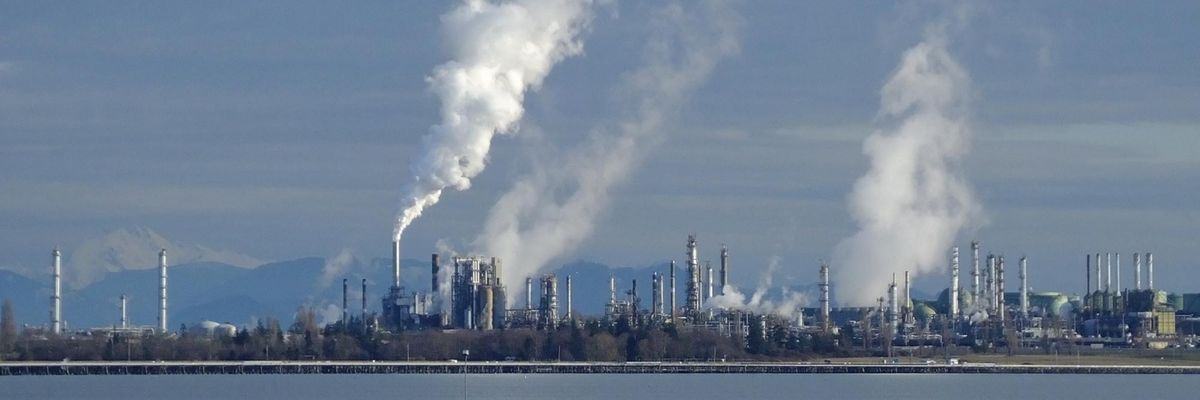
View of the Tesoro Anacortes oil refinery in Skagit County, Washington on January 15, 2017. (Photo: Linda, Fortuna future/Flickr/cc)
On the eve of Earth Day and the start of U.S. President Joe Biden's Leaders Summit on Climate, a group of 101 Nobel laureates published a letter urging world leaders and governments to "keep fossil fuels in the ground" as a critical first step toward addressing the climate emergency.
"Urgent action is needed to end the expansions of fossil fuel production, phase out current production, and invest in renewable energy."
--Nobel laureates' letter
The letter--which was signed by Nobel peace, literature, medicine, physics, chemistry, and economic sciences laureates--notes that the climate emergency "is threatening hundreds of millions of lives, livelihoods across every continent, and is putting thousands of species at risk." It adds that "the burning of fossil fuels--coal, oil, and gas--is by far the major contributor" to the crisis.
Signers of the letter--who include Mairead Corrigan-Maguire, the Dalai Lama, Rigoberta Menchu Tum, Adolfo Perez Esquivel, Jody Williams, and Muhammad Yunus--said that "urgent action is needed to end the expansions of fossil fuel production, phase out current production, and invest in renewable energy."
The letter continues:
The burning of fossil fuels is responsible for almost 80% of carbon dioxide emissions since the industrial revolution. In addition to being the leading source of emissions, there are local pollution, environmental, and health costs associated with extracting, refining, transporting, and burning fossil fuels.
These costs are often paid by Indigenous peoples and marginalized communities. Egregious industry practices have led to human rights violations and a fossil fuel system that has left billions of people across the globe without sufficient energy to lead lives of dignity.
For both people and the planet, continued support must be given to tackling climate change through the United Nations Framework Convention on Climate Change and its Paris agreement. Failure to meet the Paris agreement's temperature limit of 1.5degC risks pushing the world towards catastrophic global warming. Yet, the Paris agreement has no mention of oil, gas, or coal.
Meanwhile, the fossil fuel industry continues to plan new projects. Banks continue to fund new projects. According to the most recent United Nations Environment Program report, 120% more coal, oil, and gas will be produced by 2030 than is consistent with limiting warming to 1.5degC. Efforts to meet the Paris agreement and to reduce demand for fossil fuels will be undermined if supply continues to grow.
The signatories urge world leaders to do the following "in a spirit of international cooperation":
"Fossil fuels are the greatest contributor to climate change," the letter concludes. "Allowing the continued expansion of this industry is unconscionable. The fossil fuel system is global and requires a global solution--a solution the Leaders Climate Summit must work towards. And the first step is to keep fossil fuels in the ground."
The Nobel laureates' letter comes two days after United Nations Secretary-General Antonio Guterres warned that humanity stands "on the verge of the abyss" as the climate crisis pushes the world "dangerously close" to hitting the 1.5degC target limit of warming.
Guterres said that the world is "way off track" of the goal of reducing by 2030 global greenhouse gas emissions by 45% from 2010 levels and reaching net-zero emissions by 2050, which scientists say is necessary to avert the worst impacts of the climate emergency.
Dear Common Dreams reader, It’s been nearly 30 years since I co-founded Common Dreams with my late wife, Lina Newhouser. We had the radical notion that journalism should serve the public good, not corporate profits. It was clear to us from the outset what it would take to build such a project. No paid advertisements. No corporate sponsors. No millionaire publisher telling us what to think or do. Many people said we wouldn't last a year, but we proved those doubters wrong. Together with a tremendous team of journalists and dedicated staff, we built an independent media outlet free from the constraints of profits and corporate control. Our mission has always been simple: To inform. To inspire. To ignite change for the common good. Building Common Dreams was not easy. Our survival was never guaranteed. When you take on the most powerful forces—Wall Street greed, fossil fuel industry destruction, Big Tech lobbyists, and uber-rich oligarchs who have spent billions upon billions rigging the economy and democracy in their favor—the only bulwark you have is supporters who believe in your work. But here’s the urgent message from me today. It's never been this bad out there. And it's never been this hard to keep us going. At the very moment Common Dreams is most needed, the threats we face are intensifying. We need your support now more than ever. We don't accept corporate advertising and never will. We don't have a paywall because we don't think people should be blocked from critical news based on their ability to pay. Everything we do is funded by the donations of readers like you. When everyone does the little they can afford, we are strong. But if that support retreats or dries up, so do we. Will you donate now to make sure Common Dreams not only survives but thrives? —Craig Brown, Co-founder |
On the eve of Earth Day and the start of U.S. President Joe Biden's Leaders Summit on Climate, a group of 101 Nobel laureates published a letter urging world leaders and governments to "keep fossil fuels in the ground" as a critical first step toward addressing the climate emergency.
"Urgent action is needed to end the expansions of fossil fuel production, phase out current production, and invest in renewable energy."
--Nobel laureates' letter
The letter--which was signed by Nobel peace, literature, medicine, physics, chemistry, and economic sciences laureates--notes that the climate emergency "is threatening hundreds of millions of lives, livelihoods across every continent, and is putting thousands of species at risk." It adds that "the burning of fossil fuels--coal, oil, and gas--is by far the major contributor" to the crisis.
Signers of the letter--who include Mairead Corrigan-Maguire, the Dalai Lama, Rigoberta Menchu Tum, Adolfo Perez Esquivel, Jody Williams, and Muhammad Yunus--said that "urgent action is needed to end the expansions of fossil fuel production, phase out current production, and invest in renewable energy."
The letter continues:
The burning of fossil fuels is responsible for almost 80% of carbon dioxide emissions since the industrial revolution. In addition to being the leading source of emissions, there are local pollution, environmental, and health costs associated with extracting, refining, transporting, and burning fossil fuels.
These costs are often paid by Indigenous peoples and marginalized communities. Egregious industry practices have led to human rights violations and a fossil fuel system that has left billions of people across the globe without sufficient energy to lead lives of dignity.
For both people and the planet, continued support must be given to tackling climate change through the United Nations Framework Convention on Climate Change and its Paris agreement. Failure to meet the Paris agreement's temperature limit of 1.5degC risks pushing the world towards catastrophic global warming. Yet, the Paris agreement has no mention of oil, gas, or coal.
Meanwhile, the fossil fuel industry continues to plan new projects. Banks continue to fund new projects. According to the most recent United Nations Environment Program report, 120% more coal, oil, and gas will be produced by 2030 than is consistent with limiting warming to 1.5degC. Efforts to meet the Paris agreement and to reduce demand for fossil fuels will be undermined if supply continues to grow.
The signatories urge world leaders to do the following "in a spirit of international cooperation":
"Fossil fuels are the greatest contributor to climate change," the letter concludes. "Allowing the continued expansion of this industry is unconscionable. The fossil fuel system is global and requires a global solution--a solution the Leaders Climate Summit must work towards. And the first step is to keep fossil fuels in the ground."
The Nobel laureates' letter comes two days after United Nations Secretary-General Antonio Guterres warned that humanity stands "on the verge of the abyss" as the climate crisis pushes the world "dangerously close" to hitting the 1.5degC target limit of warming.
Guterres said that the world is "way off track" of the goal of reducing by 2030 global greenhouse gas emissions by 45% from 2010 levels and reaching net-zero emissions by 2050, which scientists say is necessary to avert the worst impacts of the climate emergency.
On the eve of Earth Day and the start of U.S. President Joe Biden's Leaders Summit on Climate, a group of 101 Nobel laureates published a letter urging world leaders and governments to "keep fossil fuels in the ground" as a critical first step toward addressing the climate emergency.
"Urgent action is needed to end the expansions of fossil fuel production, phase out current production, and invest in renewable energy."
--Nobel laureates' letter
The letter--which was signed by Nobel peace, literature, medicine, physics, chemistry, and economic sciences laureates--notes that the climate emergency "is threatening hundreds of millions of lives, livelihoods across every continent, and is putting thousands of species at risk." It adds that "the burning of fossil fuels--coal, oil, and gas--is by far the major contributor" to the crisis.
Signers of the letter--who include Mairead Corrigan-Maguire, the Dalai Lama, Rigoberta Menchu Tum, Adolfo Perez Esquivel, Jody Williams, and Muhammad Yunus--said that "urgent action is needed to end the expansions of fossil fuel production, phase out current production, and invest in renewable energy."
The letter continues:
The burning of fossil fuels is responsible for almost 80% of carbon dioxide emissions since the industrial revolution. In addition to being the leading source of emissions, there are local pollution, environmental, and health costs associated with extracting, refining, transporting, and burning fossil fuels.
These costs are often paid by Indigenous peoples and marginalized communities. Egregious industry practices have led to human rights violations and a fossil fuel system that has left billions of people across the globe without sufficient energy to lead lives of dignity.
For both people and the planet, continued support must be given to tackling climate change through the United Nations Framework Convention on Climate Change and its Paris agreement. Failure to meet the Paris agreement's temperature limit of 1.5degC risks pushing the world towards catastrophic global warming. Yet, the Paris agreement has no mention of oil, gas, or coal.
Meanwhile, the fossil fuel industry continues to plan new projects. Banks continue to fund new projects. According to the most recent United Nations Environment Program report, 120% more coal, oil, and gas will be produced by 2030 than is consistent with limiting warming to 1.5degC. Efforts to meet the Paris agreement and to reduce demand for fossil fuels will be undermined if supply continues to grow.
The signatories urge world leaders to do the following "in a spirit of international cooperation":
"Fossil fuels are the greatest contributor to climate change," the letter concludes. "Allowing the continued expansion of this industry is unconscionable. The fossil fuel system is global and requires a global solution--a solution the Leaders Climate Summit must work towards. And the first step is to keep fossil fuels in the ground."
The Nobel laureates' letter comes two days after United Nations Secretary-General Antonio Guterres warned that humanity stands "on the verge of the abyss" as the climate crisis pushes the world "dangerously close" to hitting the 1.5degC target limit of warming.
Guterres said that the world is "way off track" of the goal of reducing by 2030 global greenhouse gas emissions by 45% from 2010 levels and reaching net-zero emissions by 2050, which scientists say is necessary to avert the worst impacts of the climate emergency.