SUBSCRIBE TO OUR FREE NEWSLETTER
Daily news & progressive opinion—funded by the people, not the corporations—delivered straight to your inbox.
5
#000000
#FFFFFF
To donate by check, phone, or other method, see our More Ways to Give page.
Daily news & progressive opinion—funded by the people, not the corporations—delivered straight to your inbox.
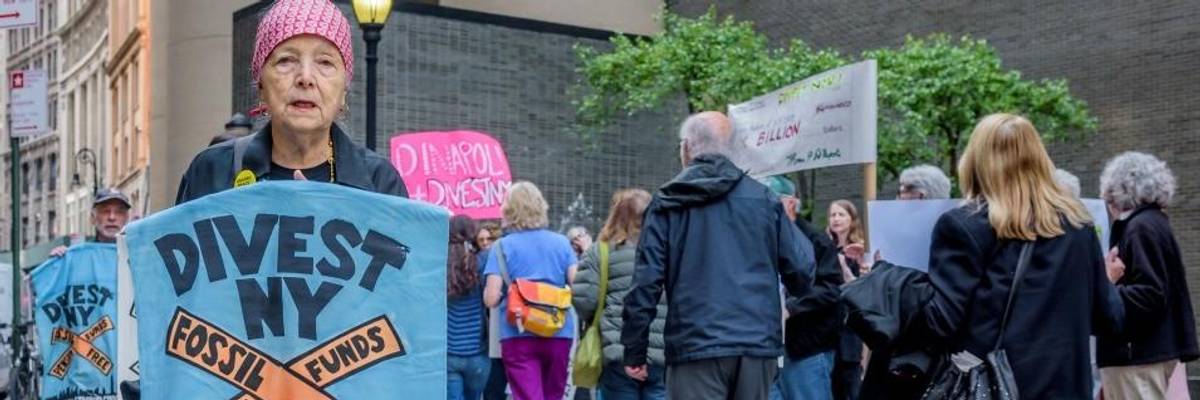
Fossil Free Divest NY, in coordination with community members and dozens of groups across America, held a rally outside the office of the New York State Comptroller in New York City, on May 14, 2018. (Photo: Erik McGregor/LightRocket via Getty Images)
In a development climate campaigners welcomed as a harbinger of more institutions ditching fossil fuel investments, New York state's pension fund will divest $7 million from seven tar sands companies, the state comptroller announced Monday.
"As nations around the world become increasingly serious about addressing the threat of climate change and as market forces drive a low-carbon economic transition, we need to make sure our investments line up with this reality," said New York State Comptroller Thomas DiNapoli in a statement.
"We have carefully reviewed companies in the oil sands industry and are restricting investments in those that do not have viable plans to adapt to the low-carbon future," he said. "Companies responsible for large greenhouse gas emissions, like those in this industry, pose significant risks for investors."
New York's is the nation's third largest public pension fund, holding $247.7 billion in assets.
Seven companies were singled out by the comptroller because they "failed to show they are transitioning out of oil sands production"--Imperial Oil, Canadian Natural Resources, Husky Energy, MEG Energy Corp., Athabasca Oil Corporation, Cenovus Energy, and Japan Petroleum Exploration.
In addition to selling off the over $7 million in securities it now holds in those companies, the pension fund will not in the future purchase or directly hold debt or equity securities in them.
The divestment announcement reflects the broader plan for the pension fund to divest from fossil fuels and conduct reviews of the "riskiest" fossil fuel assets. In December, DiNapoli announced a 2040 goal for net-zero carbon emissions for the fund.
DiNapoli, a Democrat, said last year that the fund divested from "22 thermal coal mining companies that are not prepared to thrive, or even survive, in the low-carbon economy." Coming under the comptroller office's scrutiny next for such climate reviews are firms engaged in fracking.
Among those cheering Monday's announcement was author and 350.org co-founder Bill McKibben, who said tar sands were worthy of particularly condemnation.
"Alberta's oil patch is the dirtiest of the dirtiest--there's no need for this crude, and no place for it on a planet serious about the climate crisis. Kudos to Tom DiNapoli for making it clear that you can't build your retirement on tar sands," said McKibben.
Richard Brooks with environmental advocacy group Stand.earth said the divestment news was "no small matter."
"This is only the beginning," he said, "as other North American pension funds are increasingly recognizing that the tar sands is a risky investment both for pensioners and our planet."
"It's time to pivot to clean, safe renewable energy," he continued. "That's where the smart money, led by New York, is headed."
Dear Common Dreams reader, It’s been nearly 30 years since I co-founded Common Dreams with my late wife, Lina Newhouser. We had the radical notion that journalism should serve the public good, not corporate profits. It was clear to us from the outset what it would take to build such a project. No paid advertisements. No corporate sponsors. No millionaire publisher telling us what to think or do. Many people said we wouldn't last a year, but we proved those doubters wrong. Together with a tremendous team of journalists and dedicated staff, we built an independent media outlet free from the constraints of profits and corporate control. Our mission has always been simple: To inform. To inspire. To ignite change for the common good. Building Common Dreams was not easy. Our survival was never guaranteed. When you take on the most powerful forces—Wall Street greed, fossil fuel industry destruction, Big Tech lobbyists, and uber-rich oligarchs who have spent billions upon billions rigging the economy and democracy in their favor—the only bulwark you have is supporters who believe in your work. But here’s the urgent message from me today. It's never been this bad out there. And it's never been this hard to keep us going. At the very moment Common Dreams is most needed, the threats we face are intensifying. We need your support now more than ever. We don't accept corporate advertising and never will. We don't have a paywall because we don't think people should be blocked from critical news based on their ability to pay. Everything we do is funded by the donations of readers like you. When everyone does the little they can afford, we are strong. But if that support retreats or dries up, so do we. Will you donate now to make sure Common Dreams not only survives but thrives? —Craig Brown, Co-founder |
In a development climate campaigners welcomed as a harbinger of more institutions ditching fossil fuel investments, New York state's pension fund will divest $7 million from seven tar sands companies, the state comptroller announced Monday.
"As nations around the world become increasingly serious about addressing the threat of climate change and as market forces drive a low-carbon economic transition, we need to make sure our investments line up with this reality," said New York State Comptroller Thomas DiNapoli in a statement.
"We have carefully reviewed companies in the oil sands industry and are restricting investments in those that do not have viable plans to adapt to the low-carbon future," he said. "Companies responsible for large greenhouse gas emissions, like those in this industry, pose significant risks for investors."
New York's is the nation's third largest public pension fund, holding $247.7 billion in assets.
Seven companies were singled out by the comptroller because they "failed to show they are transitioning out of oil sands production"--Imperial Oil, Canadian Natural Resources, Husky Energy, MEG Energy Corp., Athabasca Oil Corporation, Cenovus Energy, and Japan Petroleum Exploration.
In addition to selling off the over $7 million in securities it now holds in those companies, the pension fund will not in the future purchase or directly hold debt or equity securities in them.
The divestment announcement reflects the broader plan for the pension fund to divest from fossil fuels and conduct reviews of the "riskiest" fossil fuel assets. In December, DiNapoli announced a 2040 goal for net-zero carbon emissions for the fund.
DiNapoli, a Democrat, said last year that the fund divested from "22 thermal coal mining companies that are not prepared to thrive, or even survive, in the low-carbon economy." Coming under the comptroller office's scrutiny next for such climate reviews are firms engaged in fracking.
Among those cheering Monday's announcement was author and 350.org co-founder Bill McKibben, who said tar sands were worthy of particularly condemnation.
"Alberta's oil patch is the dirtiest of the dirtiest--there's no need for this crude, and no place for it on a planet serious about the climate crisis. Kudos to Tom DiNapoli for making it clear that you can't build your retirement on tar sands," said McKibben.
Richard Brooks with environmental advocacy group Stand.earth said the divestment news was "no small matter."
"This is only the beginning," he said, "as other North American pension funds are increasingly recognizing that the tar sands is a risky investment both for pensioners and our planet."
"It's time to pivot to clean, safe renewable energy," he continued. "That's where the smart money, led by New York, is headed."
In a development climate campaigners welcomed as a harbinger of more institutions ditching fossil fuel investments, New York state's pension fund will divest $7 million from seven tar sands companies, the state comptroller announced Monday.
"As nations around the world become increasingly serious about addressing the threat of climate change and as market forces drive a low-carbon economic transition, we need to make sure our investments line up with this reality," said New York State Comptroller Thomas DiNapoli in a statement.
"We have carefully reviewed companies in the oil sands industry and are restricting investments in those that do not have viable plans to adapt to the low-carbon future," he said. "Companies responsible for large greenhouse gas emissions, like those in this industry, pose significant risks for investors."
New York's is the nation's third largest public pension fund, holding $247.7 billion in assets.
Seven companies were singled out by the comptroller because they "failed to show they are transitioning out of oil sands production"--Imperial Oil, Canadian Natural Resources, Husky Energy, MEG Energy Corp., Athabasca Oil Corporation, Cenovus Energy, and Japan Petroleum Exploration.
In addition to selling off the over $7 million in securities it now holds in those companies, the pension fund will not in the future purchase or directly hold debt or equity securities in them.
The divestment announcement reflects the broader plan for the pension fund to divest from fossil fuels and conduct reviews of the "riskiest" fossil fuel assets. In December, DiNapoli announced a 2040 goal for net-zero carbon emissions for the fund.
DiNapoli, a Democrat, said last year that the fund divested from "22 thermal coal mining companies that are not prepared to thrive, or even survive, in the low-carbon economy." Coming under the comptroller office's scrutiny next for such climate reviews are firms engaged in fracking.
Among those cheering Monday's announcement was author and 350.org co-founder Bill McKibben, who said tar sands were worthy of particularly condemnation.
"Alberta's oil patch is the dirtiest of the dirtiest--there's no need for this crude, and no place for it on a planet serious about the climate crisis. Kudos to Tom DiNapoli for making it clear that you can't build your retirement on tar sands," said McKibben.
Richard Brooks with environmental advocacy group Stand.earth said the divestment news was "no small matter."
"This is only the beginning," he said, "as other North American pension funds are increasingly recognizing that the tar sands is a risky investment both for pensioners and our planet."
"It's time to pivot to clean, safe renewable energy," he continued. "That's where the smart money, led by New York, is headed."