SUBSCRIBE TO OUR FREE NEWSLETTER
Daily news & progressive opinion—funded by the people, not the corporations—delivered straight to your inbox.
5
#000000
#FFFFFF
To donate by check, phone, or other method, see our More Ways to Give page.
Daily news & progressive opinion—funded by the people, not the corporations—delivered straight to your inbox.
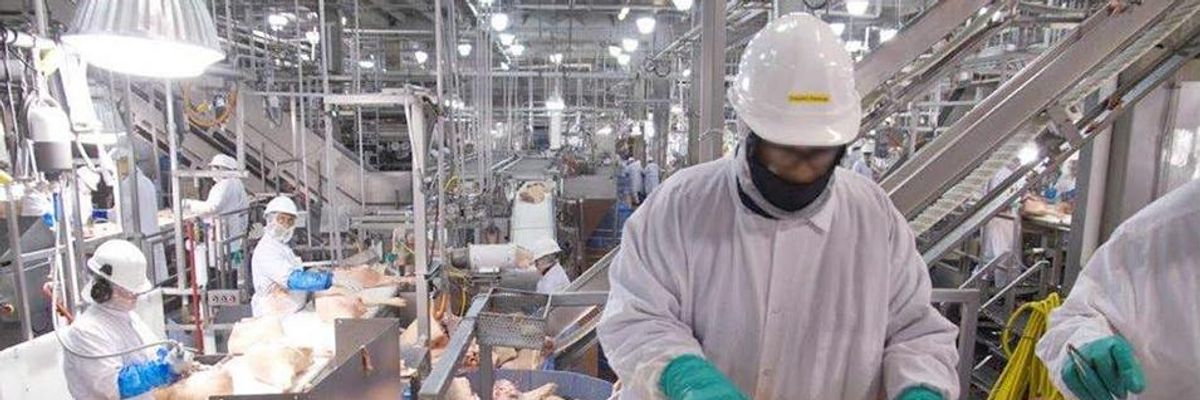
Workers process pig carcasses at a U.S. meatpacking plant. (Photo: Government Accountability Office)
Documents obtained from the United States Department of Agriculture by the consumer advocacy group Public Citizen and published Wednesday reveal how leading players in the meatpacking industry--one of the hardest-hit by the coronavirus pandemic--fought the minimal efforts imposed by the Trump administration to prevent the spread of Covid-19 in meat processing plants last spring.
As Public Citizen put it, "these docs are utterly damning."
Responding to Public Citizen's Freedom of Information Act (FOIA) request, the USDA handed over documents (pdf) showing that:
Adam Pulver, an attorney at the Public Citizen Litigation Group, said in a statement that "it is heartbreaking to see the callousness of the meatpacking industry, pushing back against basic safety measures that could have saved hundreds of lives and helped contain the Covid-19 pandemic."
"While we knew that meatpacking companies did not take adequate measures to protect their workers and the communities they lived in from the threat of Covid-19, these documents show that the industry actively pushed back against the few steps the Trump administration took to try to ensure the safety of meatpacking workers and federal inspectors," Pulver added.
As Public Citizen notes, at least 45,000 coronavirus cases and 240 Covid-19 deaths have been linked to U.S. meatpacking facilities.
In September 2020, Public Citizen and American Oversight published documents also obtained via FOIA requests that showed how the USDA and the meatpacking industry worked together to downplay and disregard risks to worker health during the pandemic. The documents revealed that a leading meat industry lobby group drafted a proposed executive order that was strikingly similar to a directive issued a week later by then-President Donald Trump to keep meatpacking plants open against the orders of local health officials.
Last September's revelations were followed by a November scandal involving supervisors at a Tyson Foods plant in Waterloo, Iowa who placed cash bets on how many workers at the facility would contract the coronavirus. More than 1,000 employees--over a third of the plant's workforce--were infected.
Dear Common Dreams reader, It’s been nearly 30 years since I co-founded Common Dreams with my late wife, Lina Newhouser. We had the radical notion that journalism should serve the public good, not corporate profits. It was clear to us from the outset what it would take to build such a project. No paid advertisements. No corporate sponsors. No millionaire publisher telling us what to think or do. Many people said we wouldn't last a year, but we proved those doubters wrong. Together with a tremendous team of journalists and dedicated staff, we built an independent media outlet free from the constraints of profits and corporate control. Our mission has always been simple: To inform. To inspire. To ignite change for the common good. Building Common Dreams was not easy. Our survival was never guaranteed. When you take on the most powerful forces—Wall Street greed, fossil fuel industry destruction, Big Tech lobbyists, and uber-rich oligarchs who have spent billions upon billions rigging the economy and democracy in their favor—the only bulwark you have is supporters who believe in your work. But here’s the urgent message from me today. It's never been this bad out there. And it's never been this hard to keep us going. At the very moment Common Dreams is most needed, the threats we face are intensifying. We need your support now more than ever. We don't accept corporate advertising and never will. We don't have a paywall because we don't think people should be blocked from critical news based on their ability to pay. Everything we do is funded by the donations of readers like you. When everyone does the little they can afford, we are strong. But if that support retreats or dries up, so do we. Will you donate now to make sure Common Dreams not only survives but thrives? —Craig Brown, Co-founder |
Documents obtained from the United States Department of Agriculture by the consumer advocacy group Public Citizen and published Wednesday reveal how leading players in the meatpacking industry--one of the hardest-hit by the coronavirus pandemic--fought the minimal efforts imposed by the Trump administration to prevent the spread of Covid-19 in meat processing plants last spring.
As Public Citizen put it, "these docs are utterly damning."
Responding to Public Citizen's Freedom of Information Act (FOIA) request, the USDA handed over documents (pdf) showing that:
Adam Pulver, an attorney at the Public Citizen Litigation Group, said in a statement that "it is heartbreaking to see the callousness of the meatpacking industry, pushing back against basic safety measures that could have saved hundreds of lives and helped contain the Covid-19 pandemic."
"While we knew that meatpacking companies did not take adequate measures to protect their workers and the communities they lived in from the threat of Covid-19, these documents show that the industry actively pushed back against the few steps the Trump administration took to try to ensure the safety of meatpacking workers and federal inspectors," Pulver added.
As Public Citizen notes, at least 45,000 coronavirus cases and 240 Covid-19 deaths have been linked to U.S. meatpacking facilities.
In September 2020, Public Citizen and American Oversight published documents also obtained via FOIA requests that showed how the USDA and the meatpacking industry worked together to downplay and disregard risks to worker health during the pandemic. The documents revealed that a leading meat industry lobby group drafted a proposed executive order that was strikingly similar to a directive issued a week later by then-President Donald Trump to keep meatpacking plants open against the orders of local health officials.
Last September's revelations were followed by a November scandal involving supervisors at a Tyson Foods plant in Waterloo, Iowa who placed cash bets on how many workers at the facility would contract the coronavirus. More than 1,000 employees--over a third of the plant's workforce--were infected.
Documents obtained from the United States Department of Agriculture by the consumer advocacy group Public Citizen and published Wednesday reveal how leading players in the meatpacking industry--one of the hardest-hit by the coronavirus pandemic--fought the minimal efforts imposed by the Trump administration to prevent the spread of Covid-19 in meat processing plants last spring.
As Public Citizen put it, "these docs are utterly damning."
Responding to Public Citizen's Freedom of Information Act (FOIA) request, the USDA handed over documents (pdf) showing that:
Adam Pulver, an attorney at the Public Citizen Litigation Group, said in a statement that "it is heartbreaking to see the callousness of the meatpacking industry, pushing back against basic safety measures that could have saved hundreds of lives and helped contain the Covid-19 pandemic."
"While we knew that meatpacking companies did not take adequate measures to protect their workers and the communities they lived in from the threat of Covid-19, these documents show that the industry actively pushed back against the few steps the Trump administration took to try to ensure the safety of meatpacking workers and federal inspectors," Pulver added.
As Public Citizen notes, at least 45,000 coronavirus cases and 240 Covid-19 deaths have been linked to U.S. meatpacking facilities.
In September 2020, Public Citizen and American Oversight published documents also obtained via FOIA requests that showed how the USDA and the meatpacking industry worked together to downplay and disregard risks to worker health during the pandemic. The documents revealed that a leading meat industry lobby group drafted a proposed executive order that was strikingly similar to a directive issued a week later by then-President Donald Trump to keep meatpacking plants open against the orders of local health officials.
Last September's revelations were followed by a November scandal involving supervisors at a Tyson Foods plant in Waterloo, Iowa who placed cash bets on how many workers at the facility would contract the coronavirus. More than 1,000 employees--over a third of the plant's workforce--were infected.