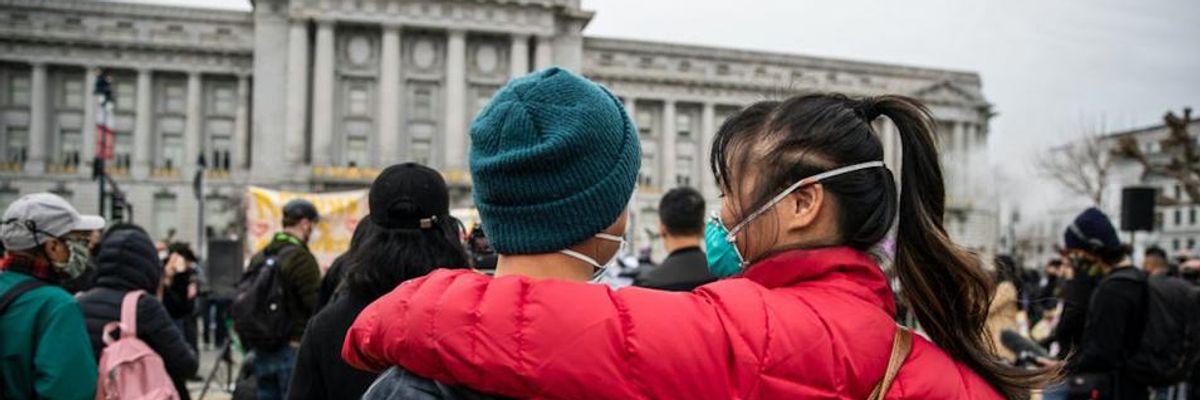
Atendees of a February 14, 2021 "Love Our People, Heal Our Communities" rally embrace in San Francisco's Civic Center Plaza. (Photo: Stephen Lam/San Francisco Chronicle via Getty Images)
'Justice Rooted in Compassion': Asian, Black Progressives Stress Unity and Understanding Amid Attacks on Asian Americans
"The ideas that fuel anti-Asian prejudice really come from our nation's white supremacist history and can't be separated from that history."
As violent attacks on Asian Americans, many of them elders, increase across the nation amid the coronavirus and economic crises and the still-frothing wake of racist rhetoric from former President Donald Trump, Asian and Black progressive organizers are standing in solidarity to denounce violence and division at events including a Saturday rally in New York City.
"We cannot let these violent incidents fuel the call for more cops or more hatred between different racial groups--because we know that neither of those make our communities safer."
--Claire Lau,
San Francisco Berniecrats
Hundreds of masked people attended an emergency rally hosted by Asian, Black, and Latinx organizers in Greenwich Village's Washington Square Park on Saturday to demand justice for Vicha Ratanapakdee--an 84-year-old San Francisco man who died in a brutal January 28 assault--and to call for interracial unity.
"The current justice system is pitting Black and Asian communities against one another, just like how news sources did during the L.A. Riots," said rally co-organizer Rohan Zhou-Lee, who is of Black and Asian descent. "We can fight anti-Asian and anti-Black hate at the same time."
"We have to imagine a new world of justice rooted in compassion," Zhou-Lee added, "not a system built on the slavery of Africans, the genocide of the Indigenous, the exploited labor of Asians, and the lynching of all the above."
Eight miles uptown, state Sen. John Liu (D) and Rev. Al Sharpton spoke to a masked and distanced audience at the latter's National Action Network House of Justice in Harlem.
"We do not need to be anything but unequivocal in standing against the rise in hate against Asian Americans, because we know what hate feels like," said Sharpton.
Both men blamed Trump--who frequently referred to the coronavirus as the "China virus" and Covid-19 as the "kung flu"--for fanning the flames of bigotry.
"Despite the advice of community leaders, of advocates, of health and public professionals, to say that it would be inaccurate and downright derogatory to use those terms, 45 didn't care, he kept using it," said Liu, referring to Trump.
According to researchers at the Universities of California in Berkeley and San Francisco and Tulane School of Medicine in New Orleans, the use of the phrase "China virus" by Trump and other top officials in the former administration coincided with the reversal of a more than decadelong decline in anti-Asian bias in the United States.
Stop AAPI Hate, a San Francisco State University-based project documenting anti-Asian bigotry during the pandemic, reported more than 2,800 anti-Asian incidents nationwide between March and December of last year. An April 2020 Ipsos survey for the Center for Public Integrity found that 30% of respondents--and 60% of Asian respondents--personally witnessed pandemic-related anti-Asian bias.
Similar events to Saturday's New York rally have been taking place across the nation in recent weeks. In the San Francisco Bay Area--where attacks on Asian elders have regularly made headlines over the past year--Asian-Black unity rallies were held in San Francisco and Oakland last weekend.
Hundreds of people showed up for the February 14 "Love Our People, Heal Our Communities" event in Oakland's Madison Park, where City Council President Nikki Fortunato Bas said the way to address racist violence is "by getting to the root causes of what causes violence and crime, violence, and poverty."
"That's healthcare, education, housing, jobs," said Fortunato Bas.
It is unclear which, if any, of the recent Bay Area attacks were racially motivated and which were driven by the economic desperation that has accompanied the pandemic and which is particularly acute in a metropolitan area that already suffered some of the nation's most severe wealth disparities before the current crises hit.
What is clear to progressive Asian and Black leaders is that solidarity is more important now than ever, as some conservative leaders have used the attacks to push a political agenda that involves more and tougher policing and penalties, and targets progressive leaders like Fortunato Bas and San Francisco District Attorney Chesa Boudin.
"Narrative matters," Claire Lau, co-chair of the San Francisco Berniecrats, an Our Revolution affiliate, told Common Dreams. "When you scapegoat particular groups of people it fuels hatred."
"As progressives, it's important for us to support the communities in pain, as well as work together to make our communities safer," said Lau. "We cannot let these violent incidents fuel the call for more cops or more hatred between different racial groups--because we know that neither of those make our communities safer."
"If addressing violence against Asian Americans entails furthering stereotypes about Black criminality and the policies associated with those stereotypes... we've misdiagnosed the problem."
--Prof. Janelle Wong,
University of Maryland
Janelle Wong, an Asian American studies professor at the University of Maryland, told MSNBC that "if addressing violence against Asian Americans entails furthering stereotypes about Black criminality and the policies associated with those stereotypes... we've misdiagnosed the problem."
"The ideas that fuel anti-Asian prejudice really come from our nation's white supremacist history and can't be separated from that history," added Wong. "Engaging in anti-Black rhetoric or blame does nothing to get at the roots of this prejudice."
Underscoring Wong's point, Japanese American communities over the weekend solemnly observed the 79th anniversary of the internment of people of Japanese origin and ancestry--including U.S. citizens--in concentration camps during World War II.
Beyond acknowledging that history and shared systems of oppression, Lau stressed the importance of unified action, including "building a multiracial coalition to fight against systemic racism" and demanding that "our government invest in our community--education, healthcare, housing--instead of the prison industrial complex and in corporations."
We are at a crossroads
This country and this world are at a monumental crossroads. In a few short weeks, US voters will have an opportunity to beat back the forces of fascism and confront the billionaires who are rigging the economy, our media system, and our democracy, making it increasingly impossible for ordinary people to get by. We’re not just talking about the election. We’re talking about what must be done once these fascist elements are vanquished from power. We need a bolder set of solutions than what either major party has so far been willing to offer and a working-class movement ready to fight like hell for it. Trump didn't emerge from nowhere. The conditions that fueled MAGA authoritarianism were created by decades of radical neoliberal economic policies and a corrupt political system dominated by corporate interests. They slashed taxes on the super-rich, promising that the benefits would trickle down. They said giveaways to the corporate titans would make life more affordable for the rest of us. It was all bullshit. And when a bitter, betrayed populace searches for someone to blame, right-wing demagogues have little trouble finding scapegoats. People know when they're being lied to, but you won't hear any of this from the corporate media. Only independent journalism—powered and funded by people who believe in building a better world—can deliver truly trustworthy daily news. Our Fall Campaign is underway, and we need your help. To power our newsroom through the rest of the year, we need to raise $125,000 by midnight on October 31. So if you share our vision, please contribute whatever you can to sustain our work. |
As violent attacks on Asian Americans, many of them elders, increase across the nation amid the coronavirus and economic crises and the still-frothing wake of racist rhetoric from former President Donald Trump, Asian and Black progressive organizers are standing in solidarity to denounce violence and division at events including a Saturday rally in New York City.
"We cannot let these violent incidents fuel the call for more cops or more hatred between different racial groups--because we know that neither of those make our communities safer."
--Claire Lau,
San Francisco Berniecrats
Hundreds of masked people attended an emergency rally hosted by Asian, Black, and Latinx organizers in Greenwich Village's Washington Square Park on Saturday to demand justice for Vicha Ratanapakdee--an 84-year-old San Francisco man who died in a brutal January 28 assault--and to call for interracial unity.
"The current justice system is pitting Black and Asian communities against one another, just like how news sources did during the L.A. Riots," said rally co-organizer Rohan Zhou-Lee, who is of Black and Asian descent. "We can fight anti-Asian and anti-Black hate at the same time."
"We have to imagine a new world of justice rooted in compassion," Zhou-Lee added, "not a system built on the slavery of Africans, the genocide of the Indigenous, the exploited labor of Asians, and the lynching of all the above."
Eight miles uptown, state Sen. John Liu (D) and Rev. Al Sharpton spoke to a masked and distanced audience at the latter's National Action Network House of Justice in Harlem.
"We do not need to be anything but unequivocal in standing against the rise in hate against Asian Americans, because we know what hate feels like," said Sharpton.
Both men blamed Trump--who frequently referred to the coronavirus as the "China virus" and Covid-19 as the "kung flu"--for fanning the flames of bigotry.
"Despite the advice of community leaders, of advocates, of health and public professionals, to say that it would be inaccurate and downright derogatory to use those terms, 45 didn't care, he kept using it," said Liu, referring to Trump.
According to researchers at the Universities of California in Berkeley and San Francisco and Tulane School of Medicine in New Orleans, the use of the phrase "China virus" by Trump and other top officials in the former administration coincided with the reversal of a more than decadelong decline in anti-Asian bias in the United States.
Stop AAPI Hate, a San Francisco State University-based project documenting anti-Asian bigotry during the pandemic, reported more than 2,800 anti-Asian incidents nationwide between March and December of last year. An April 2020 Ipsos survey for the Center for Public Integrity found that 30% of respondents--and 60% of Asian respondents--personally witnessed pandemic-related anti-Asian bias.
Similar events to Saturday's New York rally have been taking place across the nation in recent weeks. In the San Francisco Bay Area--where attacks on Asian elders have regularly made headlines over the past year--Asian-Black unity rallies were held in San Francisco and Oakland last weekend.
Hundreds of people showed up for the February 14 "Love Our People, Heal Our Communities" event in Oakland's Madison Park, where City Council President Nikki Fortunato Bas said the way to address racist violence is "by getting to the root causes of what causes violence and crime, violence, and poverty."
"That's healthcare, education, housing, jobs," said Fortunato Bas.
It is unclear which, if any, of the recent Bay Area attacks were racially motivated and which were driven by the economic desperation that has accompanied the pandemic and which is particularly acute in a metropolitan area that already suffered some of the nation's most severe wealth disparities before the current crises hit.
What is clear to progressive Asian and Black leaders is that solidarity is more important now than ever, as some conservative leaders have used the attacks to push a political agenda that involves more and tougher policing and penalties, and targets progressive leaders like Fortunato Bas and San Francisco District Attorney Chesa Boudin.
"Narrative matters," Claire Lau, co-chair of the San Francisco Berniecrats, an Our Revolution affiliate, told Common Dreams. "When you scapegoat particular groups of people it fuels hatred."
"As progressives, it's important for us to support the communities in pain, as well as work together to make our communities safer," said Lau. "We cannot let these violent incidents fuel the call for more cops or more hatred between different racial groups--because we know that neither of those make our communities safer."
"If addressing violence against Asian Americans entails furthering stereotypes about Black criminality and the policies associated with those stereotypes... we've misdiagnosed the problem."
--Prof. Janelle Wong,
University of Maryland
Janelle Wong, an Asian American studies professor at the University of Maryland, told MSNBC that "if addressing violence against Asian Americans entails furthering stereotypes about Black criminality and the policies associated with those stereotypes... we've misdiagnosed the problem."
"The ideas that fuel anti-Asian prejudice really come from our nation's white supremacist history and can't be separated from that history," added Wong. "Engaging in anti-Black rhetoric or blame does nothing to get at the roots of this prejudice."
Underscoring Wong's point, Japanese American communities over the weekend solemnly observed the 79th anniversary of the internment of people of Japanese origin and ancestry--including U.S. citizens--in concentration camps during World War II.
Beyond acknowledging that history and shared systems of oppression, Lau stressed the importance of unified action, including "building a multiracial coalition to fight against systemic racism" and demanding that "our government invest in our community--education, healthcare, housing--instead of the prison industrial complex and in corporations."
As violent attacks on Asian Americans, many of them elders, increase across the nation amid the coronavirus and economic crises and the still-frothing wake of racist rhetoric from former President Donald Trump, Asian and Black progressive organizers are standing in solidarity to denounce violence and division at events including a Saturday rally in New York City.
"We cannot let these violent incidents fuel the call for more cops or more hatred between different racial groups--because we know that neither of those make our communities safer."
--Claire Lau,
San Francisco Berniecrats
Hundreds of masked people attended an emergency rally hosted by Asian, Black, and Latinx organizers in Greenwich Village's Washington Square Park on Saturday to demand justice for Vicha Ratanapakdee--an 84-year-old San Francisco man who died in a brutal January 28 assault--and to call for interracial unity.
"The current justice system is pitting Black and Asian communities against one another, just like how news sources did during the L.A. Riots," said rally co-organizer Rohan Zhou-Lee, who is of Black and Asian descent. "We can fight anti-Asian and anti-Black hate at the same time."
"We have to imagine a new world of justice rooted in compassion," Zhou-Lee added, "not a system built on the slavery of Africans, the genocide of the Indigenous, the exploited labor of Asians, and the lynching of all the above."
Eight miles uptown, state Sen. John Liu (D) and Rev. Al Sharpton spoke to a masked and distanced audience at the latter's National Action Network House of Justice in Harlem.
"We do not need to be anything but unequivocal in standing against the rise in hate against Asian Americans, because we know what hate feels like," said Sharpton.
Both men blamed Trump--who frequently referred to the coronavirus as the "China virus" and Covid-19 as the "kung flu"--for fanning the flames of bigotry.
"Despite the advice of community leaders, of advocates, of health and public professionals, to say that it would be inaccurate and downright derogatory to use those terms, 45 didn't care, he kept using it," said Liu, referring to Trump.
According to researchers at the Universities of California in Berkeley and San Francisco and Tulane School of Medicine in New Orleans, the use of the phrase "China virus" by Trump and other top officials in the former administration coincided with the reversal of a more than decadelong decline in anti-Asian bias in the United States.
Stop AAPI Hate, a San Francisco State University-based project documenting anti-Asian bigotry during the pandemic, reported more than 2,800 anti-Asian incidents nationwide between March and December of last year. An April 2020 Ipsos survey for the Center for Public Integrity found that 30% of respondents--and 60% of Asian respondents--personally witnessed pandemic-related anti-Asian bias.
Similar events to Saturday's New York rally have been taking place across the nation in recent weeks. In the San Francisco Bay Area--where attacks on Asian elders have regularly made headlines over the past year--Asian-Black unity rallies were held in San Francisco and Oakland last weekend.
Hundreds of people showed up for the February 14 "Love Our People, Heal Our Communities" event in Oakland's Madison Park, where City Council President Nikki Fortunato Bas said the way to address racist violence is "by getting to the root causes of what causes violence and crime, violence, and poverty."
"That's healthcare, education, housing, jobs," said Fortunato Bas.
It is unclear which, if any, of the recent Bay Area attacks were racially motivated and which were driven by the economic desperation that has accompanied the pandemic and which is particularly acute in a metropolitan area that already suffered some of the nation's most severe wealth disparities before the current crises hit.
What is clear to progressive Asian and Black leaders is that solidarity is more important now than ever, as some conservative leaders have used the attacks to push a political agenda that involves more and tougher policing and penalties, and targets progressive leaders like Fortunato Bas and San Francisco District Attorney Chesa Boudin.
"Narrative matters," Claire Lau, co-chair of the San Francisco Berniecrats, an Our Revolution affiliate, told Common Dreams. "When you scapegoat particular groups of people it fuels hatred."
"As progressives, it's important for us to support the communities in pain, as well as work together to make our communities safer," said Lau. "We cannot let these violent incidents fuel the call for more cops or more hatred between different racial groups--because we know that neither of those make our communities safer."
"If addressing violence against Asian Americans entails furthering stereotypes about Black criminality and the policies associated with those stereotypes... we've misdiagnosed the problem."
--Prof. Janelle Wong,
University of Maryland
Janelle Wong, an Asian American studies professor at the University of Maryland, told MSNBC that "if addressing violence against Asian Americans entails furthering stereotypes about Black criminality and the policies associated with those stereotypes... we've misdiagnosed the problem."
"The ideas that fuel anti-Asian prejudice really come from our nation's white supremacist history and can't be separated from that history," added Wong. "Engaging in anti-Black rhetoric or blame does nothing to get at the roots of this prejudice."
Underscoring Wong's point, Japanese American communities over the weekend solemnly observed the 79th anniversary of the internment of people of Japanese origin and ancestry--including U.S. citizens--in concentration camps during World War II.
Beyond acknowledging that history and shared systems of oppression, Lau stressed the importance of unified action, including "building a multiracial coalition to fight against systemic racism" and demanding that "our government invest in our community--education, healthcare, housing--instead of the prison industrial complex and in corporations."